Workers compensation claims management software runs a claim from the first report of injury to closure: it records the injury and the dates that start each clock, holds the medical record, calculates and schedules benefits, drafts and transmits the state's forms and electronic reports, and shows every deadline before it passes. What makes it hard to buy is that workers' compensation is a state programme. The forms, the payment clocks, the benefit formulas and the electronic reporting standard are set state by state, so a system that is right in Georgia can be wrong in Florida on the same claim. Botminds' Workers' Compensation Claims Management is an agentic solution for lost-time claims in which six agents read every document on a claim, keep its medical picture, benefits and state forms current, and draft the next step, while the adjuster decides, pays and signs.
This guide is written for claims leaders and IT owners choosing or replacing a system. It uses the rules of four Southeastern states, government and research data on the size of the market, and a fictional sample caseload to show what a state-by-state go-live looks like.
The system a workers comp claims platform has to fit into
~150M
jobs covered by workers’ compensation in 2023
$64.1B
benefits paid in 2023, medical and cash together
55.6%
of benefits paid by private insurers
25.6%
paid by self-insured employers; 13.3% by 22 state funds
What is workers compensation claims management software?
It is the system of record and the workbench for the people who handle workers' compensation claims: insurers, self-insured employers, state funds and the third-party administrators they hire. The National Academy of Social Insurance counts "nearly 150 million jobs" covered in 2023 and $64.1 billion paid in benefits, almost half of it for medical care. Private insurers paid 55.6% of benefits, self-insured employers 25.6%, the 22 state funds 13.3% and the federal government 5.5% (NASI). All of them file under the same state rules.
The category is often confused with case management software, which serves the nurse and medical side of a claim. The two overlap on restrictions, appointments and return to work, and differ on benefits, forms and penalties. Our guide to workers compensation case management software draws the line between them.
What should a workers comp claims system track?
Every date that starts or stops a legal clock, and every document that changes an amount. The table below lists the items a lost-time claim needs, each with the Georgia rule that makes it matter. A system that does not hold the date cannot compute the deadline; a system that does not read the document cannot see that the date has changed.
What a lost-time claim needs tracked, and the Georgia rule behind each item
| Item | Why it matters | Georgia rule |
|---|---|---|
| Date the employer knew | Starts the first-report and first-payment clocks | WC-1 to the Board, and the first payment, by the 21st day after knowledge |
| Date of disability and days lost | Decides whether the claim is lost time and when the waiting week is paid | Benefits from the eighth day; first seven paid after 21 consecutive days |
| Wage statement and average weekly wage | Sets every weekly benefit | 13 weeks before the injury; WC-6 filed when the rate is under the maximum |
| Each installment and its due date | A late installment carries a penalty | 15% when income benefits are not paid when due |
| Decision to accept or controvert | Late controverts risk penalties and fees | WC-1 or WC-3 before the 21st day; within 60 days of the first payment’s due date if payment has started |
| Restrictions and their review dates | Decide whether a job offer can be approved | Doctor’s approval after an examination within the last 60 days |
| Modified-duty offers | Can end temporary total disability, if made correctly | WC-240 at least ten days before the start date |
| Medical bills | Carry their own penalty clock | Paid within 30 days; 10%, then 20% and interest |
| Case progress reports | Keep the Board’s file current and close it | WC-4 within a year of injury, every 12 months, and within 30 days of the last payment |
| Electronic filing results | A rejected transaction is an unfiled form | Below 80% successful submissions, EDI privileges may be suspended |
Does workers comp software file state forms?
It prepares and transmits them; a person at the insurer or administrator remains responsible for what is filed. Georgia accepts filings "three ways: online via ICMS; via EDI; and in paper", but for insurers and administrators "All claims submitted ... to the Board must be in EDI format", and paper forms on claims created since 1 July 2009 "may be rejected" (Claims Adjuster Reference). The Board had registered "over 2,100 insurers, self-insurers, group fund, and claims office users" for its online system by July 2024.
Some forms need attachments, and the electronic filing does not carry them. When benefits are suspended by an electronic report and an attachment is required, "such as a medical report, or WC-240", the insurer "shall mail to, or electronically file with the Board the required attachment prior to or simultaneously with the filing of the appropriate EDI transaction" (Rule 62(1)(c)). A system that sends the transaction and forgets the attachment has filed half a suspension.
In Botminds' solution the state filing drafter fills each form and electronic report from the claim and sets its due date from the state's rule. It holds a form whose preconditions are not met, and says which: on the sample claim, the suitable-employment form was held until the treating doctor had approved the job. Nothing is filed without the adjuster's signature.
What states require EDI reporting?
Many do, on different releases of the same national standard. The IAIABC, an association of workers' compensation agencies and private organisations that maintains it, says its claims standards "are used by claims administrators to report workers' compensation first report of injury and subsequent report of injury claims data to U.S. jurisdictions", and that "EDI Claims Release 3.1 is the most current release", with revised documentation published each 1 January (IAIABC).
States adopt it on their own terms. Georgia uses "the IAIABC Claims Release 3 EDI standard" (Claims Adjuster Reference) and requires valid data under its own R3.0 element requirement table (Rule 62(3)). Kansas requires every insurer, pool and self-insured employer to file under Release 3.1 and to submit a trading partner profile "at least 30 days before submitting claim information" (K.A.R. 51-9-17). Minnesota mandated electronic first reports in 2014 and required all companies handling claims to report by EDI from 31 August 2020, in XML (Minnesota DLI). Alabama's manual says EDI "is now being used in Alabama in place of" its paper forms (Alabama). How a report travels from the claim to the state is set out in what EDI is in workers comp.
Can claims software calculate TTD?
Yes, if it holds each state's formula rather than one formula with a state field. The wage period alone differs: 13 weeks before the injury in Georgia and Florida, four quarters of reported wages in South Carolina. Partial-disability benefits differ more: two thirds of the wage loss in Georgia, and in Florida 80% of the gap between 80% of the average weekly wage and post-injury earnings. On the sample claim, the same modified job yields $90.13 a week in Georgia and, by our arithmetic on Florida's formula, nothing in Florida. The full method is in how to calculate average weekly wage in workers compensation.
The test for a calculator is whether it shows its working. An adjuster or auditor should see the wage lines, the average, the rate, the maximum applied and its effective date, the waiting period and each installment's due date. A weekly figure with no working cannot be checked, and an unchecked figure is how a claim gets paid at last year's maximum.
One caseload across four states, each claim on its own state's clock
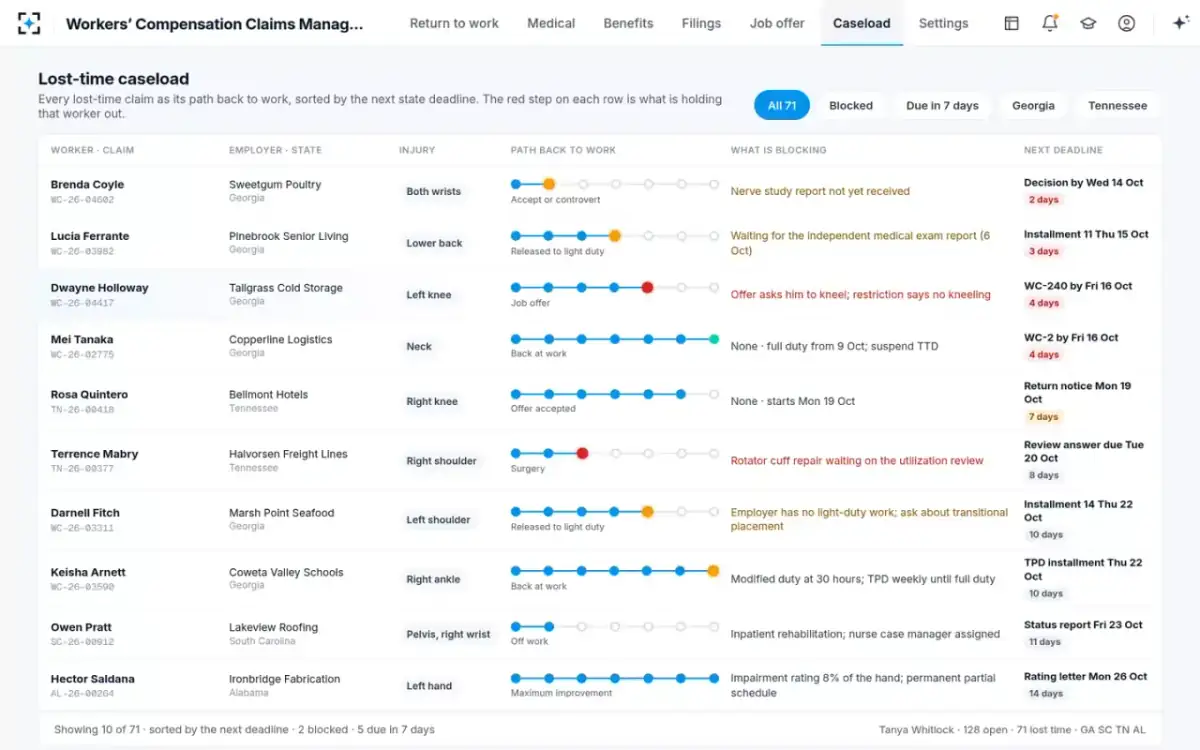
How long does workers comp software take to implement?
As long as it takes to set up and prove each state's rules, which is why the plan should run state by state rather than system-wide. The core of any implementation is the same five areas for every jurisdiction: forms and their triggers, payment clocks, benefit formulas, electronic reporting and the return-to-work route. Each has to be written down with its source and effective date, and each has to be proven on claims the team already closed.
The rollout grid: five areas to capture and prove for each state
| Area | Question to answer | Georgia, as an example | Proof on closed claims |
|---|---|---|---|
| Forms and their triggers | Question to answerWhich forms does this state require, and what event starts each one? | Georgia, as an exampleWC-1 within 21 days of the employer’s knowledge; WC-6 when the rate is under the maximum; WC-2 on any change; WC-4 within a year, then yearly | Proof on closed claimsEvery form on a closed claim, dated as the rule would date it |
| Payment clocks | Question to answerWhen is the first payment due, how often after, and when is it late? | Georgia, as an exampleFirst on the 21st day after knowledge, then weekly; 15% when not paid when due | Proof on closed claimsEach installment’s due date against the date it was actually paid |
| Benefit formulas | Question to answerWage period, rate, minimum and maximum by date of injury, partial-benefit formula | Georgia, as an example13 weeks; two thirds; $50 minimum; $800 maximum from 1 July 2023 | Proof on closed claimsThe rate the software computes against the rate on the filed WC-1 or WC-2 |
| Electronic reporting | Question to answerWhich EDI release and element table, which trading-partner steps, which attachments? | Georgia, as an exampleIAIABC Claims Release 3; FROI and SROI; WC-240 and medical reports filed with the SROI | Proof on closed claimsThe transactions the software would send against those the state accepted |
| Return-to-work route | Question to answerWhat must a modified-duty offer contain, and how much notice? | Georgia, as an exampleWC-240 with the doctor’s approval, at least ten days before the start | Proof on closed claimsEach offer’s dates against the rule, including the 60-day examination |
Sequencing follows volume and complexity. Start with the state that carries most of the lost-time book, prove it, and add states one at a time, so that a problem in one state's rules is found before it touches another's claims. The example below shows how a four-state book might be sequenced; the weeks are an illustration of the order and overlap, not a benchmark for any system.
An example sequence for a four-state lost-time book
- Capture rulesRules 3 wk
- Replay closed claimsReplay 3 wk
- Run beside the deskParallel 4 wk
- Wait
- Rules2 wk
- Replay2 wk
- Parallel run3 wk
- Wait
- Rules2 wk
- Replay2 wk
- Parallel run3 wk
Prove each state's clocks on closed claims first
The only fair test of claims software is your own history. Take a set of closed lost-time claims from each state, run them through the system as if they were new, and compare what it produces with what actually happened: the due date of every installment, the trigger and date of every form, the rate and its maximum, the controvert deadline, the date every modified-duty offer went out. Each disagreement is either a defect in the system's rules or a defect in the original handling, and both are worth knowing.
Count the disagreements by cause, not just in total. A missed waiting-week payback, a wrong maximum year, a form dated from the insurer's notice instead of the employer's knowledge and a suspension filed without its attachment are four different problems with four different fixes. In Florida, where the state fines carriers below a 95% timely-payment rate (§ 440.20(8)(b)), the replay also shows the on-time rate the old process actually achieved.
Ten questions to put to any workers comp claims management vendor
- Which states’ rules are configured today, and who keeps them current?
Georgia’s 2025 rule changes took effect on 1 July; a rule table without effective dates will apply this year’s rule to last year’s claim.
- Can we see the source of each rule?
Every clock and formula should cite the statute, rule or form it comes from.
- Does it date clocks from the employer’s knowledge?
Not from the day the insurer opened the claim.
- Does it show the working for every benefit?
Wage lines, average, rate, maximum and its effective date, waiting period, due dates.
- Does it hold a form whose preconditions are not met?
And say which precondition is missing.
- Does it file attachments with electronic suspensions?
The transaction and the attachment have to reach the state together.
- Does it read new documents, or wait for data entry?
A work-status note or a wage statement changes clocks and amounts the day it arrives.
- Who approves payments and signs filings?
A named person, recorded with the time, for every one.
- Will it replay our closed claims before go-live?
With disagreements counted by cause, per state.
- What happens when we add a state?
The same grid, captured and proven, before the first live claim.
Where Botminds fits, and where it does not
Botminds' Workers' Compensation Claims Management works with the claim file a carrier or administrator already has: first reports and employer statements, medical records and work-status notes, wage statements, state forms and electronic reports, employer modified-duty offers and the treating doctors' offices. Six agents read each document as it arrives. They summarise the medical record with a citation for every sentence, track restrictions and review dates, work out benefits with the working shown, draft each state form against its clock, and test each modified-duty offer against the current restrictions.
One claim, opened on the step that is holding the worker out
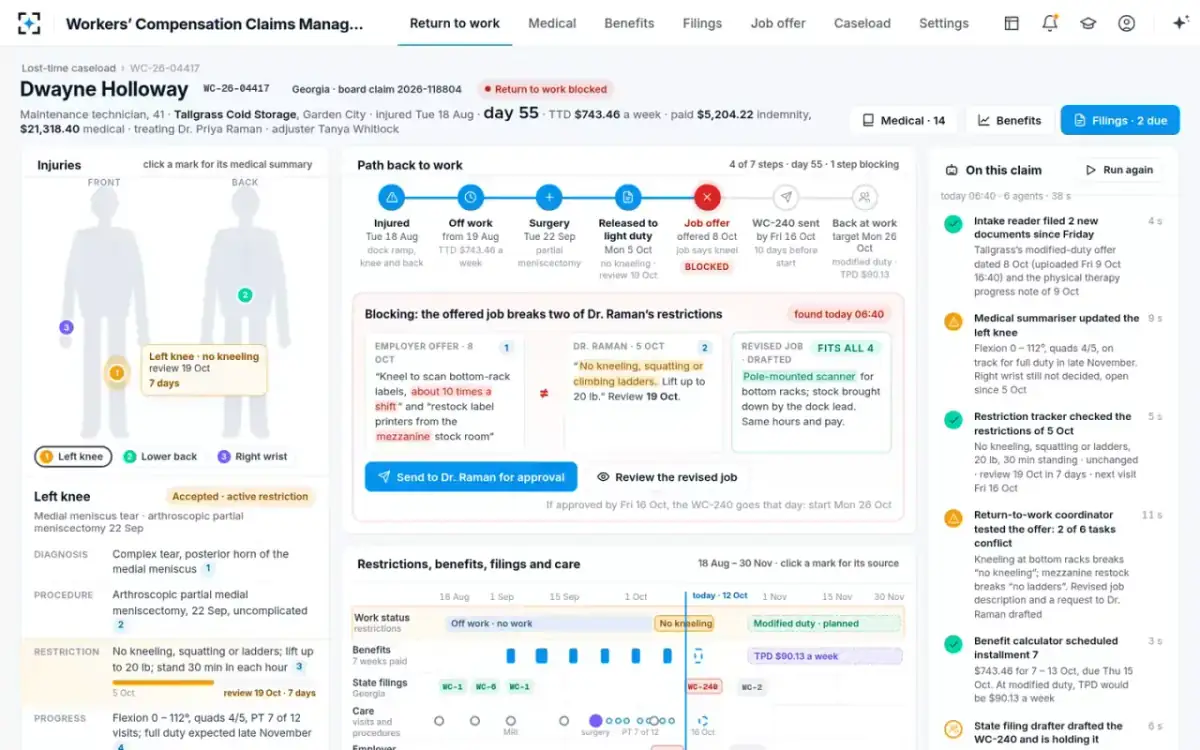
Where it stops is just as important. The agents never decide compensability, never issue a payment, never file without the adjuster's signature and never contact the worker. The sample configuration covers Georgia, South Carolina, Tennessee and Alabama; states in scope are a setting, each with its own rule set, and a new state needs its forms, clocks and benefit rules captured and proven before its first live claim. The design target is a draft ready before the alert date for every form and installment. It is a target, not a measured result, and the replay on your own closed claims is how to find out what it would have meant for your book.
States, clocks and approvals as versioned settings
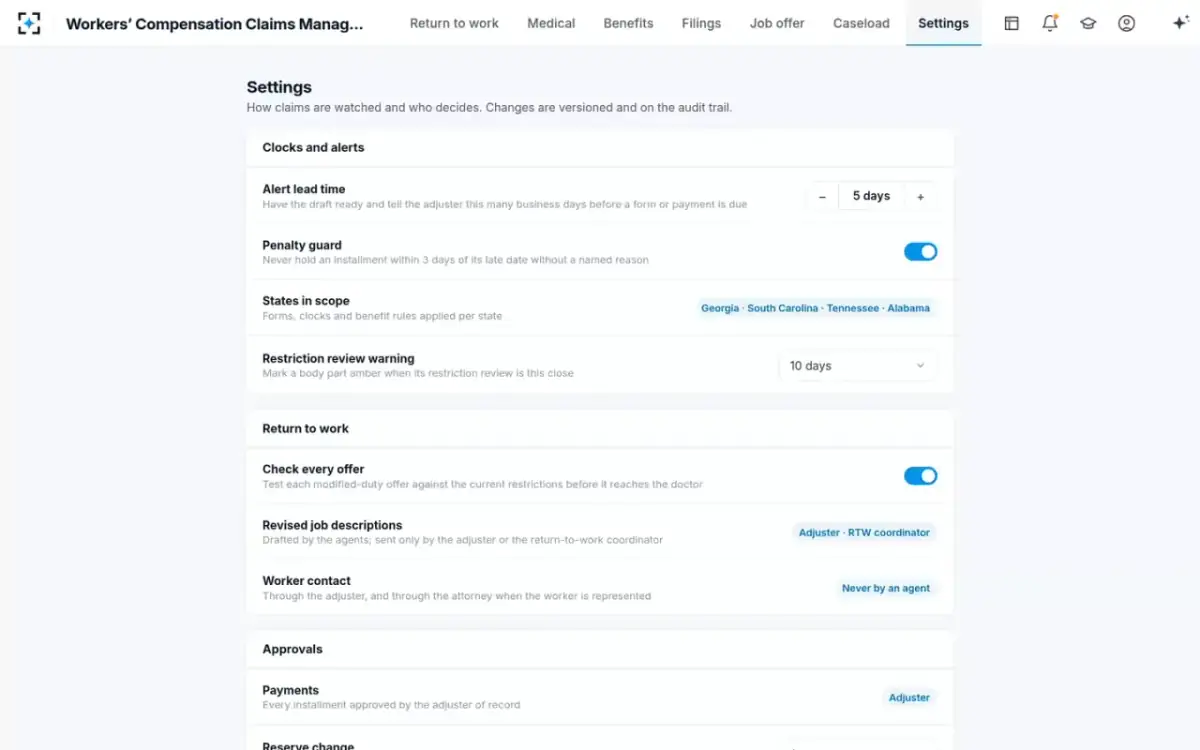
To see the sample claim screen by screen, or to run the replay on a sample of your own lost-time claims, start from Workers' Compensation Claims Management.
Questions people ask
Do self-insured employers need claims software?
They carry the same filing duties as insurers: Georgia's electronic-filing rule names insurers, self-insurers, group self-insurers and their claims offices alike. Self-insured employers paid 25.6% of all workers' compensation benefits in 2023, according to the National Academy of Social Insurance, so many run their own claims or hire an administrator that does.
What happens to open claims when we change third-party administrators?
In Georgia the outgoing administrator must hand over open indemnity files current to the transfer date with a case progress report completed within 30 days, and the new administrator must notify all open claimants within 14 days of receiving the files. A notice of the change, Form WC-121, is filed with the Board.
What is ICMS in Georgia workers comp?
The State Board's Integrated Claims Management System, its online filing system, alongside EDI and paper. The Board reported more than 2,100 insurers, self-insurers, group funds and claims offices registered for ICMS II access as of July 2024.
Can claims software handle Medicare reporting?
Medicare reporting is a separate federal obligation: when a claimant is on Medicare, the insurer or self-insured employer must tell CMS under Section 111 about any settlement and about medical bills it has taken on paying, and a late record draws a daily civil money penalty. The current rules and the 2026 set-aside guide are covered in our guide to the CMS Medicare set-aside for workers compensation.
Does claims software replace the adjuster?
It should not, and the rules assume it does not: a person certifies the WC-240, signs the forms and answers for each payment. Software that reads documents and drafts can take the reading and the date-keeping off the desk, leaving the decisions with the adjuster.