Workers compensation case management software is the tool a nurse or other medical case manager uses to coordinate an injured worker's treatment and return to work: consent, appointments, the treating doctor's notes, restrictions, job descriptions and the reports owed to the parties. Claims management software is the adjuster's: compensability, benefits, forms, electronic reports, payments and penalties. The two are easy to confuse: search engines suggest one when buyers type the other, the same phrase also names practice software for law firms that represent injured workers, and on a lost-time claim the nurse's tool and the adjuster's share the same facts. They are governed by different rules and fail in different ways. Botminds' Workers' Compensation Claims Management is claims-side software for lost-time claims in which agents read every medical record with a citation for each sentence, track restrictions, work out benefits and draft forms; the nurse case manager, the adjuster and the return-to-work coordinator each work their part of the same claim.
This guide uses Georgia's rules for medical case management and claims handling, which describe both seats in detail, and one fictional sample claim with a nurse, an adjuster and a return-to-work coordinator working the same knee injury.
Why the medical side cannot be a separate world
47%+
of workers’ compensation benefits paid in 2023 were medical
$64.1B
total benefits paid, medical and cash, in 2023
8
credentials that qualify a Georgia medical case manager
10days
notice of a private meeting with the treating doctor
What is workers comp case management software?
Software built around the case manager's duties rather than the adjuster's. In Georgia those duties are defined by rule. A medical case manager in a non-catastrophic claim provides "telephonic or field medical case management services" and contacts the treating physician "for purposes of assessing, planning, implementing, and evaluating the options and services required to effect a cure or provide relief". In catastrophic claims, a registered rehabilitation supplier must "meet with the injured employee within thirty (30) days of appointment" and file a rehabilitation plan "within ninety (90) days", then progress reports "no less than every ninety days" (Rules 200.1 and 200.2).
So the software's job is to record consent, schedule and notice contacts, hold the doctor's documents and distribute them, and produce the plans and reports the Board requires. It is not built to pay benefits or file a first report, and it should not be: the rules keep the case manager away from some decisions entirely, including utilization review and, for rehabilitation suppliers, "settlement negotiations, surveillance or provision of legal advice".
Case management or claims management: what is the difference?
The owner, the clock and the output. Case management belongs to the nurse and runs on consent and notice; claims management belongs to the adjuster and runs on payment and filing deadlines. The comparison below sets them side by side for a lost-time claim in Georgia.
Two categories on one Georgia lost-time claim
Case management software: Nurse case manager or rehabilitation supplier, retained by the employer or insurer.
Claims management software: Adjuster, supervisor and claims compliance, at the insurer, self-insurer or administrator.
Case management software: Rules 200.1 and 200.2: consent, notice, copies, credentials, plans.
Claims management software: The Act and Rules 61, 62, 220, 221 and 240: forms, clocks, benefits, penalties.
Case management software: Ten days’ notice of private meetings; review dates; 90-day reports in catastrophic claims.
Claims management software: The 21st day after the employer knew; weekly installments; 60-day controvert window; ten days for a WC-240.
Case management software: Consent records, meeting notices, copies to all parties, plans and progress reports.
Claims management software: First reports, wage statements, notices of payment and suspension, electronic reports, payments.
Case management software: Utilization review; settlement negotiation, surveillance or legal advice (rehabilitation suppliers).
Claims management software: Pay without approval, suspend without the required notice, or file a form whose conditions are not met.
Do nurse case managers use claims software?
Often they use their own, and the adjuster sees their reports. That split is where restrictions go wrong. The rules already require the case manager's information to reach everyone: she "shall provide copies of all medical records, medical reports, office notes, test results, and all other written documents received from the employee’s treating physician to all parties and their attorneys" (Rule 200.2(C)(2)). When the nurse's system and the adjuster's system each keep their own copy of the restriction, one of them is eventually out of date.
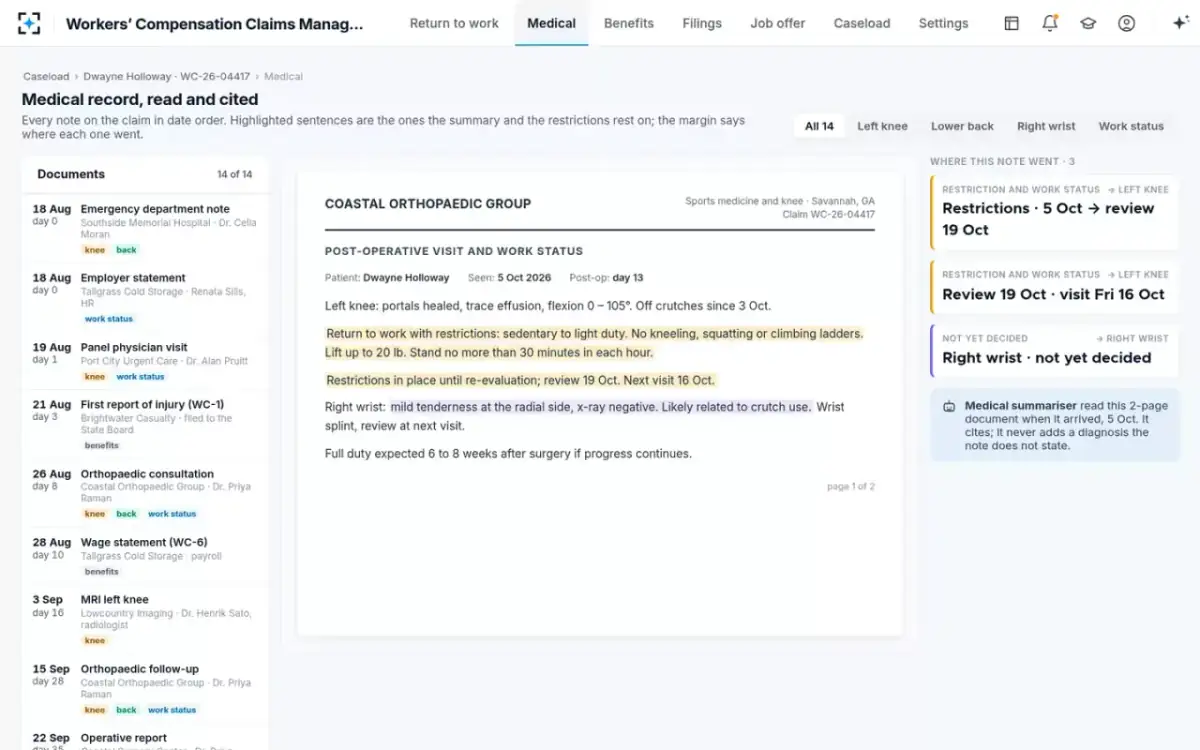
The fix is not to make the nurse work in the adjuster's screens, or the reverse. It is to give both the same source: the doctor's note, read once, with the restriction quoted and dated, and each role's view built on it. On the sample claim the nurse case manager reads the same 5 October note as the adjuster, with the restriction sentence highlighted, carries the revised job to the doctor and records the doctor's answer. The adjuster's view of the same claim shows the restriction beside the benefits it decides.
The nurse's view: the medical record, read and cited
What features does workers comp case management need?
The features the rules imply, before any the vendor proposes. Each row below is a duty a Georgia case manager or rehabilitation supplier owes; software that cannot record it leaves the case manager proving compliance from memory.
Features a Georgia case management tool needs, and the rule behind each
| Feature | The rule it serves | Applies to |
|---|---|---|
| Consent capture, with withdrawal | Consent to work with the worker; written for appointments; the worker told in writing it may be refused | Non-catastrophic medical case management (Rule 200.2(B)) |
| Retention notice before first doctor contact | Written notice to all parties when working without consent | Rule 200.2(B)(2) |
| Meeting notices with day, time and place | Ten days’ notice of a private meeting with a treating physician | Rule 200.1(II)(D)(4); Board guidance for 200.2 |
| Distribution log | Copies of every written document from the treating physician to all parties and attorneys | Rule 200.2(C)(2); 200.1(II)(D)(1) |
| Credential and registration record | One of eight credentials; Board registration, numbered, expiring 30 November | Rules 200.1(I) and 200.2(A) |
| Plans and progress reports | Meeting within 30 days; plan within 90 days; progress reports at least every 90 days | Catastrophic claims (Rule 200.1(II)) |
| Closure request | Form WC-R3 sixty days after return to work, among other triggers | Catastrophic claims (Rule 200.1(II)(F)) |
| Job description hand-off | Copy to worker and counsel when the job goes to the doctor | Rule 240(b)(1); Rule 200.2(B)(5) |
Can one system handle medical and indemnity?
It can, if it is built around the claim's documents rather than around one role's workflow, and the money says it should. The National Academy of Social Insurance reports that "Medical benefits accounted for more than 47% of the $64.1 billion paid in benefits" in 2023 (NASI). On a lost-time claim, medical facts drive indemnity directly: a restriction decides whether temporary total disability continues, a job approval decides when partial disability starts, and a new body part decides what the claim covers.
The sample claim shows the coupling. The doctor's note of 5 October restricted kneeling and ladders; the employer's offer asked for both; the revised job, once approved, cut weekly indemnity from $743.46 to $90.13. A medical tool that does not know the offer, or a claims tool that does not read the note, misses the link that is worth $653.33 a week on this claim alone.
One lost-time claim, two categories: what each owns and what they must share
Case management owns
- Consent: verbal, written for appointments, revocable
- Ten days’ notice of private meetings with the doctor
- Copies of every doctor’s document to every party
- Rehabilitation plans and 90-day progress reports (catastrophic)
- Credentials and Board registration
Both must share
- Work-status notes and restrictions, in the doctor’s words
- Review dates and appointments
- The job description sent to the doctor, and the answer
- Who may see diagnoses, and who sees only work status
Claims management owns
- Average weekly wage and every installment
- Forms and electronic reports on state clocks
- Accept, controvert and suspend, with notice
- Medical bills against the fee schedule and 30-day clock
- Penalties, reserves and approvals
How do case managers share restrictions with adjusters?
In the doctor's words, with the note's date and the review date, and with the employer seeing only what it needs. The ADA guidance on workers' compensation allows supervisors and managers to be told "about necessary restrictions on the work or duties of the employee and about necessary accommodations" (EEOC), which is the line between work status and diagnosis. A rehabilitation supplier in Georgia must also "insure the confidentiality of the injured employee's medical records" and not disclose them to non-parties without written consent (Rule 200.1).
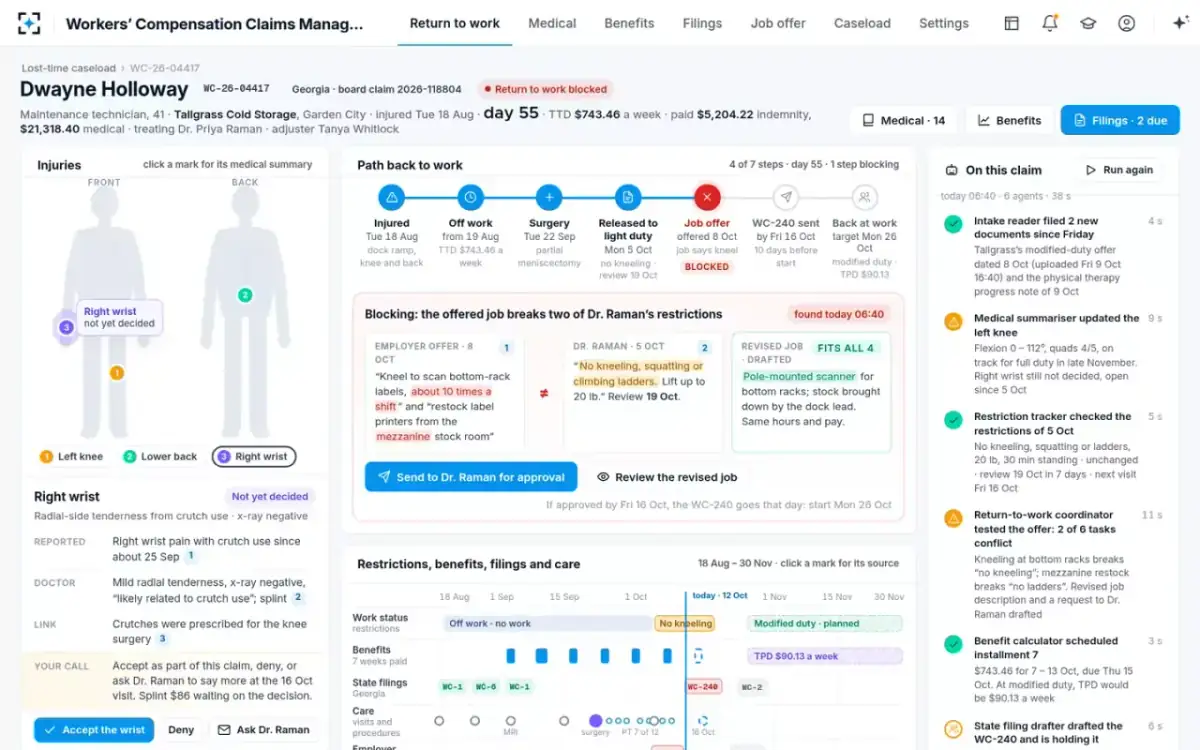
The harder problem is the body part nobody has decided about. On the sample claim, a therapy note of 2 October recorded right-wrist pain from crutch use, and the doctor wrote "likely related to crutch use". That is a medical observation, not a compensability decision, and a case management tool that files it as "wrist" under the claim's accepted injuries has made the adjuster's decision for her.
A new body part, marked not yet decided, with the notes side by side
Pre-authorization: the five-day hand-off between the two
Treatment requests are where the two categories most often drop a ball, because the request reaches one side and the deadline belongs to the other. In Georgia, pre-authorization is not required, but a treating provider may ask for it on Form WC-205, and the insurer "must respond within five (5) business days of receipt of the form". If it does not, "the treatment or testing stands pre-approved". An initial written refusal within the five days buys 21 days from receipt to either authorize the treatment in writing or controvert it on Form WC-3 (Claims Adjuster Reference).
The worker has a fast route too. When a recommended treatment has gone unauthorized for at least five business days, the worker or attorney may file a petition, Form WC-PMT, and the Board sets a telephone conference before a judge "not more than 5 business days from the date of the Petition". A request faxed to the nurse's system on a Thursday and first seen by the adjuster on the Friday of the following week has already been approved by default. Whichever tool receives the request has to put its deadline in front of the person who can answer it the same day.
Medical bills then run on their own clock. Georgia gives 30 days from receipt of the charges and reports, then adds 10%, 20% and, after 90 days, 12% a year in interest, all payable to the provider. A case management tool that tracks the treatment but not the bill, or a claims tool that pays the bill without knowing the treatment was disputed, will meet those penalties from one side or the other.
Buying questions for case management software
A buyer choosing between a case management tool, a claims platform or both should test each against a real lost-time claim with a restriction change, a job offer and a disputed body part. The questions below separate tools that hold the rules from tools that hold notes.
Eight questions for any workers comp case management tool
- Does it record consent the way your state requires?
Verbal and written, per contact type, with the date the worker was told consent can be refused.
- Does it count notice periods for doctor meetings?
Ten days in Georgia, with the day, time and place in the notice.
- Does it log every copy sent, to whom and when?
The rule requires copies to all parties; the log is the proof.
- Does the restriction come from the doctor’s note, quoted?
With the note date and the review date, linked to the page.
- Does the adjuster see the same restriction, not a retyped one?
One source, two views.
- Can the employer see work status without diagnoses?
The ADA line: restrictions and accommodations, not medical records.
- Does it keep compensability with the adjuster?
A new body part should be flagged, not filed under the accepted injury.
- Does it hold catastrophic plans and report dates?
Thirty-day meeting, 90-day plan, 90-day progress reports, closure on Form WC-R3.
Where the solution fits
Botminds' solution sits on the claims side, built around the claim's documents. The medical summariser reads every record and keeps a summary per body part with a citation for every sentence; the restriction tracker extracts each note's restrictions with start and review dates and quotes the doctor; the return-to-work agent tests offers against them. Medical records are visible to the claim team and the nurse case manager; the employer's contact sees work status and restrictions only. No agent contacts the worker.
It is not presented here as a nurse case management system. The sample's nurse view covers reading the record, carrying requests to the treating doctor and recording the answers; consent records, meeting notices, catastrophic rehabilitation plans and closure reports are not part of what the sample shows, so a carrier that needs them in one place should ask about them directly or keep them in the nurse's own tool. For the nurse's duties in detail, see the nurse case manager's seat in workers comp; for the claims side, see workers compensation claims management software, state by state. The sample claim itself is at Workers' Compensation Claims Management.
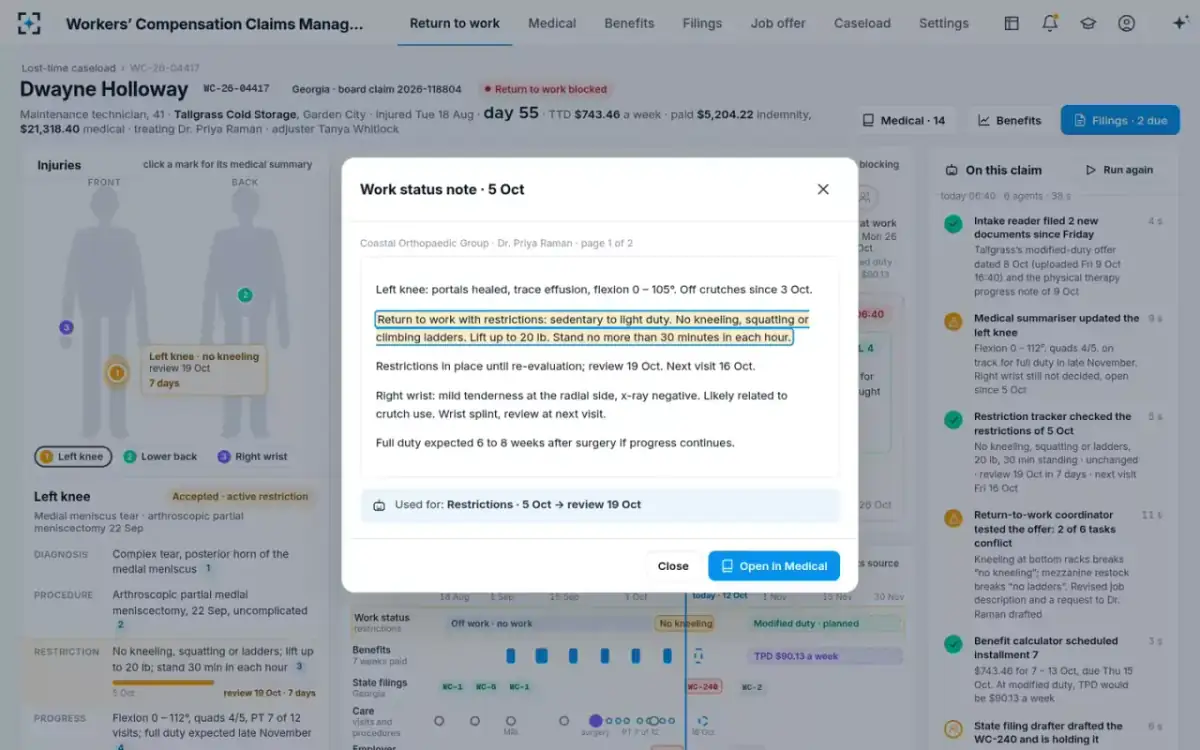
The citation behind the restriction, one click from the claim
Questions people ask
Do catastrophic claims need different software?
They need more of it. In Georgia a catastrophic claim gets a registered rehabilitation supplier, appointed within 48 hours of accepting the injury, who must meet the worker within 30 days, file a plan within 90 days and report at least every 90 days. Those obligations are case management features first, and a claims system built for adjusters may not hold them.
Who owns the case manager's notes?
Under Georgia's guidance, a case manager employed directly by the employer, insurer or third-party administrator does not have to provide copies of her notes to the worker or attorney. A retained case manager must still copy every document received from the treating physician to all parties.
Can case management software do utilization review?
Software can support a review done by others, but in Georgia the medical case manager may not perform it: Rule 200.2 says nothing in it allows "utilization review on the part of the qualified medical case manager". Necessity disputes go through the Board's separate procedures.
What is a rehabilitation supplier in Georgia?
A registered professional who "delivers and coordinates services under an individualized rehabilitation plan", from coordinating medical care to job analysis and placement, under Rule 200.1. Catastrophic claims require one; non-catastrophic claims may use a medical case manager under Rule 200.2 instead.
How much of workers' compensation spending is medical?
More than 47% of the $64.1 billion in benefits paid in 2023, according to the National Academy of Social Insurance. The Academy cautions against comparing its figures across states, because industries and laws differ.