A lost time claim is a workers' compensation claim in which the injury keeps the worker off work, or on reduced pay, for longer than the state's waiting period, so that income benefits are owed in addition to medical care. A medical-only claim pays for treatment and nothing else. The line is a number of days set by statute: Georgia's Board tells workers that the employer pays part of lost wages "if you are disabled from work for more than seven (7) calendar days", Florida and South Carolina also wait seven days, and Alabama three. The line matters because crossing it starts several legal clocks at once, for the first report, the first payment, the wage statement and the penalty, and it is crossed by a doctor's note rather than by anyone's decision. Botminds' Workers' Compensation Claims Management is software for lost-time claims in which agents read each new document, including the note that turns a medical-only claim into a lost-time one, and set its clocks for the adjuster.
The examples come from four Southeastern states' rules and from one fictional sample claim: a warehouse maintenance technician who twisted his knee on a Tuesday in August and was still off work in October.
Where four states draw the lost-time line
7days
Georgia: benefits from the eighth day; the first seven paid once 21 consecutive days are lost
7days
Florida: paid from the start if disability lasts more than 21 days
7days
South Carolina: paid from the start if disability lasts more than 14 days
3days
Alabama: added back once the worker is out 21 days
What is a lost time claim?
It is a claim that owes wage-loss benefits, which in practice means one where disability outlasts the waiting period. Researchers use the same line. A 2024 NBER study of attorney involvement in workers' compensation drew its sample from "more than 950,000 claims with more than seven days of lost time" (NBER w33210), the threshold Georgia's statute uses.
Lost time does not require total absence. A worker back on light duty at lower pay has a lost-time claim too, paid as temporary partial disability; Georgia's form describes it as two thirds of "the difference between what you make after your injury and what you made before" (Form WC-2). What makes a claim lost time is the wage loss, not where the worker spends the day.
Medical only vs lost time: what changes
The forms, the clocks and the way the claim is counted. In Georgia every claim, medical only or not, needs a first report: "Effective January 1, 2019, the filing of a Form WC-1 is required in all medical only claims", completed in Section D, "for medical-only injuries where no indemnity benefits are due" (Claims Adjuster Reference). A lost-time claim uses Section B instead, which records the weekly rate, the average weekly wage and the date of the first payment.
The change is also permanent for counting purposes. On the Board's annual report of claims and payments, Form WC-26, medical-only totals must exclude "any claims that have ever had any indemnity payments": "Any medical claims that at one time had indemnity payments should be included under section C", the indemnity section (Claims Adjuster Reference, ch. 5). Once a claim has paid a week of wage loss, it is a lost-time claim in the state's figures for good.
What changes when a Georgia claim crosses into lost time
| Medical only | Lost time | |
|---|---|---|
| First report | Form WC-1, Section D, within 21 days of the employer’s knowledge | Form WC-1, Section B, with the rate and the date of the first payment |
| Wage statement | Not needed | Form WC-6 when the weekly benefit is under the maximum |
| Payments | Medical bills within 30 days | First income benefit on the 21st day after the employer knew, then weekly |
| Penalties | 10% and 20% on late medical bills, plus interest after 90 days | 15% on income benefits not paid when due, as well |
| Changes and suspension | Not applicable | Form WC-2 for any change in benefits; 10 days’ notice for most suspensions |
| Case progress | Form WC-4 within a year | Form WC-4 within a year, every 12 months, and within 30 days of the last payment |
| Annual count (WC-26) | Medical only, while it never paid indemnity | Indemnity, permanently |
How many days off makes a lost time claim?
More than the waiting period, which is seven calendar days in Georgia, Florida and South Carolina and three in Alabama. The waiting days are not paid at first, and in each state they are paid back once the disability lasts long enough. Georgia's rule: "Entitlement to benefits for the first seven days of disability, or any part thereof, requires 21 consecutive days of disability", and the insurer pays them "on the 21st consecutive day" (Rule 220(b)). Florida allows compensation from the start "if the injury results in more than 21 days of disability" (§ 440.12(1)); South Carolina if "the injury results in disability of more than fourteen days" (§ 42-9-200).
Alabama's three days work the same way at a different scale: "When the injured employee is out twenty-one (21) days, the three (3) day waiting period is added to the first compensation payment due after the twenty-one (21) days", and where it is obvious the absence will exceed 21 days the wait "may be waived and compensation begun on the first day of disability" (Alabama claim handling manual). Alabama's first report of injury is due within 15 days "if days lost from work exceed three(3) days".
What is the waiting period for workers comp?
The days of disability a state does not pay for unless the disability lasts long enough, and the counting rules matter as much as the number. Georgia counts from the date of disability, "the first day the employee is unable to work a full day", unless the employee "is paid in full for the date of injury", in which case it starts the next day. The days are "the first seven calendar days of disability even though the days may not be consecutive", and "Intervening days, which are not scheduled workdays, during disability or preceding a return to work, are days of disability" (Rule 220(a)).
So weekends count. The Board's manual gives the example of an employee "injured on Thursday and is unable to work Friday", whose following Saturday and Sunday "must be counted as two days of the waiting period" (Claims Adjuster Reference). Alabama's manual works the same arithmetic with dates: an employee injured on 5 July and paid in full for that day has a date of disability of 6 July, a waiting period of 6, 7 and 8 July, and compensation from 9 July.
A claim does not become lost time when someone decides it has. It becomes lost time on the eighth calendar day of disability, whether or not anyone has noticed.
When do workers comp payments start?
On a date set by statute and counted from the employer's knowledge, not from the claim's arrival at the insurer. Georgia: on the 21st day after the employer learns of the injury, when every income benefit then owed must be paid (Claims Adjuster Reference). Florida: no later than "the 14th calendar day after the employer receives notification of the injury or death, when disability is immediate and continuous for 8 calendar days or more" (§ 440.20(2)(a)). South Carolina, under an agreement: "the fourteenth day after the employer has knowledge" (§ 42-9-230), and an employer there may begin payments after eight days out without waiving a good-faith denial for up to 150 days (§ 42-9-260).
The practical consequence is that a lost-time claim can be late before the insurer knows it exists. An employer that reports an injury a week after it happened has used a third of Georgia's 21 days. What lateness costs, state by state, is set out in workers comp late payment penalties.
Day one to day twenty-one on one Georgia claim
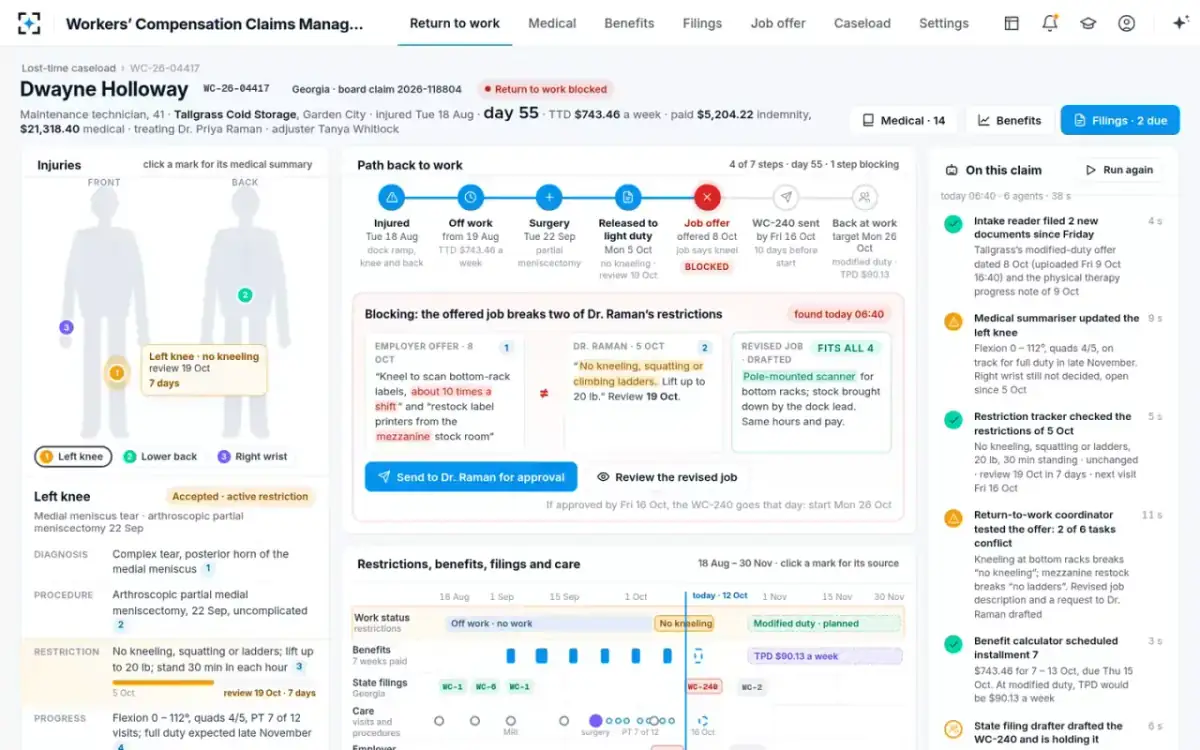
The sample claim shows both clocks running side by side. The technician was injured on Tuesday 18 August, which is also the day his employer knew. He was off work from Wednesday 19 August, so that is his date of disability. His waiting week ran from 19 to 25 August; benefits were payable from 26 August, the eighth day; and because he was still off on the 21st consecutive day, 8 September, the waiting week became payable too. On the employer's clock, the first report went to the Board on 21 August, the wage statement on 28 August, and the first payment on 3 September, five days before its due date of 8 September.
Two Georgia clocks on one sample claim, each 21 days long
- Waiting week, unpaid until day 2119–25 Aug
- Benefits payable from the eighth day26 Aug – 8 Sep
- First report filedWC-1 · 21 Aug
- Wage statement filedWC-6 · 28 Aug
- First payment madePaid · 3 Sep
- Margin before the due dateDue · 8 Sep
The coincidence is not one. Georgia's two 21s, the employer-knowledge clock for the first payment and the 21-day threshold for paying back the waiting week, land on the same day whenever the employer knows on the day of injury and disability starts the next day. A claim reported late breaks that alignment, and the waiting-week payback then falls on a different date from the first payment.
The claim's own dated strip: work status, benefits, filings and care
What forms are due on a lost time claim?
In Georgia, the first report, the wage statement, a notice for every change, a controvert if the claim is disputed, and periodic progress reports. The first report goes to the Board "within 21 days of the employer's knowledge of injury, disability, or death", with a copy to the employee and counsel. A Form WC-6 wage statement is required "when the weekly benefit is less than the maximum". Form WC-2 reports "any change in income benefits, classification, or rating of disability", and Form WC-3 controverts. Form WC-4 is filed within a year of the injury, every 12 months on open cases and within 30 days of the last payment (Claims Adjuster Reference).
Insurers and administrators file most of these electronically. Georgia requires "both the first reports of injury (FROI) and subsequent reports of injury (SROI) transactions to create a valid WC-1", and its later forms travel as subsequent reports. Our guide to EDI in workers comp follows those reports from the claim to the Board.
Days away, restricted duty and the median case
National injury data suggest that a typical case with time off sits close to the line. The Bureau of Labor Statistics counted 1.8 million private-industry cases involving days away from work over 2023 and 2024, and those cases "resulted in a median of 8 days away from work". Days-away cases made up 61.5% of all cases involving days away, job restriction or transfer; the other 1.1 million involved only restriction or transfer, with a median of 15 days (BLS).
Serious workplace injuries split between time away and restricted work
Private-industry cases with days away, job restriction or transfer, 2023–2024
- Days away from work · median 8 days · 61.5%
- Restriction or transfer only · median 15 days · 38.5%
The categories are the survey's, not the statutes', so they do not map onto lost-time claims one for one. But a median of eight days away means the typical case sits one day past Georgia's seven-day line, and the restricted-duty share is where temporary partial disability lives. For a claims desk, the cases that need watching are the ones near the line: a few more days off turns a medical-only claim into a lost-time one with a first payment due within days.
Why the crossing belongs on the claim, not in a diary
The event that crosses the line is a document: a work-status note keeping the worker off, an employer's report of a missed shift, a payroll record showing reduced hours. A diary entry made when the claim was opened as medical only does not know about any of them. The adjuster finds out when the next diary date comes round, which may be after the first payment is due.
In Botminds' solution the intake reader files each new document to its claim as it arrives, and the restriction tracker extracts each work-status note's restrictions with their start and review dates. The benefit calculator schedules installments against the state clock from the dates on the claim, and the state filing drafter drafts the form each change requires. The adjuster decides, pays and signs. The caseload then shows every lost-time claim with its next deadline under its own state's rule.
Seventy-one lost-time claims, sorted by the next state deadline
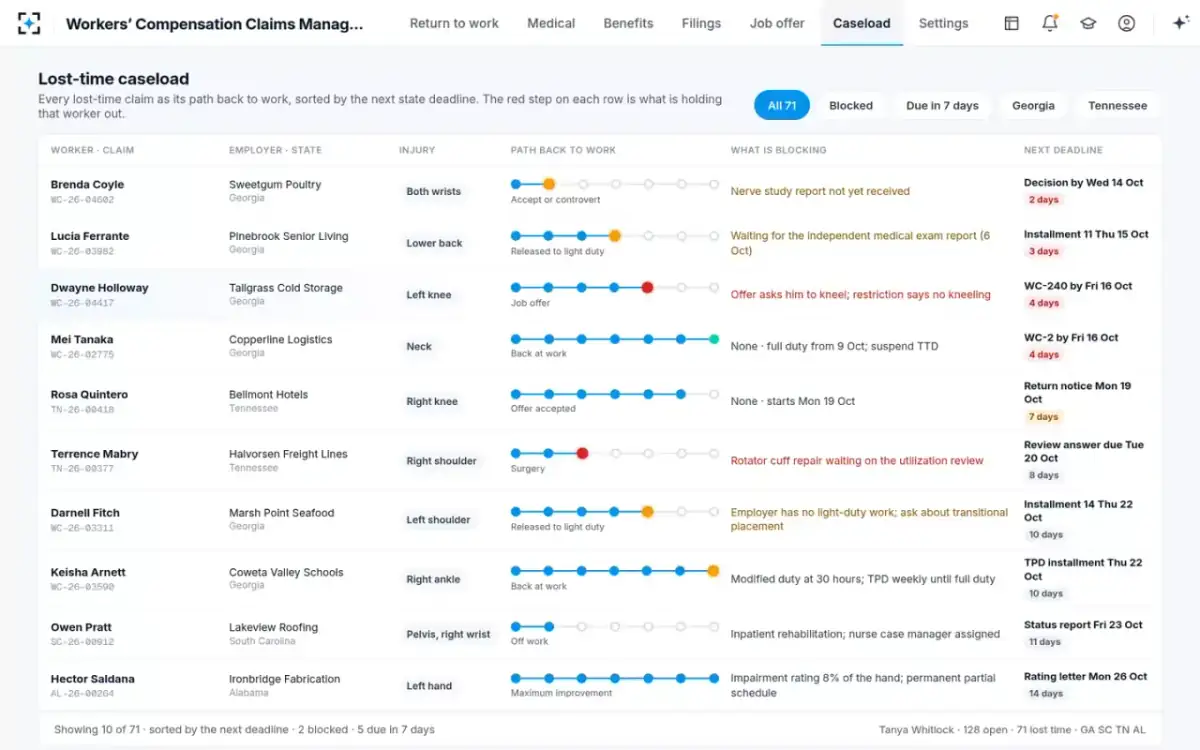
To see the sample claim's clocks and filings in full, start from Workers' Compensation Claims Management.
Questions people ask
Is light duty at lower pay still a lost time claim?
Yes. The claim owes wage-loss benefits as temporary partial disability: in Georgia, two thirds of the difference between the pre-injury average weekly wage and what the worker now earns, up to $533 a week for accidents from 1 July 2023. On the sample claim, a $980 modified job pays $90.13 a week in partial benefits.
What is a no lost time claim?
Another name for a medical-only claim: the worker loses no more than the waiting period, so only medical care is owed. Georgia still requires a first report, Form WC-1 Section D, on every medical-only claim since 1 January 2019.
Does the day of injury count toward the waiting period?
Only if the worker is not paid in full for it. Georgia's Rule 220 makes the date of disability the first day the employee cannot work a full day, and moves it to the next day when the employee is paid in full for the date of injury. Alabama's manual applies the same test.
Can a medical-only claim become lost time months later?
Yes, when the injury later causes time off, such as surgery after a period of treatment at work. The clocks then run from the new disability, and in Georgia the claim moves permanently into the indemnity count on the Board's annual Form WC-26.
Is a lost time claim the same as an OSHA days-away case?
No. Injury and illness records count days away from work under federal recordkeeping categories, which the Bureau of Labor Statistics summarises nationally; a lost-time claim is defined by each state's workers' compensation statute and its waiting period. Many cases are both, but neither definition decides the other.