A CMS Medicare set-aside for workers compensation, a WCMSA, is the part of a workers' compensation settlement allocated to future medical care for the work injury that Medicare would otherwise cover; that money has to be used up, appropriately, before Medicare pays for injury-related care. CMS will review a proposed amount when the claimant is a Medicare beneficiary and the total settlement is greater than $25,000, or when the claimant reasonably expects Medicare within 30 months and the settlement is expected to exceed $250,000. Submitting for review is voluntary, but protecting Medicare's interest is not, and since 2025 settlements that include a set-aside are reported to CMS under Section 111, with civil money penalties for late records. Botminds' Workers' Compensation Claims Management keeps the lost-time claim file that settlement work draws on, a cited medical record and a benefit history, though it does not prepare set-asides or report to CMS.
This guide uses CMS's own pages and the WCMSA Reference Guide, version 4.7, dated 5 October 2026, together with CMS's Section 111 civil money penalty page and its 2026 workers' compensation reporting webinar.
The WCMSA numbers that matter in 2026
$25,000
settlement above which CMS reviews a set-aside for a Medicare beneficiary
$250,000
for a claimant expecting Medicare within 30 months
45–60days
CMS’s aim for a decision once every document is in
$1,000/day
top daily penalty for a late Section 111 record, capped at $365,000
What is a workers comp Medicare set-aside?
It is money from a settlement set aside for the injured worker's future Medicare-covered care for the work injury. CMS's guide: "A WCMSA allocates a portion of the WC settlement for all future work-injury-related medical expenses that are covered and otherwise reimbursable by Medicare", and the approved amount "must be appropriately exhausted before Medicare will begin to pay for care related to the beneficiary’s settlement" (WCMSA Reference Guide, Section 3.0). It can be paid as a lump sum or structured, "with a fixed amount of funds paid each year for a fixed number of years, often using an annuity".
The reason is the Medicare Secondary Payer law. Workers' compensation pays before Medicare for work injuries, and Medicare "may not pay for a beneficiary's medical expenses when payment 'has been made or can reasonably be expected to be made under a workers’ compensation plan'" (Section 2.1). A settlement that closes future medical care without accounting for it shifts that care to Medicare, which is what the set-aside prevents.
When is a WCMSA required?
Submitting one to CMS is never required; considering Medicare's interest always is. CMS states that "there are no statutory or regulatory provisions requiring that a WCMSA proposal be submitted to CMS for review" (CMS), and the guide adds that "WC claimants must always protect Medicare’s interests" (Section 4.2). The guide then lists when a set-aside is not necessary: the settlement compensates only past medical expenses and is not inflated elsewhere to Medicare's cost, for example where the treating physician documents that no further injury-related treatment will be needed, or where the claim was denied and nothing has been paid.
Two situations need no set-aside at all. If the settlement leaves the carrier responsible for ongoing medical care, "a WCMSA is not necessary". And CMS will no longer look at an empty one: "Effective July 17, 2025, CMS no longer accepts or reviews WCMSA proposals with a zero-dollar ($0) allocation" (Section 4.2). A set-aside is "still recommended" when the claimant has other cover, including Medicare Advantage or Part D plans, because that cover "could be canceled" (Section 4.1.3).
What are the CMS review thresholds for a WCMSA?
Two, one for current beneficiaries and one for people expected to become beneficiaries. CMS will review when "The claimant is a Medicare beneficiary and the total settlement amount is greater than $25,000.00", or when "The claimant has a reasonable expectation of Medicare enrollment within 30 months of the settlement date and the anticipated total settlement amount for future medical expenses and disability/lost wages over the life or duration of the settlement agreement is expected to be greater than $250,000.00" (CMS).
The guide defines "reasonable expectation" by facts a claim file can hold: the claimant has applied for Social Security disability benefits, has been denied but expects to appeal, is appealing or re-filing, "is 62 years and 6 months old", or has end-stage renal disease without yet qualifying for Medicare on that basis (Section 8.1). Three further rules matter in practice. The thresholds "are created based on CMS’ workload and are not intended to indicate that claimants may settle below the threshold with impunity". Below them, CMS "will not issue a 'verification letter'". And "CMS will honor the threshold in effect at the time of settlement" (Section 8.1).
What changed in the WCMSA reference guide in 2025 and 2026?
The guide itself changed in small steps; the bigger change was in reporting. Version 4.7, dated 5 October 2026, adds one item: "In order to address the many reasons a case may be ineligible for review, a new 'Ineligible – Other' letter is now available" (Section 1.1). Earlier versions in the 4.x series added the policy on zero-dollar requests, a Notice of Settlement Received letter "To support Medicare set-aside reporting requirements", and removed "The one-year wait period for amended reviews".
The reporting change came through Section 111. Since 4 April 2025, insurers and other responsible reporting entities must report set-aside details with the settlement when "Some portion of that TPOC is designated as a WCMSA", the TPOC being the total payment obligation to the claimant, and CMS has said that "enforcement of CMPs related to WCMSAs will be limited to TPOC dates on or after 8/1/2025" (CMS webinar, April 2026). The civil money penalty rule itself became applicable on 11 October 2024 and is "enforced as of October 11, 2025" (CMS). CMS published version 8.6 of its Section 111 user guide for liability, no-fault and workers' compensation reporters on 5 October 2026 (CMS).
The set-aside rules that changed, and when
| Change | Where it is set out | Effective |
|---|---|---|
| Section 111 reports carry set-aside details: amount, period, funding, deposits, case number, administrator | CMS Section 111 user guide; April 2026 webinar | Settlements dated on or after 4 April 2025 |
| Civil money penalties for late Section 111 records apply to set-aside fields | CMS webinar, April 2026 | Settlements dated on or after 1 August 2025 |
| Zero-dollar set-aside proposals no longer accepted or reviewed | Reference Guide, Section 4.2 | 17 July 2025 |
| Civil money penalties enforced; quarterly audits of 250 records | CMS civil money penalties page | Enforced from 11 October 2025; audits from January 2026 |
| New “Ineligible – Other” letter | Reference Guide v4.7, Section 1.1 and Appendix 5 | 5 October 2026 |
Does CMS have to approve a workers comp settlement?
No, but the parties carry the risk of not asking. CMS approves the set-aside amount, not the settlement, and only when asked. If the parties set an amount without approval, "CMS is not bound by the set-aside amount stipulated by the parties, and it may refuse to pay for future medical expenses related to the WC work-related injury". If CMS approves the amount and it is "later appropriately exhausted, Medicare will pay Medicare-covered, WC work-injury-related medical bills for services otherwise covered and reimbursable by Medicare regardless of the amount of care the beneficiary continues to require" (Section 8.0).
That is the trade a claims leader is making: certainty in exchange for time. CMS "tries to review and decide on proposed settlements within 45 to 60 days from the time that all relevant documents are submitted", and the parties may settle the indemnity separately "in order to avoid having indemnity payments continue while CMS is still reviewing the proposal" (Section 15.1).
What is Section 111 reporting for workers comp?
It is the federal requirement for insurers, self-insured employers and other responsible reporting entities to report to CMS when they settle with, or accept ongoing medical responsibility for, a Medicare beneficiary. A record is timely if it is reported "within 1 year (365 days)" of the settlement date or the date funding was delayed beyond it. Late records can draw a civil money penalty "for each calendar day a record is late with a maximum penalty of $365,000", and "Beginning January 2026, and continuing on a quarterly basis, CMS will randomly select 250 MSP records to audit" (CMS).
The daily penalty on a late Section 111 record rises with lateness
CMS's own example shows how quickly it adds up: a settlement of 5 February 2025 reported on 1 May 2026, 85 days after its due date, faces "a potential CMP amount of $21,250 (as adjusted for inflation)" (CMS). For workers' compensation settlements with a set-aside, the report now carries seven extra fields.
The set-aside fields a Section 111 settlement report now carries
| Field | Name | What it holds |
|---|---|---|
| 37 | MSA Amount | The amount set aside for future injury-related care; zero, or up to the total settlement |
| 38 | MSA Period | How many years the set-aside is expected to last |
| 39 | Lump sum or structured | L for a lump sum funded at once; S for a structured or annuity set-aside |
| 40 | Initial deposit amount | The seed amount of a structured set-aside; zero for a lump sum |
| 41 | Anniversary deposit amount | The amount made available each year of a structured set-aside |
| 42 | Case control number | Links a reviewed set-aside to the report, so one case is not opened twice |
| 43 | Professional administrator EIN | Identifies a professional administrator, if one is used |
How long does CMS take to review a WCMSA?
Its aim is 45 to 60 days once the file is complete, and the most common delay is a file that is not. When the review contractor needs more, it sends a development letter, and "If the submitter does not respond to the development letter within the allotted time frame (i.e., 30 days for cases submitted to the BCRC, 20 business days for cases submitted on the WCMSAP), the case is closed for lack of response" (Section 9.4.1). The first of the guide's "five most frequent reasons for development requests" is "Insufficient or out-of-date medical records".
From a complete submission to a CMS decision, through the online portal
- Review and decision45–60 days
- Review to the requestabout 30 days, assumed
- Response window20 business days
- Review resumes to decision45–60 days
The guide's tips are blunt about size: if a submitter plans to send "more than 200 pages of information or more than two years of medical records", it should contact the review contractor first (Section 14.0). A medical record that is already summarised, with every line pointing to its source page, is the difference between sending everything and sending what the reviewer needs.
After approval: re-review, attestation and the account
There is no appeal, only narrow re-reviews, and the account has to be accounted for every year. "When CMS does not believe that a proposed set-aside adequately protects Medicare’s interests ... there is no formal appeals process" (Section 16.1). A re-review is available for a mathematical error, for evidence dated before the submission that CMS did not consider, or for a documentation error that changes pricing by "no less than $2500.00", with no more than one request of each type for approvals from 1 September 2022; a one-time amended review is possible before the case settles (Sections 16.1–16.3).
Once funded, the account pays only for Medicare-covered, injury-related care. The administrator must send an annual attestation "no later than thirty days after the end of each year, beginning one year from the establishment of the WCMSA account", and the account may not pay "administrative fees", "expenses for administration of the WCMSA" or "attorney costs for establishing the WCMSA" (Section 17.5).
What the claim file must hold before settlement talks
Everything CMS will ask for, gathered while the claim is open rather than assembled when a settlement figure is on the table. The guide's submission checklist runs from a cover letter and a consent to release, through rated age or life expectancy, a future treatment plan, the settlement agreement and an administration agreement, to "Medical Records" and "Payment History" (Table 10-1). The last two are the claim file itself.
Before a workers' comp settlement with a possible set-aside
- Medicare status, and the 30-month tests
Entitlement and its basis; any Social Security disability application, denial or appeal; age against 62 years and 6 months; end-stage renal disease.
- Medical records, current and complete
Out-of-date records are the first reason CMS asks for more. More than two years of records: call the review contractor first.
- Payment history
What the carrier has paid for the injury, by provider, and any conditional payments Medicare made.
- Which body parts are accepted
A set-aside covers the settled injury; a body part still marked undecided needs a decision first.
- Future treatment and its pricing basis
A treatment plan, priced on the state fee schedule or on actual charges, stated consistently.
- The allocation in the settlement
Past and future medical shown separately; the same duration used for every part of the settlement.
- The Section 111 data, ready on the settlement date
Amount, period, lump sum or structured, deposits, case control number and administrator, with the report due within a year.
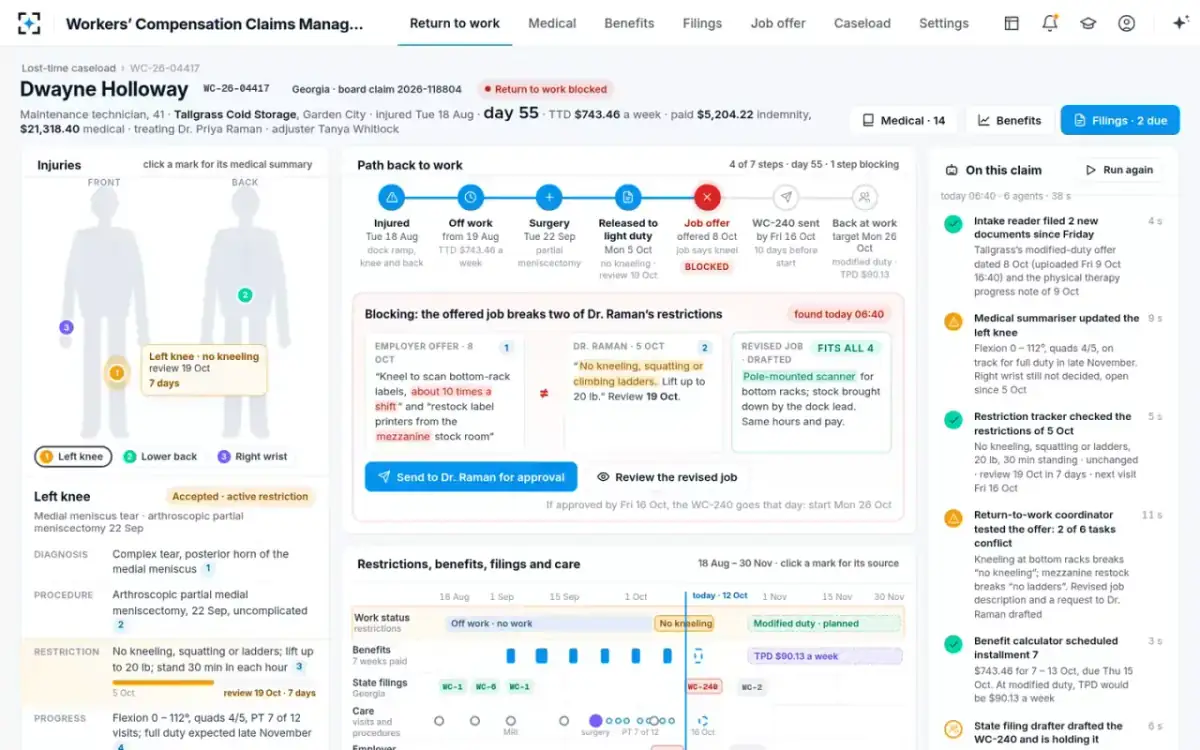
In Botminds' solution the medical summariser keeps a summary per body part with a citation for every sentence, all documents in date order; the benefit calculator keeps every installment with its working; and a new body part is marked "not yet decided" until the adjuster accepts or denies it. That is the material a set-aside proposal and a Section 111 report draw on. The solution does not prepare set-aside proposals, price future care or report to CMS; those stay with the carrier's Medicare compliance team and its chosen vendors.
The medical record a reviewer will ask for, already in date order with citations
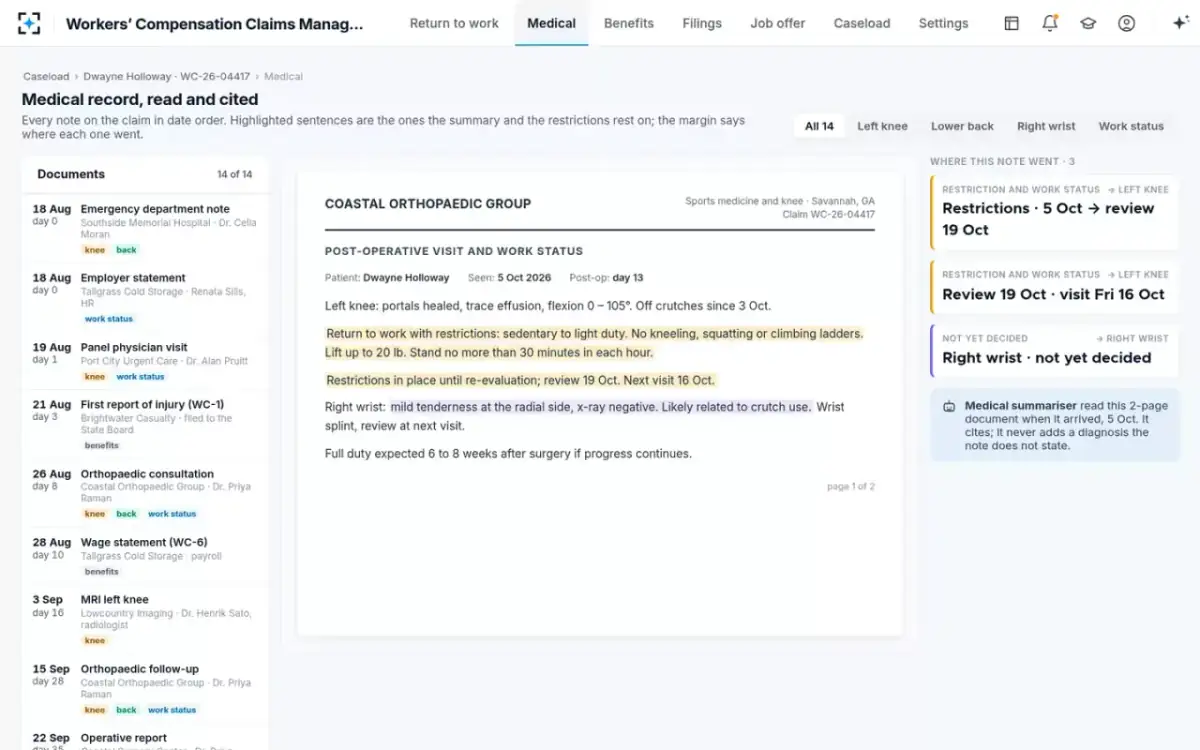
Settlement is also when a claim's history is tested against its own dates. A claim whose benefits were calculated and paid on time, as described in how to calculate average weekly wage in workers compensation, has a payment history CMS can read. Choosing the system that will hold that history is covered in workers compensation claims management software, state by state. The sample claim, from first report to return to work, is at Workers' Compensation Claims Management.
One claim, its body parts and its dated history on a single screen
Questions people ask
Who can submit a WCMSA to CMS?
CMS's guide names injured workers themselves, their attorneys, set-aside agents or consultants, and other appointed representatives. Submission through CMS's online portal is the recommended route, because CMS says it is "significantly more efficient" than paper or CD by mail.
Can a Medicare set-aside be self-administered?
Yes. The guide describes accounts administered by the claimant or by a professional administrator, and CMS's April 2026 reporting example includes "a $69,348.52 CMS-approved Self-Administered MSA". Either way the administrator keeps records and sends the annual attestation.
Does Medicare Advantage remove the need for a set-aside?
No. The guide says a set-aside is still recommended with Medicare Advantage, Part D or other coverage, which could be cancelled, and that the set-aside is primary to all Medicare coverage for the settled injury. CMS tells Part C and D plan sponsors when a set-aside is approved but not its details.
Can set-aside funds pay legal or administration fees?
No. The account may pay costs directly tied to it, such as copying, postage, bank fees and income tax on its interest, but not administrative fees, the cost of administering it, or attorney costs for setting it up. CMS also excludes administration fees from the amount it approves.
Does the settlement date or the review date decide the threshold?
The settlement date. CMS "will honor the threshold in effect at the time of settlement", and reserves the right to change thresholds, so a file prepared under one threshold should be checked against CMS's page again before closing.