The Georgia workers compensation 240 process is the route the State Board of Workers' Compensation sets for offering an injured worker on restrictions a job suitable to those restrictions. The employer gets the authorized treating physician's written approval of the job's duties, sends the worker and the worker's attorney a Form WC-240 with the job description and the approval attached at least ten days before the start date, and may suspend income benefits if the worker unjustifiably refuses to try it. If the worker tries the job and cannot keep doing it, benefits come straight back. Every step is dated, and one missing date undoes the suspension. Botminds' Workers' Compensation Claims Management is software for lost-time claims in which agents test the job against the current restrictions, draft the WC-240 and hold it until the doctor's approval is on file, while the adjuster signs and sends.
This guide quotes the State Board's Rule 240, its forms and its manuals, and follows one fictional sample claim, a warehouse technician recovering from knee surgery, from an offer the doctor could not approve to a signed WC-240.
The four numbers of a Georgia WC-240
60days
the doctor must have examined the worker within, before approving the job
10days
minimum notice: the WC-240 reaches worker and attorney before the start
8hours
or one scheduled workday, whichever is greater: the attempt that protects the worker
15work days
within which a failed attempt reinstates benefits immediately
What is a WC-240 in Georgia?
It is the Board's "Notice to Employee of Offer of Suitable Employment", the form an employer uses "to notify an employee of an offer of employment which is suitable to his/her impaired condition, as required by O.C.G.A. § 34-9-240 and Board Rule 240". It names the job's title, essential duties, rate of pay, location, hours and days, and the date and time to report, and states that a copy of the treating physician's approval is attached. It is not filed with the Board on its own: it "should only be filed with the Board as an attachment to a Form WC-2" (Form WC-240).
The form also tells the worker the consequences in plain terms. Refusing to attempt the job, or attempting it "for less than eight cumulative hours or one scheduled work day, whichever is greater", lets the employer or insurer suspend income benefits from the date the worker was scheduled to report. "Should you attempt but fail to continue working for fifteen (15) scheduled work days, your income benefits shall immediately be reinstated." It closes with a certificate the sender signs, covering the job's availability, the doctor's approval and the ten days' notice.
How does the Georgia workers comp 240 process work?
In five dated steps: approval, copies, notice, attempt and, if needed, suspension or reinstatement. Rule 240(b) lets the employer or insurer suspend benefits "without an order of the Board" when the worker "unjustifiably refuses to accept employment which has been approved by the authorized treating physician(s) suitable to his/her impaired condition and offered to the employee in writing", provided the WC-240 and the WC-2 are filed showing that each condition was met (Rule 240(b)(1)). The flow below shows the steps as the sample claim ran them, with the agents' drafting and the people's decisions marked.
The 240 process on one sample claim, from offer to start
Agent
Test the offerSix tasks of the employer’s offer against the four restrictions of the 5 October note: two conflict. A revised job and a request to the doctor are drafted.
Never: contacts the worker
A person decides
Adjuster and nurse case managerSend the revised job description to the treating doctor; a copy goes to the worker and counsel at the same time, as Rule 240 requires.
A person decides
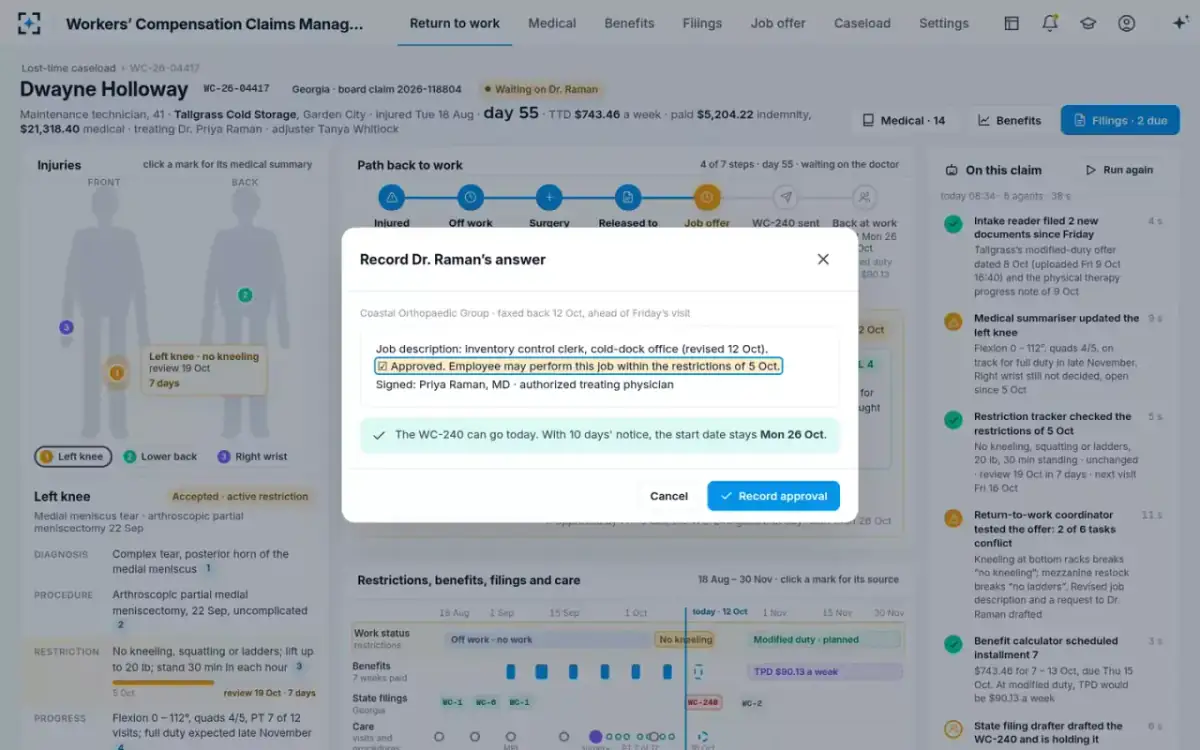
Authorized treating physicianApproves the job in writing: “Employee may perform this job within the restrictions of 5 Oct.” Last examination: 5 October, within 60 days.
Agent
Draft the WC-240Title, duties, pay, location, report date and time; held until the approval was recorded, then marked ready.
Never: files without the adjuster’s signature
A person decides
AdjusterSigns and sends the WC-240 with the approved job to the worker by mail and email, copies to the Board and the employer: 14 days before the start.
A person decides
WorkerReports on Monday 26 October at 07:00. If he cannot continue within 15 scheduled work days, benefits are reinstated at once.
How many days notice for a WC-240?
At least ten days before the date the worker is expected to report, to the worker and to the worker's attorney. The form's instruction: it "must be provided to the employee and counsel for the employee at least ten days prior to the date the employee is expected to return to work". The rule says the same of the filing: the WC-240 and WC-2 certify "that at least ten days before the employee was required to report for work he/she was notified on the completed Form WC-240 mailed to the employee and his/her attorney" (Rule 240(b)(1)).
Count back from the report date. A start on Monday 26 October means the WC-240 must go by Friday 16 October; on the sample claim it went on Monday 12 October, giving 14 days. A margin is worth having. The rule for a different suspension, release without restrictions, adds "three additional days" to the notice period when the notice goes by regular mail (Rule 221(i)(4)(b)). Rule 240 does not say the same, but a sender who mails on the tenth day has no room for any argument about receipt.
The doctor's approval and the 60-day examination
The job has to be approved by the authorized treating physician, in writing, after an examination within the last 60 days. The rule requires the WC-240 to show the job "was approved by his/her authorized treating physician(s) after an examination within the last 60 days", and the attachments must include "the written approval of the authorized treating physician(s) of the essential job duties to be performed" (Rule 240(b)(1) and (3)). The certificate on the form repeats it: the duties "have been approved by the authorized treating physician(s) who has examined the employee within 60 days of the attached approval" (Form WC-240).
Two practical rules follow. First, the approval must cover the job as offered; an approval of a different job description does not carry over. Second, the examination date has to be checked before the WC-240 is drafted, not after a hearing request arrives. On the sample claim the doctor last examined the worker on 5 October and approved the revised job on 12 October, seven days later.
The rule also protects the worker's side of the conversation with the doctor. "The employer/insurer shall provide to the employee and legal counsel a copy of any job description/analysis ... at the time of submission to the authorized treating physician(s)." A job description sent to the doctor quietly, and disclosed only with the WC-240, does not meet that requirement. The nurse case manager is often the one carrying it, under rules covered in the nurse case manager's seat.
The doctor's written approval, recorded the day it came back
What is a WC-240A?
It is the Board's Job Analysis form, an optional attachment to the WC-240. Board Rule 61 says an employer or insurer "may use this form in conjunction with a Form WC-240 to provide a detailed job description", and Rule 240 adds that "Attaching a properly completed Form WC-240A will satisfy the requirements for making a proper offer of employment as set forth herein" (Rules 61(b)(37) and 240(b)(3)).
The form grades each physical demand by frequency, "Occasional (up to 1/3 of the time)", frequent or constant, lists postures from sitting to kneeling, squatting and climbing, asks for the equipment and tools used, and ends with a section for the treating physician to release the worker to the job, refuse, or release "with the following restrictions/limitations/modifications" (Form WC-240a). It is, in effect, the Board's own job-description template, and the approach to writing one is set out in the modified duty job description template.
What happens if I refuse a WC-240 job?
If the offer met every requirement and the refusal is unjustified, income benefits can be suspended from the day the worker was due to report. Rule 240(b)(4) authorises suspension "effective the date that they unjustifiably refused to report to work" when the worker refuses or attempts the job for less than eight cumulative hours or one scheduled workday, whichever is greater. The insurer files a WC-2 giving that reason, and the form's own text states that "Form WC-240 was sent at least ten days before the employee was required to report for work" (Form WC-2).
A worker who believes the suspension is wrong can contest it. The WC-2 tells workers to request a hearing on Form WC-14, and Rule 240(f) lets the worker ask the Board for an interlocutory order reinstating benefits pending the hearing, supported by the worker's affidavit and current medical records. Whether a refusal was justified is a question for the Board, not for the form; this guide describes the procedure, not what any worker should do.
What is the 15 day grace period in Georgia workers comp?
It is fifteen scheduled work days during which a worker who tries the suitable job and cannot continue gets benefits back at once. The Board's manual calls it a "15 working day “grace period”" (Supervisor's Manual). Rule 240(c) is specific: if the worker attempts the job for eight cumulative hours or one scheduled workday, whichever is greater, "but fail to continue working for more than the prescribed fifteen (15) scheduled work days", the employer or insurer, "whether or not they have sent a WC-240, shall immediately reinstate payment of income benefits" and file a WC-2.
Two details decide disputes. The count is of scheduled work days, and "each day or part thereof during which the employee is scheduled to perform his/her job duties" counts as one (Rule 240(d)). And the penalty for a slow reinstatement is severe: failure to reinstate immediately "shall result in the waiver of the employer/insurer's defense of the suitability of employment" for the period benefits were not paid when due. An insurer that reinstates promptly can still argue suitability at a hearing and seek reimbursement (Rule 240(c)(i)–(ii)).
One WC-240, from offer to start
On the sample claim the doctor released the worker to light duty on 5 October with a review on 19 October and a visit on 16 October. The employer's offer arrived on 8 October and asked him to kneel and climb a ladder. A doctor who had written "no kneeling" could not approve it as written, and if the job had waited for the 16 October visit, that visit was also the last day to send a WC-240 for a 26 October start. Fixed first, it was approved by fax on 12 October and the WC-240 went the same day.
The sample claim's 240 dates, and the latest dates the rule allowed
- Note to offer5–8 Oct
- Tested, approved, sent8–12 Oct
- Notice before the start14 days
- Note to offer5–8 Oct
- Waiting for the visit8–16 Oct
- Minimum notice10 days
On track to return: the approved job and the WC-240 ready to sign

Where 240 offers fail
Most of the ways a WC-240 fails are dates and copies, not the job itself. Each failure below comes from a requirement in the rule or on the form, and each turns a suspension the insurer thought it had into benefits owed.
Where a Georgia WC-240 suspension comes apart
| What went wrong | The requirement it breaks | What to check before sending |
|---|---|---|
| The doctor approved a different version of the job | Written approval of “the essential job duties to be performed” | The approval names the job description, with its date |
| The approving doctor last examined the worker more than 60 days earlier | Approval “after an examination within the last 60 days” | The last examination date, against the approval date |
| The job description went to the doctor without a copy to the worker and counsel | Copy “at the time of submission to the authorized treating physician(s)” | The copies’ dates match the submission date |
| The WC-240 arrived fewer than ten days before the start | At least ten days before the report date | Send date at least ten days back from the start; more if mailed |
| The attorney was not served | Mailed “to the employee and his/her attorney” | Representation checked on the day of sending |
| The suspension was filed electronically without the WC-240 | The served WC-240 and medical report filed with the electronic report | Attachments sent with or before the transaction |
| Benefits were not reinstated after a failed attempt | Immediate reinstatement within 15 scheduled work days | A watch on attendance for the first 15 scheduled days |
In Botminds' solution these checks run on the claim's own documents. The return-to-work agent tests the job against the restrictions before it goes to the doctor; the state filing drafter holds the WC-240 while the approval is missing and says why; the claim shows the latest send date for the planned start. The adjuster signs and sends, and the worker is contacted only through the adjuster, or through the attorney when the worker is represented.
Before you sign a Georgia WC-240
- The job description sent to the doctor is the job on the form
Same tasks, hours, pay, location and start.
- The doctor’s approval is written and on file
With the doctor’s name and the date.
- The last examination is within 60 days of the approval
Counted from the examination, not from the approval.
- Copies went to the worker and counsel when the job went to the doctor
The rule fixes the timing, not just the fact.
- The start date is at least ten days away, with margin
Count back from the report date and time.
- The job is available as described
The certificate says so, and the employer has confirmed it.
- A plan for the first fifteen scheduled work days
Who watches attendance, and who files the WC-2 if benefits must be reinstated.
To see the sample claim's job offer, approval and WC-240 screen by screen, start from Workers' Compensation Claims Management.
Questions people ask
Who signs the WC-240?
The person making the offer for the employer or insurer completes the certificate of service, with a name and title. It certifies that the job is available, that the duties have been approved by the treating physician within the 60-day examination window, and that the offer is made in good faith at least ten days before the start.
Is the WC-240 filed with the State Board?
Only as an attachment. The form says it "should only be filed with the Board as an attachment to a Form WC-2", which happens when benefits are suspended. If the suspension is filed electronically, the served WC-240 and the supporting medical report go to the Board with or before the electronic report.
Does the WC-240 job have to pay the same as before?
No. If it pays less, temporary partial disability makes up two thirds of the difference, up to $533 a week for accidents from 1 July 2023. On the sample claim, a $980 job against a $1,115.19 average weekly wage pays $90.13 a week in partial benefits.
Can benefits be suspended for refusing a job without the WC-240 route?
Only by order of the Board. Rule 240(e) lets the employer or insurer move, on Form WC-102D, for suspension pending a hearing, with an employer's affidavit that suitable employment was offered and the offer is continuing, the job analysis attached, and an examination by the treating physician within 60 days. No suspension is granted unless the treating physician approves the job.
What happens after the 15 scheduled work days?
A worker who keeps working past them is back at work, and benefits follow the wages: none if the job pays the pre-injury wage or more, partial benefits if it pays less. The insurer reports the change on Form WC-2.