EDI in workers comp is electronic data interchange: the electronic filing of claim information by insurers, self-insured employers and claims administrators with state workers' compensation agencies, in the standard format maintained by the IAIABC. A claim is opened with a First Report of Injury (FROI) and followed by Subsequent Reports of Injury (SROI) whenever benefits begin, change, stop or are denied. The IAIABC says its standards "are used by claims administrators to report workers' compensation first report of injury and subsequent report of injury claims data to U.S. jurisdictions". It replaced paper forms, and in states such as Georgia it is now the required way for an insurer to file. What makes it hard is that each state adopts its own release and its own element rules, and every transaction carries data that someone on the claim had to get right first. Botminds' Workers' Compensation Claims Management is software for lost-time claims in which a state filing drafter agent prepares each form and electronic report from the claim's documents, with its due date, for the adjuster to sign.
This guide draws on the IAIABC's standard pages, the rules of Georgia, Kansas, Minnesota and Alabama, and one fictional sample claim whose benefit changes from total to partial disability.
The EDI claims standard in four numbers
68
data elements in Claims Release 1.0, most for first reports
275+
data elements in Release 3.1, the current release
80%
successful submissions below which Georgia may suspend EDI filing
2,100+
insurers, self-insurers, funds and claims offices registered for Georgia’s online system
What is EDI in workers comp?
It is the electronic version of the state claim forms, sent as standard transactions instead of paper. Minnesota's Department of Labor and Industry describes the IAIABC standard as "an electronically secure means to replace required paper forms", which "began with Claims Release version 1.0 with 68 data elements, most of which were used for First Reports of Injury (FROI), with a limited set for Subsequent Reports of Injury (SROI). The standard has since grown to include more than 275 data elements in the current version R3.1" (Minnesota DLI). Each element has a number; Minnesota's example is "DN0031", the data element number for the date of injury.
EDI covers the insurer-to-state leg only. Minnesota notes that its mandate "does not affect the method insured employers use to report injuries to their insurance companies". In Georgia the employer still completes the first section of Form WC-1 "immediately upon knowledge of an injury" and sends it to the insurer, which completes the rest and files it (Claims Adjuster Reference).
What is a FROI and SROI, and how do they differ?
The FROI opens or updates the claim; the SROI reports what happens to its benefits. In Minnesota's words, "the FROI transaction is used to transmit new and updated claim information; the SROI transaction is used to transmit payment and denial information related to previously submitted claims" (Minnesota DLI). Kansas treats the first report as the legal filing: its "FROI 00" "shall be considered the filing of an accident report" under the state's statute (K.A.R. 51-9-17(d)).
Georgia needs both to make one form. "The Board requires reporting both the first reports of injury (FROI) and subsequent reports of injury (SROI) transactions to create a valid WC-1". The FROI completes the identifying section of the WC-1; "SROI payment transactions are required to complete the data in Sections B, C or D". After that, subsequent reports carry the Board's other forms: the WC-2 notice of payment or suspension, the WC-2a for death benefits, the WC-3 controvert and the WC-4 case progress report (Claims Adjuster Reference, ch. 6). Unless the first report is itself a denial, a Georgia WC-1 filed as a FROI with no SROI is, in the Board's terms, not yet a valid WC-1.
What is IAIABC Release 3.1?
It is the current version of the IAIABC's claims reporting standard, the specification states adopt for FROI and SROI transactions. "EDI Claims Release 3.1 is the most current release and is maintained on an ongoing basis. Revised documentation for EDI Claims Release 3.1 is published on January 1 of each year." The previous release, 3.0, had its final publication on 1 January 2017, and Release 1.0 on 15 February 2002 (IAIABC). The documents are licensed: non-members and associate members pay $295 per standard (IAIABC).
Adopting a release is a state decision with a state implementation guide. Minnesota adopted Release 3.1 with its own guide, effective 31 August 2020, and "mandates submission of data using an XML format". Kansas requires reporting under the IAIABC's "release 3.1 standards" through its "Kansas EDI release 3.1 guide", revised 16 July 2018. Georgia's Board describes its standard as "the IAIABC Claims Release 3 EDI standard", and its Rule 62 requires valid data under the "GA SBWC R3.0 Element Requirement Table" (Rule 62(3)). A claims operation reporting in several states is therefore working to several versions of one standard at once.
Which states require workers comp EDI?
A growing number, each by its own law. Among the states in this guide: Georgia requires that "All claims submitted by insurers, self-insurers, group self-insurers, and designated claims offices (TPAs) to the Board must be in EDI format", and paper forms on claims created on or after 1 July 2009 "may be rejected". Minnesota "mandated FROI EDI reporting in 2014" and required all companies handling claims to report by EDI from 31 August 2020. Kansas requires "Each insurer, group-funded workers compensation pool, and self-insured employer" to participate in its EDI programme. Alabama's manual says EDI "is now being used in Alabama in place of" its paper forms (Alabama).
The IAIABC publishes jurisdictional profiles of state implementations. For a claims leader the useful list is shorter: the states where the book has claims, each with its release, element table, trading-partner steps and attachment rules, kept with effective dates. That list is the backbone of any workers compensation claims management software rollout.
What triggers a subsequent report of injury?
Any event the state wants to know about after the first report: the first payment, a change in benefit type or rate, a suspension, a denial, a reinstatement and the periodic or final progress report. In Georgia, Form WC-2 "is the proper form to report any change in income benefits, classification, or rating of disability", and "If Form WC-1 is filed by EDI then subsequent Form WC-2 and Form WC-3 must be filed EDI (SROI) also" (Claims Adjuster Reference).
On the sample claim, the worker starts a modified job on Monday 26 October at $980 a week. That ends temporary total disability at $743.46 and starts temporary partial disability at $90.13, so a WC-2 and the matching subsequent report are planned for that day. The suitable-employment form sent on 12 October did not itself trigger a report; it would have mattered only if benefits had been suspended for a refusal, and then Georgia requires the served WC-240 and the doctor's report to be filed "simultaneously" with the subsequent report (Rule 240(b)(2)).
One benefit change on the sample claim, from the doctor's approval to the state
A person decides
Treating doctorApproves the modified job within the restrictions of 5 October.
A person decides
AdjusterSigns and sends the WC-240 for a start on Monday 26 October; benefits continue until the worker starts.
Agent
Benefit calculatorWorks out partial disability from 26 October: two thirds of $1,115.19 less $980, $90.13 a week.
Never: issues a payment
Agent
State filing drafterPlans the WC-2 and the subsequent report for the change of benefit type, dated for 26 October.
Never: files without the adjuster’s signature
A person decides
AdjusterConfirms the worker started, approves the first partial payment and signs the WC-2 and the report.
A person decides
State agencyRuns its edits and sends an acknowledgment: accepted, or rejected with the reason.
The path a report travels
A FROI or SROI passes through five layers, and each has its own owner and its own way of failing. The stack map below follows one transaction from the documents on the claim to the state's acknowledgment and back.
The EDI stack: from the claim file to the state and back
1
Source documents
Employer’s first report, wage statement, work-status notes, job offers, payment approvals
2
The claim
Dates of injury, knowledge and disability; benefit type, rate and payments; reasons for change
3
Translation and trading partner
Claim data mapped to the state’s release, element table and format, such as XML in Minnesota
4
The state agency
Edits run on the transmission and each transaction; acknowledgments sent back
5
Back to the claim
Acceptance recorded, or the error fixed and the report re-sent; attachments filed alongside
Layer 3 is where most claims teams have least visibility. Georgia requires vendors and trading partners to file "an EDI Trading Partner Agreement and Application for EDI Partnership", a trading partner profile and a list of the insurers and claims offices they report for, and to be certified "after completing EDI testing", after which "the Trading Partner shall not report EDI forms in paper" (Claims Adjuster Reference). Kansas wants the trading partner profile "at least 30 days before submitting claim information" and any change to it "within five days" (K.A.R. 51-9-17).
Why EDI filings are rejected
Because the state's edits find a missing or invalid value, or because the attachment the state needs never arrived. Minnesota distinguishes two levels. A rejected transmission, such as one with "a missing header record data element", is acknowledged and "no further processing of that transmission file will take place". A rejected transaction, such as "a missing value for a mandatory field", is acknowledged but "nothing is written to the database for that claim", and "a new transmission or transaction must be submitted" (Minnesota DLI).
Georgia sets the data standard and the consequence. Filers "must send valid data for names, addresses, dates of birth, dates of injury, and all other information required", and the Board may suspend EDI filing for anyone "who consistently reports incorrect and invalid data" (Rule 62(3)); its manual puts the line at successful submissions "below 80%". Attachments have their own rule: every document filed "shall contain the employee’s name, date of injury, and Board claim number", and "Any document that does not contain this information shall be rejected by the Board" (Rule 240(b)(2)).
Seven checks that prevent most EDI rejections and missed filings
- Identity fields from the source, not memory
Name, address, date of birth and date of injury as the employer’s report and the claim record show them.
- The right release for the state
Release 3.1 in Kansas and Minnesota; Georgia’s R3.0 element table; each with its implementation guide.
- Every mandatory element filled for the transaction type
A missing mandatory value rejects the transaction outright.
- Attachments filed with or before the report
WC-240, medical reports and WC-104 in Georgia, each carrying name, date of injury and claim number.
- Acknowledgments read the day they arrive
A rejected subsequent report is an unfiled form; its due date has not moved.
- The acceptance rate watched by state
Below 80% in Georgia, filing privileges are at risk.
- Trading-partner details kept current
Kansas wants changes reported within five days; Georgia when a claims office is added or changed.
Every field has an owner
An EDI rejection is usually the last link in a chain that started with a document nobody read. The table below names who owns the data behind the fields that most often decide whether a report is right, and the document it should come from.
Who owns the data behind the fields that decide a report
| Data | Comes from | Owner |
|---|---|---|
| Date of injury and the date the employer knew | Employer’s first report and statement | Employer, checked by the adjuster |
| Date of disability and days lost | Employer’s statement, work-status notes | Adjuster, from the documents |
| Average weekly wage | Employer’s wage statement for the statutory weeks | Employer’s payroll; adjuster checks the period |
| Benefit type, rate and start date | Benefit calculation and restrictions | Adjuster |
| Payment dates and amounts | Payments as approved and issued | Adjuster and payments |
| Reason and effective date of a change or suspension | Return to work, release, WC-240 or controvert | Adjuster, with the supporting document |
| Attachments | Doctor’s report, WC-240, WC-104 | Adjuster; nurse case manager for medical documents |
Where the solution fits in the EDI path
Botminds' solution works at layers 1, 2 and 5 of the stack: the documents, the claim and the decision on what goes out. The intake reader files each new document to its claim; the benefit calculator works out each change with the working shown; the state filing drafter drafts each form and electronic report with its due date under the state's rules, holds any whose preconditions are not met, and says which. Nothing is filed without the adjuster's signature. How the signed report travels to each state, through the carrier's own EDI arrangement or trading partner, is a separate question to settle per state before go-live.
Six agents' morning run on the sample claim, including the filing drafter's
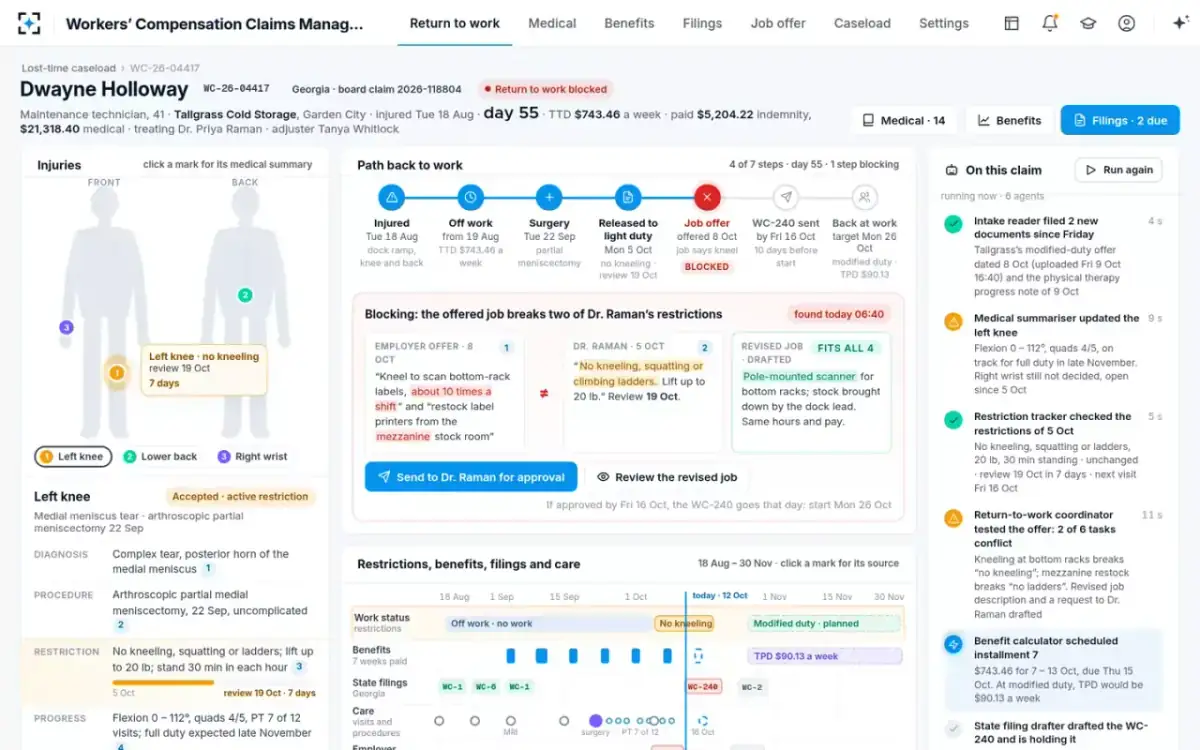
Across a caseload, the same reports appear as dated items: a decision to accept or controvert due on the 21st day, an installment due on Thursday, a suspension notice due on Friday. Our guide to the lost time claim definition explains which event starts each of those clocks.
Every claim's next state deadline, in one list
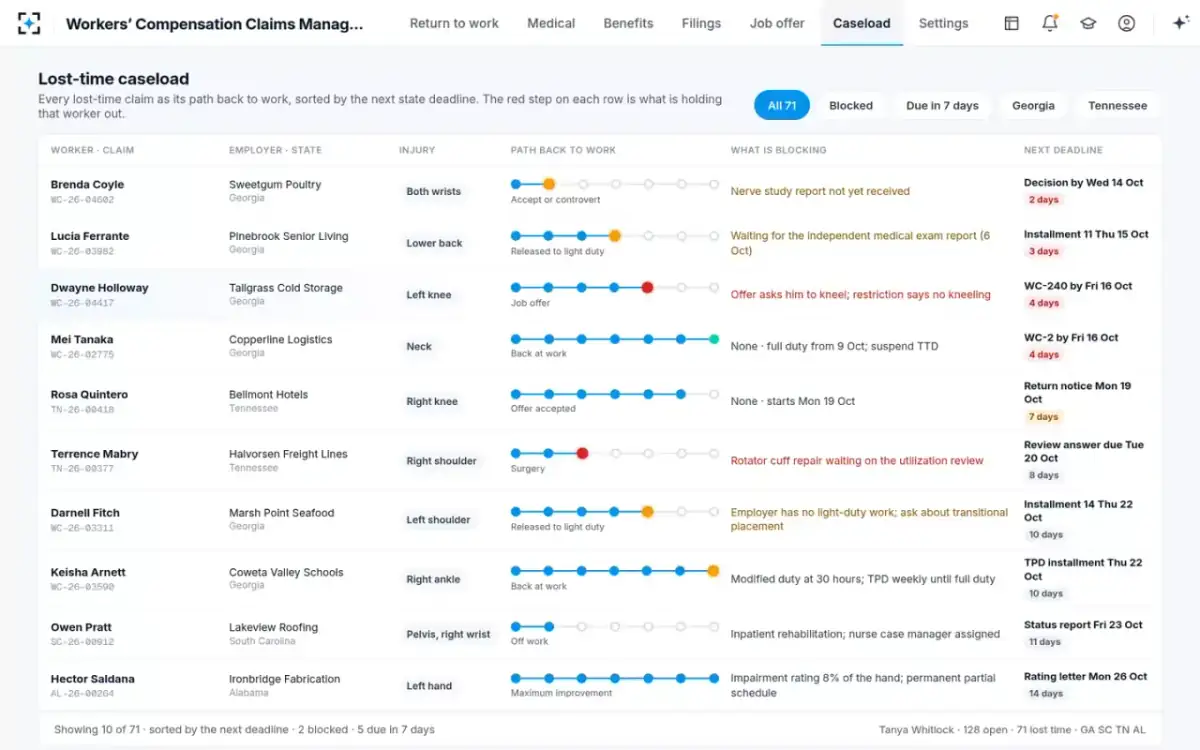
To see the sample claim's forms and reports in context, start from Workers' Compensation Claims Management.
Questions people ask
What is a trading partner in workers comp EDI?
The organisation that sends EDI transactions to the state: an insurer, self-insurer or administrator filing for itself, or a vendor filing for it. Georgia requires a trading partner agreement, a trading partner profile and a list of the insurers and claims offices covered, and certification after testing; Kansas requires the profile at least 30 days before the first submission.
Do employers file EDI reports?
Insured employers generally report the injury to their insurer, which files with the state; Minnesota's notice says its EDI mandate does not change how insured employers report to their insurers. Self-insured employers file as reporters in their own right, which is why Kansas names them alongside insurers and pools.
Is claims EDI the same as medical billing EDI?
No. The IAIABC maintains separate standards for claims, for medical bill data and for proof of coverage. A FROI or SROI reports the claim and its indemnity benefits, not individual medical bills.
How much does the IAIABC standard cost?
The IAIABC sells its EDI standards to non-members and associate members for $295 each, with later publications in the same release at $149 through its subscription service. Minnesota notes that the release is copyrighted by the IAIABC and offers a paper copy for review at its offices.
Can a rejected FROI make a first report late?
Yes, in effect. A rejected transaction writes nothing to the state's database for that claim, so the form is not filed until a corrected transaction is accepted. In Georgia the first report is due within 21 days of the employer's knowledge, and that clock does not pause for a rejection.