To calculate the average weekly wage in workers compensation, take the employee's gross wages for the period the state's statute names, usually the 13 weeks immediately before the injury in Georgia and Florida and the 52 weeks before it in South Carolina, and divide by the number of weeks. The weekly benefit for temporary total disability is then two thirds of that average, never more than the state maximum for the date of injury. On the sample claim in this guide, 13 weeks of gross wages of $14,497.52 give an average weekly wage of $1,115.19 and a weekly benefit of $743.46, under Georgia's $800 maximum. The arithmetic is simple. The errors come from the inputs: the wrong weeks, a missing benefit, a second job left out, last year's maximum, or a first installment dated from the wrong day. Botminds' Workers' Compensation Claims Management is software for lost-time claims whose benefit calculator works from the wage statement under each state's rule, shows every step, and schedules each installment for the adjuster to approve.
The sample claim is fictional: a maintenance technician at a Georgia cold-storage warehouse, injured on 18 August, off work from the next day. Its figures are sample data, worked through the State Board's own rules.
From the wage statement to dated installments on one sample claim
Agent
Read the wage statementThirteen weeks before the injury from the employer’s Form WC-6: 520 regular hours and 26.5 overtime hours, $14,497.52 gross.
Agent
Average weekly wage$14,497.52 ÷ 13 = $1,115.19, with each week’s line kept beside the total.
Agent
Weekly rate$1,115.19 × 2/3 = $743.46, checked against Georgia’s $800 maximum for accidents from 1 July 2023: not reached.
Agent
Schedule against the clockFirst payment due on the 21st day after the employer knew (8 Sep), then weekly; the waiting week once 21 consecutive days are lost.
Never: issues a payment
A person decides
AdjusterReviews the working and approves each installment before it is paid.
How do you calculate average weekly wage for workers comp?
Add the wages for the statutory period and divide by its weeks. Georgia's Board puts its default plainly: "The employer/insurer must use the 13 weeks immediately preceding the injury. The employee must have worked substantially the whole of the 13 weeks to compute the average weekly wage" (Claims Adjuster Reference). Florida's statute uses the same 13 weeks and defines the hard part: "substantially the whole of 13 weeks" means "not less than 75 percent of the total customary hours of employment", counted over "the 13 calendar weeks before the date of the accident, excluding the week during which the accident occurred" (Fla. Stat. § 440.14(1)(a)).
On the sample claim the employee worked 40 regular hours in each of the 13 weeks ending 15 August, with overtime in seven of them. His gross pay ran from $1,036.00 in a week without overtime to $1,269.10 in his longest week. The 13 weeks total $14,497.52, and dividing by 13 gives $1,115.19. That figure, not his hourly rate, sets every benefit that follows.
The sample claim's benefit inputs, from one wage statement
$14,497.52
gross wages in the 13 weeks before the injury
$1,115.19
average weekly wage
$743.46
weekly temporary total disability, two thirds of the average
$800
Georgia’s weekly maximum for accidents from 1 July 2023
What counts as wages in the average?
More than the paycheque. Georgia's Rule 260(a) says the computation "shall include, in addition to salary, hourly pay, or tips, the reasonable value of food, housing, and other benefits furnished by the employer without charge to the employee which constitute a financial benefit to the employee and are capable of pecuniary calculation" (Rule 260(a)). A worker given free housing on a farm or meals on a shift has a higher average weekly wage than the payroll register shows.
Second jobs count when they are similar. "If the employee has similar concurrent employment the wages paid by all similar concurrent employers shall be included" (Rule 260(c)), and the Board's manual gives an example of how broadly "similar" reaches: "a record clerk and a salesclerk are similar employment." Alabama defines the base differently again: its Workers' Compensation Division says the average weekly wage "is based on the employee’s earnings which are subject to federal income taxation and reportable on the Federal W-2 tax form" (Alabama claim handling manual). The same worker's average can therefore differ by state before any arithmetic is done.
What if the employee worked less than 13 weeks?
Use a similar employee's wages, and if that does not work, the full-time weekly wage. Georgia's three methods run in order: the employee's own 13 weeks; then "the wages of a similar employee in the same employment who has worked substantially the whole of 13 weeks", noted as such on Form WC-6; and where those 13-week figures "cannot reasonably and fairly be applied", the employee's full-time weekly wage (Claims Adjuster Reference, citing O.C.G.A. § 34-9-260). Florida's fallback is the same similar-employee rule, plus a third route for seasonal workers: the calendar year or "the 52 weeks immediately preceding the accident", with the employee bearing the burden of showing it is fairer (§ 440.14(1)(b)–(c)).
South Carolina starts from a year rather than a quarter. Its statute defines average weekly wages over "the period of fifty-two weeks immediately preceding the date of the injury", calculated from "the total wages paid for the last four quarters immediately preceding the quarter in which the injury occurred" as reported to the state's Department of Employment and Workforce, "divided by fifty-two or by the actual number of weeks for which wages were paid, whichever is less". A shorter employment divides the earnings by the weeks actually worked, where that is fair to both sides (S.C. Code § 42-1-40).
Thirteen weeks or fifty-two: four Southeastern rules
Four neighbouring states, four answers to the same question. An adjuster who handles claims across them needs each rule applied by the state of the claim, not by habit.
How four states build the average weekly wage and the weekly rate
| State | Wage period | Short or irregular history | Total disability rate | Waiting period |
|---|---|---|---|---|
| Georgia | 13 weeks immediately before the injury, worked substantially the whole | A similar employee’s 13 weeks; then the full-time weekly wage | Two thirds, $50 minimum, $800 maximum for accidents from 1 July 2023 | 7 days; paid once 21 consecutive days are lost |
| Florida | 13 calendar weeks before the accident, excluding its week; at least 75% of customary hours | A similar employee’s 13 weeks; seasonal workers may use 52 weeks | 66 2/3%, up to 104 weeks of temporary total | 7 days; paid from the start if disability lasts more than 21 days |
| South Carolina | 52 weeks: last four quarters of reported wages ÷ 52, or weeks paid if fewer | Earnings ÷ weeks worked; or a comparable worker in the locality | 66 2/3%, $75 minimum, capped at the state average weekly wage | 7 days; paid from the start if disability lasts more than 14 days |
| Alabama | Base: earnings subject to federal income tax and reportable on a W-2; the period is set by statute | Not summarised in the state’s claim handling manual | 66 2/3%, within the minimum and maximum in effect at injury | 3 days; added back once the worker is out 21 days |
How is TTD calculated from average weekly wage?
Two thirds of the average weekly wage, then the state's floor and ceiling. Georgia's Form WC-2 states the rule for injured workers: "2/3 of your average weekly wage with a maximum of $800 per week if your date of accident was on or after July 1,2023", with "a minimum of $50.00 per week, or your actual weekly wage if less than $50.00 per week" (Form WC-2). South Carolina pays "sixty-six and two-thirds percent of his average weekly wages, but not less than seventy-five dollars a week", and no more than the state's average weekly wage for the preceding fiscal year (§ 42-9-10).
Temporary total disability is not paid from the first day. Georgia's Board manual says benefits "are payable from the eighth day of disability" (Claims Adjuster Reference), and Rule 220 pays the first seven days only once there are 21 consecutive days of disability, on the 21st consecutive day (Rule 220). The seven days are calendar days, so a weekend counts. Florida pays the first seven days if the injury "results in more than 21 days of disability" (§ 440.12(1)), South Carolina if it lasts "more than fourteen days" (§ 42-9-200), and Alabama, with a three-day wait, once the worker has been out 21 days. Our guide to the lost time claim definition lays these thresholds out day by day.
What is the maximum weekly benefit, and which year's applies?
The maximum in force on the date of injury, not the date of payment. Georgia's Act has raised the maximum six times since 2007, and each claim keeps the maximum from its accident date. The State Board's summary, revised in July 2025, records "No benefit rate changes in 2024/2025", leaving $800 for accidents on or after 1 July 2023 (SBWC provisions summary). An injury in June 2023 is still capped at $725, however late it is paid.
Georgia's weekly maximum for temporary total disability, by the date the change took effect
A cap that binds changes the paperwork as well as the payment. In Georgia, a Form WC-6 wage statement is required "when the weekly benefit is less than the maximum" (Claims Adjuster Reference), because only then does the average weekly wage decide the rate. On the sample claim the rate is under the cap, so the WC-6 was filed, on 28 August, ten days after the injury.
From weekly rate to dated installments
A correct rate paid on the wrong day is still a violation, so the calculation is not finished until each installment has a due date. In Georgia the Board's adjuster manual puts the first payment on the 21st day after the employer learned of the injury, with weekly installments after that; a cheque mailed from outside the state has to go three days before the due date, and an electronic payment counts from the day the transfer is started. The penalties for missing those dates, state by state, are worked through in the workers comp late payment penalty.
On the sample claim the employer knew on 18 August, so the first installment was due on 8 September. It was paid on 3 September. Installment 7, covering 7 to 13 October, is due on Thursday 15 October and waits for the adjuster's approval. What happens to an installment that misses its date is the subject of workers comp late payment penalties; in Georgia the price is 15% of the benefits paid late.
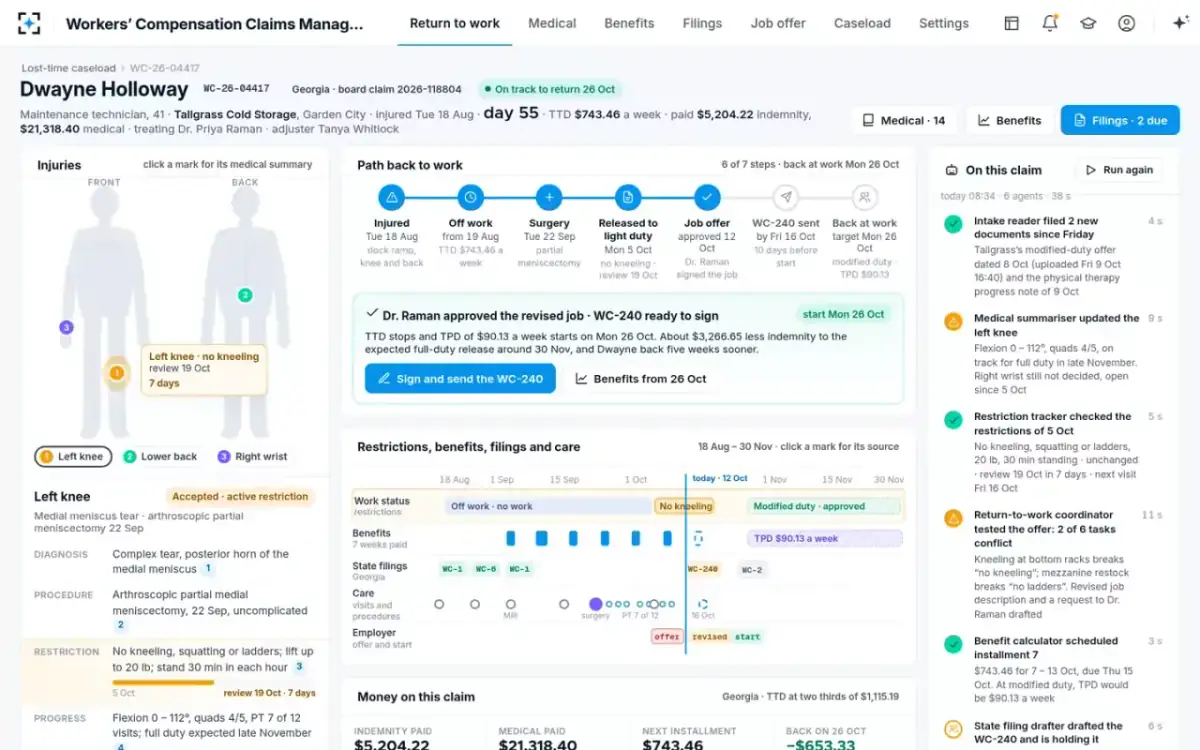
The money on the claim, with the average weekly wage the rate rests on
Temporary partial disability: one wage, two formulas
When the worker returns at lower pay, the same average weekly wage feeds a different formula, and here the states part company sharply. Georgia pays "2/3 of your wage loss (the difference between what you make after your injury and what you made before)", up to $533 a week for accidents from 1 July 2023 (Form WC-2). An employer may compute it week by week, "multiplying two-thirds times the difference between the average weekly wage on the date of injury and the actual weekly wage the employee earned each week thereafter", and files Form WC-262 every 13 weeks (Rule 262). South Carolina and Alabama also use two thirds of the difference.
Florida does not. Its partial benefit is "80 percent of the difference between 80 percent of the employee’s average weekly wage and the salary, wages, and other remuneration the employee is able to earn postinjury", capped at two thirds of the average weekly wage (§ 440.15(4)(a)). Run the sample worker's modified job, $980 a week against a $1,115.19 average, through each formula and the answers diverge.
The same modified job, the same wage, three states' partial benefit
The comparison is not a judgment on any state; it shows that a benefit calculator cannot be one formula with a state field. In Georgia the sample worker's return to a $980 job cuts the weekly benefit from $743.46 to $90.13, a difference of $653.33. The return itself depends on an offer the doctor can approve, covered in the modified duty job description template.
How do you check a workers comp benefit calculation?
Check the inputs before the arithmetic, and the dates after it. Most calculation errors are not multiplication errors; they are the wrong 13 weeks, a missing benefit, a concurrent job left out, a maximum from the wrong year, or a waiting week paid on the wrong day. A reviewer who can see every step can check each in a minute. A reviewer who sees only the weekly rate cannot check anything.
Ten checks on any average weekly wage and benefit calculation
- The wage source
The employer’s wage statement or payroll for the named weeks, not an annual salary divided by 52.
- The period
The weeks your state names, ending where it says: immediately before the injury in Georgia; excluding the injury week in Florida; four quarters in South Carolina.
- Substantially the whole period
If not, the similar-employee or full-time method, and a note saying which was used.
- Everything that counts as wages
Food, housing and other benefits with a money value in Georgia; W-2 earnings in Alabama.
- Similar concurrent employment
A second job of the same general nature, included.
- The rate and its cap
Two thirds, then the minimum and the maximum in force on the date of injury.
- The waiting period
Counted in calendar days from the date of disability, and paid back on the right day once the threshold is crossed.
- The first due date
From the employer’s knowledge, not from the date the claim reached the insurer.
- Every installment against its date
Including the mailing rule for payments sent from out of state.
- Partial disability recomputed on schedule
In Georgia, the WC-262 every 13 weeks, or each week’s actual earnings.
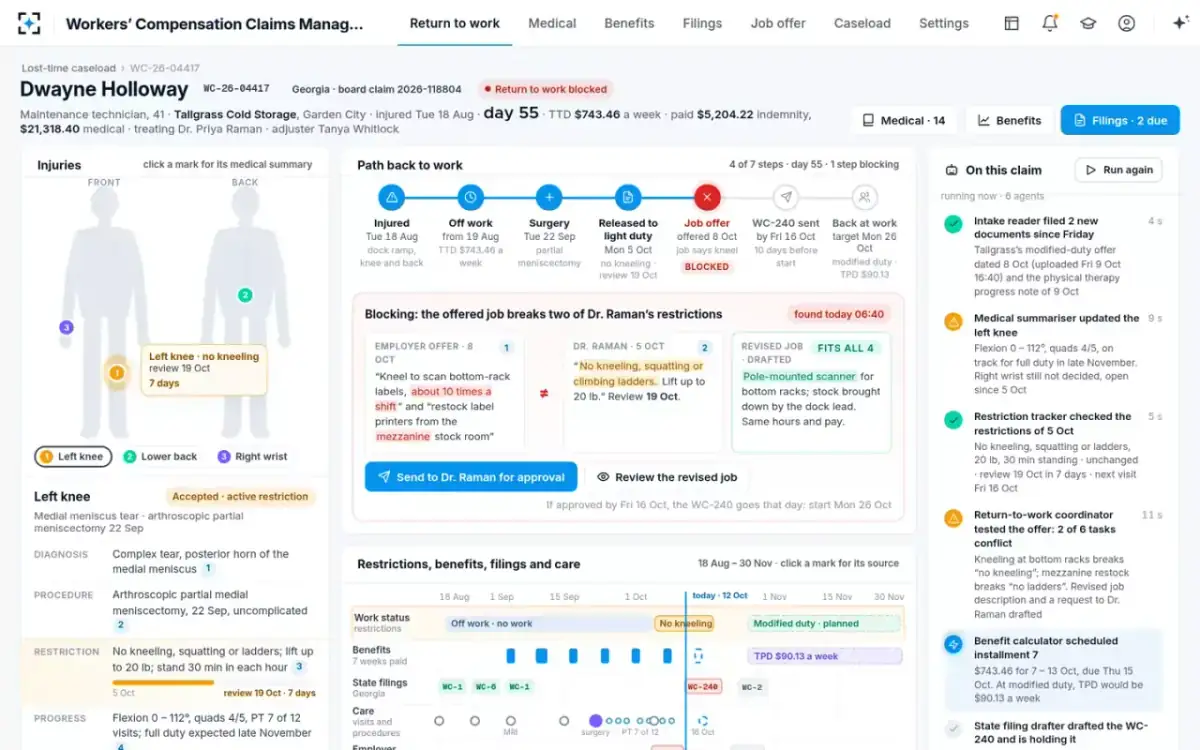
In Botminds' solution the benefit calculator does this from the wage statement and the claim's dates, under the rules of the claim's state, and shows the working step by step: wage table, average, rate, maximum, waiting week and each installment's due date. It never issues a payment. Each installment waits for the adjuster's approval, and the what-if for a modified-duty wage sits beside the schedule. Agents re-read the claim each morning, so a new wage statement or a new job offer changes the working the day it arrives.
The benefit calculator's morning run, beside the claim it updates
To see the full calculation on the sample claim, start from Workers' Compensation Claims Management.
Questions people ask
Is overtime included in the average weekly wage?
Wages actually paid in the statutory period are the base, and Georgia's rule names salary, hourly pay and tips and adds benefits with a money value; the sample claim's wage statement includes 26.5 overtime hours across seven weeks. Whether particular payments count in other states is a question for each statute, so a reviewer should check the state's definition rather than assume.
What is the average weekly wage if I was paid salary?
The same method applies to the salary paid in the period: in Georgia, the 13 weeks immediately before the injury. Georgia's rules assume a five-day week and treat the daily wage as one fifth of the weekly pay unless the facts show otherwise.
Can the average weekly wage be changed after benefits start?
Florida's statute lets a seasonal worker prove that a 52-week or calendar-year base is fairer, and gives the employer 30 days from receiving that proof to adjust the rate, including any back payment due. In Georgia a party can ask the employer in writing for a copy of the Form WC-6, which must be sent within 30 days, and a disputed rate goes to the Board.
Does the average weekly wage include the waiting week?
No. The waiting week is a period of benefits, not wages: in Georgia the first seven days of disability are unpaid unless 21 consecutive days are lost, and are then paid at the same weekly rate. The average weekly wage is fixed from the weeks before the injury.
How long do temporary total benefits last in Georgia?
For accidents on or after 1 July 1992, no more than 400 weeks unless the injury is catastrophic, according to the State Board's Form WC-2. Florida caps temporary total disability at 104 weeks, and South Carolina's total disability benefit runs up to 500 weeks.