An experience mod lookup finds the workers' compensation experience modification that a rating organization has issued for an employer: the mod, the rating effective date it applies from, and its status. Where you can look depends on the plan. In the states that use NCCI's plan, the worksheet goes to the employer, its carrier of record and its producer of record, and to anyone else only with the employer's written authorization; California issues mods under its own plan through its rating bureau; in Washington the state fund's account manager provides the calculation. A lookup proves what the bureau issued. It cannot show whether the claims, payroll and ownership the bureau was given are right, which is the question Botminds' Experience Mod Verification answers before a quote: it rebuilds the mod from the loss runs and audits beside the bureau's figure and explains every difference.
Where the official experience mod lives, and who may see it
NCCI states
36 jurisdictions, plus the interstate ratings of 3 with their own bureaus
Issued by
The applicable rating organization calculates and issues the worksheet.
Who may see it
The employer, which the bureau instructs how to obtain it; the carrier of record; the producer of record; anyone the employer authorizes in writing.
California
Its own plan, Experience Rating Plan—1995
Issued by
The rating bureau the Insurance Commissioner designates as his statistical agent.
Who may see it
Through the bureau and the insurer; the Department of Insurance hears appeals from their decisions on requests for policyholder information and for review.
Other states with their own plans
Delaware, Michigan, New Jersey, New York, Pennsylvania; Minnesota and Wisconsin
Issued by
Each state’s own bureau, under its own plan.
Who may see it
Set by each bureau’s rules, which this guide does not compare.
Monopolistic state funds
North Dakota, Ohio, Washington, Wyoming
Issued by
The state fund that insures the employer.
Who may see it
In Washington, the employer’s L&I account manager provides the calculation.
How do I look up my experience mod?
Ask the party that holds the worksheet. In NCCI states the rating organization does the reaching out: it "notifies and instructs any qualifying risk on how to obtain a copy of its Experience Rating Worksheet" (NCCI Experience Rating Plan Manual, Texas edition). Your insurer and your broker, if they are the carrier and producer of record on your policy, can also see it and tell you the figure, the rating date and the status.
Elsewhere the door is different. California rates experience under its own plan, the California Workers' Compensation Experience Rating Plan—1995, with the rating bureau designated as the Insurance Commissioner's statistical agent collecting the data (CDI notice, March 2026). Washington's state fund answers the question in its own words: "Your account manager can provide you with the calculation of your experience modification factor" (Washington L&I). In any state, the mod on a renewal is the one your insurer applied; if it surprises you, the worksheet is the document to ask for.
Is my experience mod public?
Not in NCCI states. The plan names who gets access to the worksheet: "the carrier of record", "the producer of record", and "additional parties if the risk authorizes that access in writing". The employer controls the list. A general contractor, a prospective insurer or a lender sees your mod because you or your broker give it to them, not because they can look it up.
That has two consequences. A prospective insurer quoting your account will ask your broker for the worksheet, and should; quoting on a figure from a letter alone is quoting on someone's restatement. And a mod you hand to a general contractor is the bureau's number as issued, errors included. The sources this guide relies on describe no public search for mods in the other plans either; each bureau sets its own terms.
What does an experience mod lookup show?
The issued figure and the facts that tell you what kind of figure it is. A lookup worth relying on gives the mod, the rating effective date, the entities it covers and the status, because the same number means different things in different states of completion.
Four kinds of mod a lookup can return, and whether each can still change
| What the lookup shows | What it means | Can it change? |
|---|---|---|
| A final mod | Calculated with rating values the regulator has approved | Yes, if corrected data arrives within the revision window: the current and two preceding mods |
| A preliminary mod | Uses existing rating values expected to change with a pending rate filing | Yes: recalculated when the filing is approved, then final |
| A contingent mod | Missing some data the insurer is expected to submit, but meets the minimum data requirement | Yes: replaced by a mod with the same rating date when the data arrives |
| A unity factor, 1.00 | No rating: not eligible, too little data, a new business, or data lost in an ownership change; or a mod that calculates to exactly 1.00 | Yes, once the employer qualifies or the data arrives |
The unity row is the one lookups most often misread. The plan applies 1.00 for reasons that include "the risk not qualifying for experience rating", "the risk being a new business with no data available", and "the insurance provider being unable to provide the data as a result of changes in ownership". A 1.00 can be a clean record, or the absence of one.
How do I look up a contractor's EMR?
Through the contractor. You cannot look up another employer's worksheet in an NCCI state without its written authorization, so the usual route is a letter from the contractor's carrier or producer of record restating the mod. Ask for the rating effective date, the status, the entities covered and the two preceding ratings with it; the EMR verification letter guide lists what a complete letter states.
Read what you receive for what it is. If you are an owner in Virginia contracting for construction services, you may ask for the mod, but you may not make a specified figure a condition of the bid or the contract: Virginia's Code prohibits any construction contract or offer to contract that requires a bidder to have a specified mod (Code of Virginia § 11-9.8). Why the number is a weak screen on its own is set out in EMR for contractors.
Five checks to run on any mod you look up
A lookup can be read critically in five minutes, before any loss run is opened. Each check below uses only the worksheet or letter and the submission in front of you.
Does the rated entity match the insured? A mod can cover several companies under common majority ownership, or omit one that should be in it. Compare the names on the worksheet with the named insureds and any recent acquisitions in the submission. Does the rating effective date line up with the policy? NCCI's plan lists the reasons they may differ, among them "a policy that is longer than one year and 16 days", "cancellations", "changes in ownership or combinability status", "gaps in coverage", "interstate operations" and "late receipt of current policy information by the rating organization". A mismatch is a question, not necessarily an error.
Are the right policy years in it? The plan uses policies that started 21 to 57 months before the rating date; check that the three years shown match the prior carriers named on the loss runs. What is the status? Preliminary and contingent mods will change. How did it move? Set this year's three policy years beside last year's: a mod that rose with no new claims usually means a good year dropped out or an old claim developed, and either can be confirmed from the worksheet alone.
Anything that fails one of these checks is a reason to read the sources. Everything that passes is still only the bureau's figure, which is the subject of the next section.
What a lookup cannot prove
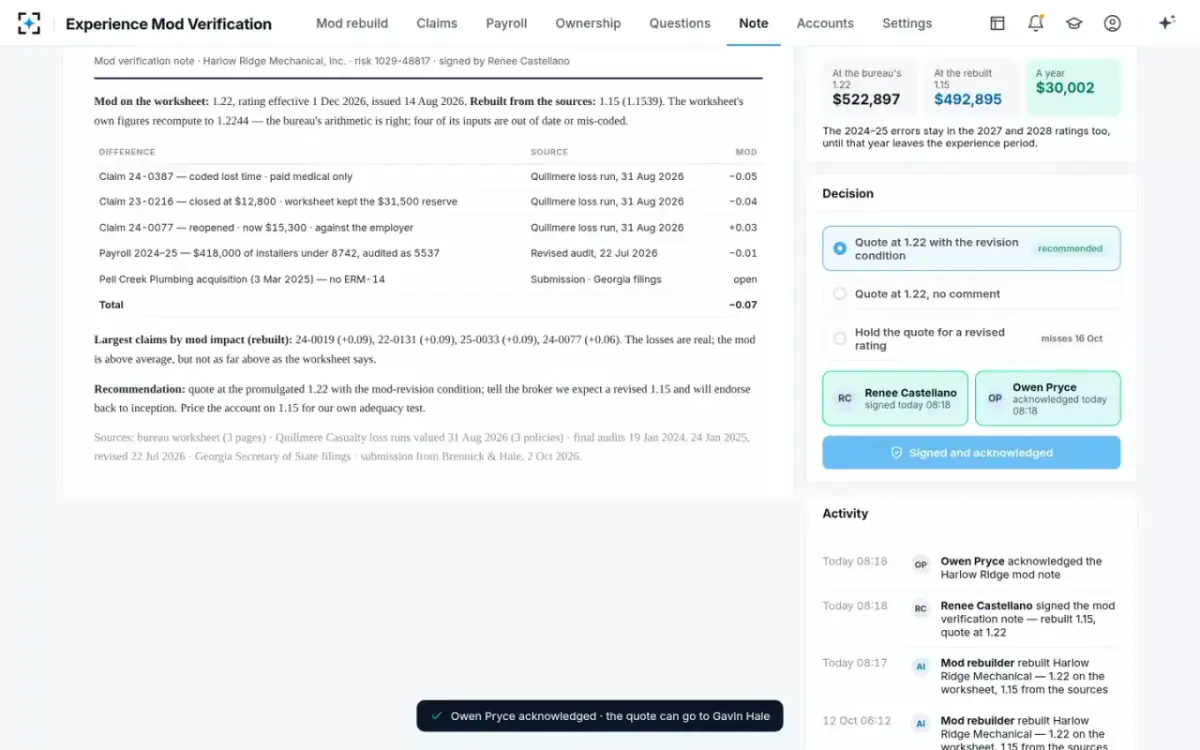
A lookup proves the bureau's figure; it says nothing about the bureau's inputs. Those come from insurers' unit statistical reports, and the bureau calculates from what it is sent. On a fictional sample account used across this series, a Georgia HVAC and plumbing contractor, the lookup would return 1.22, issued 14 August 2026 for a 1 December rating. Every word of that is true. Rebuilt from the prior carrier's loss runs and audits, the mod is 1.15.
What a lookup tells you, and what only a verification can
Experience mod lookup: What did the bureau issue?
Experience mod verification: Is what the bureau issued built on the right inputs?
Experience mod lookup: The worksheet, or someone’s restatement of it
Experience mod verification: The worksheet, the prior carriers’ loss runs, the final and revised audits, the ownership filings
Experience mod lookup: Invisible
Experience mod verification: Found: $0 indemnity and no days lost on the loss run
Experience mod lookup: Invisible
Experience mod verification: Found against the revised audit
Experience mod lookup: Invisible
Experience mod verification: Found in the filings; the estimate kept out of the figure
Experience mod lookup: 1.22
Experience mod verification: 1.15, four differences, one open question
Experience mod lookup: Yes: it is the bureau’s mod
Experience mod verification: No: labelled rebuilt; the quote uses the bureau’s mod
Neither replaces the other. The lookup gives the number every quote must use; the verification gives the reasons to ask for it to change. A buyer who wants only the first needs a broker and a phone; one who wants the second needs the documents behind the worksheet and the time, or the tooling, to read them.
How often are experience mods updated?
Once a year for each rating, and in between when data changes. A new mod applies from each rating effective date, generally for 12 months and, under NCCI's plan, for "no less than three months" and "no more than 15 months". Between ratings it can be recalculated: a correction report makes the bureau rework the current mod and up to two earlier ones, a preliminary mod becomes final when the rate filing is approved, and a contingent mod is replaced when the missing data arrives.
The plans' rules change too. NCCI is moving its states to standalone manuals: Texas's took effect for policies from 1 July 2025, and the Commissioner's order notes that "NCCI is creating standalone manuals for every NCCI state" (Texas Commissioner's Order 2024-9013). Washington refiles its values each January and caps any one year's change in a mod at 25%, up or down (WAC 296-17-865). A lookup is a snapshot of one date; a figure from last quarter can already be superseded.
Some changes reach a mod only at its next rating. In a precedential California decision, a claim that closed for $27,508 after its report's valuation date still counted at the reported $43,031 in that year's mod; the closed value arrived with the next (B.D.D. Pest Control, California Department of Insurance). Looking the mod up again will not show a change the rules have not yet let in.
When a lookup is enough, and when to verify
A lookup is enough when the number is only being repeated: a certificate, a renewal summary, a prequalification form where the mod is one input among many. Verify when the number will be priced, disputed or relied on for a decision, and especially when one of the signals below is present.
Signals that a mod needs verifying, not just looking up
- The mod moved more than your tolerance since last year
Find out whether a year dropped out, a claim developed, or an input changed.
- An ownership change in the last four years
Acquisitions, mergers and new entities move experience; check that the bureau has the ownership form.
- A claim closed, reopened or recovered since its valuation date
Know whether this rating or the next will reflect it.
- A revised audit after a classification dispute
The unit report may still carry the first audit’s classes.
- A preliminary or contingent status
The figure will be recalculated; quote with that in mind.
- Payroll in several states
Interstate mods combine some states and not others; payroll in the wrong state moves the mod.
- A unity factor on an employer that should be rated
Missing data or a lost history, not necessarily a clean record.
- A quote where a hundredth of a point is real money
On the sample account, each 0.01 was worth about $4,286 a year.
What Experience Mod Verification adds to a lookup
It starts from the worksheet a lookup returns and reads the documents a lookup cannot. Six agents read the bureau's worksheet, the prior carriers' loss runs, the final and revised audits and the ownership filings; rebuild the mod line by line beside the bureau's, with the bureau's own parameters; rank every claim by its share of the mod; and draft the questions to the broker, the prior carrier and the bureau. The underwriter decides and signs. On the sample account that took 41 seconds and produced a signed note: quote at the bureau's 1.22 with a revision condition, tell the broker to expect 1.15, and, because the difference was more than $25,000 a year, an acknowledgement from the underwriting manager before the quote went out.
It is not a lookup service. It does not search bureaus for mods, publish them, or show anyone a worksheet they are not entitled to see; it works on the documents already in the underwriting file. It never changes the bureau's figure and never presents its own as official. For a buyer, the honest comparison is with the hours a careful review takes by hand, about two per mod by Botminds' estimate, and with the accounts that today are never reviewed at all; the experience mod review guide sets out what such a review should check and how to test a tool that does it.
The signed note: the bureau's mod, the rebuilt one, each difference with its source, and who signed
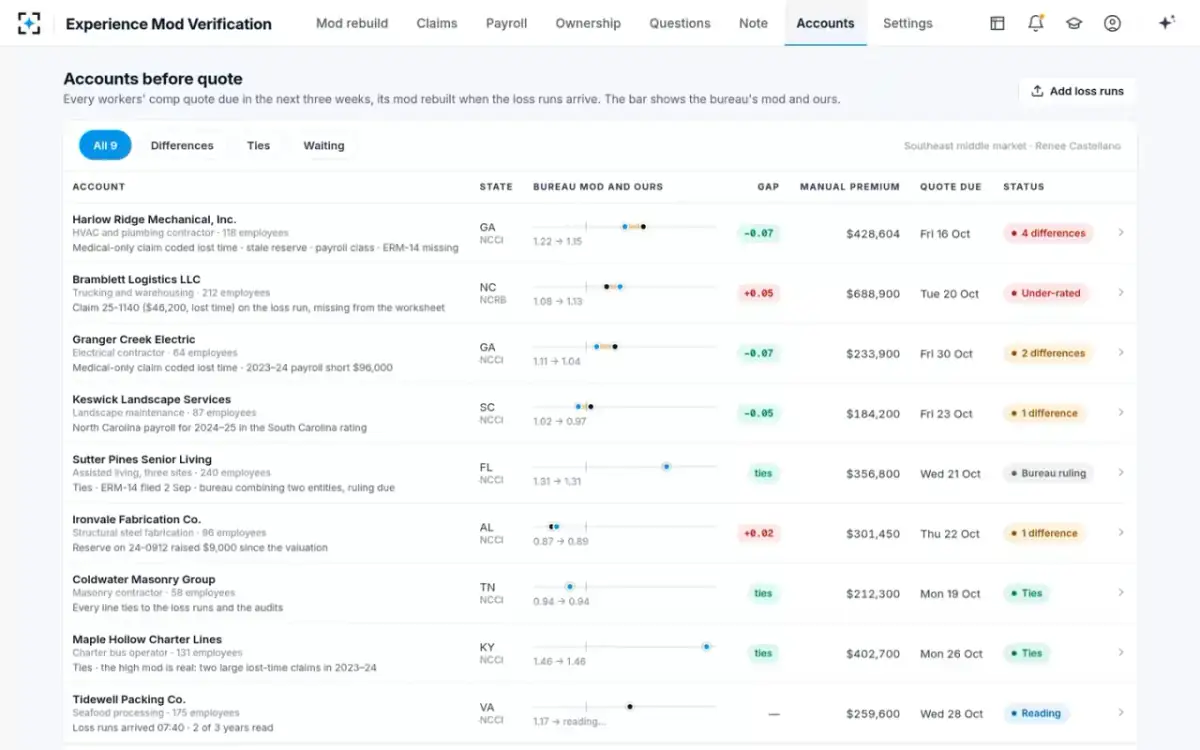
Every quote due in three weeks, each mod already rebuilt beside the bureau's
Questions people ask
Who publishes experience mods?
The rating organization for the employer's state: in NCCI states the applicable rating organization, NCCI or a participating state bureau; in California the rating bureau the Insurance Commissioner designates; in the four monopolistic states the state fund. It issues the mod on a worksheet to the employer and the parties entitled to see it rather than publishing it to the world.
Can I see the worksheet online?
The rating organization tells each qualifying employer how to obtain its worksheet, and the method is the bureau's to set. Your carrier and producer of record have access too, so the quickest route is often your broker. Anyone else needs your written authorization.
Where can I find my EMR rating?
On the experience rating worksheet, from the rating organization, your insurer or your broker; in Washington, from your L&I account manager. Your insurer applies it to the premium on your policy, so a renewal that moves sharply is a reason to ask for the worksheet itself.
How do I know if a mod I looked up is current?
Check its rating effective date against the policy period and its status. A preliminary or contingent mod will be recalculated, and any mod can be revised when corrected data arrives; under NCCI's plan, revisions reach the current and two preceding mods. Ask for the worksheet's issue date along with the figure.
Does a lookup tell me why my mod went up?
No. It gives the figure, not the cause. The cause is on the worksheet, in which policy year dropped out, which claims developed and how payroll moved, and sometimes in an input error only the loss runs and audits reveal.