An experience mod review checks a workers' compensation experience modification against the documents it was built from: the rating bureau's worksheet against the prior carriers' loss runs, the final and revised payroll audits, and the ownership record, with every difference explained before the account is quoted. The hard part is not finding a difference. It is that the reviewer cannot correct any of them, because every number on the worksheet belongs to someone else: the insurer that reported the claims, the auditor who classed the payroll, the bureau that decides ownership. Botminds' Experience Mod Verification is built around that limit. Its agents rebuild the mod line by line and then draft, for each difference, the question to the one party who can correct it; an underwriter edits and sends.
The examples below come from a fictional sample account as it runs through the solution: Harlow Ridge Mechanical, a Georgia HVAC and plumbing contractor being quoted on a bureau mod of 1.22, which rebuilds to 1.15 from its sources.
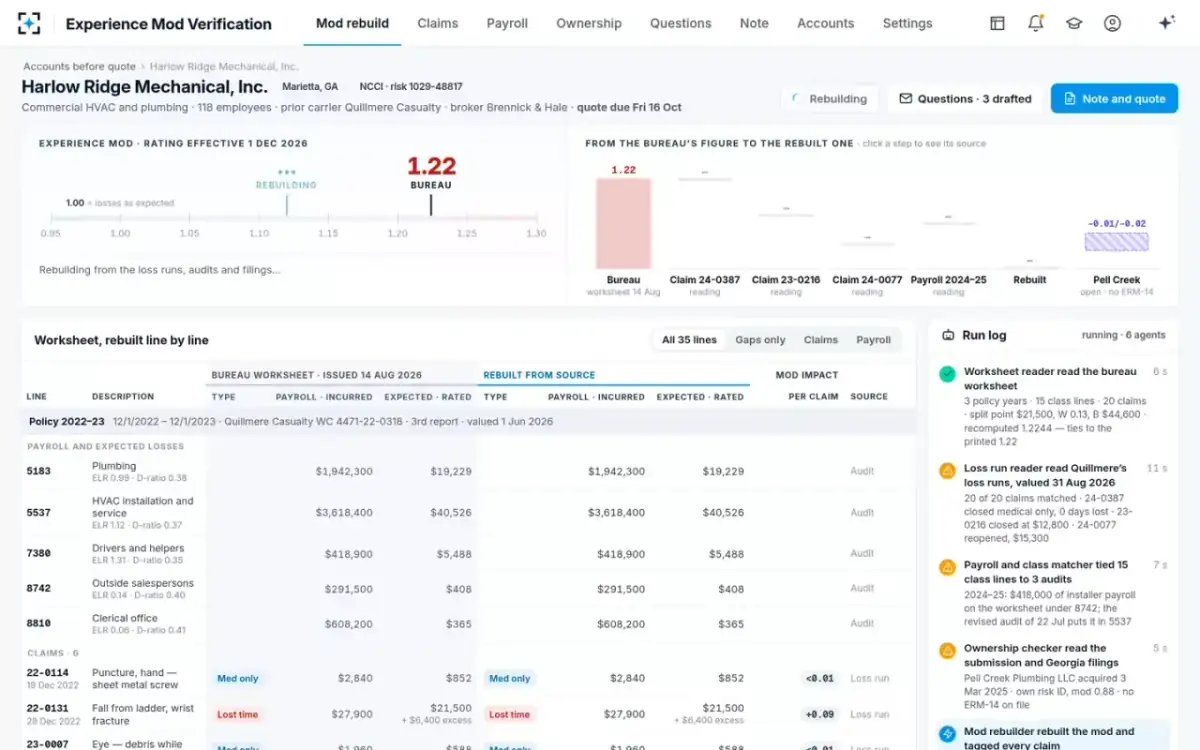
From a difference to a sent question: six agents, two people, and what each may never do
Agent
Worksheet readerReads the bureau’s worksheet and recomputes the printed mod from its own lines. On the sample, 1.2244: the bureau’s arithmetic is right.
Never: Alters a bureau figure
Agent
Loss run readerMatches every claim on the worksheet to the prior carrier’s loss runs: 20 of 20, with three that differ.
Never: Infers a claim it cannot cite
Agent
Payroll and class matcherTies worksheet payroll by class to the final and revised audits; finds $418,000 of installers left in a sales class.
Never: Re-classes payroll itself
Agent
Ownership checkerFinds an acquisition in the last four years with no ownership form on file, and applies the plan’s tests.
Never: Decides whether experience combines
Agent
Mod rebuilderRecomputes the mod from the sources with the worksheet’s own parameters and builds the bridge from 1.22 to 1.15.
Never: Presents the rebuilt mod as official
Agent
Question and note drafterDrafts one question per party, each citing the worksheet line and loss-run or audit page it rests on.
Never: Sends anything
A person decides
UnderwriterEdits and sends the questions, quotes on the bureau’s mod with the revision condition, and signs the note.
A person decides
Underwriting managerAcknowledges the signed note when the mod question moves premium by more than $25,000 a year.
What is an experience mod review?
It is a comparison, not a recalculation for its own sake. The review starts from the bureau's worksheet and asks two questions of every line: does the arithmetic follow from the line, and does the line match the source document it should have come from? The first question almost always gets a yes. On the sample account the worksheet recomputes exactly; the four differences were all in the inputs.
A review ends in one of three places. The rebuilt mod ties to the bureau's, and the account is quoted on it with more confidence than before. It differs, and each difference becomes a question with a value attached. Or it cannot be finished, because a loss run is stale or missing, and the first question is a request for the document. On the sample's quote list of nine accounts, five had a difference, two tied, one was waiting on a bureau ruling and one was still being read.
Who does it varies. Carrier underwriters review mods before quoting, brokers review them for clients, and employers review their own when a renewal jumps. The method is the same, and so is the constraint: none of them can change the worksheet.
Who can correct an experience mod?
Only the rating organization issues and revises a mod, and it acts on what others report. NCCI's plan, as approved in Texas for policies from 1 July 2025, says it plainly: "The appropriate rating organization calculates, issues, and if necessary, revises the experience rating modification", while insurers "apply the calculated experience rating modification in accordance with this Plan, other applicable rules, statutes, and regulations" (NCCI Experience Rating Plan Manual, Texas edition). So a review's real output is a set of requests, each addressed to the party that owns the input.
Who can correct each kind of mod error, and how the change reaches the mod
| Difference found | Who holds the input | How it is corrected | When the change applies |
|---|---|---|---|
| Claim coded lost time that paid no indemnity | The insurer that reported it | A correction report to its 1st, 2nd or 3rd unit report | The bureau recalculates the current and up to two preceding mods; a decrease runs back to the start of the policy |
| Reserve far above what the claim closed for | The reporting insurer | Its next report level, valued 12 months later | This rating only if the next report is filed before the mod is calculated; otherwise the next one. In California a claim that closes after its valuation date keeps its reported value until then |
| Claim reopened or developed upward | The reporting insurer | The next report, at the higher value | An increase follows the 60-day rule: back to inception if within 60 days of the policy start, otherwise from the endorsement |
| Payroll in the wrong class | The premium auditor, then the insurer | A revised audit and a payroll correction report, within three years of the policy’s expiry | The bureau may recalculate; not where the class changed because operations changed |
| Subrogation recovery not reflected | The insurer that recovered | A correction report with the revised loss value | Current and two preceding mods, and further back on request to the fifth most recent rating date |
| Ownership change not reported | The employer | The ERM-14 form or a signed letter, within 90 days of the change | The bureau decides; a revision runs back to the date of the change |
| The bureau applied a rule wrongly | The rating organization | The applicable dispute or appeal process | As the bureau or the appeal decides |
The second row is the one reviews most often get wrong. A reserve that looks stale is not always an error. In a precedential California decision, a claim was reported open at $43,031 and closed in May 1998 at $27,508, before the October 1998 mod took effect; the bureau still used $43,031, and the closed value entered the 1999 mod instead. The decision adopted the bureau's position that neither plan permits a corrected unit filing when a claim closes between the valuation date and the mod's effective date (B.D.D. Pest Control, California Department of Insurance). A good review labels that kind of difference as timing, not as a mistake by the insurer.
What should you check on an experience mod?
Check the inputs against their sources, in the order that finds the largest errors first. A review that recomputes the formula and stops there will almost always tie, and will have tested the one part of the worksheet least likely to be wrong.
Ten checks for an experience mod review, largest errors first
- Every claim on the prior carriers’ loss runs is on the worksheet, and every worksheet claim is on a loss run
A missing lost-time claim makes the mod too low; a phantom one makes it too high. Report both directions.
- Medical-only and lost-time coding matches what was paid
A claim with no indemnity paid and no days lost counts at 30% of its value as medical only in NCCI states.
- Each claim’s value against the latest loss run, with both valuation dates
Separate a claim that developed since the valuation date (timing) from one reported wrong (error).
- Reopened claims and subrogation recoveries
Both change the loss value and need a report from the insurer.
- Payroll by class and year against the final and any revised audit
A class change after an audit dispute often reaches the audit before the unit report.
- Payroll and claims in the right state
An interstate mod applies to all of a risk’s operations; payroll filed under the wrong state skews the expected losses.
- Ownership changes in the last four years, and an ownership form for each
Experience follows ownership; an unreported acquisition can carry another company’s losses in or out.
- Excluded claims
COVID-19 claims reported under Catastrophe Number 12 (accident dates 1 Dec 2019 to 30 Jun 2023), noncompensable and fraudulent claims are excluded.
- The mod’s status and rating effective date
A preliminary or contingent mod will be recalculated; review the final one before relying on a difference.
- The arithmetic, last
Recompute the printed mod from the worksheet’s own lines. If it ties, the bureau used what it was given.
On the sample account those checks found four differences worth −0.07 in total: the miscoded claim (−0.05), a reserve the worksheet carried at its first-report value of $31,500 after the claim had closed at $12,800 (−0.04), a reopened knee claim now at $15,300 against the worksheet's $8,200 (+0.03, against the employer, and shown just the same), and installer payroll in a sales class (−0.01). A fifth item, the unreported acquisition, was left open: its estimated effect is shown but kept out of the rebuilt figure.
One drafted question, line by line
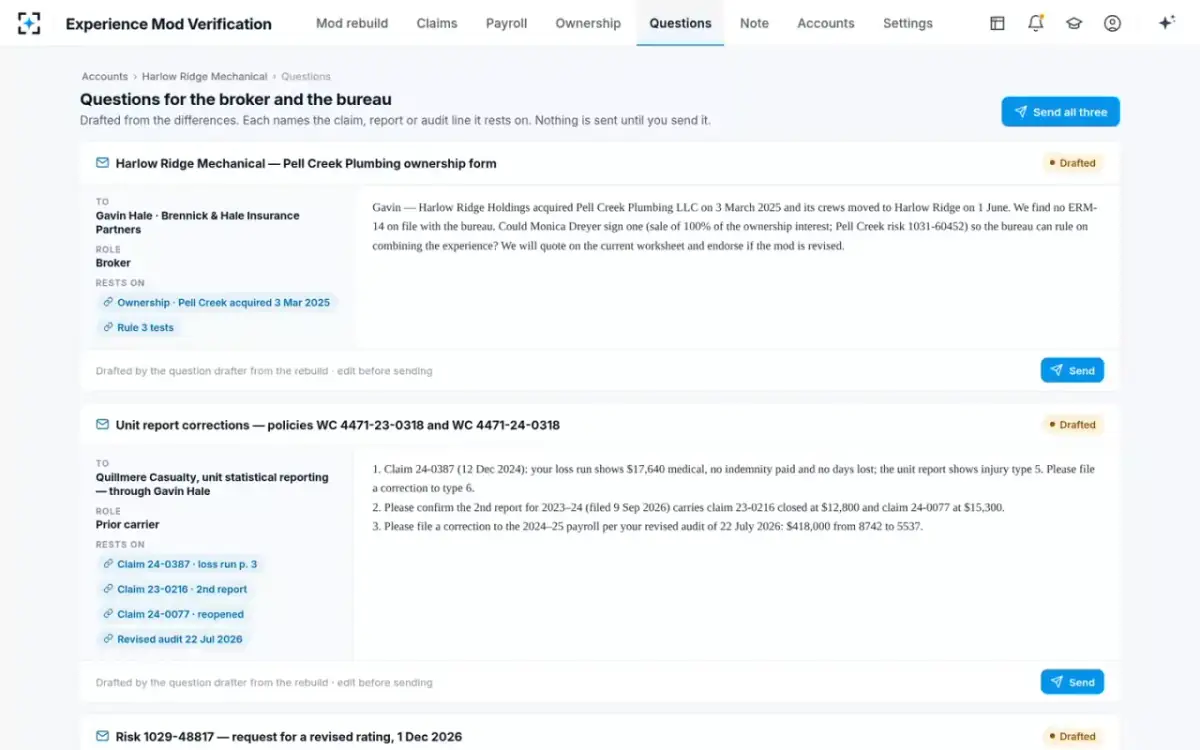
A question is useful when the person who receives it can act on it without calling back. That means it names the claim, the page it rests on, what is asked and what it is worth, and it goes to the party that can file the correction. The drafter writes one per party; on the sample account that made three: one to the broker for the missing ownership form, one to the prior carrier's statistical reporting through the broker with three numbered corrections, and one to the bureau asking for a revised rating once the corrections are filed.
Anatomy of one correction request the agents drafted
- Asks
- Correct the injury type on claim 24-0387 from lost time to medical only.
- To
- The prior carrier’s unit statistical reporting, sent through the broker, because only the reporting insurer can file a correction to its unit report.
- Rests on
- The prior carrier’s loss run valued 31 Aug 2026, page 3: $17,640 medical paid, $0 indemnity paid, 0 days lost, closed 19 Mar 2025. The worksheet’s 2024–25 first report, page 2, carries the claim as lost time.
- Worth
- −0.05 on the rebuilt mod: as lost time the claim counts at $17,640; as medical only it counts at 30%, $5,292.
- Does not say
- That the bureau erred (it used the data it was sent), the worker’s name, or a revised mod as fact.
- Sent by
- The underwriter of record, after editing. The agent that drafted it cannot send it.
Experience Mod Verification: the drafted questions, each with the lines it rests on
Can an underwriter change an experience mod?
No, and a review that pretends otherwise creates two problems. The first is a rating problem: the insurer must apply the mod the bureau calculated. The plan also forbids getting around it by any route, treating as evasion "any action that results in the miscalculation or misapplication of an experience rating modification determined under this Plan", "regardless of the intent". A carrier that quotes on its own rebuilt figure is not applying the promulgated mod.
The second is a judgement problem. What an underwriter does control is the decision about the quote: quote on the bureau's mod with a condition that it will be endorsed if the bureau revises it, quote on the bureau's mod without comment, or hold the quote for a revised rating. On the sample account the recommended choice was the first, because holding would miss the broker's 16 October deadline, and because a decrease from a revision applies back to the policy's inception under the plan. Schedule rating is a separate lever with its own rules, and the actuaries' warning applies: "The key is for the underwriter to avoid double-counting the effect of a risk characteristic in both the experience modification and schedule rating" (Werner and Modlin, Basic Ratemaking, Casualty Actuarial Society).
The cost of not reviewing is concrete on the sample: standard premium is $522,897 at the bureau's 1.22 and $492,895 at the rebuilt 1.15, $30,002 a year on one quote. How an error like that carries into later ratings is worked through in what one wrong claim costs over three years.
How long does a mod correction take, and from when does it apply?
The correction itself is as fast as the reporting insurer files it; the bureau recalculates automatically on receipt. What a review should state is the date the change will apply from, because that decides how much premium moves. The plan sets four rules worth putting in the file note.
Decreases go back to the start. A decrease for any reason other than a classification correction applies "retroactively to the inception of the policy", or from the rating date if that is later. Increases depend on timing. Under the 60-day rule, an increase within 60 days of the policy's start applies from inception; after that, "pro rata from the date the insurance provider endorses the policy". Ownership changes go back to the change. A revision for ownership or combinability applies "retroactively to the date of the change". Only three ratings can move. Issuance and revision are limited "to the current and two preceding experience rating modifications", except for special fund reimbursements and subrogation recoveries, which can reach back to the fifth most recent rating date.
When a correction is refused, the route depends on the state. In Texas, NCCI's dispute process is voluntary; the Commissioner's order adopting the Texas version says it "is not an administrative remedy that must be satisfied before the parties may take their dispute to court" (Texas Commissioner's Order 2020-6301). In California an employer first files a Complaint and Request for Action with the insurer or the rating bureau, and may appeal to the Department of Insurance within 30 days of a written decision being served, or, if no decision is served, within 120 days of serving the complaint (California Department of Insurance, form CDI-002).
One state attaches consequences to the input itself. In Florida, if the state finds an employer "materially misrepresented or concealed information pertinent to the computation and application of an experience rating modification factor", the carrier must start a physical onsite audit within 30 days (Florida Statutes § 440.381). A review that finds payroll moved between classes is worth documenting carefully for that reason alone.
Is a rebuilt mod official?
No. A rebuilt mod is an underwriter's working figure, and its value lies in the differences it explains, not in the number. Experience Mod Verification labels it "rebuilt — not the promulgated mod" on every screen and in the note, quotes always use the bureau's figure, and estimates that depend on a bureau decision stay out of it. On the sample account, the estimate if the bureau combines the acquired plumbing company's experience is 1.13 to 1.14; the rebuilt figure stays at 1.15 until the bureau rules.
The rebuild still has to be right, which is a separate question from being official. How to test a mod checker by replaying accounts whose mods you already know is set out in the experience mod calculation guide.
Choosing experience mod review software: eight tests
Most of what distinguishes one tool from another is what it does with a difference, not how it computes the formula. Ask a vendor, or your own team if you build it, to run these tests on three accounts whose mods you have already reviewed by hand.
Eight tests for experience mod review software
- Does it recompute the printed mod from the worksheet’s own lines first?
If it cannot tie the bureau’s arithmetic, every difference it reports is suspect.
- Does every rebuilt value cite a page and line?
A difference without its loss-run page or audit page is an opinion.
- Does it report differences that raise the mod as well as those that lower it?
A tool that only finds credits is a sales tool, and the bureau will notice.
- Does it carry each plan’s own rules?
The 70% medical-only reduction in NCCI states, Washington’s fixed deduction and split, California’s own plan, each state’s eligibility and rating values.
- Does it tell timing from error?
A claim that closed after its valuation date is not the insurer’s mistake, and a correction request will be refused.
- Does it keep estimates out of the rebuilt figure?
An ownership combination the bureau has not ruled on is a range, not a number.
- Does it draft questions to the party that can act, and send nothing itself?
Corrections go to the reporting insurer, ownership forms to the employer, rulings to the bureau.
- Is every run, send and signature on the account’s history?
An examiner or a manager should be able to see who sent what, when, on which figure.
Where Experience Mod Verification stops
The solution covers the review and the paperwork around it, and nothing on the bureau's side. It does not file correction reports, which only the reporting insurer can do. It does not decide whether experience combines after an ownership change, which only the bureau can do, on a signed form. It never prices the account and never changes a bureau figure. It reads worksheets in each bureau's own format, NCCI's and the independent bureaus' set in its settings, and it needs the loss runs: when they are older than a set freshness, 90 days in the sample settings, its first question is a request for new ones.
What it changes is the time a review takes and whether it happens at all. Botminds estimates about two hours to rebuild and explain one mod by hand and about six minutes with the solution, and the solution's design target is every mod checked before quote. Neither is a measured customer result. For a broker or employer who wants to estimate a mod rather than verify one, calculators and rebuilt mods are compared in a separate guide.
The agents at work: each step with what it read and what it found
Questions people ask
How do you review an experience mod?
Start from the bureau's worksheet and match every line to its source: claims to the prior carriers' loss runs, payroll to the final and revised audits, entities to the ownership record. Recompute the printed mod from the worksheet's own lines last; it usually ties, because errors sit in the inputs. Write each difference down with its page, its value on the mod and the party who can correct it.
How do you ask the bureau to correct a mod?
Usually you don't ask the bureau first. Claim and payroll corrections come from the insurer that reported the data, through correction reports the bureau then uses to recalculate; ownership changes go to the bureau on the employer's ownership form. Ask the bureau directly for a revised rating once the corrections are filed, or through the state's dispute or appeal process if it applied a rule wrongly.
What happens when a claim is coded wrong?
The mod overstates or understates that claim until the reporting insurer files a correction. A medical-only claim coded as lost time is the costly case in NCCI states, because medical-only losses count at 30%: on the sample account, a $17,640 claim moved the mod by 0.05. Once corrected, a decrease applies back to the start of the policy.
Can a mod review raise the mod?
Yes, and a sound review reports it. On the sample account a reopened knee claim added 0.03 against the employer, and on another fictional account a lost-time claim missing from the worksheet meant the bureau's 1.08 rebuilt to 1.13. Underwriters need those as much as the credits.
Who pays for a mistake in the mod?
The employer does, in premium, until it is corrected; the carrier does, in adequacy, when an error runs the other way. When a revised mod lowers premium, the insurer on each affected policy applies the change under the plan's rules, back to the policy's inception for a decrease, so any refund comes from whichever insurer wrote that policy.