The difference between a hard market and a soft market in insurance is the direction of price and the supply of capacity: in a hard market premiums rise, terms tighten and carriers write less; in a soft market premiums fall or flatten, terms loosen and carriers compete for accounts. In 2026 commercial insurance is not in one phase but two. The NAIC's review of 2025 results says property lines, "particularly commercial property", are entering soft-market territory, while casualty lines "remain firm due to social inflation and nuclear verdicts". The Federal Insurance Office's figures show the same split: 2025 premiums grew 9.3% in commercial auto liability and 8.0% in other liability, against 4.7% for commercial lines overall. For renewal underwriters the split matters because a softening market is when renewals re-quoted on the expiring file quietly lose rate adequacy: the book rate change stops covering loss trend, and the exposure the account added during the year goes unpriced. Botminds' Commercial Renewal Review Automation re-reads every commercial account 90 days before it renews, so the price can rest on this year's exposure and losses whatever the market is doing.
Market figures on this page come from the NAIC's 2025 full-year analysis, the Federal Insurance Office's 2026 annual report and research published by the Casualty Actuarial Society. Account examples are fictional sample data.
2025 direct premium growth by commercial line: casualty still rising fastest
What is a hard market in insurance?
A hard market is a period when insurers raise prices, tighten terms and limit how much they write, usually after losses or capital shocks have eroded their surplus. Buyers see higher renewal premiums, higher retentions, lower limits and more exclusions, and some accounts struggle to find cover at all.
Actuarial research describes the mechanism as a loop between price and capital. In a paper published by the Casualty Actuarial Society, Wang, Major, Pan and Leong set out the "capacity constraint" view: "Low surplus constrains writings; prices rise because supply cannot meet demand", then "Adequate pricing brings profits and increased surplus" (Variance, Casualty Actuarial Society). Hard markets end because they work: prices rise, profits rebuild capital, and capital looks for business.
What is a soft market in insurance?
A soft market is the other half of the loop: capital is plentiful, carriers compete for accounts, and prices fall or rise more slowly than losses. Buyers see flat or lower renewals, broader terms and more markets willing to quote. In the same model: "Flush with surplus, competitive pressure leads to decreasing prices", until "Inadequate pricing leads to net losses and decreased surplus" (Variance).
Hard market vs soft market, as a renewal underwriter sees them
Hard market: Renewal premiums rise; rate is the largest step in the bridge
Soft market: Renewal premiums flat or falling; exposure and experience steps matter more than rate
Hard market: Carriers cut limits, raise retentions, nonrenew
Soft market: More carriers quote; brokers remarket to save money
Hard market: New exclusions and conditions; conditional renewals
Soft market: Broader terms, credits to retain accounts
Hard market: Every renewal is repriced; files get read
Soft market: Renewals roll over on the book rate; files go unread
Hard market: Losing good accounts with blunt increases
Soft market: Charging last year's price for this year's exposure
Is commercial insurance in a soft market in 2026?
Partly. Property is softening and casualty is not. The NAIC's 2025 full-year analysis says the industry "is beginning to shift into a unique market cycle where property lines are entering soft market territory, particularly commercial property, evidenced by rapid deceleration of premium growth and improving loss ratios. Conversely, casualty lines remain firm due to social inflation and nuclear verdicts which continue to drive loss costs" (NAIC, 2025 full-year results).
2025 pure net loss ratios: commercial auto and liability far above property
The overall numbers explain why property can soften. The NAIC reports that the industry's combined ratio improved 4.0 points to 92.9% in 2025, and the FIO, using data that include policyholder dividends, puts it at 93.03, down from 96.65 in 2024 and by far the lowest in ten years (FIO, 2026). The FIO also reports that reserve development across the sector was more favorable in 2025 than in any year of the past ten. But the averages hide the casualty lines. The NAIC traces years of shrinking reserve releases to adverse development in the commercial liability lines, which it puts down to economic and social inflation (the adverse reserve development guide reads that chart line by line), and its chart of 2025 prior-year development by line shows other liability on occurrence policies developing adversely by $7,278 million even as the industry released reserves overall.
The 2025 split in three numbers
92.9%
P&C industry combined ratio, improved 4.0 points (NAIC)
$7.3B
adverse prior-year reserve development in other liability, occurrence (NAIC)
+9.3%
commercial auto liability premium growth, against +4.7% for all commercial lines (FIO)
Why is commercial auto still hard?
Commercial auto is still hard because claim costs keep outrunning price. The NAIC attributes the line's 2025 improvement, a pure net loss ratio down 3.0 points to 71%, to rate increases that kept coming because social inflation kept pushing claim costs up (NAIC, 2025 full-year results). A loss ratio of 71% before expenses still leaves little or no underwriting margin once acquisition and general expenses are added, and premium grew 9.3% in 2025 because carriers are still pushing rate.
For a renewal desk this means commercial auto and the umbrellas above it are where an unread file costs most. The fictional sample account in this series added seven power units to its schedule during the year and bought a for-hire trucking company with 22 more, none on any schedule, under a $10 million umbrella. Renewing that account on the expiring file and a book rate in the line with the highest loss ratio in commercial lines is the soft-market habit applied in a hard-market line. The fleet side is covered in the commercial auto underwriter guide.
Where workers' compensation sits in the cycle
Workers' compensation has been the profitable exception in commercial lines, and the 2025 figures keep it there with a first sign of wear. The NAIC reports that its pure net loss ratio "worsened slightly to 48% but remained one of the most profitable commercial lines", and that "Workers’ compensation reserves continued to develop favorably" (NAIC, 2025 full-year results). Years of favorable development invite competition for accounts, which in the capacity constraint model is how a soft market begins.
That makes workers' compensation the commercial line where exposure does most of the work at renewal. Its premium is charged on payroll by class, and the CAS lists payroll among the exposure bases that rise with inflation on their own. On the fictional sample account, payroll rose 30.2% during the term, most of it in a new manufacturing class at a new plant, and a forklift injury claim's reserve went from $40,000 to $186,000. A renewal priced on last year's payroll and a flat rate would have charged neither. The audit would recover some of the payroll after the term; nothing would recover the class the account was never rated for until someone read the payroll report.
What causes the insurance market cycle?
The insurance market cycle comes from the gap between when a price is set and when its losses are known. Wang and co-authors put it in two sentences: "Time lags in reporting and in the emergence of losses interfere with the ability of firms to anticipate changes or make quick adjustments. The result is the cycle" (Variance). Carriers price casualty business years before they know what it costs; by the time reserves show prices were too low, the market has been soft for several years.
The same research traces two full cycles in U.S. property-casualty data, "one from 1970 to 1983, and another from 1994 to 2008", separated by the "liability crisis" of 1986 to 1992. It also finds momentum: "A softening (DOWN) year generally tends to be followed by another softening year." For 2026 that is a reason for caution in property. A softening that has started tends to continue, and the renewals written in it carry their price for a full term.
How does a soft market affect renewals?
A soft market affects renewals in two ways, one visible and one not. The visible one is price: competition caps the rate a carrier can take, and brokers remarket accounts that see increases. The invisible one is attention: when the book rate change is small, renewals are re-quoted on the expiring file because there seems to be nothing to decide, and the exposure the account added during the year goes into the new term at last year's price.
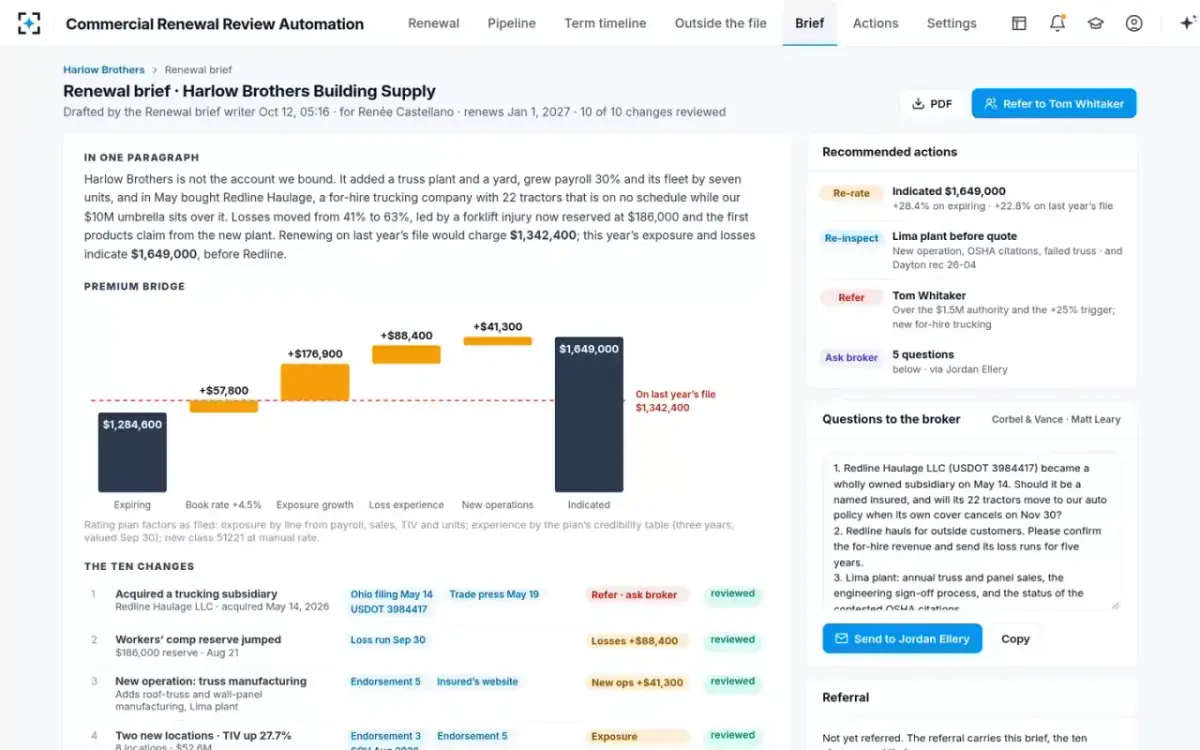
The NAIC already sees the effect coming. Its 2025 analysis notes that "rate and pricing trends have softened in some lines of business" and that this will pressure underwriting results in 2026 (NAIC, 2025 full-year results). On a renewal desk, the defence is not to resist the market's rate but to price what changed. On the fictional sample account, the book rate step was $57,800 of a $364,400 increase; the rest was exposure growth, loss experience and a new operation. In a soft market the book rate step shrinks; the other steps do not.
The price on last year's file beside the price on this year's exposure and losses, across the window
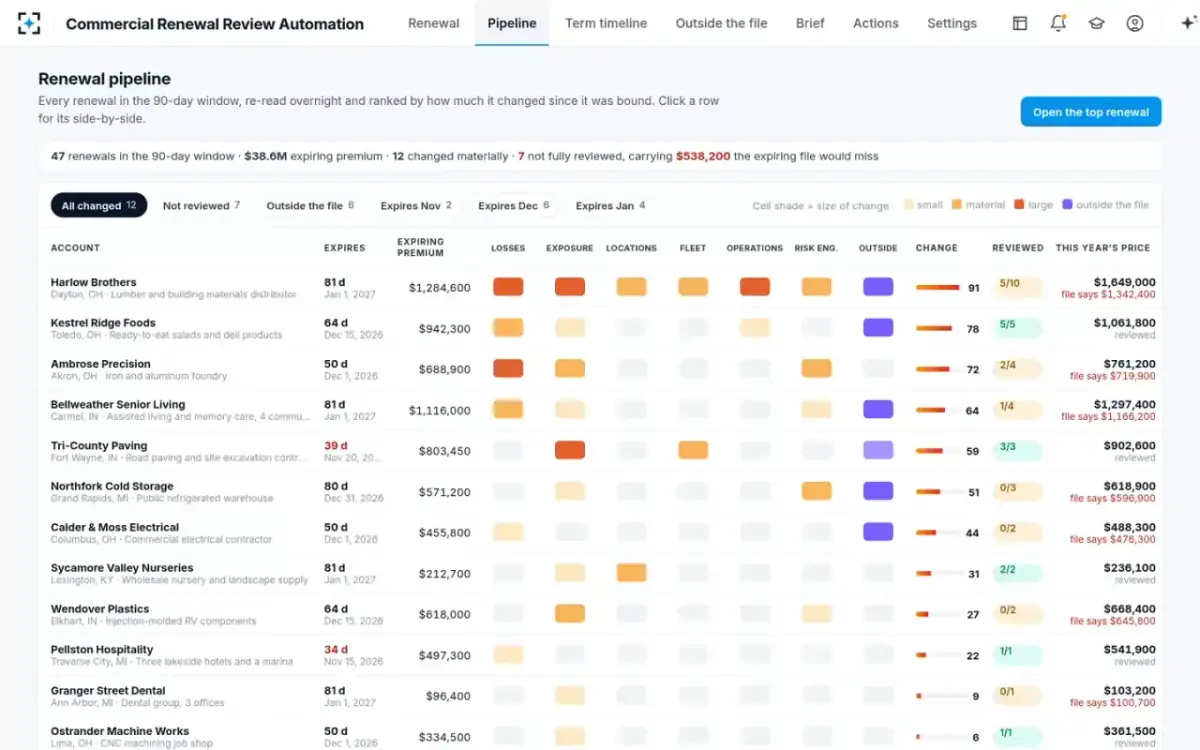
What the cycle does to renewal notices
The market phase also changes which renewals need notice. Where a state's conditional renewal rule counts only the rate part of an increase, as New York's does with its 10% threshold, a hard market sends many more renewals over the line, because rate is the largest step in the increase. In a soft market the same rule is rarely triggered by rate, and a renewal can rise 25% or more on exposure and experience without a conditional renewal notice, provided limits, deductibles and coverage are unchanged.
That is a reason to keep the split visible whatever the phase. On the fictional sample account the indicated premium is 28.4% above expiring, but the rate step is 4.5%; written in New York, it would need no premium-driven notice, while in Illinois, which counts the whole increase on known exposure against a 30% line, it would sit just below the threshold. The premium bridge guide works through both rules.
A soft-market renewal in one chart: a small rate step, a large exposure step
What is rate adequacy, and how do renewals lose it?
Rate adequacy is whether a premium is enough to pay the expected losses, loss adjustment expense, underwriting expense and a reasonable profit for the policy term. Actuaries test it at the level of a rate filing; underwriters lose it one renewal at a time. The CAS frames ratemaking around exactly this balance: "the fundamental insurance equation requires that income (premium) equals outgo (loss and loss adjustment expenses and underwriting expenses), and target profit during the period in which the rates will be in effect" (CAS, Basic Ratemaking). A renewal premium that ignores what the account added during the year breaks that equation for one account, whatever the filed rate.
Four ways a renewal loses rate adequacy in a softening market
| How adequacy leaks | What happens | What catches it |
|---|---|---|
| Rate below loss trend | The book rate change is smaller than the growth in claim costs, so each renewal is a little less adequate than the last | The carrier's rate filing and monitoring; not a renewal-desk decision |
| Unpriced exposure | Locations, vehicles and payroll added during the term carry into the new term at last year's premium | Re-reading the term's endorsements and reports before pricing |
| Unpriced experience | A reserve that rose after the last loss run, or new claims, are not in the renewal price | Comparing the current loss run with the one used last year |
| Credits given to retain | Schedule credits applied to keep an account, with no documented risk reason | Documented reasons for every credit and debit |
The last three rows are the renewal desk's. They are also where the market phase changes the arithmetic most. In a hard market a 10% book rate covers a lot of unpriced exposure; in a soft market a 2% rate covers almost none, and the account's own growth becomes the largest thing the renewal should price. What a full re-read costs sets that against underwriter time.
Questions people ask
Are commercial property rates going down in 2026?
The NAIC describes commercial property as entering soft-market territory, citing a rapid slowdown in premium growth and improving loss ratios; commercial multi-peril non-liability's pure net loss ratio improved 9.6 points to 43% in 2025. Whether an individual renewal's rate falls depends on the carrier's filings and the account's own exposure and losses.
How long does an insurance market cycle last?
There is no fixed length. Research published by the Casualty Actuarial Society identified two full U.S. property-casualty cycles, from 1970 to 1983 and from 1994 to 2008, separated by the liability crisis of 1986 to 1992, and found that softening years tend to be followed by more softening years.
What is the difference between a hard market and a soft market?
In a hard market prices rise, capacity shrinks and terms tighten; in a soft market prices flatten or fall, capacity is plentiful and carriers compete. In 2026 commercial lines show both: the NAIC describes property as softening and casualty, including commercial auto and liability, as still firm.
Why does a soft market lead to a hard market?
Because prices set in a soft market turn out too low once the losses emerge, which takes years on casualty lines. In the capacity constraint model, inadequate pricing produces losses that reduce surplus, and low surplus restricts how much carriers can write, so prices rise.
Should underwriters change how they review renewals in a soft market?
They should read more, not less. When the book rate change is small, the account's own changes during the term, new exposure, new operations, reserve movements, are the largest part of what the renewal ought to price, and they are exactly what a renewal re-quoted on the expiring file misses.