A renewal workflow in commercial insurance is the sequence that takes an account from the day it enters the renewal window to the bound renewal: open the file, read what changed during the term, price it, refer it if it is over authority, send questions and terms to the broker, and bind. Putting agents into that workflow is the easy part; getting underwriters to start from what the agents found is the hard one. Research on how people respond to algorithms suggests why: they abandon one faster after seeing it err, and accept it more readily when they can adjust its output. Trust comes from three things, in this order: every finding opens the document it came from, the agents have a track record on renewals the underwriter already worked, and the underwriter can overrule any finding. Botminds' Commercial Renewal Review Automation is built to be adopted that way: six agents re-read every account 90 days before it expires, show each change with its source, and leave the review of every change and every decision with the underwriter.
Examples on this page come from fictional sample data: a regional middle-market desk with 47 renewals in its window, a senior underwriter, her regional manager, an account executive and a risk engineer. The adoption plan is ours; the research behind it is linked where it appears.
A trust ladder for agents in the renewal workflow: shadow, assist, default
- 1ShadowFirst renewal window
AgentsRe-read every renewal overnight; nobody is asked to use the result.
PeopleUnderwriters work as they do today. A quality reviewer compares what the agents found with what the underwriter priced.
Move up whenThe agents' misses and false matches are counted, and underwriters have seen the agents right on accounts they know.
- 2AssistSecond renewal window
AgentsThe ranked window and each account's changes are where the underwriter starts.
PeopleUnderwriters open each source before ticking a change reviewed, and overrule what they disagree with.
Move up whenMost changes are confirmed on the first click; overrulings are rare and explained.
- 3DefaultFrom the third window
AgentsThe re-read is the standard start of every renewal; referrals carry its changes.
PeopleUnderwriters review changes and decide; a manager reads a sample of renewals each month in full.
Move up whenKept only while the monthly sample keeps agreeing with the agents.
What is a renewal workflow in insurance?
A renewal workflow is the order of steps, owners and hand-offs that turns an expiring policy into a renewal decision. In commercial lines it has more hand-offs than most: the underwriter depends on claims for loss runs, on premium audit and the insured for payroll, on risk engineering for surveys, on the manager for anything over authority, and on the account executive to reach the broker.
The commercial renewal workflow, step by step, with and without agents
| Step | Who does it today | With Commercial Renewal Review Automation |
|---|---|---|
| Open the renewal | Underwriting assistant, from a renewal list | Renewal window agent at 60, 90 or 120 days, with expiring terms and premium by line |
| Read the term | Underwriter, if there is time | Term reader, loss and reserve watcher and risk engineering reader, overnight and again when documents arrive |
| Look outside the file | Underwriter, rarely | Outside-the-file agent, matched and scored, below-threshold matches kept apart |
| Price the changes | Underwriter | Agents draft a premium bridge with the filed plan; the underwriter sets the terms |
| Refer over authority | Underwriter to manager, by email | Underwriter sends; the referral carries every change, its source and who reviewed it |
| Questions to the broker | Account executive, often after the broker calls | Drafted with sources; the account executive edits and sends |
| Re-inspect | Risk engineer, when asked | Requests tied to the renewal, with a reason and a due date |
The table shows where the agents enter: at the reading steps, which today are the ones skipped. They do not add a step the underwriter must learn. The workflow's decisions, approvals and messages stay where they are, which is the first condition for adoption: a tool that asks a desk to change how it refers or quotes meets resistance a reading tool does not.
Where commercial renewal workflows break
Commercial renewal workflows break at the hand-offs, where one seat waits for another and nobody owns the wait. A renewal process flow chart drawn as boxes and arrows hides this; drawn as who is waiting on whom, it shows that most of the 90 days is queue.
Five hand-offs where a commercial renewal stalls, and what fixes each
| Hand-off | What usually goes wrong | What fixes it |
|---|---|---|
| Claims to underwriter: the loss run | The run is pulled once, early; a reserve moves afterwards and nobody re-reads it | Re-read when a new run arrives, and compare it with last renewal's run |
| Service to underwriter: endorsements | Each endorsement is processed alone and never seen again as part of the account | Read the year's endorsements in date order at the start of the renewal |
| Underwriter to risk engineer | New sites are added without a survey; open recommendations are not chased | A re-inspection request tied to the renewal, with a reason and a due date |
| Underwriter to manager: the referral | The referral arrives late, carrying what the underwriter had time to attach | A referral that carries every change, its source and who reviewed it |
| Underwriter to account executive to broker | Questions go out after the broker calls, inside the notice window | Questions drafted with their sources at 90 days, edited and sent by the account executive |
The last row is where adoption shows first. On the sample desk, the five questions for the Harlow Brothers broker were drafted on 12 October with 81 days to go and due to the account executive two days later. On a desk without the re-read, the same questions would exist only once an underwriter had read the file, and the first one, about a trucking company the insured bought in May, would exist only if someone had searched outside it.
Why underwriters ignore a new renewal tool
Underwriters ignore a new renewal tool when its first mistakes cost more trust than its first successes earn, and research suggests that is the normal pattern, not a training problem. In five experiments, Dietvorst, Simmons and Massey found that "people more quickly lose confidence in algorithmic than human forecasters after seeing them make the same mistake" (Journal of Experimental Psychology: General, 2015). Their participants avoided an algorithm after watching it err even when it had outperformed a person.
For a renewal desk, the dangerous mistake is the confident wrong one: an OSHA citation attached to a company with a similar name, a payroll figure estimated where the report was missing. One of those in the first week can end adoption. That is why the design choices that look like caution are adoption choices. On the sample desk an outside match is shown as a change only at a score of 0.85 or more, with the name, address and officer evidence beside it, and lower matches are kept apart; a figure the agents cannot find is marked "not reported", never estimated.
What each seat needs to see before it relies on the agents
Today
Trusts her own reading of the file, when she has time to do it.
With agents
Relies on a change when it opens the endorsement, report or record behind it, with the lines highlighted.
Still theirs: The decision on every change and every term
Today
Trusts referrals from underwriters he knows, less from the rest.
With agents
Relies on a referral that shows every change, its source and that the underwriter reviewed it.
Still theirs: The signature on renewals over authority
Today
Relays questions without knowing where they came from.
With agents
Sends questions that each carry their source, so the broker's pushback can be answered.
Still theirs: What goes to the broker, and when
Today
Gets requests with no context.
With agents
Gets re-inspection requests with the reason, the values at stake and a due date before the quote.
Still theirs: The inspection and what the survey says
Can underwriters reject an AI finding?
They must be able to, and the same research says the ability to adjust an algorithm's output is what gets people to use it. In a follow-up paper, the same researchers report that "people are considerably more likely to choose to use an algorithm, and thus perform better, when they can modify its forecasts. Importantly, this is true even when they are severely restricted in the modifications they can make" (Dietvorst, Simmons and Massey, author manuscript).
In a renewal workflow, the modification is the review itself. Each change the agents report is something the underwriter confirms, prices differently or sets aside, and the renewal's terms are hers. In Commercial Renewal Review Automation the underwriter ticks each change as reviewed, sets the terms, and decides what the broker is asked; an outside fact never moves the price on its own. A desk adopting any renewal tool should also keep the reason when an underwriter sets a finding aside, because those reasons are the best evidence of where the agents need tuning.
Rejection is also an examination point. The NAIC's examination standards have examiners check that the reason for every credit and deviation is documented (NAIC exam standards, chapter 21). A workflow where an underwriter can overrule an agent but leaves no reason is one where the price on the file cannot be explained.
What should a renewal review contain?
A renewal review should contain what the underwriter needs to decide and what an examiner or manager needs to follow the decision: the account as bound beside the account now, each change with its source, the price effect of each change, what is missing, and who reviewed what. The sample desk's renewal brief, drafted by the agents and edited by the underwriter, has seven parts.
Seven parts of a renewal review an underwriter can trust
- One paragraph on what changed
Harlow Brothers "is not the account we bound": a truss plant, payroll up 30%, seven more trucks, a trucking subsidiary.
- The account as bound beside the account now
Sales, payroll by class, insured values, locations, units, drivers, losses, open recommendations.
- Each change with its source and date
Endorsement, loss run, payroll report, survey or outside record, with the cited lines.
- A premium bridge
Expiring premium, rate, exposure, experience and new operations to the indicated premium, each step with the plan factor used.
- What was not found
Figures marked "not reported" and outside matches rejected, so the gaps are visible.
- Recommended actions
Re-rate, re-inspect, refer, ask the broker, each with a reason and a due date.
- Who reviewed each change
So a referral shows that the underwriter, not only the agents, looked at it.
Two renewal windows to adoption
Adoption takes about two renewal windows if the exit tests are met: one in shadow, one in assist, and default from the third. A desk that meets the shadow test early should not skip it; the point of the first window is that underwriters see the agents right on accounts they know, before they are asked to rely on them.
Two renewal windows from shadow to default
- Shadow: re-read, not usedweeks 1–13
- Assist: underwriters start hereweeks 14–26
- Defaultweek 27 on
- Work as todayweeks 1–13
- Open sources, tick, overruleweeks 14–26
- Review changes, decideweek 27 on
- Compare agents with priced renewalsweeks 1–13
- Read overrulingsweeks 14–26
- Monthly full readsweek 27 on
Experience with generative AI in other work suggests the gains will not be even across the desk. In a field study of an AI assistant in customer support, published by the NBER, productivity rose 14% on average and 34% for novice and low-skilled workers (NBER working paper 31161). That is customer support, not underwriting, and the study measured issues resolved per hour; but the pattern, that the least experienced gain most, is a reason to start the assist rung with newer underwriters and let the senior ones keep shadow longer.
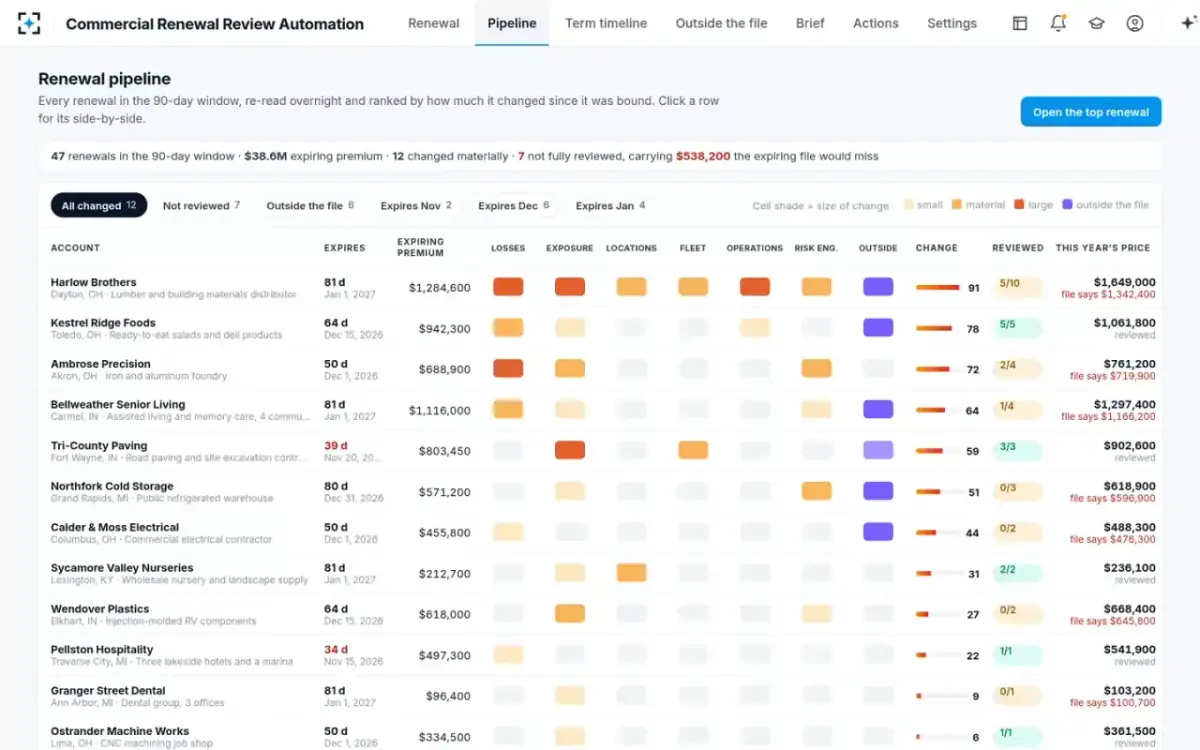
The manager's view of adoption: every renewal in the window, and how much of its change was reviewed
How do you measure adoption of underwriting tools?
Measure adoption by what underwriters do with the findings, not by logins. Four measures do most of the work, and each comes from the workflow itself.
The first is the share of changes reviewed before a renewal is priced or referred. On the sample desk, seven of the twelve materially changed renewals still had changes nobody had reviewed, together $538,200 between what last year's file would charge and this year's indicated price; that figure falling over a window is adoption. The second is the overruling rate and its reasons: near zero suggests underwriters are ticking without reading, very high suggests the agents need tuning. The third is how many days before expiry the terms go out, which should move earlier as the reading leaves the underwriter's desk. The fourth, slower, is how many findings the final audit and the next year's file later confirm.
What the manager signs, and what changes for the manager
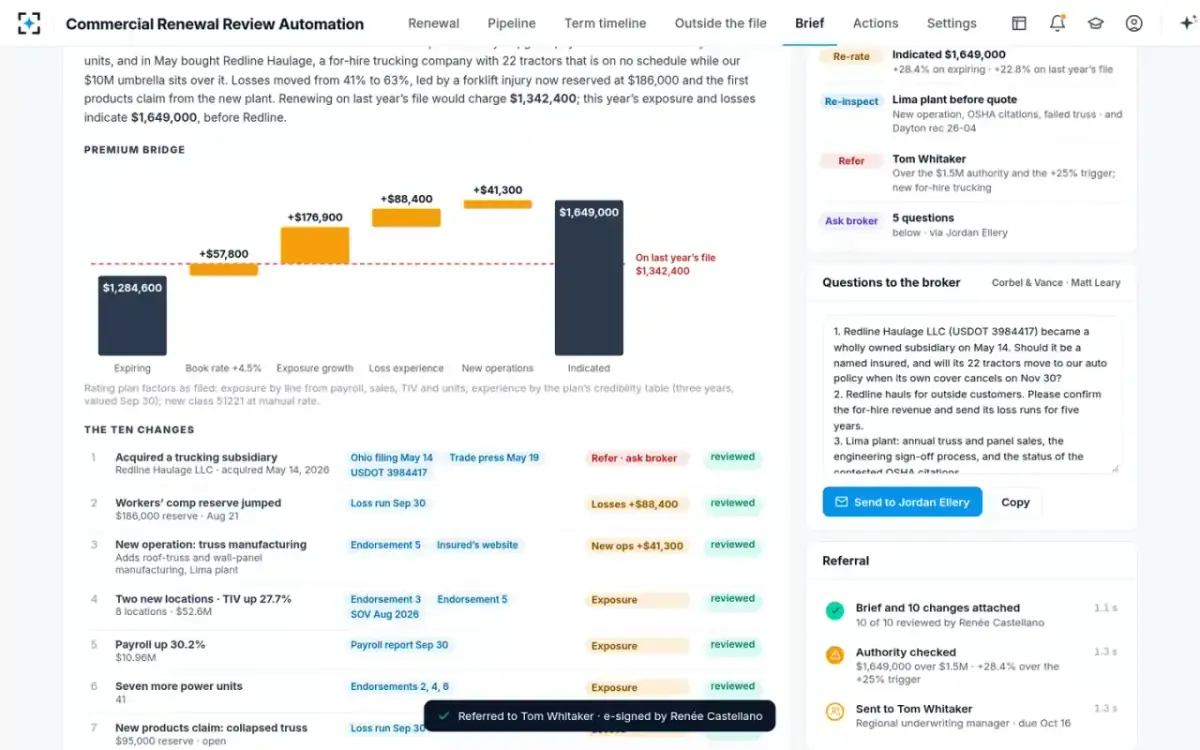
The manager signs the same thing as before, a renewal over the underwriter's authority, but with more in it: every change, its source and the fact that the underwriter reviewed it. On the sample desk the authority line is $1.5 million of premium or a change of more than 25%, and the Harlow Brothers renewal crossed both: $1,649,000 indicated, 28.4% above expiring. The referral went to the regional manager with all ten changes reviewed and attached, due in four days.
A referral that carries its own evidence
The manager also owns the settings. How far out a renewal opens, what counts as a change, which outside sources are searched and the match score shown are settings, and on the sample desk each change to them is saved as a new version and shown to the regional manager. That is the governance the NAIC's model bulletin expects of a carrier's AI program over "all phases of an AI System’s life cycle", including "on-going monitoring" (NAIC model bulletin, 1.7), applied at the level of one desk. Where the agents' authority stops sets out the limits the manager is relying on.
Questions people ask
How do you get underwriters to use new tools?
Let them see the tool right on accounts they already know before asking them to rely on it, make every finding open its source, and let them overrule it. Research on algorithm use found people lose confidence in an algorithm faster than in a person after the same mistake, and use one more readily when they can adjust its output, even slightly.
How do underwriters review automated findings?
One change at a time, from the source. In Commercial Renewal Review Automation each change opens the endorsement, loss run, payroll report, survey or outside record behind it with the cited lines highlighted, and the underwriter ticks it reviewed; outside matches show which of name, address and officer agree and their score.
How long does it take to adopt a renewal tool?
Plan on two renewal windows, about six months for a desk whose renewals are spread through the year: one window in shadow, comparing the agents with what underwriters priced, and one in assist, with underwriters starting from the agents' findings. Move to default only when both exit tests are met.
What is a 90-day renewal review?
It is a re-read of the account that starts 90 days before expiry, early enough that the review, any referral and any nonrenewal or conditional renewal notice can be finished before notice deadlines that fall 60 days out in states such as New York and Illinois. The sample desk opens every renewal at 90 days and re-reads it nightly until it is priced.
Does a renewal tool change the referral process?
It should not change who signs or when; it changes what the referral carries. On the sample desk a renewal over $1.5 million or 25% goes to the regional manager as before, but with every change, its source and the underwriter's review attached, so the manager can check the reasoning without reopening the file.