An exposure change in insurance is a change in the unit a premium is charged on, between the time a policy was rated and the time it renews: workers' compensation payroll by class, general liability sales or receipts, property values, the number of vehicles on a commercial auto schedule. It matters because a renewal priced on last year's exposure charges last year's risk, and in commercial lines exposure moves mid-term through endorsements, payroll reports and acquisitions that nobody re-reads together. A renewal review is accurate if it finds the exposure changes that happened and does not invent ones that did not. Botminds' Commercial Renewal Review Automation re-reads every commercial account 90 days before expiry and shows each change with its source, and it should be judged on four measures: how many real changes it catches, how many outside matches it gets wrong, how much of what it reads is out of date, and how much of what it shows can be traced to a document.
The account used as an example on this page is fictional sample data: Harlow Brothers Building Supply, a Dayton lumber distributor renewing on 1 January 2027, as it runs through the solution. Definitions and rules come from the Casualty Actuarial Society, the NAIC and the regulators linked where they appear.
Four measures that say whether to trust a renewal review
1
Recall on known changes
changes the review found ÷ changes that really happened
What to countUse closed renewals where the final audit and the next year's file show what changed.
Why it mattersThe measure that tells you what you would have priced wrong.
2
False outside matches
outside matches shown that were not the insured ÷ outside matches shown
What to countEvery filing, inspection, docket or news item the review attached to an account.
Why it mattersKept low by a match threshold and evidence on name, address and officers.
3
Stale data rate
changes resting on a document older than its replacement ÷ changes shown
What to countA loss run, payroll report or survey superseded before the renewal was priced.
Why it mattersKept low by re-reading when a new document arrives.
4
Cited share
changes that open their source and cited lines ÷ changes shown
What to countA change with no document behind it counts as uncited, however right it looks.
Why it mattersShould be 100%: an uncited change has to be checked by hand.
What is an exposure change in insurance?
An exposure change is any change in the measure the rating plan multiplies by its rate. The Casualty Actuarial Society defines the exposure base as the basic unit that measures a policy's exposure to loss, and sets three tests for a good one: "it should be directly proportional to expected loss, it should be practical, and it should consider any preexisting exposure base established within the industry" (CAS, Basic Ratemaking). When that unit grows, the premium should grow with it, at the same rate.
The exposure each commercial line is charged on, and where a change shows up
| Line | Common exposure base | Where a mid-term change appears |
|---|---|---|
| Workers' compensation | Payroll per $100, by class code | Payroll reports, new class codes on an endorsement, the final audit |
| General liability | Sales or receipts, sometimes payroll or area, by class | Sales figures at renewal, a new operation added by endorsement |
| Commercial property | Insured values by location | Statement of values revisions, locations added by endorsement |
| Commercial auto | Vehicles by type, use and radius | Vehicles and drivers added to the schedule by endorsement |
| Umbrella | Follows the underlying exposures and limits | Any change to the underlying policies, and operations no underlying policy lists |
The umbrella row is where exposure changes hide best. On the sample account, a $10 million umbrella sits over the liability policies. In May the insured bought a trucking company whose 22 power units appear on no auto schedule. No endorsement records it, so no exposure on any policy changed, yet the sample file notes that the umbrella follows the new subsidiary. That is an exposure change with no exposure figure attached to it, and a review that only compares numbers will never find it.
Exposure on large accounts: composite rating
On large accounts the exposure change can be hidden inside a single number. The CAS explains that "Composite rating is used for some large commercial risks when the amount of exposure is difficult to track throughout the policy period", with a proxy exposure measure standing in for the separate bases of each coverage (CAS, Basic Ratemaking). Instead of auditing sales for general liability and values for property one by one at the end of the term, the carrier tracks one proxy measure and adjusts premium on it.
The convenience has a cost at renewal. A composite base that grows 10% can hide a property schedule that grew 30% and a general liability exposure that fell, or a new operation rated under the old proxy. A renewal review on a composite-rated account has to go back to the underlying measures, which is where the term's endorsements and reports come in.
What is the difference between rate change and exposure change?
A rate change moves the price per unit of exposure; an exposure change moves the number of units. Both raise premium, but only one makes the account more expensive per unit of risk. The CAS puts it plainly: "Rate changes are not the only thing that can change the average premium level. In fact, the average premium level can change over time due to inflation in lines of business with exposure bases that are inflation-sensitive, like payroll (for workers compensation) or receipts (general liability)" (CAS, Basic Ratemaking).
The distinction is not academic. Brokers and insureds read a renewal increase as a price rise unless the carrier shows how much of it is growth, and New York's conditional renewal rule counts only the rate part toward its 10% trigger. A premium bridge is the tool for showing the split; this page is about whether the exposure side of it is right.
How do exposure changes affect renewal premium?
Exposure changes flow into renewal premium at the filed rate for each unit, so an exposure increase of 30% on a payroll-rated line raises that line's manual premium by about 30% before any rate change, experience modification or schedule rating is applied. Most of the increase on a growing account is exposure, not rate.
On the sample account every exposure measure moved past the 10% materiality line
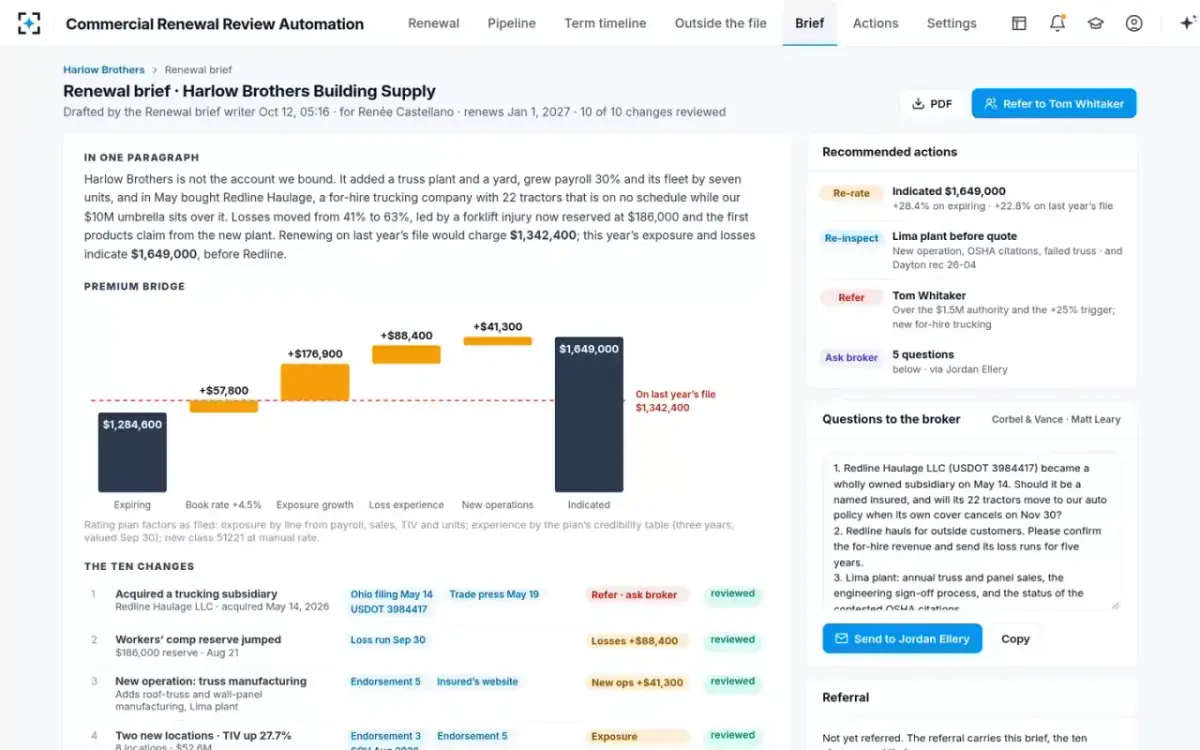
Priced with the plan's own factors, those movements are worth $176,900 of the $364,400 increase from expiring to indicated premium on the sample account. The book rate change, 4.5%, is $57,800. Without the re-read, the carrier would have charged the rate change and missed the exposure, renewing at $1,342,400 instead of $1,649,000.
How do underwriters find mid-term changes?
Underwriters find mid-term changes by reading the documents that record them: endorsements, schedules, statement of values revisions, payroll and audit reports. The hard part is that each document is processed separately, often by service staff, at the time it arrives, and no one reads the year's set together until something forces the file open.
The actuaries see the same effect from the other end. The CAS describes how actuaries analyze "historical patterns of premium development to better understand the effect of cancelations and mid-term amendments on the policy year premium" (CAS, Basic Ratemaking). Premium that develops after a policy is written is the footprint of exposure that changed during the term. A renewal that starts from the written premium at inception starts from a number the year has already overtaken.
On the sample account, the fleet grew by seven power units through three endorsements, and two more endorsements added a yard and a plant at a pro-rata premium; neither site was inspected. The term reader in Commercial Renewal Review Automation reads all of them, with the August statement of values revision and the 30 September payroll report, and builds the account as it stands now. Where a figure is missing it marks it "not reported" rather than estimating it, because an estimated exposure is a change the review invented. The year's endorsements, read in date order, shows how they accumulate.
How do you measure renewal review quality?
Measure renewal review quality on renewals the desk has already closed, where the answer is known: the final audit gives the real payroll, the next year's file shows what was added, and the loss runs show what moved. Run the review on those accounts as they stood 90 days before their renewal, and score what it found against what happened.
Examiners use the same logic on carriers. In North Carolina's examination of a commercial writer, the department drew 50 of 2,864 workers' compensation policies at random and applied a 10% tolerance, above which it cites the company (NC DOI, 2020). Fifty files will not measure a rare miss precisely, but it shows the size of the problem. If a review finds every known change in 50 renewals, the statistical rule of three still puts the true miss rate anywhere up to about 6% (3 ÷ 50) at 95% confidence; that is our arithmetic, and it is why a second sample of 50 is cheap insurance.
Testing a renewal review on your own closed renewals
- Pick 50 renewals from last year with at least one mid-term endorsement
A test of accounts where nothing changed tells you only about false alarms.
- Build the answer key from documents, not memory
Final audit payroll, next year's schedules, the loss run at renewal, the survey log.
- Freeze the inputs at 90 days before each renewal
Give the review only what existed then, or it will look better than it can be.
- Score recall by line and by type of change
A review that catches payroll but misses new locations needs a different fix.
- Have an underwriter judge every outside match
The false-match rate is a judgment call; record who made it and why.
- Count changes that rest on a superseded document
A reserve read from a run that a newer run replaced is a stale change.
- Open every change and check its citation
Cited share is mechanical: it either opens the source lines or it does not.
- Keep the rejected findings
The changes underwriters rejected, with reasons, are your next test set.
What is a false positive in renewal review?
A false positive in renewal review is a change the review reports that did not happen, or an outside record it attaches to the wrong company. The second is the commoner and the more dangerous, because it can turn into a question to the broker about something the insured never did.
Public data sources warn about it themselves. OSHA's establishment search cautions, in capitals, that different companies may have similar names and that the address has to be checked closely (OSHA establishment search). The Treasury's sanctions office, writing about screening generally, says that most potential matches a screen turns up are false positives, and that because several businesses can share an address, an address match alone may not be enough to call something a potential match (OFAC FAQ 5, updated 9 September 2026).
The sample desk's answer is a threshold and evidence. An outside match is shown only at a score of 0.85 or more, and each shows which of name, address and officer agree. Overnight the outside-the-file agent searched eleven sources across the window and kept nine matches; four were rejected and kept apart, never in a change list. One of them, Harlow Building Products Ltd of Ontario, scored 0.31: same surname, different country, no address or officer in common. Matching an OSHA record to the right insured works through the method.
Stale data: the change the review read too early
Stale data is the failure a one-off review cannot avoid: it reads a loss run, a reserve moves the next week, and the renewal is priced on the old figure. The fix is to re-read whenever a document arrives, not on a calendar.
The NAIC's examination standard asks that "Underwriting, rating and classification are based on adequate information developed at or near inception" (NAIC exam standards, chapter 21). For a renewal, inception is the renewal date, and "at or near" is the argument for reading the latest documents rather than the ones that happened to be on file at 90 days. On the sample account a workers' compensation claim was reserved at $40,000 in April and $186,000 in August, after surgery and a second opinion. A review run on the April figure would have missed a change that crosses the sample desk's materiality line of $50,000 or 100% several times over, on a claim the sample file says will drive next year's experience modification.
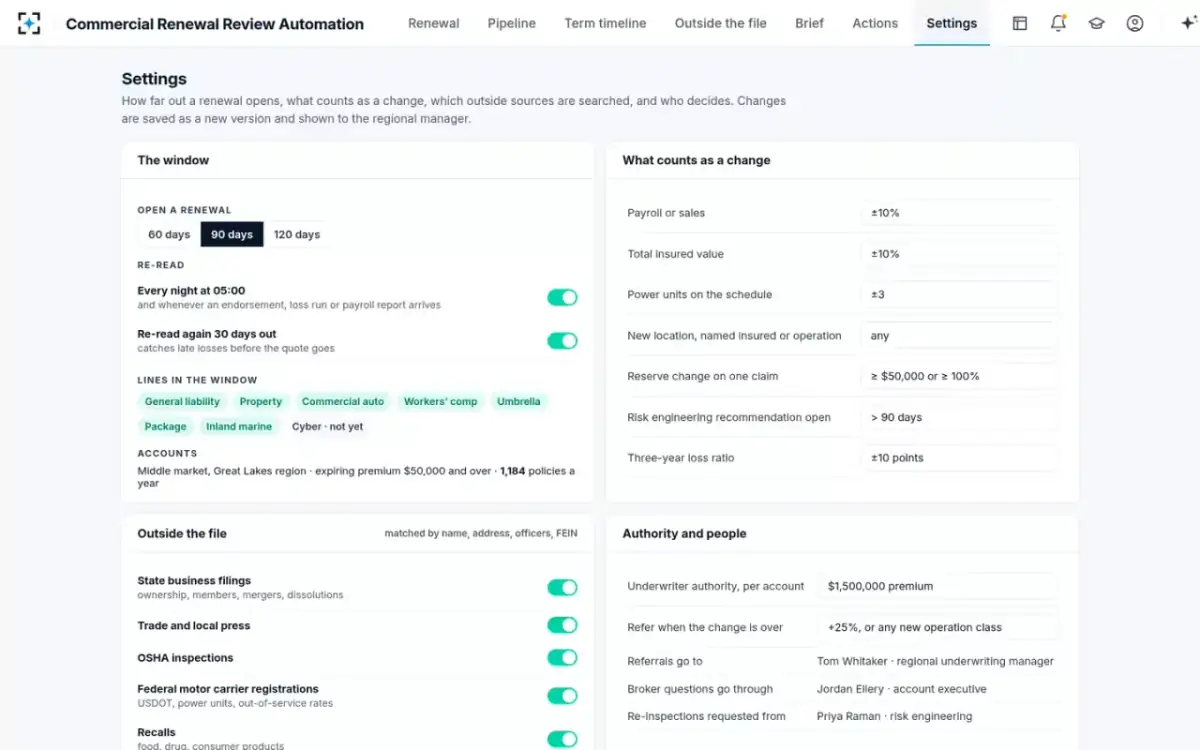
What counts as a change is a setting the quality team can test
Cited share: the measure that makes the others possible
Cited share is the fraction of reported changes that open the document they came from, with the lines highlighted. It should be 100%, and it is the easiest of the four to check: open every change and see whether it lands on a source.
It matters because it decides how cheaply the other three can be measured and how cheaply an underwriter can accept or reject a finding. A change that cites "Endorsement 5" and highlights the added location can be confirmed in seconds; one that says "TIV up 27.7%" with no source has to be rebuilt by hand, which is the work the review was meant to remove. The examination standards make the same demand of the carrier's own decisions: credits and deviations must have their reasons documented. In Commercial Renewal Review Automation every change carries its source and its date, and the underwriter ticks each one as reviewed, so the file shows who looked at what before the terms went out.
Ten changes, each with the documents it rests on
Questions people ask
What is exposure basis in insurance?
The exposure basis is the unit a line's premium is charged on: payroll for workers' compensation, sales or receipts for much general liability, insured value for property, vehicles for commercial auto. The Casualty Actuarial Society says a good one is directly proportional to expected loss, practical to measure, and consistent with the base already used in the industry.
How often do exposures change mid-term?
No public statistic counts them across the market; the best evidence is a carrier's own premium development, the gap between written premium at inception and premium after endorsements and audit. Actuaries study that pattern because mid-term amendments and audits keep changing policy-year premium after the policy is written.
Is an exposure change the same as an audit adjustment?
An audit adjustment is how an exposure change is settled after the term on an auditable line: the insured pays on estimated payroll or sales, and the final premium is set once the actual figure is known. A renewal review looks for the same change earlier, so the next term starts from the right estimate instead of waiting for the audit to correct it.
What counts as a material exposure change at renewal?
That is the carrier's choice and should be written down. The fictional sample desk counts payroll, sales or insured value moving 10%, three or more power units, any new location, named insured or operation, and a reserve move of $50,000 or 100% on one claim; accounts crossing none of those lines renew on the expiring basis.
Can a renewal review find an exposure change that is not in the policy file?
Only by looking outside it. Acquisitions, new plants and new fleets often reach the carrier only when the broker mentions them. A review that searches state business filings, OSHA inspection data and federal motor carrier registrations, and matches them on name, address and officers, can raise them as questions before the renewal is priced.