Commercial renewal underwriting means deciding, for each account about to expire, whether last year's terms still fit this year's risk, and the honest way to decide is to re-read the year: the endorsements, the loss run against last year's, the payroll and sales reports, the survey log and anything public about the insured. By Botminds' estimate that takes about five underwriter hours on a middle-market account that changed, which at Bureau of Labor Statistics wages is roughly $290 to $510 of underwriter time. Multiplied across a 90-day window of 40 or 50 renewals, it is more time than one underwriter has, which is why so many accounts renew on the expiring file plus a book rate change. The cost of that shortcut is the premium the year's changes should have added. Botminds' Commercial Renewal Review Automation moves most of the reading to agents overnight, so the underwriter spends about 1.3 hours on the changes rather than five on the file, and the comparison between reading cost and premium at stake can be made account by account.
The hours and account figures on this page are Botminds' estimates and fictional sample data: a middle-market desk with 47 renewals in its window, and Harlow Brothers Building Supply, a Dayton lumber distributor renewing on 1 January 2027. Wage figures come from the Bureau of Labor Statistics; the arithmetic on them is ours and shown.
Where an underwriter's hours go on one changed renewal, by hand and with agents
By hand · 5.0 hours
- Expiring terms · 10%
- Endorsements, SOV, payroll · 30%
- Loss runs · 10%
- Surveys · 10%
- Outside searches · 20%
- Pricing and writing · 20%
With agents · 1.3 hours
- Expiring terms · 8%
- Endorsements, SOV, payroll · 19%
- Loss runs · 8%
- Surveys · 8%
- Outside searches · 19%
- Pricing and writing · 38%
How long does it take to underwrite a renewal?
A full re-read of a changed middle-market commercial renewal takes about five hours of underwriter time by Botminds' estimate; a renewal re-quoted on the expiring terms takes minutes. No government or academic source publishes a time per commercial renewal, so treat any figure, including this one, as a starting point to replace with your own desk's timings.
The five hours break down as the split above shows. The largest block, an hour and a half, is reading the year's endorsements, statement of values revisions and payroll reports and rebuilding the account as it now stands. An hour goes on searching outside the file: business filings, OSHA, motor carrier records, recalls, court dockets. Another hour goes on pricing what changed and writing it up for the file, the manager and the broker. The rest is assembly: the expiring terms by line, the loss run against last year's, the survey and its open recommendations.
The pattern matters more than the total. Four-fifths of the by-hand time is finding and reading; one-fifth is judgment. With agents doing the reading, the underwriter's 1.3 hours are mostly judgment: half an hour on pricing and writing, the rest on checking what the agents found. That is the shift the economics turn on.
How do you price underwriter time?
Price underwriter time at the employer's full cost per hour worked: the wage plus benefits. The BLS puts the median insurance underwriter wage at $81,370 in May 2025, with the highest tenth above $145,160 (BLS Occupational Outlook Handbook). For full-time private industry workers, wages and salaries "accounted for 68.5 percent of employer costs" in June 2026, the rest being benefits (BLS Employer Costs for Employee Compensation).
What one hour of underwriter time costs, and one full renewal re-read
| Step | Median underwriter | Senior underwriter (top tenth) |
|---|---|---|
| 1. Annual wage, May 2025 | $81,370 | $145,160 |
| 2. Hourly wage at 2,080 paid hours | $39.12 | $69.79 |
| 3. Full cost per hour, wage ÷ 0.685 | $57.11 | $101.88 |
| 4. Five hours, a full re-read by hand | $286 | $509 |
| 5. 1.3 hours, the same renewal with agents | $74 | $132 |
| 6. 47 renewals in a 90-day window, all re-read by hand | 235 hours | 235 hours |
A senior commercial underwriter is the right column for most middle-market desks, and the result is about $500 of time to re-read one changed account properly. That sounds small next to a premium of a million dollars, and on one account it is. The problem is the window, not the account.
Why are renewals rolled over on the expiring file?
Renewals are rolled over on the expiring file because the hours do not exist, not because underwriters think nothing changed. Line 6 of the table is the reason: 47 renewals re-read by hand is 235 hours, about six working weeks, landing in the same 90 days as the underwriter's new business and referrals. Something has to give, and the account with no claim flag is what gives.
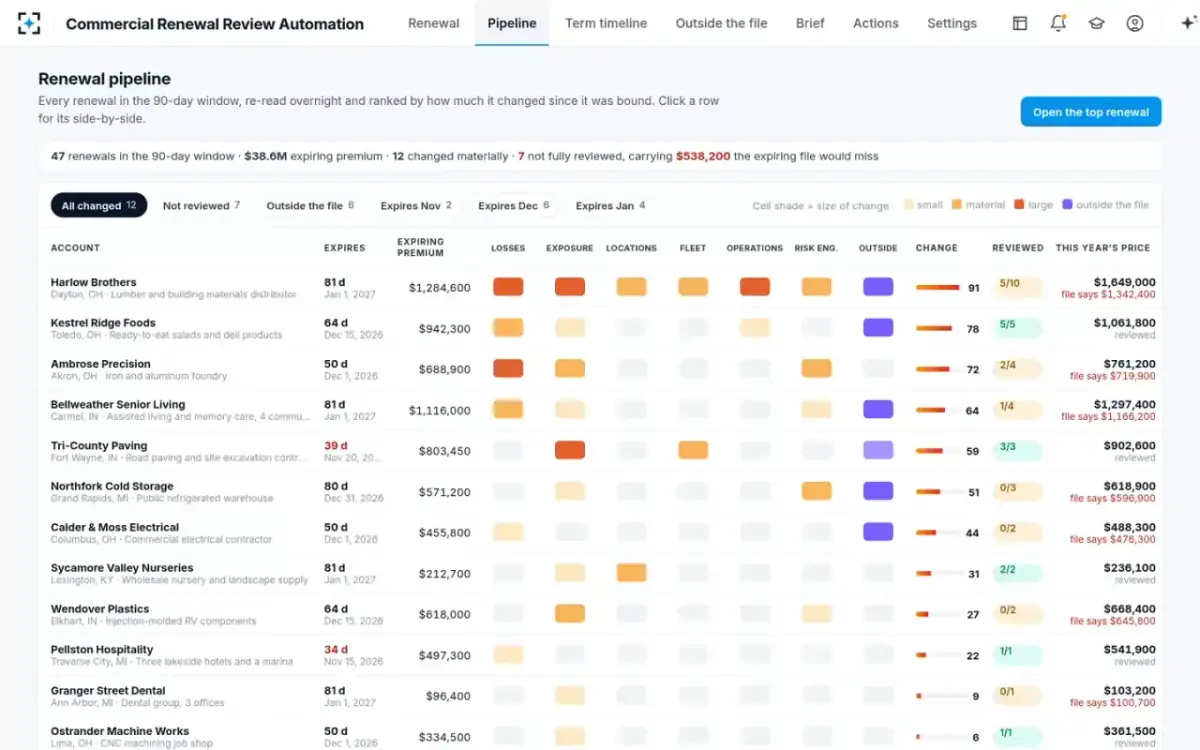
The trade-off is rational account by account and expensive across a book. Most accounts in a window do not change materially. On the sample desk, 35 of 47 renewals crossed none of the materiality lines and renew on the expiring basis without loss. The other twelve carry the risk: on seven of them, the changes had not all been reviewed, and the expiring file would charge $538,200 less than this year's exposure and losses indicate. Harlow Brothers alone accounts for $306,600 of it.
Premium the expiring file would miss on the seven sample renewals not fully reviewed
What is the cost of a missed exposure change?
The cost of a missed exposure change is a year of premium that does not match the risk, and how much of it is lost depends on the line. On auditable lines the gap is partly recovered later; on the others it is gone until the next renewal.
Workers' compensation and much general liability are charged on estimated payroll or sales and settled at audit. The CAS notes that premium on such lines keeps developing after the policy period ends (premium audit tracking shows the arithmetic), with workers' compensation's final premium set by payroll audit some months after expiry (CAS, Basic Ratemaking). A missed payroll increase is therefore partly trued up, but late, at the cost of a deposit premium that was too small and an audit bill the insured did not expect.
Property values, vehicle counts, new operations and loss experience are different. A building added mid-term and never re-valued, a fleet grown by seven units, a reserve that jumped after the loss run was pulled: none of these is corrected by an audit. On the sample account the exposure growth, loss experience and new operations steps of the bridge come to $306,600, and only the payroll- and sales-rated share of the exposure step would come back at audit. The rest, missed, leaves the carrier carrying the risk for a year at last year's price, with the account's loss ratio absorbing the difference.
One sample renewal, priced two ways
$1.342M
on last year's file: expiring premium plus a 4.5% book rate
$1.649M
on this year's exposure and losses, before the new trucking subsidiary is priced
22.8%
the gap, $306,600, against about $500 of senior underwriter time to find it
How many renewals does an underwriter handle, and how many underwriters will there be?
No public statistic counts commercial renewals per underwriter; loads vary with account size, line and how much new business a desk writes. What the public data does show is the size and direction of the workforce. The BLS counted about 125,600 insurance underwriters in 2025, 52% of them at property and casualty carriers, and projects employment to fall 4% from 2025 to 2035, with about 6,800 openings a year from people leaving the job (BLS Occupational Outlook Handbook).
A shrinking workforce and a book that does not shrink means more renewals per underwriter, which pushes the rollover rate up unless the reading gets cheaper. The BLS itself names the cause of the decline as automation of underwriting work. For a commercial desk the question is which part gets automated: the decision, which the law and the examiners expect a person to own, or the reading, which is where the five hours go. Where renewal automation should stop takes the first half of that question.
The window ranked by change, with this year's price beside what the file would charge
Which renewals deserve a full review?
A renewal deserves a full review when the premium a change could move is larger than the cost of reading, which in practice means accounts with mid-term activity, loss movement or outside events. The trouble is that you only know which accounts those are after reading them, so the triage itself has to be cheap.
The value of re-reading one renewal, as a sum
Premium the change moves
indicated premium − premium on last year's file
Exposure, experience and new operations priced with the filed plan
Underwriter
Loss avoided by re-terming
what new terms, an inspection or a referral prevent
A sprinkler impairment fixed, an unscheduled fleet priced or excluded
Underwriter and risk engineer
Reading time
hours × full cost per hour
5.0 hours by hand, 1.3 with agents, by Botminds' estimate
Underwriting manager
Retention risk
chance the insured leaves × margin on the account
A larger, justified increase can still lose the account
Account executive
Materiality lines make the triage cheap. The sample desk counts payroll, sales or insured value moving 10%, three power units, any new location, named insured or operation, a reserve move of $50,000 or 100% on one claim, a survey recommendation open more than 90 days and a three-year loss ratio moving 10 points. An account crossing none of them renews on the expiring basis. An account crossing several goes to the top of the window. The retention term is real: a renewal re-priced upward is a renewal the broker may take elsewhere, which is why splitting the increase into rate and exposure matters as much as finding it.
The cost per renewal with agents doing the reading
With agents doing the reading, the cost per renewal falls to the underwriter's time on the changes, about 1.3 hours by Botminds' estimate, or $74 to $132 at the wage figures above, plus the cost of the software. The more important change is that the triage is no longer a guess: every renewal in the window has been read before anyone decides which ones to work.
In Commercial Renewal Review Automation the window is ranked by how much each account changed, with the expiring premium and this year's price side by side. On the sample desk's Monday, Harlow Brothers is first with ten changes, two of them from outside the file; Kestrel Ridge Foods is second with five. The design target is that every renewal in the window is re-read before it is priced. The underwriter still decides how much of each change to price and what to ask the broker; what the agents remove is the five hours of finding out.
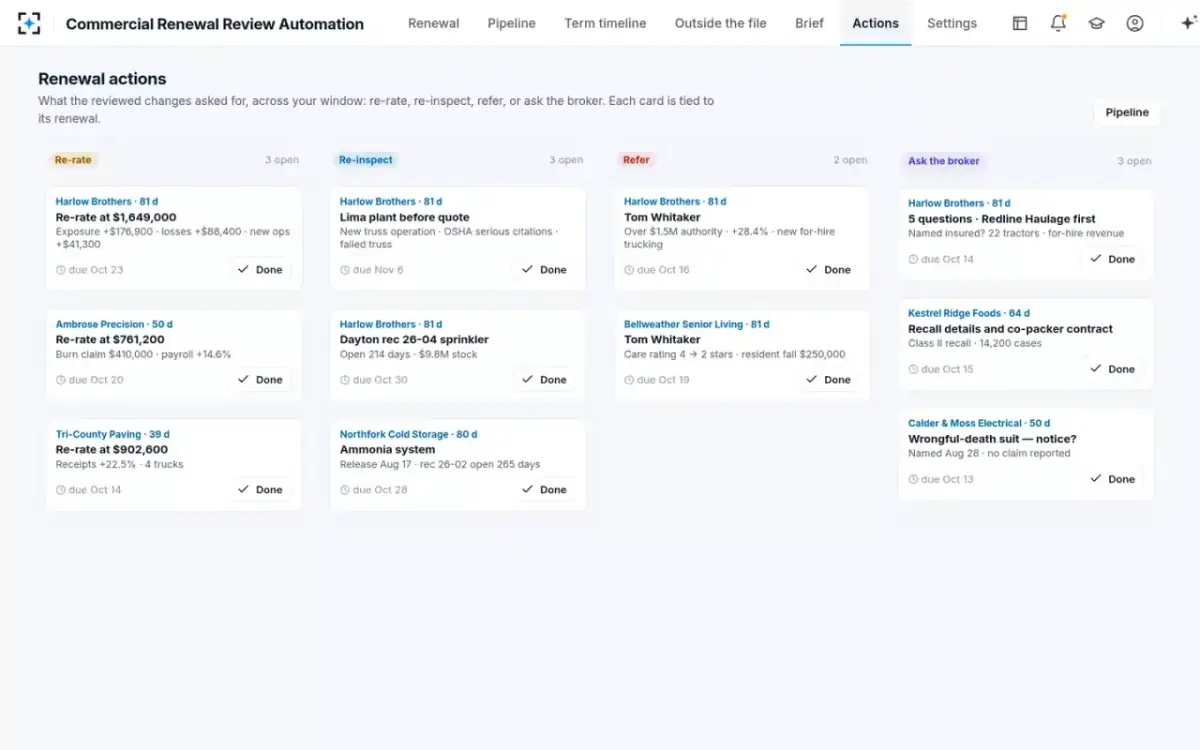
The renewal actions the reviewed changes call for, across the window
What the estimate leaves out
The estimate leaves out three costs a finance team should add. The first is software and integration: read access to the policy, claims and payroll systems, and the cost of the solution. The second is the underwriter's time on accounts the agents flag but that turn out not to matter, which depends on how tightly the materiality lines are set. The third is the work the review creates downstream: re-inspections, referrals and broker questions that would not have happened on a rolled-over renewal.
It also leaves out a benefit that is hard to price: the file. A renewal whose changes were each reviewed and sourced is easier to defend when an examiner asks why a credit was given, why a debit was applied or why the account was nonrenewed. The NAIC's 2025 results note that "Underwriting results for commercial lines were largely unchanged overall" (NAIC, 2025 full-year results); in a year without much underwriting slack, the premium a desk leaves on rolled-over renewals is premium it needs. What the 2026 market cycle means for renewals takes that argument further.
Questions people ask
What does a renewal review cost?
By Botminds' estimate a full re-read of a changed middle-market renewal takes about five underwriter hours, which at BLS wages loaded for benefits is about $290 for a median underwriter and $510 for one at the top-decile wage. With agents doing the reading, the underwriter's share falls to about 1.3 hours, before software costs.
Does re-reading every renewal slow down quoting?
Not if the reading moves earlier rather than longer. On the fictional sample desk the agents re-read each account overnight when it enters the window at 90 days, so the underwriter starts from the changes with 81 days to go instead of reading the file in the last few weeks before the quote.
What is renewal retention?
Renewal retention is the share of expiring policies or premium that renews with the same carrier. It pulls against re-pricing: an account re-priced for its real exposure may move to another market, which is why carriers explain increases as a bridge from rate, exposure and experience rather than as one number.
Does a premium audit fix a renewal priced on old exposure?
Partly, and only on auditable lines. Workers' compensation and sales-rated general liability are settled at audit after the term, so a payroll increase is billed later. Property values, vehicle counts, new operations and loss experience are not audited, so a change missed at renewal on those is lost for the year.
Is it worth re-reading small commercial renewals?
Usually not in full. On small accounts the premium a change could move is close to the cost of reading. Materiality thresholds, such as payroll moving 10% or a new location, let small accounts renew on the expiring basis unless something crosses a line.