Insurance renewal automation is software that does the preparation of a renewal: it assembles the expiring terms, reads every mid-term endorsement, loss run, payroll report and survey from the year, checks public records on the insured, prices what changed with the carrier's own rating plan and drafts the questions for the broker. In commercial lines it should stop there. Price, terms, a nonrenewal and anything said to the broker carry legal duties of reason, notice and documentation, and the carrier answers for them in an examination. The work worth automating is the reading, which is exactly what a busy desk skips: with dozens of renewals in a 90-day window, an underwriter re-quotes the expiring file unless something forces the file open. Botminds' Commercial Renewal Review Automation is built on that division. Six agents re-read every account 90 days before it expires and show what changed, each change with its source and price effect; the underwriter reviews every change and sets the terms.
The figures and screens on this page come from fictional sample data: a middle-market desk with 47 renewals in its window and one account, Harlow Brothers Building Supply, a Dayton lumber distributor renewing on 1 January 2027. The rules come from the statutes, regulators and examination reports linked where they appear.
Commercial Renewal Review Automation: six agents prepare, three people decide
Agent
Renewal window agentOpens every commercial policy at 90 days and assembles the expiring terms, premium by line and the bound application. Re-opens it when a new endorsement, loss run or payroll report arrives.
Never: changes a policy, a quote or a diary; it is read-only on the policy system
Agent
Term readerReads every endorsement, schedule, statement of values, payroll and audit report and builds the account as it stands now: payroll by class, sales, insured values, units, locations, operations.
Never: estimates a missing figure; it marks it "not reported"
Agent
Loss and reserve watcherCompares the current loss run with last renewal's: new claims, reserve moves of $50,000 or 100%, closures, the three-year incurred loss ratio.
Never: sets or questions a reserve; it reports reserves as booked
Agent
Risk engineering readerLists recommendations open more than 90 days, the values they protect and promised dates missed.
Never: closes a recommendation or contacts the insured
Agent
Outside-the-file agentSearches business filings, OSHA, federal motor carrier records, recalls, court dockets and press for the insured, scoring each match on name, address, officers and tax ID.
Never: shows a match under 0.85 as a change, or lets an outside fact move the price
Agent
Renewal brief writerRanks the changes, prices them with the filed rating plan's factors and drafts the premium bridge, the actions and the broker questions.
Never: quotes, binds or sends anything to the broker
A person decides
UnderwriterReviews every change, accepts or rejects each one, sets the renewal terms within authority, decides renew, re-terms, refer or nonrenew.
A person decides
Regional underwriting managerSigns any renewal over the underwriter's authority or referral trigger, with the changes and their sources attached.
A person decides
Account executiveEdits and sends the questions to the broker, and carries the answers back.
What is insurance renewal automation?
Insurance renewal automation covers three different things that share a name: renewing a policy without any person looking at it, renewing it without asking the insured for a new application, and preparing it so a person can decide quickly. The first suits small, homogeneous books where the premium is too small to repay any reading. The second is a data question. The third is what a commercial underwriting desk usually needs, because its accounts change during the year in ways that matter to the price.
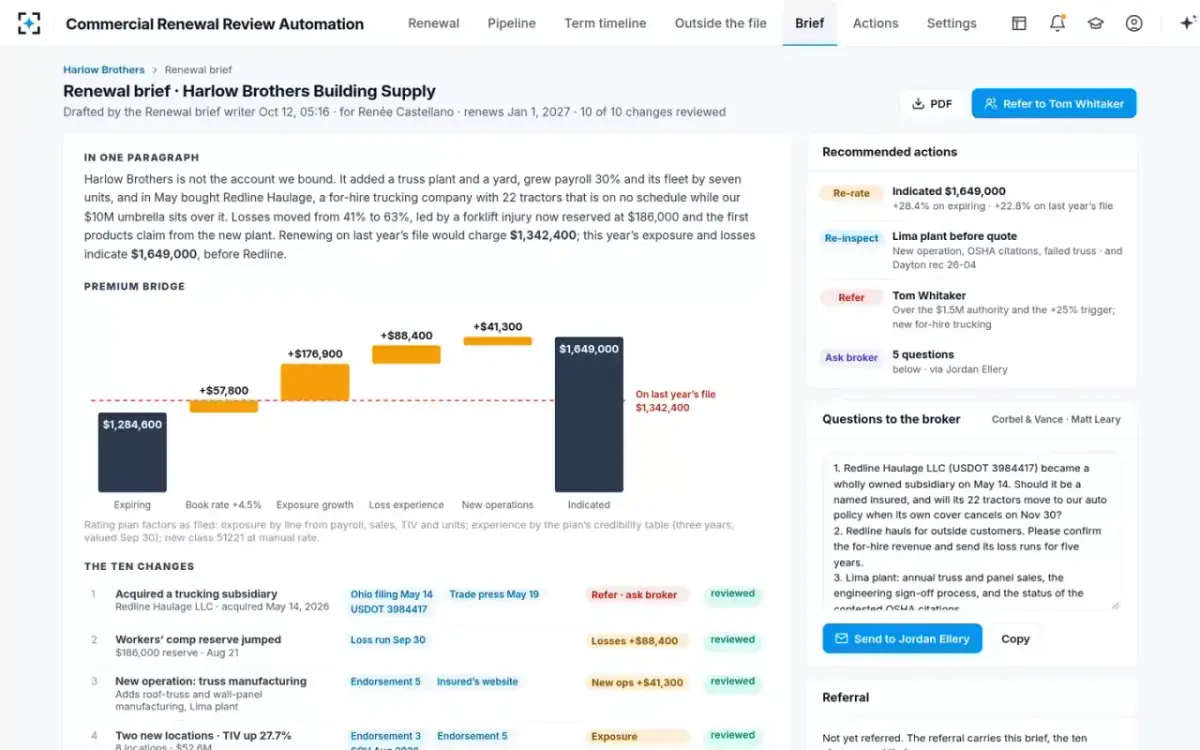
The difference shows in what each one reads. A straight-through renewal reads the policy declarations and applies the book rate. A preparation tool reads what happened to the account: the endorsements that added a location or a fleet, the reserve that moved after the loss run was pulled, the survey recommendation still open, the subsidiary the insured bought. On the sample account, the expiring file plus a 4.5% book rate says $1,342,400. The re-read says $1,649,000, and that is before a newly acquired trucking company with 22 power units is priced at all.
What can be automated at a commercial renewal, and what cannot
Everything that is reading, matching, arithmetic and drafting can be automated at a commercial renewal; the decisions that bind the carrier or reach the insured should not be. The test is simple: if a regulator could ask the carrier to explain a step, a named person should have taken it, on evidence they could see.
Prepared by agents, decided by people
What the agents prepare: Payroll by class, sales, insured values, units and locations read from each endorsement and report, each value cited
What the underwriter or manager decides: Whether a change is real and material for this account
What the agents prepare: New claims, reserve moves and the three-year loss ratio against last year's run
What the underwriter or manager decides: What the losses mean for terms; reserves stay with claims
What the agents prepare: Matches to filings, inspections, carrier registrations and dockets, with the evidence and a score
What the underwriter or manager decides: Whether a match is the insured, and what to ask the broker
What the agents prepare: An indicated premium from the filed rating plan's own factors, as a bridge from the expiring premium
What the underwriter or manager decides: The renewal premium, any schedule credits or debits, and their reasons
What the agents prepare: Recommended actions: re-rate, re-inspect, refer, ask the broker
What the underwriter or manager decides: Renew, re-term, refer or nonrenew, and the reasons on any notice
What the agents prepare: Draft questions, each tied to its source
What the underwriter or manager decides: What is sent, by whom and when
How do agents prepare a renewal?
Agents prepare a renewal by splitting the reading the way an experienced underwriter would, then putting the results side by side. On the sample account the whole re-read ran overnight, from 05:10 to 05:16, across 214 pages and eleven outside sources, and each agent left a one-line account of what it found.
The renewal window agent opened the policy at 90 days with five lines and $1,284,600 of expiring premium. The term reader read six endorsements, the August statement of values revision and the 30 September payroll report, and found four changes. The loss and reserve watcher read the 30 September loss run and the reserve history: six open claims, three changes. The risk engineering reader read the March survey: two recommendations, one open for 214 days. The outside-the-file agent searched eleven sources, kept two matches at 0.97 and 0.99 and rejected three below 0.85. The renewal brief writer priced the ten changes with the rating plan and drafted an indicated premium of $1,649,000.
The order matters less than the hand-off at the end. Each finding arrives at the underwriter as a change with its source, not as a conclusion, and the underwriter's first act is to open it. That is what makes six minutes of agent work worth trusting with a decision worth $306,600 on one account.
Can AI nonrenew a policy?
A nonrenewal is a decision the carrier must explain, and the explanation has to be specific, valid and timely; none of the statutes cited here mentions software, but each puts the reasons on the insurer. New York requires every nonrenewal notice to "set forth or be accompanied by the reason for nonrenewal" (N.Y. Ins. Law § 3426(h)). Illinois requires the notice to explain the specific reasons (215 ILCS 5/143.17a(a); both clocks are compared in the renewal timeline guide).
Examiners read those reasons. In its examination of a North Carolina commercial carrier, the department reviewed all 46 nonrenewed commercial auto policies and cited five, a 10.9% error ratio, for reasons that were not precise (NC DOI, 2020). That is the failure an automated nonrenewal would multiply: a model that produces a category ("adverse underwriting") rather than the facts that drove it.
The safer design lets software do what makes reasons precise, and leaves the decision with the underwriter. In Commercial Renewal Review Automation the agents can recommend a re-rate, a re-inspection or a referral, and every change carries the document it came from. They have no action that nonrenews, quotes or binds. An underwriter who decides to nonrenew does so with the changes already written down, which is what a precise reason is.
Does automation change renewal pricing?
Automation should change what is priced, not how it is priced. A renewal tool that brings in its own pricing logic creates an unfiled rate; one that applies the carrier's filed rating plan to the account as it now stands simply stops the carrier from charging last year's exposure for this year's risk.
The examination standards point the same way. Examiners check that credits, debits and deviations are applied consistently and without discrimination, and that the reason for each is documented; schedule rating must rest on objective criteria "with usage supported by appropriate documentation" (NAIC exam standards, chapter 21). The Casualty Actuarial Society describes schedule rating as the tool "to alter manual rates to reflect characteristics that are expected to have a material effect on the insured’s future loss experience but that are not actually reflected in the manual rate" (CAS, Basic Ratemaking): judgment, but judgment that has to be written down. A tool that shows which part of an increase came from exposure, which from experience and which from a judgment debit makes both checks easier.
On the sample account the renewal brief writer bridges $1,284,600 of expiring premium to $1,649,000 indicated: book rate +$57,800, exposure growth +$176,900, loss experience +$88,400 and new operations +$41,300, each with the plan factor it used. The outside facts, including the trucking acquisition, are not in that number. In this design an outside fact never moves a price; it becomes a question to the broker, and the underwriter prices the answer. How a premium bridge is built works through the steps.
The renewal the agents prepare: summary, premium bridge, ten changes and the broker questions
What regulators will ask about an automated renewal
Regulators will ask how the carrier governs the system, how it tests it and whether each decision can be explained. The NAIC's model bulletin on insurers' use of AI systems, which its adoption map listed in 29 jurisdictions on 8 October 2026 (NAIC map), expects a written program covering the whole insurance life cycle, underwriting, rating and pricing among the stages it names (the EU AI Act and NAIC bulletin guide sets out the text; NAIC model bulletin, 1.6). It adds that "the decisions made as a result of an Insurer’s use of AI Systems are subject to the Department’s examination".
For a renewal tool that means three kinds of evidence: what each agent may and may not do, written down; how its findings were checked against renewals the desk already worked; and, for each renewal, who reviewed which change before the terms went out. The bulletin's scope and New York's circular letter are covered from the compliance side in the questions to ask before buying AI for commercial underwriting; the renewal desk's part is to keep that evidence as it works.
One check belongs in every renewal regardless of tooling. The Treasury's sanctions office says that "insurers should also consider screening against OFAC sanctions at policy renewal, policy amendment" and not only at issuance (OFAC insurance FAQs, updated 13 November 2024). A renewal re-read that already searches business filings for new owners and subsidiaries is the natural place to rerun that screen against the names the year added.
What a submissionless renewal is, and where it breaks
A submissionless renewal is one the carrier prices without asking the insured for a new application, using what it already holds: the expiring policy, the year's endorsements, audits, loss runs and surveys. It saves the broker and the insured a form. It breaks where the account changed in a way nothing in the carrier's files records.
The sample account shows both sides. Eight of its ten changes were in documents the carrier held: endorsements, the payroll report, the loss run, the survey log. The other two were not. The May purchase of Redline Haulage appeared only in a state business filing, a trade press story and a federal motor carrier registration, and a July OSHA inspection at the new plant only in OSHA's public data. No application question would have caught either, because no application was sent. The re-read found them because one agent looks outside the file. What a renewal submission still has to ask the insured lists the questions that cannot be answered from the carrier's side.
How to judge a renewal automation product
Judge a renewal automation product by whether an underwriter can check every finding in a few seconds and overrule it with a reason. Speed matters less than it seems: overnight is fast enough for a 90-day window. What matters is whether the findings are right, whether the gaps are admitted, and whether the decisions stay where the law puts them.
Ten questions for a renewal automation vendor
- Does every change open the document it came from, with the lines cited?
An uncited change has to be re-checked by hand, which removes the saving.
- What does it do with a figure it cannot find?
The right answer is "marks it not reported". A tool that estimates missing payroll has invented exposure.
- Does it read endorsements, or only the declarations?
Mid-term changes live in endorsements and schedules; a declarations-only tool misses most of them.
- When does it re-read?
A one-off read at 90 days misses the loss run that arrives at 60. Look for re-reading when documents arrive.
- How does it decide an outside record is about your insured?
Ask for the evidence fields, the threshold, and where rejected matches go.
- Can an outside fact change the price on its own?
It should not; it should become a question to the broker.
- Does it use your filed rating plan, and show each factor?
Otherwise it is pricing with a plan you never filed.
- Can it quote, bind, nonrenew or contact the broker?
For a commercial desk the answer should be no, in the product, not in a policy document.
- Can the underwriter reject a finding with a reason, and is that kept?
Rejections are the best test data you will get.
- Will you run it on renewals we already worked?
Closed renewals with known changes are the fairest test of what it catches and invents.
The last question matters most. Measuring what a renewal review caught sets out four measures and how to compute them on your own closed renewals, and what one full re-read costs puts the underwriter hours beside the premium it moves.
Where Commercial Renewal Review Automation fits, and where it does not
Commercial Renewal Review Automation fits a desk whose renewals change during the year and are large enough for a change to matter: middle-market package, property, general liability, auto, workers' compensation and umbrella accounts with endorsements, payroll reports and surveys. The sample desk applies it to accounts with $50,000 or more of expiring premium, 1,184 policies a year. It does not fit everywhere, and a buyer should know where.
Where the solution fits a renewal desk, and where it does not
| Situation | Fit | Why |
|---|---|---|
| Middle-market accounts with mid-term endorsements, payroll reports and surveys | Strong | The changes are in documents nobody re-reads together; the premium repays the reading. |
| Accounts that grow by acquisition or new operations | Strong | The outside-the-file agent finds what no endorsement records. |
| Small accounts that auto-renew on the book rate | Weak | Little changes and the premium does not repay a full re-read; a materiality threshold keeps most of them on the expiring basis. |
| Rating and issuing the renewal | Not its job | Your rating engine and policy system stay the systems of record; the agents read them and never write to them. |
| Setting reserves or inspecting sites | Not its job | Claims sets reserves and risk engineers inspect; the agents report both and request, never perform. |
| Personal lines renewals | Not this solution | Homeowners renewals turn on different questions, covered by a separate solution. |
The solution also depends on what a carrier can give it: read access to the policy system, the claims system's loss runs, payroll and audit reports, the survey log and a list of the public sources it may search. Without endorsements in readable form, the term reader has little to read. For personal lines, Homeowners Renewal Underwriting is the separate solution.
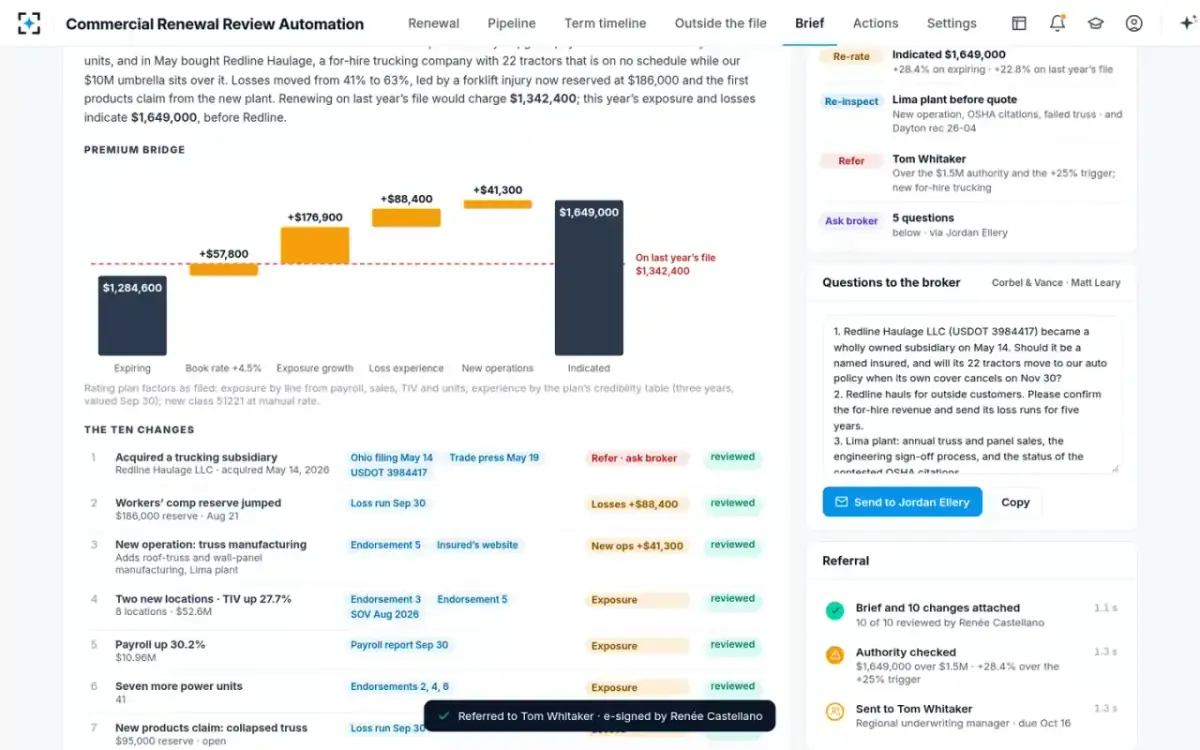
A renewal over authority goes to the manager with the changes attached
Questions people ask
Can renewals be automated in commercial insurance?
The preparation can: assembling expiring terms, reading endorsements, loss runs and payroll, checking public records and pricing the changes with the filed plan. The decisions are harder to automate safely, because renewal terms, notices and their reasons are tested in market conduct examinations; North Carolina cited one commercial carrier for imprecise nonrenewal reasons on 10.9% of the files it reviewed.
Who approves an automated renewal?
The underwriter, within the authority the carrier has given them, and the regional underwriting manager for anything over it. On the fictional sample desk that line is $1.5 million of premium or a change over 25%; the sample account's $1,649,000 indicated premium crossed both, so it went to the manager with every change and source attached.
Is renewal automation the same as straight-through processing?
Not in the sense commercial underwriters need. Straight-through processing renews a policy with no person involved and suits small, uniform accounts. Renewal review automation prepares the file for a person: it reads the term, finds what changed and prices it, and the underwriter decides; on the fictional sample desk, 35 of 47 renewals crossed no materiality line and renewed on the expiring basis anyway.
Does renewal automation replace the policy administration system?
No. A preparation tool reads the policy, claims and payroll systems and leaves them as the systems of record. In this solution the agents are read-only on the policy system and never change a policy, a quote or a diary.
Should outside data change a renewal price?
Not on its own. A filing, an inspection or a news story can be about a different company with a similar name, and OSHA itself warns that companies may have similar names and that close attention to the address may be needed. The safer use is as a question to the broker, priced once the insured confirms it.