A commercial insurance renewal timeline usually runs about 120 days, and it is set by the notice law, not the expiry date. In New York a nonrenewal or conditional-renewal notice on a covered commercial policy must go out at least 60 and no more than 120 days before expiration; Illinois also asks for 60 days on a nonrenewal or on a renewal premium up 30% or more. So the underwriter has to know what changed on the account, and what the renewal should cost, by about day 70, which means the file has to be opened at 90 days or earlier. Much of that time is not spent reading: it goes on waiting for loss runs, payroll reports, re-inspections and referral signatures. Botminds' Commercial Renewal Review Automation exists for that gap. It opens every commercial account 90 days before it expires, re-reads the year's endorsements, loss runs, payroll, surveys and public records overnight, and hands the underwriter a ranked list of what changed while there is still time to act on it.
The examples on this page come from fictional sample data: a regional middle-market desk whose senior underwriter carries 47 renewals in her 90-day window, and one of them, Harlow Brothers Building Supply, a Dayton lumber distributor renewing on 1 January 2027. The law and the figures about it come from the statutes and regulators linked where they appear.
The renewal season runs backwards from the notice date
- Prior term still running120–90
- Re-read and price90–70
- Notice margin70–60
- Quote, negotiate, bind60–0
- Renewal information requested120–90
- Questions to the broker90–60
- Terms out, remarketing decided60–0
- Open recommendations120–90
- Re-inspect new sites90–55
- Follow-up55–0
- Weekly window review120–75
- Referrals signed75–60
- Exceptions only60–0
When does a commercial insurance renewal start?
A commercial insurance renewal starts when the carrier opens the file, usually 90 to 120 days before expiry, because the earliest notice date the law allows is 120 days out in New York. Starting earlier rarely helps: the year is not over, the latest loss run is not yet valued and the payroll report for the last quarter has not arrived. Starting later leaves no time to act on what the review finds.
The 120-day ceiling is written into the statute. New York's § 3426 requires the notice to "be mailed or delivered at least sixty, but not more than one hundred twenty, days in advance of the expiration date of the policy" (N.Y. Ins. Law § 3426(e)(3)). For an excess liability policy or a jumbo risk the floor drops to 30 days but the ceiling stays at 120. A carrier that wants to raise terms has to decide inside that band, and the decision rests on the review.
What starts at 120 days is mostly paperwork that the review will need: the request to the broker for updated values and payroll, the loss run pull, the survey schedule. What starts at 90 is the review itself. The sample desk opens a renewal at 90 days. Harlow Brothers entered the window on 3 October for a 1 January expiry, and on Monday 12 October, with 81 days to go, its re-read was already done.
Work back from the notice date, not the expiry
The useful way to plan a renewal season is backwards: find the last day a notice can lawfully go, subtract the time a referral takes to be signed, and subtract the time it takes to read the file. Whatever is left is when the review must begin. On a 60-day state with a week for referral sign-off and two weeks of reading, that is roughly day 85.
The states do not agree on the outer date. New York sets a window of 60 to 120 days. Illinois requires a company intending to nonrenew to "mail written notice to the named insured at least 60 days prior to the expiration date of the current policy" and to give "a specific explanation of the reasons for nonrenewal" (215 ILCS 5/143.17a(a)). North Carolina's examiners tested commercial nonrenewals against a 45-day rule. The table puts the three side by side, including what each does to a carrier that misses its date.
Three state clocks for a commercial renewal, and what a late notice costs
| State | Nonrenewal notice | Notice of a worse renewal | If the notice is late |
|---|---|---|---|
| New York, Ins. Law § 3426 | 60 to 120 days before expiry (30 to 120 for excess liability and jumbo risks) | Conditional renewal notice for a premium increase over 10%, not counting exposure, experience rating, loss rating or audit; also for lower limits, higher deductibles or new exclusions | Before expiry: cover continues at expiring terms and the lower of current or prior rates until 60 days after the notice. On or after expiry: another policy period |
| Illinois, 215 ILCS 5/143.17a | At least 60 days, with a specific explanation of the reasons | At least 60 days for a premium increase of 30% or more, or coverage changes that materially alter the policy | Notice at least 31 days out: the company may extend the current policy to make up 60 days. No notice at all: renew for another year at the same terms, with any increase under 30% |
| North Carolina, as examined | At least 45 days before the termination date | Not tested in the report cited here | Examiners cited the carrier where errors passed their 10% tolerance |
Notice law belongs to the policy servicing team, and Cancellation and Nonrenewal Compliance covers it state by state. For the underwriter the table makes one point: the review is the input every notice depends on. A conditional renewal notice in New York must state the amount of any premium increase, or a reasonable estimate when the amount cannot be known yet (§ 3426(e)(2); the premium bridge guide shows how that figure is built). That amount is the output of the renewal review. If the review has not happened, the notice cannot be written.
What happens 90 days before a commercial renewal?
Ninety days before a commercial renewal, the underwriter should be reading what changed during the term: mid-term endorsements, the latest loss run against the one used last year, payroll and sales reports, statement of values revisions, open risk engineering recommendations and anything public about the insured. That reading decides whether the account renews as is, renews on new terms, is referred or is not renewed.
Take the sample account as it runs through Commercial Renewal Review Automation. Overnight at 90 days, six agents read the policy year: six endorsements, an August statement of values revision, the 30 September payroll report, the 30 September loss run and a March survey, plus eleven outside sources. By Monday morning the underwriter has ten changes in front of her, each with its source: payroll up 30.2%, two new locations taking insured value from $41.2 million to $52.6 million, seven more power units on the auto schedule, a workers' compensation reserve raised from $40,000 to $186,000, a new truss manufacturing operation and, outside the file, a trucking company the insured bought in May.
None of those changes was hidden. Each sat in a document the carrier already held or could find. What was missing was the time to put them side by side before the price was set. That is the work the 90-day mark is for, and it is why mid-term endorsements need re-reading at renewal even when each one was processed correctly.
Who is involved in a commercial renewal, seat by seat
Four seats inside the carrier carry a commercial renewal, with the broker outside: the underwriter who prices and decides, the account executive who carries questions and terms to the broker, the risk engineer whose recommendations and re-inspections feed the price, and the regional underwriting manager who signs what is over the underwriter's authority. The calendar fails at the hand-offs between them.
The four seats that carry one renewal, and what changes for each
Today
Carries 47 renewals in the 90-day window plus new business. Opens a file when a claim flag fires; otherwise re-quotes the expiring terms with the book rate.
With agents
Starts each morning from the window ranked by how much each account changed, every change with its source, and ticks each one reviewed.
Still theirs: Price, terms, nonrenewal, the referral decision
Today
Hears the questions after the broker calls, often inside 60 days.
With agents
Receives the questions drafted with their sources while there is still time to get answers before terms go out.
Still theirs: What is said to the broker, and when
Today
Issues recommendations that sit open for months; learns of new sites after the quote.
With agents
Gets re-inspection requests tied to a renewal, with a reason and a due date before the quote.
Still theirs: Whether a site is inspected and what the survey says
Today
Signs referrals that arrive late, with whatever the underwriter had time to attach.
With agents
Sees every renewal in the window shaded by change, and signs referrals that carry the changes and their sources.
Still theirs: The signature on anything over authority
The broker sits outside this picture and runs a calendar of its own, often deciding whether to remarket the account to other carriers. That decision depends on the carrier's renewal terms arriving early enough to act on, which is the argument for doing the review at 90 days rather than at 45. The broker's side of the season is covered under Renewal and Remarketing Management.
How much notice is required for commercial nonrenewal?
Notice for a commercial nonrenewal is set state by state: at least 60 days before expiry in New York (with a 120-day ceiling) and in Illinois, and at least 45 days in North Carolina as its examiners applied the rule. Excess liability and jumbo risks in New York can be nonrenewed on 30 days. Workers' compensation usually runs on separate rules; New York's § 3426 expressly does not apply to it.
Examiners test the content of the notice as well as its timing. The NAIC's examination standard for property and casualty insurers reads: "Cancellation/nonrenewal notices comply with policy provisions and state laws, including the amount of advance notice provided to the insured and other parties to the contract" (NAIC exam standards, chapter 21), and the documents examiners pull include the underwriter's file or notes. In North Carolina's examination of a commercial carrier, the department reviewed every one of 46 nonrenewed commercial auto policies and found the company "in violation of the provisions of NCGS 58-41-20(e) as five policies reviewed (10.9% error ratio) were nonrenewed using reasons that were not precise" (NC DOI, 2020).
Imprecise reasons are what a rushed review produces. An underwriter who decides to nonrenew in the last week before the notice date writes "adverse underwriting" because there is no time to write what actually changed. A review finished at day 75, with each change already tied to the document it came from, gives the notice its reasons for free.
Why do renewal quotes come late?
Renewal quotes come late because the information the price depends on arrives late, and each piece arrives on someone else's clock. The loss run is valued at a date; the payroll report comes quarterly; the survey happens when the risk engineer can travel; a referral waits for a manager's calendar. Each wait is reasonable on its own. Stacked, they push the quote into the last 60 days.
Some of the waits are written into law. Illinois gives an insured three policy years of loss information "within 30 days of the insured's request" and requires the same information to accompany any nonrenewal notice (215 ILCS 5/143.10a); New York requires the carrier to send loss information within ten days of a written request (§ 3426(g)). On workers' compensation, the final premium for the term about to expire waits for a payroll audit that the CAS places three to six months after expiry (CAS, Basic Ratemaking; see premium audit tracking). The renewal is priced before the expiring year's audit exists, so the underwriter is working from the mid-term payroll reports and the prior audit.
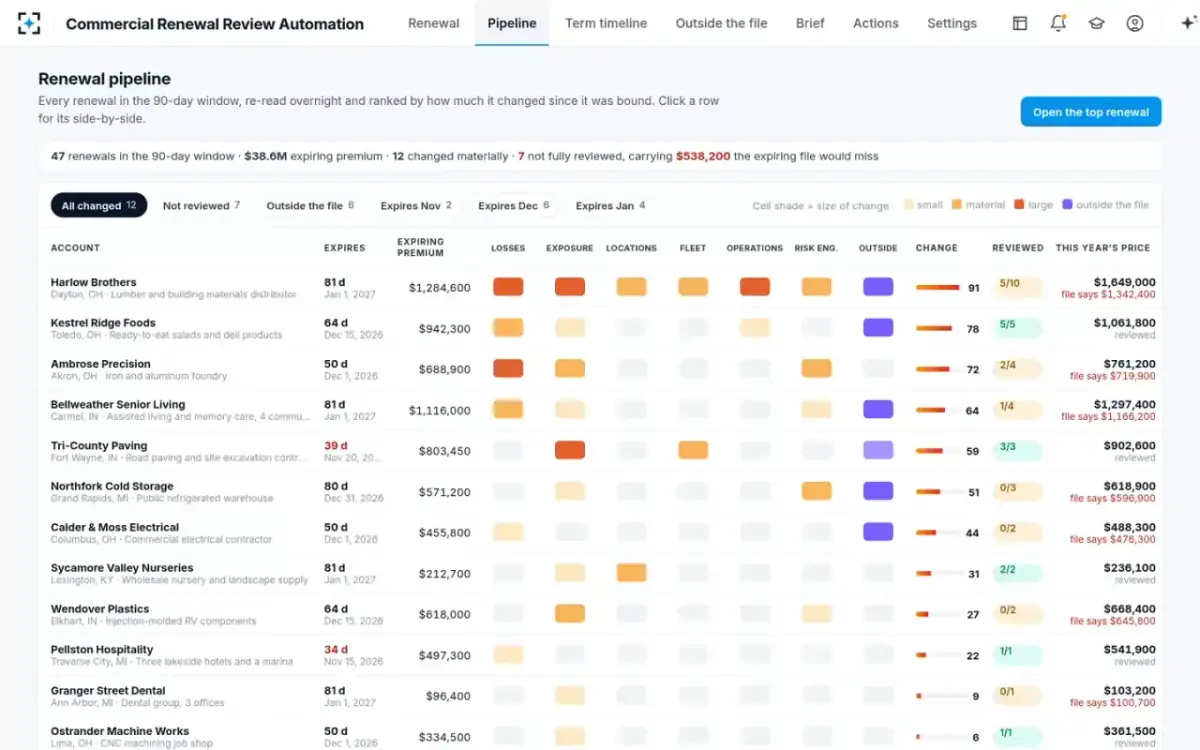
Five of the twelve changed renewals in the sample window are already inside 60 days
The chart is why a 90-day window is not generous. An account that opened at 90 days but waited three weeks for a loss run is at 69 days when the underwriter starts reading, and a referral that takes ten days puts it inside 60. The sample desk's Indiana and Michigan accounts at 39 and 34 days had already been reviewed in full, which is the point of re-reading every night rather than once.
What a late notice costs the carrier
A late notice costs the carrier the terms it wanted. In New York, a late conditional renewal or nonrenewal notice sent before expiry keeps cover in force "at the same terms and conditions of the expiring policy and at the lower of the current rates or the prior period's rates, until sixty days after such notice is mailed or delivered" (§ 3426(e)(5)(B)). Sent on or after expiry, the expiring terms run for another policy period.
Illinois works the same way with different numbers. A notice of a 30% increase sent at least 31 days out lets the company extend the current policy until 60 days have passed. With no notice at all the company "must renew the expiring policy under the same terms and conditions for an additional year", and any increase "must be less than 30% of the expiring term's premium" (215 ILCS 5/143.17a(c)).
Run the sample account through those rules as if it were written in Illinois, which it is not. On last year's file Harlow Brothers would renew at $1,342,400; on this year's exposure and losses it indicates $1,649,000, 28.4% above the expiring $1,284,600 and before the trucking subsidiary is priced at all. That is under 30% against the bound premium, and Illinois measures against the annualized premium on the last day of the term, which the year's mid-term endorsements have already raised, so the test would show less still. Pricing the 22 Redline trucks could push it over. A review finished at day 75 leaves time to send the notice. One finished at day 40 leaves the carrier choosing between an extension at old terms and a price that stops short of the account's real change. The premium bridge shows how that 28.4% splits into rate, exposure and experience, and why the split decides which notice rule applies.
Every renewal in the window, with days to go and what the expiring file would charge
Where Commercial Renewal Review Automation moves the calendar
Commercial Renewal Review Automation moves the reading, not the decisions. The renewal window agent opens each policy at the day the carrier chooses, 60, 90 or 120 days before expiry, and assembles the expiring terms, premium by line and the bound application. The other agents read the term and the public record overnight, and they read again whenever a new endorsement, loss run or payroll report arrives, so a late document re-opens the account instead of waiting for someone to notice it.
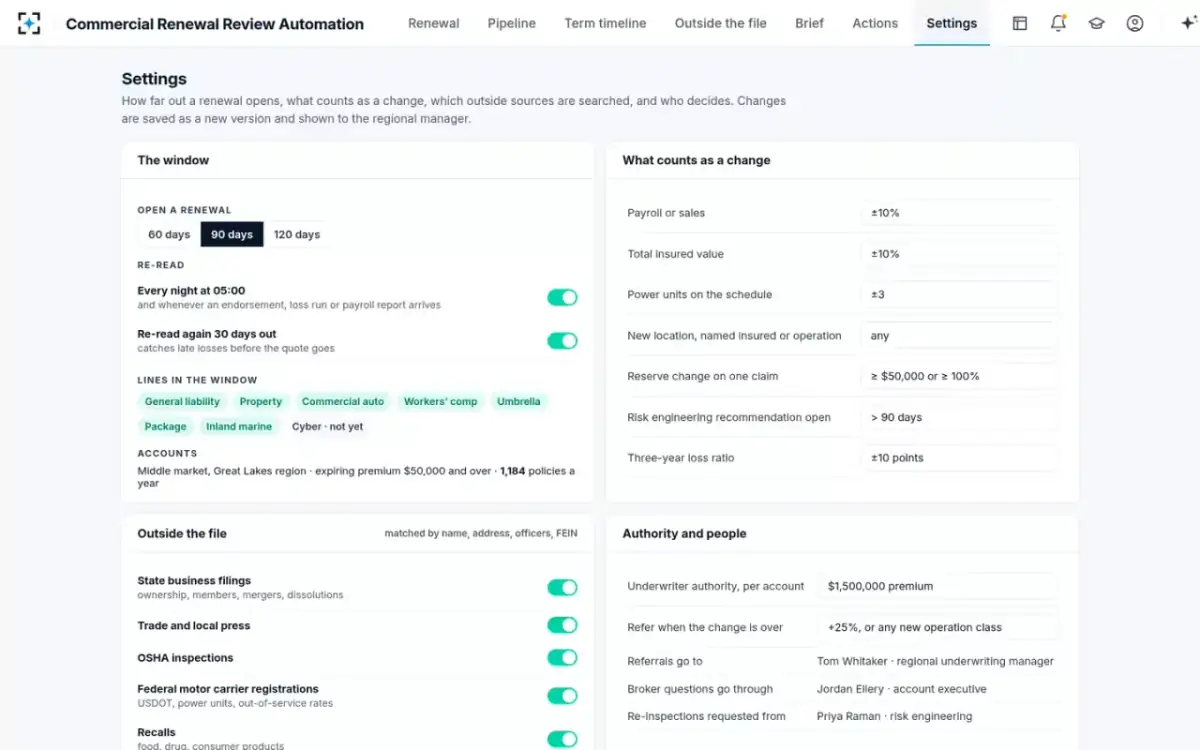
The sample desk also re-reads every account 30 days out, a setting described on its screen as catching late losses before the quote goes. The design target is that every renewal in the 90-day window is re-read before it is priced; how close a carrier gets depends on how quickly its own systems deliver the documents.
The window, the re-read and what counts as a change are the carrier's settings
What does not move is who decides. The agents never quote, bind, change a policy or contact the broker; the underwriter reviews every change and sets the terms; anything over authority goes to the manager with the changes attached. Where automation stops at renewal sets out each agent's limit.
Questions people ask
How many days before renewal does underwriting review a commercial policy?
Most carriers aim to open the file 90 to 120 days before expiry so that the review, any referral and the notice are done before the state's notice date. In New York and Illinois that date is 60 days before expiry for a nonrenewal or a materially worse renewal, so a review that starts at 90 days has about 30 days of working time.
What is a conditional renewal?
A conditional renewal is an offer to renew on worse terms: lower limits, a higher deductible, a new exclusion or a higher premium. New York requires a written conditional renewal notice 60 to 120 days before expiry when the premium rises more than 10%, counting only the rate part and not increases from added exposure, experience rating or audit.
When should a broker start remarketing a commercial account?
No statute sets a remarketing date; it depends on when the incumbent's terms are known. Because a conditional renewal or nonrenewal notice in a 60-day state must reach the insured by day 60, a broker who has the carrier's terms by then still has two months to approach other markets, which is one reason carriers try to finish their review by about day 75.
Does a commercial renewal need new loss runs?
Usually, because the loss run used at the last renewal is a year old and reserves move. Illinois requires carriers to supply three policy years of loss information within 30 days of an insured's request and with any nonrenewal notice; New York requires it within ten days of a written request. Comparing the new run with the old one shows new claims and reserve changes.
What happens if a carrier misses the renewal notice deadline?
The carrier usually keeps the old terms for longer. In New York a late notice keeps cover at the expiring terms and the lower of the current or prior rates until 60 days after the notice; a notice on or after expiry renews the policy for another period. In Illinois a carrier that sends no notice must renew for another year with any increase under 30%.