A premium bridge in insurance is a step-by-step walk from the expiring premium to the renewal premium that shows how much of the change comes from rate, how much from growth in exposure, how much from loss experience and how much from new operations or changed terms. Underwriters use it to price and to document why the price moved; account executives use it to explain the increase to a broker; and the split has legal weight, because New York's conditional renewal rule counts only the rate part of an increase toward its 10% threshold, while Illinois measures a 30% increase on the whole renewal premium at known exposure. A bridge is easy to draw and easy to get wrong: steps applied in a different order change size, mid-term endorsements can be charged twice, and experience can be counted again in a schedule debit. Botminds' Commercial Renewal Review Automation drafts a bridge for every renewal from the account as it stands 90 days out, stating the filed rating plan factor behind each step, and the underwriter sets the terms.
The bridge on this page belongs to fictional sample data: Harlow Brothers Building Supply, a Dayton lumber distributor renewing on 1 January 2027 with general liability, property, auto, workers' compensation and a $10 million umbrella. Ohio law, not New York's or Illinois', would govern its notices; where this page runs the sample through those states' rules, it says so.
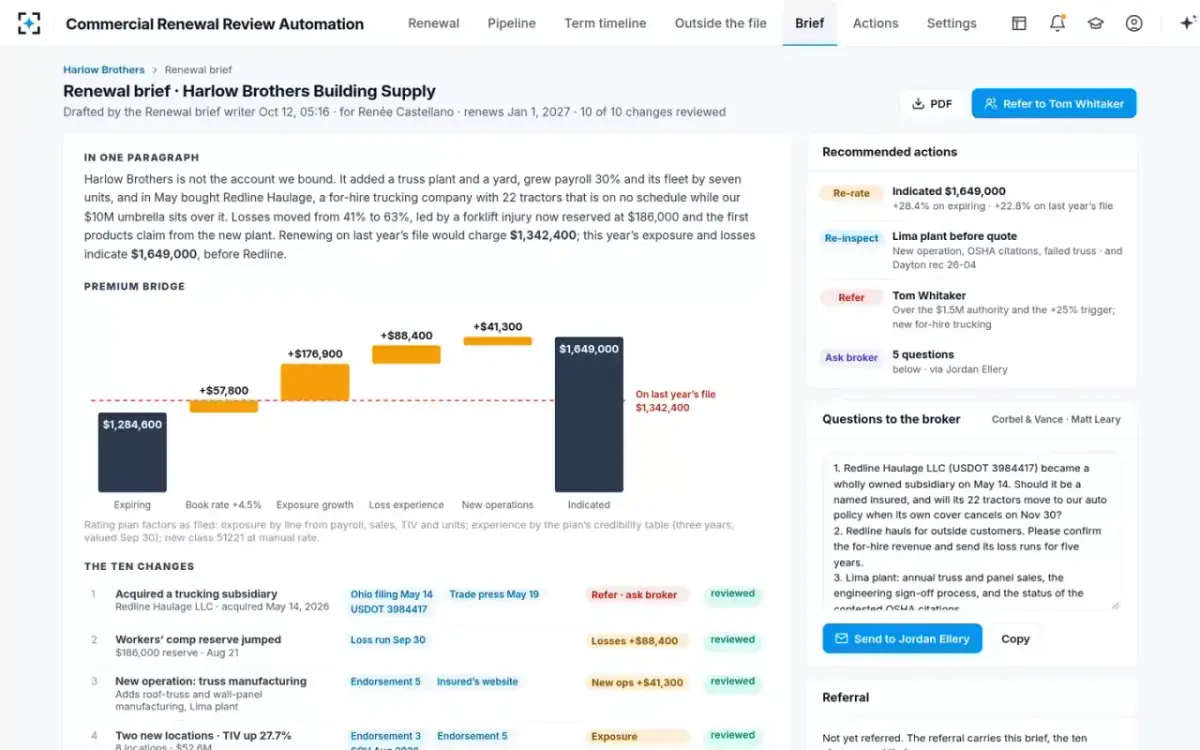
One sample renewal, bridged from expiring to indicated premium
Expiring premium
$1,284,600
Book rate +4.5%
+$57,800
Exposure growth
+$176,900
Loss experience
+$88,400
New operations
+$41,300
Indicated premium
$1,649,000
Last year's file: $1,342,400
What is a premium bridge in insurance?
A premium bridge is a reconciliation: the expiring premium, a list of named steps, and the renewal premium they add up to. Each step answers one question. How much did the price per unit change? How much did the units grow? How much did the account's own losses move it? What is new in the account that was not rated before?
On the sample account the bridge runs from $1,284,600 to $1,649,000, an increase of $364,400 or 28.4%. Only $57,800 of that is rate, the 4.5% book rate change. Exposure growth is $176,900: payroll up 30.2%, sales up 17.4%, insured values up 27.7% with two new locations, seven more power units. Loss experience adds $88,400, led by a workers' compensation claim whose reserve rose from $40,000 to $186,000. New operations add $41,300, a truss manufacturing class rated for the first time at manual rate. Without the bridge, the broker hears "28.4%" and the insured hears a price rise; with it, both see that the account grew.
How is renewal premium calculated, step by step?
Renewal premium in commercial lines is the filed rate times the account's current exposure for each line, adjusted by experience rating where the account is eligible, by schedule rating within the filed range, and by any changes in limits, deductibles or coverage. The bridge reverses that calculation: it starts from what the insured pays now and adds one adjustment at a time.
The steps of a commercial premium bridge, and where each comes from
| Step | What it measures | Source on the file | Sample amount |
|---|---|---|---|
| Expiring premium | What the insured pays now, by line | Policy system: bound premium and endorsements | $1,284,600 |
| Rate change | Filed rate changes applied to the expiring exposure | The carrier's rate filing | +$57,800 (4.5%) |
| Exposure change | More or less of each rating unit at the new rates | Payroll and sales reports, statement of values, auto schedule, endorsements | +$176,900 |
| Experience | The experience modification or loss rating at renewal | Loss runs at their valuation date; the plan's credibility table | +$88,400 |
| New operations | Classes, locations or activities not rated before | Endorsements, the insured's own description | +$41,300 |
| Schedule rating and terms | Judgment credits or debits within the filed range; limit and deductible changes | Underwriter's documented reasons | Set by the underwriter |
| Renewal premium | The sum | $1,649,000 indicated |
Experience rating and schedule rating are separate steps for a reason. The CAS describes experience rating as the adjustment "used when an individual insured’s past experience, with appropriate adjustments, is determined to be predictive of the future experience", and schedule rating as the adjustment for characteristics the manual rate and the experience do not capture (CAS, Basic Ratemaking). Putting them on one line hides which one moved.
Rate and exposure change in the same year: the order matters
When rate and exposure change in the same year, the size of each step depends on which is applied first, because the rate change applies to the new exposure too. A bridge must state its order, or two people will draw two different bridges from the same numbers.
Take the sample account. Applied first, the 4.5% rate change on the expiring premium is $57,800, and exposure growth priced at the new rates is $176,900. Applied the other way round, exposure growth at the old rates is about $169,300 ($176,900 ÷ 1.045), and the rate change, now applied to the larger base, is about $65,400. The total is the same; the rate step differs by about $7,600. That is our arithmetic, assuming the exposure step scales with the rate, and it matters wherever the rate step is the one the law counts.
A premium bridge has no single right order, but it has one wrong one: the order nobody wrote down.
Does an exposure increase count as a rate increase?
Not in New York, and yes in Illinois, which is why the same renewal can need a notice in one state and not the other. New York lets an insurer condition a renewal "upon increased premiums in excess of ten percent (exclusive of any premium increase generated as a result of increased exposure units, pursuant to subsection (d) of this section, or as a result of experience rating, loss rating, retrospective rating or audit)" (N.Y. Ins. Law § 3426(e)(1)(B)). Exposure and experience are carved out; rate and judgment are not.
Illinois measures the whole increase. A renewal with "an increase in premium of 30% or more" needs 60 days' notice, and "The increase in premium shall be the renewal premium based on the known exposure as of the date of the quotation compared to the premium as of the last day of coverage for the current year's policy, annualized" (215 ILCS 5/143.17a(b)). Growth counts, but so does the premium the insured already pays for growth endorsed during the year.
The same bridge under New York's and Illinois' notice rules
New York, § 3426: The premium increase excluding exposure units, experience rating, loss rating, retrospective rating and audit
Illinois, § 143.17a: The whole renewal premium at known exposure, against the annualized premium on the last day of the current term
New York, § 3426: More than 10%
Illinois, § 143.17a: 30% or more
New York, § 3426: 60 to 120 days before expiry; 30 to 120 for excess liability and jumbo risks
Illinois, § 143.17a: At least 60 days before the renewal date
New York, § 3426: Rate step 4.5% (or about 5.1% if exposure is applied first): under 10%, unless schedule debits or coverage changes are added
Illinois, § 143.17a: 28.4% against bound premium, and less against an annualized premium that includes mid-term endorsements: under 30%
New York, § 3426: Lower limits, changed coverage, higher deductibles, new exclusions
Illinois, § 143.17a: Changes in deductibles or coverage that materially alter the policy
The comparison shows the bridge doing legal work. A New York underwriter adding a 6% schedule debit on top of the 4.5% rate change would cross 10% and owe a conditional renewal notice, even though the same total from exposure growth would not. An Illinois underwriter at 28.4% before pricing the insured's new trucking subsidiary is one decision away from 30%. Notice rules are the business of Cancellation and Nonrenewal Compliance; the bridge is what tells it which rule a renewal has triggered.
What is a 10 percent premium increase notice?
In New York, it is the conditional renewal notice a carrier must send when it renews a covered commercial policy at a premium more than 10% higher on account of rate, rather than exposure, experience or audit. It must go out 60 to 120 days before expiration, give the specific reasons and "set forth the amount of any premium increase", or a reasonable estimate when the amount cannot yet be determined (§ 3426(e)(2)).
The estimate clause is where a bridge earns its keep. Ninety days out, payroll for the last quarter may not have arrived and a loss run may be weeks from its next valuation. The statute leaves the permissible range of an estimate to regulation and caps it at 5% of the actual amount. A bridge that shows which steps rest on documents already in hand, and which on figures still to come, is the basis for an estimate a carrier can defend.
How do brokers present a premium bridge?
Brokers present a premium bridge to the insured as the story of the account's year: what the market did, what the business did, and what the losses did. Starting with exposure usually lands best, because it is the part the insured caused and can verify: they know they hired 39 people and opened a plant. Rate is the part the insured cannot verify and is most likely to dispute.
That puts a premium on sources. On the sample account every exposure step can be traced to a document the insured itself supplied: the payroll report, the statement of values revision, the endorsements that added the yard and the plant. When the broker asks why payroll rose 30.2%, the answer is the insured's own 30 September report. Explaining the increase to the insured in writing is a separate task, covered under Premium Increase Explanation; the bridge is its input.
The premium bridge Commercial Renewal Review Automation drafts, with last year's file drawn across it
A bridge that goes down: shrinking exposure and credits
Bridges are not only for increases. An account that sold a location, cut payroll or retired vehicles should see an exposure step below zero, and in a softening market the rate step itself may be negative. The bridge then does the opposite job: it shows the insured that a lower premium reflects a smaller account, not a carrier competing on price, which matters if the account grows back next year.
Credits belong in the bridge for the same reason debits do. A schedule credit given for a new safety program should appear as its own step with its reason, because the next underwriter has to know whether the program still exists before carrying the credit forward. Across a window, the bridges together show where premium is moving for reasons the carrier can name and where it is moving because nobody looked.
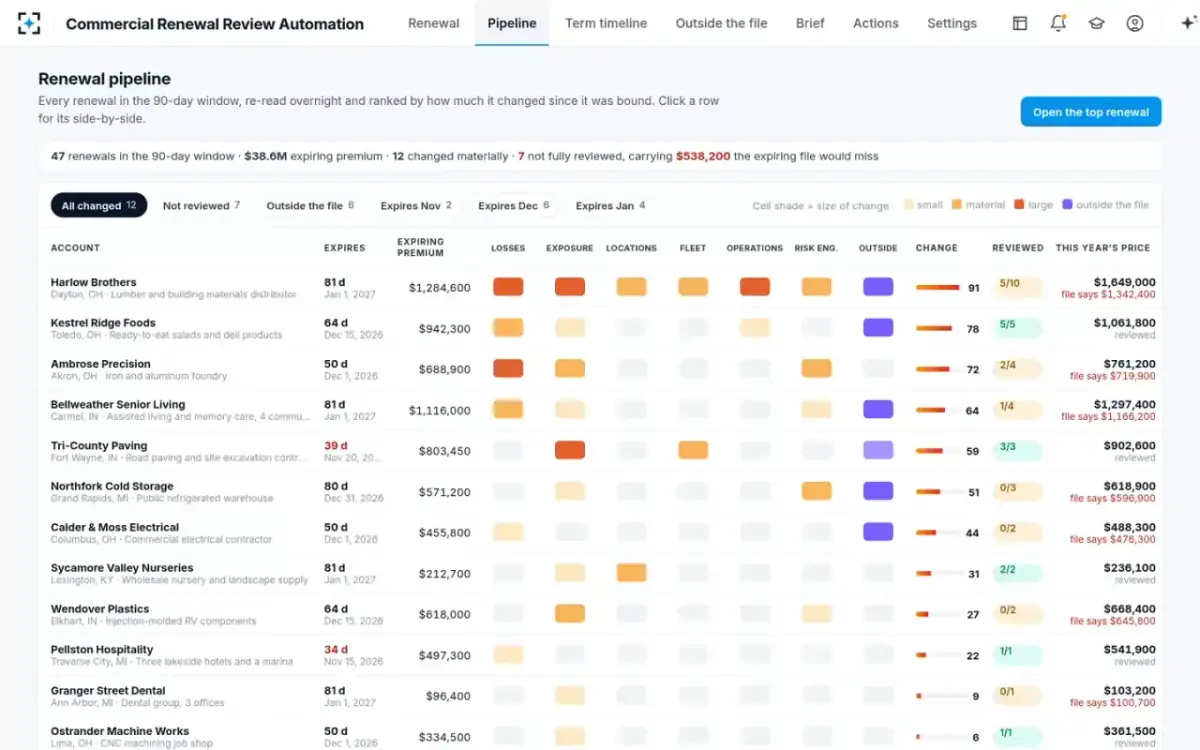
Across the window: this year's price beside what last year's file would charge
Where premium bridges go wrong
Premium bridges go wrong in four predictable ways, and each one either overstates the increase or hides where it came from. A bridge built by agents from the documents avoids the first two mechanically; the last two need the underwriter.
The first is the wrong starting point. If the yard and the plant were endorsed mid-term at a pro-rata premium, the insured is already paying for part of that growth. A bridge that starts from bound premium and adds the full annual cost of the new locations as "exposure growth" is right about the renewal premium and wrong about the increase the insured experiences. Illinois' definition, annualized premium on the last day of the term, is the honest base.
The second is a missing exposure. A bridge can only bridge what was read. The sample bridge says $1,649,000 "before Redline": the trucking subsidiary the insured bought in May, with 22 power units on no schedule, is a question to the broker, not a step, because an outside fact should not move a price until the insured confirms it. A bridge that silently omits a known gap understates the renewal.
The third is double counting. The CAS warns against counting the same risk characteristic twice, once in the experience modification and again in schedule rating (CAS, Basic Ratemaking). The sample account's loss experience step already prices the $186,000 forklift claim; a schedule debit for "poor loss history" on top would charge it twice.
The fourth is the unexplained judgment step. Schedule credits and debits are allowed within the filed range, and they belong in the bridge as their own step with their reasons. A bridge whose last step is "other" is the one an examiner and a broker will both ask about. How to test whether the exposure steps are right sets out the measures.
Questions people ask
How do you explain a renewal premium increase?
Split it. Show the expiring premium, then the rate change, the growth in payroll, sales, values or vehicles, the effect of the account's own losses, and anything new, each with the document behind it. On the sample account only $57,800 of a $364,400 increase was rate; the rest was the business growing and one large claim.
What is a rate change in commercial insurance?
A rate change is a change in the price per unit of exposure, usually filed with the state and applied across a book. It is different from a premium change, which also moves with exposure, experience and coverage; a book rate of 4.5% can sit inside a renewal premium increase of 28% or more.
Does experience rating count toward New York's 10% conditional renewal threshold?
No. New York's § 3426 excludes increases that result from experience rating, loss rating, retrospective rating and audit, as well as increased exposure units. A schedule debit or a rate change does count, as does any change to limits, coverage, deductibles or exclusions, which needs a conditional renewal notice whatever the premium.
Is a premium bridge required by law?
No statute cited here requires a document called a premium bridge. But notice rules require the carrier to know which part of an increase is rate in New York, and the whole increase at known exposure in Illinois, and examination standards expect credits and debits to have documented reasons. A bridge is the simplest way to show all three.
What premium should a bridge start from?
The premium the insured pays on the last day of the term, annualized, including mid-term endorsements; that is the base Illinois uses for its 30% test. Starting from bound premium overstates the increase whenever the insured already paid for growth during the year.