A mid-term endorsement is a written change to an insurance policy that takes effect during the policy term rather than at renewal: a vehicle or a location added, a named insured or a coverage added, a limit or deductible changed. On a commercial policy it usually adjusts the premium pro rata for the rest of the term and becomes part of the contract from its effective date. The meaning that matters to underwriters is what happens next: each endorsement is processed on its own, often by service staff working within guidelines, and the year's endorsements are rarely read together as one account until something forces the file open. By renewal, a policy can carry a new plant, a bigger fleet and a new operation, each priced correctly in isolation and none ever underwritten as part of the whole. Botminds' Commercial Renewal Review Automation starts every commercial renewal, 90 days before expiry, by re-reading the term's endorsements in date order and setting the account as it now stands beside the account as it was bound.
The policy year on this page is fictional sample data: Harlow Brothers Building Supply, a Dayton lumber distributor, bound on 1 January 2026 and renewing on 1 January 2027, with general liability, property, auto, workers' compensation and a $10 million umbrella.
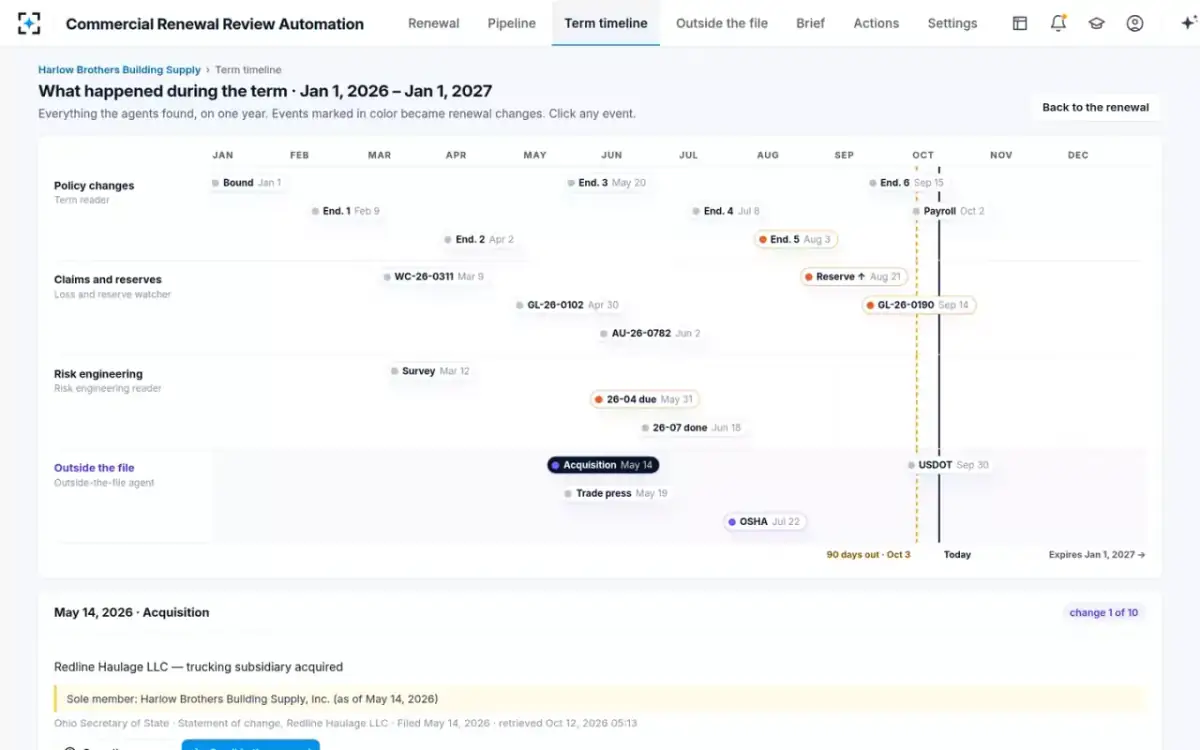
One sample policy year to the 90-day line: six endorsements, the claims, and two events outside the file
- BoundJan 1
- End. 1Feb 9
- End. 2: unitsApr 2
- End. 3: yardMay 20
- End. 4: unitsJul 8
- End. 5: plantAug 3
- End. 6
- QuietJan 1
- Forklift injury claimMar 9
- Trucking firm boughtMay 14
- OSHA visitJul 22
- Reserve upAug 21
- Claim
What is a mid-term endorsement?
A mid-term endorsement, also called a midterm change or a mid-term adjustment, is a form attached to a policy during its term that adds, removes or alters coverage, insureds, locations, vehicles, limits or deductibles from a stated effective date. It is a change to the existing contract, not a new contract: the policy period, the policy number and the rest of the terms stay as they were.
Endorsements are part of the policy, and examiners check that the policy says so. The NAIC's examination standard reads: "All forms and endorsements forming a part of the contract are listed on the declaration page and should be filed with the insurance department (if applicable)" (NAIC exam standards, chapter 21). The form itself, and which edition of it applies on a claim, is a coverage question, covered from the claims side in what insurance policy endorsements are and why the edition decides. This page is about the underwriting side: what a year of them does to the risk.
Does a mid-term endorsement change the premium?
Usually, yes: an endorsement that adds exposure, such as a vehicle, a location or payroll in a new class, adds premium from its effective date to the end of the term, normally pro rata; one that removes exposure returns premium the same way. Some endorsements change no premium at all, such as a corrected address or an added certificate holder.
Actuaries keep the dates for a reason. The Casualty Actuarial Society notes that where a carrier keeps separate records for midterm amendments, "the date of the amendment is recorded" (CAS, Basic Ratemaking), and it treats cancellations and mid-term amendments as the main reasons policy-year premium keeps moving after a policy is written. On the sample account, two locations, seven power units and a new operation were each added at a pro-rata premium. The carrier was paid for each. What nobody priced was the account they add up to.
Added mid-term at pro-rata; neither inspected.
The sample account's change list, on the Fort Wayne yard and the Lima plant
Can premium go up mid-term?
Premium can go up mid-term when exposure is added, but in some states a carrier cannot raise the rate mid-term on its own initiative. New York is explicit for covered commercial policies: after 60 days, or from the effective date of a renewal, "no premium increase for the term of the policy shall be made to become effective unless due to and commensurate with insured value added, subsequent to issuance or the last renewal date, pursuant to the policy or at the insured's request" (N.Y. Ins. Law § 3426(d)(1)), with an exception in place of cancellation where the hazard has substantially and materially increased.
That rule is why the renewal matters so much. Mid-term, the carrier may charge for what was added; it may not re-price the account for what the additions revealed. A new truss manufacturing operation is added at the class's manual rate for the rest of the term. Whether the whole account now deserves different terms, a re-inspection or a referral is a decision that, in New York and in practice elsewhere, waits for the renewal. On auditable lines, the other route by which premium rises after the fact is the audit, which settles the term's real payroll or sales after it ends.
When a mid-term change is more than an endorsement
Some changes during the term are too large to absorb by endorsement, and the law gives the carrier a different tool for them. In New York, a covered commercial policy can be cancelled mid-term for a "material change in the nature or extent of the risk, occurring after issuance or last annual renewal anniversary date of the policy, which causes the risk of loss to be substantially and materially increased beyond that contemplated at the time the policy was issued or last renewed" (N.Y. Ins. Law § 3426(c)(1)(E)), and the same statute allows a mid-term premium increase in place of such a cancellation.
Few carriers reach for that clause, and it is a high bar. Its value to an underwriter is the test it sets: was the risk "substantially and materially increased beyond that contemplated" when the policy was bound? A distributor that starts manufacturing roof trusses, adds a plant and buys a trucking company has arguably changed the nature of its risk. Mid-term, the endorsement process records the pieces; at renewal, the underwriter can ask the question the statute asks about the whole, and price or re-term the account accordingly.
The umbrella is where that question bites hardest. An umbrella is rated over the underlying policies as they were bound, and endorsements to those policies rarely reach the umbrella underwriter. On the sample account, the $10 million umbrella sat over a building materials distributor at binding and, by October, over a business that also built roof trusses and owned a for-hire trucking subsidiary that no underlying auto policy listed.
Who approves a mid-term endorsement?
Routine endorsements are usually processed by policy service staff or underwriting assistants within written guidelines; those that change the risk materially, such as a new class of operation, a large location or a fleet beyond a set size, are referred to an underwriter. Where the line falls is the carrier's choice and appears in its underwriting authority and service guidelines.
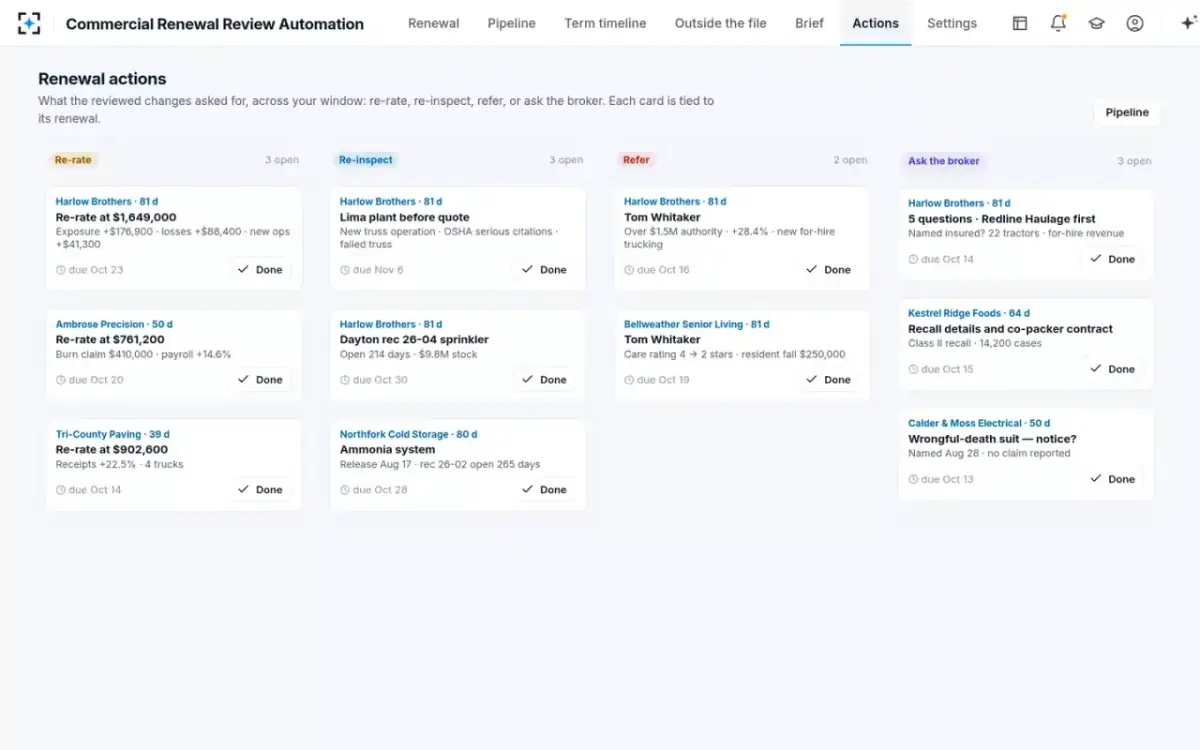
The examination standards apply to endorsements as to new business. Examiners expect underwriting, rating and classification to rest on adequate information gathered at or near inception (NAIC exam standards, chapter 21; see exposure change), and an endorsement that adds a plant is, for that plant, an inception. On the sample account the yard and the plant were added with their values but without a survey; it was the renewal re-read that sent risk engineering a request to inspect the Lima plant before the quote.
Common commercial endorsements and what each does to the risk
| Endorsement | Typical premium effect | What it can change for underwriting |
|---|---|---|
| Vehicle added to the auto schedule | Pro-rata premium for the unit | Fleet size, radius, drivers needed; experience of new drivers |
| Location added to property and liability | Pro-rata premium on its values and exposure | Construction, occupancy, protection and exposure of a site nobody surveyed |
| New class or operation | Manual rate for the new class | Products and completed operations, new workers' comp classes, new hazards |
| Named insured added | Often none on its own | Who is insured: subsidiaries, joint ventures, acquisitions |
| Limit or deductible changed | Up or down by the filed factor | The carrier's net exposure and the umbrella's attachment |
| Payroll or sales estimate revised | Deposit premium adjusted | An early signal of what the audit will find |
Why review endorsements at renewal?
Because each endorsement was priced and the account was not. Read together, a year of endorsements answers questions none of them asks alone: has the business changed what it does, how big is the fleet now, which sites has nobody inspected, does the umbrella still sit over the operations it was rated for.
On the sample account the answers were material. Payroll rose 30.2%, mostly new manufacturing payroll at the Lima plant; insured values rose 27.7% across two new sites; the fleet grew from 34 to 41 power units; a manufacturing class appeared on a distributor's general liability policy. None of the six endorsements was wrong. The account they added up to was a different risk from the one bound, which is why the renewal re-read's one-line summary says it is not the account the carrier bound.
Endorsements are also a checkpoint for screening. The Treasury's sanctions office asks insurers to consider screening at renewal and at amendment as well as at issuance (OFAC insurance FAQs). A named insured added mid-term is a new name that has not been screened since the policy was bound, unless the endorsement process does it.
The policy year in four lanes: endorsements, claims, risk engineering and outside the file
What is the difference between an endorsement and a renewal?
An endorsement changes a policy during its term; a renewal replaces the policy with a new term. The difference decides what the carrier can change, when, and with what notice.
Endorsement, renewal and audit: three ways a commercial premium changes
| Mid-term endorsement | Renewal | Premium audit | |
|---|---|---|---|
| When | Any time during the term, from its effective date | At expiry, for a new term | After the term ends, on auditable lines |
| Who usually starts it | The insured or broker, asking for a change | The carrier, offering terms | The carrier, verifying payroll or sales |
| What can change | Exposure, insureds, coverage, limits, as requested | Rate, terms, limits, coverage, or the decision to renew at all | Exposure only, to the actual figure |
| Premium | Pro rata for the rest of the term | Repriced for the new term | Final premium set; refund or additional premium |
| New York, covered commercial policies | No mid-term increase unless commensurate with value added, at the insured's request, or in place of cancellation | Notice 60 to 120 days ahead to nonrenew or renew on worse terms | Audit increases excluded from the 10% conditional renewal test |
How the renewal re-read handles a year of endorsements
A renewal re-read handles endorsements by reading all of them, in date order, and rebuilding the account as it now stands: locations, values, units, drivers, payroll by class, sales and operations. In Commercial Renewal Review Automation the term reader does this for every renewal 90 days before expiry, with the statement of values revisions and the payroll and audit reports, and every value it reports cites the endorsement or report it came from. A figure it cannot find is marked "not reported", not estimated.
Reading a policy year's endorsements at renewal
- Read every endorsement in effective-date order
A later endorsement can reverse or extend an earlier one.
- Rebuild the schedules as of today
Locations, values, vehicles and drivers, against the schedules at binding.
- Flag every new class or operation
New operations are where a distributor becomes a manufacturer.
- List sites added but never surveyed
Request the inspection before the quote, not after the next loss.
- Check the umbrella against the underlying changes
An umbrella rated over a distributor now sits over a plant and, perhaps, a trucking company.
- Screen names added mid-term
New named insureds and subsidiaries against the sanctions lists.
- Price the account, not the endorsements
The renewal is the first chance since binding to rate the whole.
The re-read ends in a list of changes the underwriter reviews one by one, and a premium bridge in which the year's endorsements appear as exposure growth and new operations. The bridge shows how that growth is priced; how to measure whether a review caught it shows how to test it.
What the endorsements led to: a re-inspection before the quote
Questions people ask
What is a midterm change in insurance?
It is any change made to a policy during its term, documented by an endorsement: adding or removing a vehicle, location, insured or coverage, or changing a limit or deductible. Premium is usually adjusted pro rata from the change's effective date to the end of the term.
What is an endorsement on a commercial policy?
An endorsement is a form that becomes part of the policy and changes or adds to its terms; examiners check that every endorsement forming part of the contract is listed on the declarations page and, where required, filed with the insurance department. Some are attached at binding; mid-term endorsements are added during the term.
Can an insurer refuse a mid-term endorsement?
An insurer can decline to add exposure it would not have written, such as a class outside its appetite or a location it cannot insure; that is an underwriting decision and should be documented like one. It cannot use a declined change to cancel the policy except on the grounds its state allows.
Do mid-term endorsements affect the renewal premium?
Yes, because the renewal is rated on the account as it stands, including everything endorsed during the term. On the fictional sample account, the year's endorsements and reports accounted for most of a $364,400 increase from expiring to indicated premium, against a book rate change of only $57,800.
How long does a mid-term endorsement last?
To the end of the current policy term. At renewal, the carrier decides whether the endorsed exposure, coverage or insured carries into the new term and on what terms; it does not continue automatically on the old pricing if the carrier re-rates the account.