To look up OSHA citations for a company, use OSHA's establishment search at osha.gov: enter the establishment name, or pick an OSHA office or a site ZIP code, open the inspection's activity number, and any citation appears under its violation items, with the citation ID linking to the details. The data is public, but it is not a verdict. OSHA warns that entries change until a case closes, that citations are modified by settlements and contests, and that different companies can share similar names, so the address has to agree before a record says anything about a particular insured. For a commercial underwriter that makes OSHA data, like other public records, a source of questions at renewal rather than a price input. Botminds' Commercial Renewal Review Automation searches OSHA inspections, state business filings, federal motor carrier registrations, recalls and court dockets for every account 90 days before it renews, scores each match on name, address and officers, and turns each one it keeps into a question for the underwriter to ask the broker.
The example on this page is fictional sample data: Harlow Brothers Building Supply, a Dayton lumber distributor renewing on 1 January 2027, whose new truss plant was inspected in July. The public sources, OSHA's own instructions and the law on contesting a citation are linked where they appear.
From an OSHA record to a renewal question: how Commercial Renewal Review Automation handles it
Agent
SearchSearches OSHA inspection data, with the other public sources, for the insured's names and every location address on its schedule.
Agent
Match and scoreCompares the establishment name and site address with the policy file, and ownership with state business filings; scores the match.
Never: shows a match under the desk's threshold, 0.85 on the sample desk, as a change
Agent
Read the inspectionRecords the inspection number and date, the violation items, their type, the proposed penalty and whether the case is open, closed or contested.
Agent
Draft the questionWrites the question for the broker with the inspection cited, and a re-inspection request if the site is insured.
Never: contacts the insured or the broker
A person decides
UnderwriterDecides whether the record matters to the terms: ask, re-inspect, re-price on the answer, or set it aside.
A person decides
Account executiveSends the question to the broker and brings back the insured's answer.
How do I look up OSHA citations for a company?
Use OSHA's establishment search. OSHA's own instructions are four steps: enter the establishment name in the "Establishment" box and search; select the activity number, which is the inspection; if a citation was issued, it appears under "Violation Items"; select the citation ID for its details (OSHA establishment search). The same page searches by OSHA office, site ZIP code, inspection number or industry code, and in October 2026 it showed inspection data through 15 October 2026.
Three details make the search work for an underwriter. Search every name the insured trades under, because inspections are recorded under the establishment name at the site, which may be a plant name or a subsidiary. Search by site ZIP code for each insured location, because a ZIP search finds an inspection filed under a name you did not think of. And note the jurisdiction: the establishment search also finds activity by state plan agencies, such as Washington's and Maryland's, while OSHA's severe injury dashboard covers federal jurisdiction only.
For volume, OSHA publishes its data for download. Its data page says that "Employers, workers, safety professionals, and other interested parties may view and download OSHA's publicly available data provided online" (OSHA data), including inspection and citation data, injury and illness data employers submit electronically, and severe injury reports. A desk checking hundreds of renewals a quarter works from the download, not the search box.
Are OSHA inspections public?
Yes. OSHA inspection and citation data are public, searchable by establishment and downloadable in bulk. So are severe injury reports: under 29 CFR 1904.39, OSHA "requires employers to report all severe work-related injuries, defined as an amputation, in-patient hospitalization, or loss of an eye", and its dashboard shows "a description of the incident and the name and address of the establishment where it happened" (OSHA severe injury reports).
For a workers' compensation underwriter, a severe injury report is close to a loss notice from outside the carrier. It should already be in the claims file if the carrier writes the account. If it is not, either the injury happened at an entity or site the policy does not list, or the claim has not been reported, and both are questions worth asking 90 days before renewal.
OSHA's electronic injury and illness data is a third source, and a different kind. Establishments that the recordkeeping rule covers submit data from their OSHA Forms 300A, 300 and 301 through OSHA's Injury Tracking Application; the deadline for timely submission of the latest data was 2 March 2026 (OSHA injury reporting). Where it exists for an insured's site, it is the employer's own account of its injuries, which a workers' compensation underwriter can set beside the carrier's claims for the same site.
What an OSHA citation record does and does not prove
An OSHA citation record proves that OSHA inspected a site and alleged violations on a date; until the case is closed, it does not prove the violations stand, and it never proves which policyholder owns the site. OSHA says so plainly. On its establishment search page: "Until cases are closed, IMIS entries concerning specific OSHA inspections are subject to continuing correction and updating, particularly with regard to citation items, which are subject to modification by amended citations, settlement agreements, or as a result of contest proceedings" (OSHA establishment search).
The law sets when a citation becomes final. After a citation, the employer "has fifteen working days within which to notify the Secretary that he wishes to contest the citation or proposed assessment of penalty"; if it does not, and no employee files, "the citation and the assessment, as proposed, shall be deemed a final order of the Commission and not subject to review by any court or agency" (29 U.S.C. § 659(a)). A contested citation stays open until the contest is resolved.
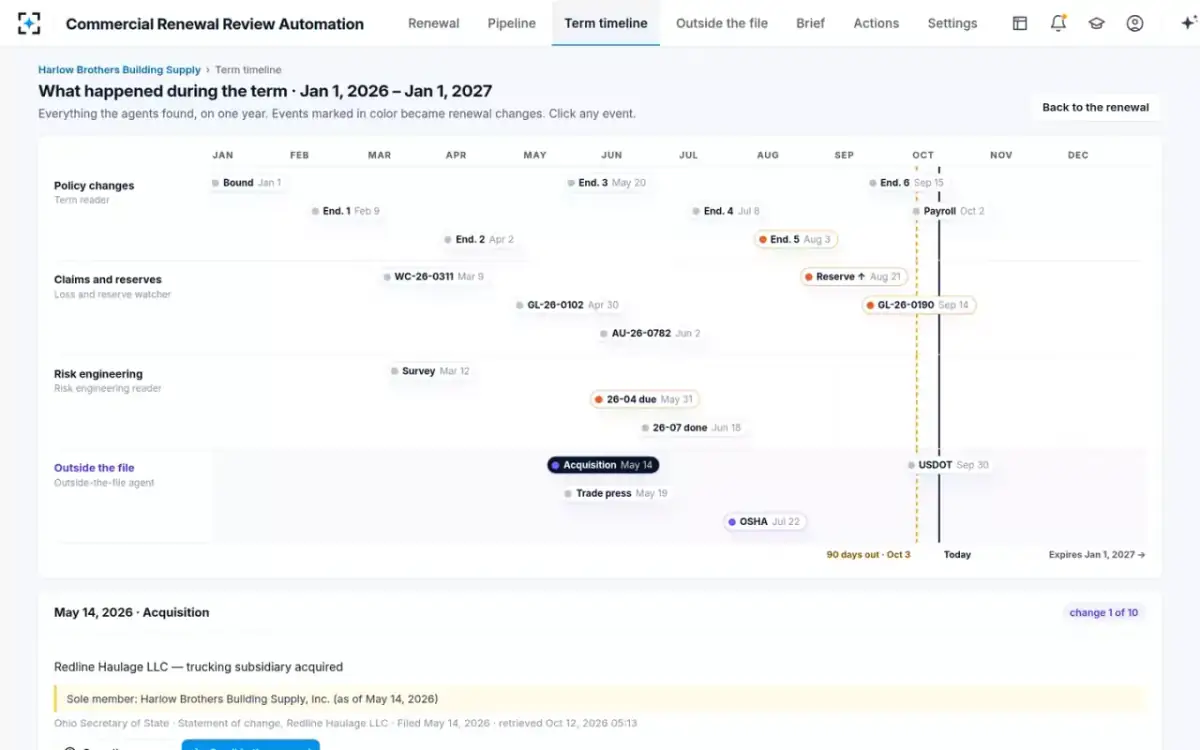
OSHA adds a warning aimed squarely at anyone using the data for something other than enforcement: "When IMIS is put to new or different uses, the data should be verified by reference to the case file and confirmed by the appropriate federal or state office." Underwriting is such a use. On the sample account, the July inspection at the new Lima plant produced serious citations for machine guarding on the truss saw and for forklift training, and the employer contested them. The renewal question is therefore about the plant and the contest, not about a penalty.
How much is an OSHA penalty in 2026?
For penalties assessed after 15 January 2026, OSHA's maximums are $16,550 per serious or other-than-serious violation, $16,550 per day beyond the abatement date for failure to abate, and $165,514 per willful or repeated violation (OSHA penalties). States running their own OSHA plans must adopt maximums at least as effective as the federal ones.
OSHA maximum penalties for 2026, per violation or per day
For an underwriter the penalty is rarely the point. A $16,550 fine does not threaten a $139 million distributor; the hazard it describes might. A serious citation for machine guarding at a plant the policy added mid-term, and that risk engineering has not yet inspected, says something about the exposure the carrier is about to renew. A willful or repeated citation says something about management. The amount is a rough guide to how OSHA saw the hazard; the violation items say what it was.
How do you match a public record to an insured?
Match a public record to an insured on at least two independent identifiers, and treat the address as the strongest one. OSHA puts it in capitals on its search page: "THE USER SHOULD ALSO BE AWARE THAT DIFFERENT COMPANIES MAY HAVE SIMILAR NAMES AND CLOSE ATTENTION TO THE ADDRESS MAY BE NECESSARY TO AVOID MISINTERPRETATION." The Treasury's sanctions office, writing about screening in general, adds the opposite caution: because several businesses can be registered or located at one address, an address match alone may not be enough either (OFAC FAQ 5, updated 9 September 2026).
Matching an OSHA record to the right insured
- Compare the site address with the schedule of locations, not the mailing address
Inspections are recorded at the site; a head office address will miss plants and yards.
- Search every legal and trading name, and every subsidiary
A plant may be inspected under its own name or a subsidiary's.
- Confirm ownership from the state business filing
OSHA data does not list officers; the secretary of state's filing shows who owns the entity.
- Check the inspection date against the policy term
An inspection before the insured bought the site belongs to the previous owner.
- Compare the industry code with the insured's operations
A manufacturing inspection at a distributor is either a new operation or a different company.
- Record why you kept or rejected the match
OFAC asks screeners to keep records of the steps taken and the information relied on; the same discipline protects an underwriting file.
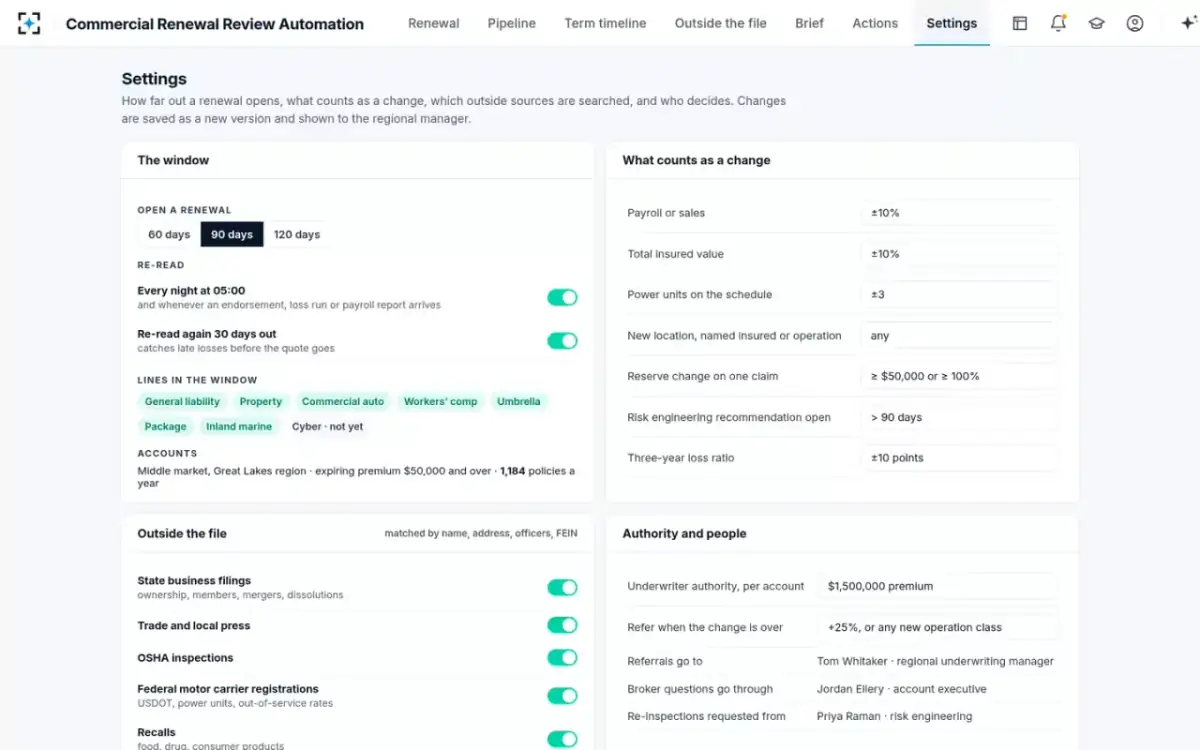
Scores make the rules repeatable. On the sample desk an outside match is shown as a change only at 0.85 or more, with the agreeing fields beside it. The Lima inspection matched at 0.99: name, address and officer all agree. Across the window that night, eleven sources produced nine matches and four rejections, among them a Harlow Building Products in Ontario at 0.31, the name and nothing else. Rejected matches are kept, so an underwriter can see what was set aside and why.
Which public sources are searched, and the match score shown, are the carrier's settings
Should insurers check OSHA records at renewal?
For workers' compensation, general liability and the property and casualty lines of a manufacturing or construction account, yes: an inspection during the term is information about the risk that the insured may not volunteer and the carrier would otherwise learn only from a loss. The case is strongest where the record touches something the policy added mid-term, as the Lima plant did.
The case is weakest as a pricing rule. OSHA's data is a management tool, by its own description, and a citation is an allegation until final. A carrier that loads a premium because a name appeared in the data is pricing on an unverified record, possibly about another company. Schedule rating must rest on objective, documented criteria, and an open citation at an unconfirmed site is neither. The defensible use is a question: what happened, what was fixed, what is the status of the contest, and may risk engineering see the site before the quote.
OSHA's July inspection on the account's term timeline, beside the endorsement that added the plant
What other public records do underwriters check?
Beyond OSHA, the public records most useful at a commercial renewal are state business filings, federal motor carrier registrations, the sanctions lists, product recalls and court dockets. Each answers a different question, and each has a known way of misleading.
Public records at renewal: what each can signal, and its catch
| Record | What it can signal at renewal | The catch |
|---|---|---|
| OSHA inspections and citations | Hazards at a site; new operations; management attitude to safety | Open cases change; citations can be contested; similar names |
| OSHA severe injury reports | A serious injury the claims file may not show | Federal jurisdiction only; describes an incident, not fault |
| State business filings | Acquisitions, new subsidiaries, changes of ownership or officers | A filing date is not an operating date |
| Federal motor carrier registration | A fleet, drivers and for-hire authority the auto schedule may not list | Self-reported and updated every 24 months; property carriers' safety percentiles are not public |
| Sanctions lists | A blocked owner, subsidiary or counterparty | Many potential matches are false positives |
| Recalls and court dockets | Products exposure, lawsuits naming the insured | A suit is an allegation; a recall class says how serious, not how many claims |
The motor carrier row is the one that found the sample account's largest change. The insured bought a for-hire trucking company in May; its federal registration showed 22 power units and 26 drivers, none on the insured's auto schedule of 41, and its own liability cover cancelling on 30 November. How a fleet desk reads a carrier's public FMCSA record is covered in FMCSA out of service rates; for the renewal desk, the registration is the reason the umbrella question goes to the broker first.
From public record to question, never to price
In Commercial Renewal Review Automation an outside fact never changes a price on its own; it becomes a question to the broker, drafted with its source, and the underwriter decides what the answer means for the terms. On the sample account the five questions run in order of importance: the trucking subsidiary first, then for-hire revenue, then the Lima plant and the status of the contested OSHA citations, then an open sprinkler recommendation, then driving records for nine new drivers. They go to the account executive, not straight to the broker.
The OSHA finding also produced an action inside the carrier: a re-inspection request to risk engineering for the Lima plant before the quote, with the new truss operation, the citations and a failed truss claim as reasons. That is the most useful thing a public record can do at renewal: send someone to look before the price is set. Measuring false outside matches covers how to check that the matching is right, and the limits on each agent how the design keeps an outside fact out of the price.
Questions people ask
Can an OSHA citation affect insurance?
It can prompt questions, a re-inspection or different terms, but a citation is an allegation until it becomes final, and an employer has fifteen working days to contest it. Underwriters who use OSHA data should confirm the site is the insured's and the case status before it influences terms, and document why.
What is OSHA establishment search?
It is OSHA's public search of its enforcement data, by establishment name, OSHA office, site ZIP code, inspection number or industry code. Results list inspections by activity number; violation items and citation details sit under each inspection. OSHA warns that open cases change and that similar company names can mislead.
What does a contested OSHA citation mean?
The employer has notified OSHA, within fifteen working days of the citation, that it disputes the citation or the proposed penalty. The citation is not a final order while the contest is pending and can be changed by settlement or by the outcome of the proceedings.
Do state plan inspections show up in OSHA's search?
The establishment search includes activity by state plan agencies; its office list names, for example, Washington's and Maryland's state programs. OSHA's severe injury report dashboard does not: it covers incidents under federal jurisdiction only.
How do underwriters avoid matching the wrong company?
By requiring at least two identifiers to agree, with the site address checked against the schedule of locations, ownership confirmed from the state business filing, and the inspection date inside the period the insured owned the site. A name-only match, like the sample desk's 0.31 match to an Ontario company, is kept apart and never treated as a change.