A renewal submission in insurance is the package a broker sends a carrier ahead of a commercial renewal: an updated application or renewal questionnaire, current payroll and sales, the statement of values, the vehicle and driver schedules, loss runs and an account of what changed during the year. For a carrier quoting its own renewal, much of that package is already in its files, because the year's endorsements, payroll reports, audits, loss runs and survey reports passed through its own systems. The request to the broker can then shrink to what the carrier cannot know: next year's estimates, what the insured plans, and anything that happened outside the policy file. That makes the renewal faster for the broker and better for the carrier, provided someone reads what the carrier holds before asking. Botminds' Commercial Renewal Review Automation does that reading 90 days before expiry and drafts the questions only the insured can answer; going live needs read access to the systems that hold the year, the carrier's rating plan and guidelines, and a sample of its own upcoming renewals.
The example on this page is fictional sample data: Harlow Brothers Building Supply, a Dayton lumber distributor renewing general liability, property, auto, workers' compensation and a $10 million umbrella on 1 January 2027, placed through a fictional broker.
A commercial renewal submission: what the incumbent carrier already holds, and what must come from the insured
| Item | Already on the carrier's file | Must come from the insured |
|---|---|---|
| Expiring terms and premium by line | Yes: the policy system | Nothing |
| Locations and values | Schedule at binding, endorsed additions, statement of values revisions | Values for next year, and any site not yet endorsed |
| Payroll and sales | Prior audit, mid-term payroll reports | Estimates for the renewal term; new class codes |
| Vehicles and drivers | Auto schedule with endorsed units; drivers listed | Vehicles and drivers added since the last endorsement |
| Loss history | Its own loss runs and reserve history, at any valuation date it chooses | Loss runs from other carriers for lines it does not write |
| Risk engineering | Surveys and the recommendation log | Proof that open recommendations were completed |
| Operations and ownership | Operations as bound and as endorsed | New operations, acquisitions, subsidiaries, changes of ownership |
| Outside events | Nothing, unless it searches public records | The insured's account of anything a search finds |
What is a renewal submission in insurance?
A renewal submission is the broker's request for renewal terms, with the information the carrier needs to set them. It plays two different roles depending on who receives it. Sent to the incumbent, it updates a file the carrier has held for a year. Sent to other carriers in a remarketing, it is a new-business submission in all but name, cleared, triaged and read from scratch, as described in the commercial insurance submission process.
This guide is about the first role. The incumbent's problem is not missing information but unread information. Its own systems hold the endorsements that added a plant and a yard, the payroll report that shows manufacturing payroll appearing in a new class, the loss run that shows a reserve rising, and the survey whose sprinkler recommendation is still open. A renewal questionnaire that asks the insured to restate all of that wastes the broker's time and still misses what changed outside the file.
What documents are needed for a commercial renewal?
A commercial renewal usually needs current exposure figures for each line, the latest loss information, the statement of values for property, vehicle and driver schedules for auto, and an account of any change in operations or ownership. Which of them a carrier needs from the broker depends on what it already holds and how current it is.
Loss information is the clearest case. Several states make carriers supply it on request: Illinois requires three policy years of loss information within 30 days of the insured's request, and with any nonrenewal notice (215 ILCS 5/143.10a); New York requires it within ten days of a written request (N.Y. Ins. Law § 3426(g)). The incumbent does not need its own loss runs from the broker; it needs to compare its current run with the one it used last year. It needs other carriers' runs only for lines it does not write. How to read a run, and the reserve it may leave out, is covered in how to read a loss run report.
Workers' compensation shows how much a state can write into an application. Florida's statute requires its workers' compensation application rules to cover the employer, the type of business, past and prospective payroll, estimated revenue, previous workers' compensation experience, employee classification and employee names (Fla. Stat. § 440.381(1)). At renewal, the incumbent already holds most of that list from the expiring term: the business, past payroll by class from its audit, its own experience. What it lacks is the prospective half: next year's payroll, revenue and any new classification.
What information does the carrier already have at renewal?
At renewal the incumbent carrier already holds the expiring policy and every endorsement, its own claims and reserve history, the payroll and audit reports it collected, the statements of values it received, and its risk engineering surveys and recommendation log. In Commercial Renewal Review Automation those are the inputs the agents read overnight, 90 days before expiry.
On the sample account, that reading found the eight of the year's ten material changes that sat in the carrier's own files, without asking the broker anything. Among them: two new locations and $11.4 million of added insured value, payroll up 30.2% with a new manufacturing class, seven more power units and nine more drivers, a workers' compensation reserve raised from $40,000 to $186,000, a new products claim, and a sprinkler recommendation open 214 days. Each came from an endorsement, a report, a loss run or the survey log the carrier already had.
The audit is the item most often misunderstood. On workers' compensation the final premium for a term is set by payroll audit after the term ends, which the CAS puts at three to six months after expiry (CAS, Basic Ratemaking). At renewal the carrier holds the audit of the term before last and the mid-term payroll reports of the current one, so the payroll estimate for the renewal term is the one figure it must ask for.
Do I need a new application at renewal?
It depends on the carrier and the account; no statute cited here requires a fresh application at every commercial renewal. Many carriers ask for a renewal questionnaire or signed application on larger or changing accounts and renew smaller ones on the information they hold. The trade-off is between the broker's time and the carrier's exposure to what it does not know.
What the insured states at renewal matters legally. In New York, a covered commercial policy can be cancelled mid-term for "discovery of fraud or material misrepresentation in the obtaining of the policy" (§ 3426(c)(1)(C)), and what the insured states at renewal is part of what the carrier relies on in issuing the new term. A targeted questionnaire, asking the insured to confirm specific changes the carrier has found and to declare anything else, gives a cleaner record than a blank form the broker fills from last year's.
Two ways to ask for renewal information
Full renewal application: Every field, including what the carrier already holds
Targeted request from the carrier's own reading: Next year's estimates and answers to specific questions
Full renewal application: Whatever the insured remembers to disclose
Targeted request from the carrier's own reading: Changes the carrier found, put to the insured for confirmation, plus a general declaration
Full renewal application: Only if the insured mentions them
Targeted request from the carrier's own reading: Raised from public records, each with its source
Full renewal application: Weeks on a large account
Targeted request from the carrier's own reading: Days, if the questions are few and specific
Full renewal application: A form, often copied from last year
Targeted request from the carrier's own reading: Each question, its source and the insured's answer
What changes must an insured report at renewal?
An insured should report every change that affects how the risk is rated or underwritten: new locations and operations, acquisitions and subsidiaries, changes in payroll, sales and values, vehicles and drivers, losses with other carriers, and any change in ownership. The policy's own conditions and the renewal questionnaire set the precise duty; misstatement carries the risk of cancellation or rescission.
The changes most likely to go unreported are the ones the insured does not think of as insurance events. On the sample account it was the purchase of a trucking company in May. The insured treated it as a corporate transaction; the trucking company kept its own federal operating authority and its own auto policy, which was cancelling on 30 November. But the insured's $10 million umbrella sat over the parent, and the subsidiary's 22 power units appeared on no schedule. The carrier found it in a state business filing and a federal motor carrier registration, not in anything the broker sent.
What still has to come from the insured
Five kinds of information still have to come from the insured, however good the carrier's files: estimates for the coming term, plans, events outside the policy file, documents from other carriers, and evidence that something was done. Each is a question, and a good renewal request asks it specifically, with the reason.
Five questions for the broker, drafted from what the carrier found
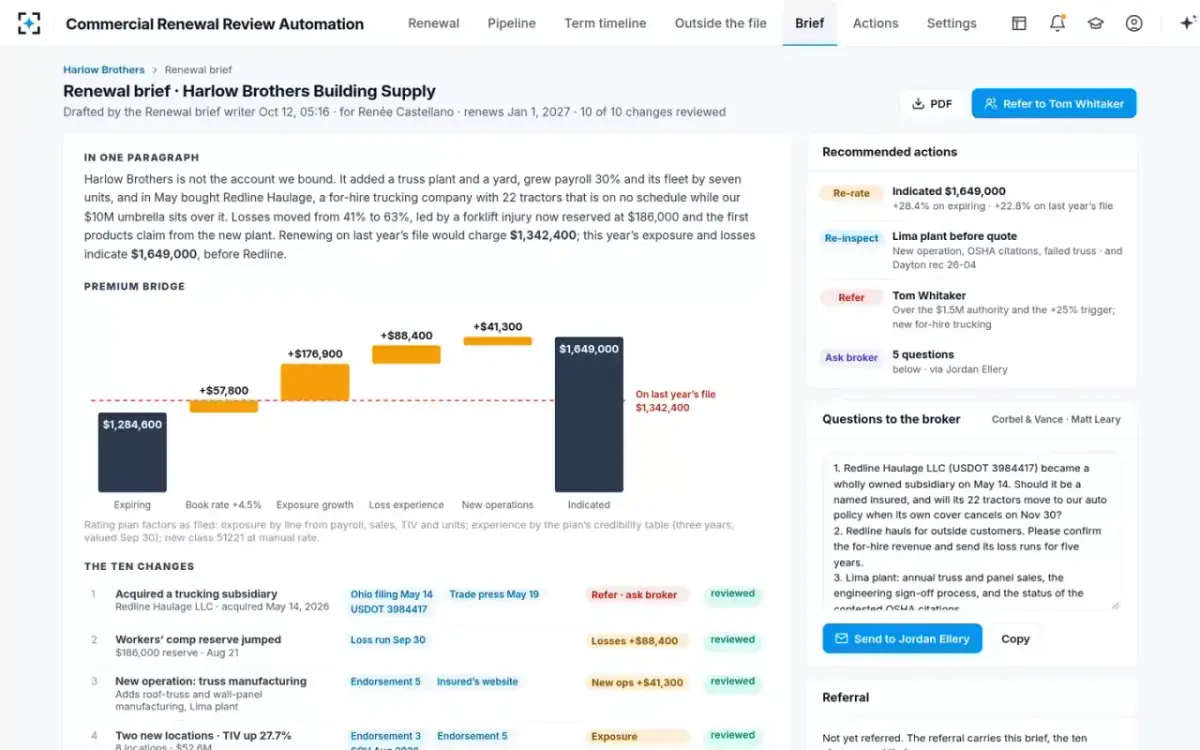
On the sample account the five questions run in order of importance: whether the trucking subsidiary should be a named insured and whether its trucks move to the carrier's auto policy; its for-hire revenue and five years of its loss runs; the new plant's sales, engineering sign-off and the status of contested OSHA citations; completion of the open sprinkler recommendation; and driving records for nine new drivers. The last is one a carrier can also obtain itself, since federal law lets an insurer use motor vehicle records for rating and underwriting (18 U.S.C. § 2721(b)(6)).
How early should a renewal submission be sent?
Early enough that the carrier can read it, refer it if needed and send any notice before the state's deadline, which in New York and Illinois falls 60 days before expiry for a nonrenewal or a materially worse renewal. In practice that means the carrier's questions should go out by about 90 days and the answers come back within a few weeks.
A carrier that has already read its own files at 90 days changes the timing. Instead of waiting for a full submission and then reading it, it drafts a short list of questions by day 81, as the sample desk did, and spends the waiting time on its own referral and re-inspection. The renewal timeline works back from the notice dates seat by seat.
What to gather before Commercial Renewal Review Automation goes live
Going live is mostly a question of access and rules, not data entry: the agents read what the carrier already holds, so the work is pointing them at it and writing down the carrier's own thresholds. The list below is what a carrier gathers in the weeks before the first renewal window.
What a carrier brings to go live
- Read access to the policy system
The renewal list, expiring terms, endorsements and schedules. The agents never write to it.
- Loss runs and reserve history from the claims system
At least the run used at last renewal and the current one, with valuation dates.
- Payroll, sales and audit reports
Mid-term reports and the last completed audit, by class.
- Statements of values and their revisions
With the dates each was received.
- Risk engineering surveys and the recommendation log
Including promised completion dates.
- The filed rating plan factors
So the premium bridge prices changes the way the carrier is allowed to.
- Underwriting guidelines and the authority grid
Who may renew what, and the referral trigger; on the sample desk $1.5 million or 25%.
- Materiality thresholds
What counts as a change: on the sample desk payroll or sales 10%, three power units, a $50,000 or 100% reserve move.
- The public sources the carrier allows
Business filings, OSHA, motor carrier registrations, recalls, dockets, press, and the match score to show.
- A sample of upcoming renewals
To run before the first live window, with underwriters comparing what they would have priced.
The rules a carrier sets before go-live: window, thresholds, sources and authority
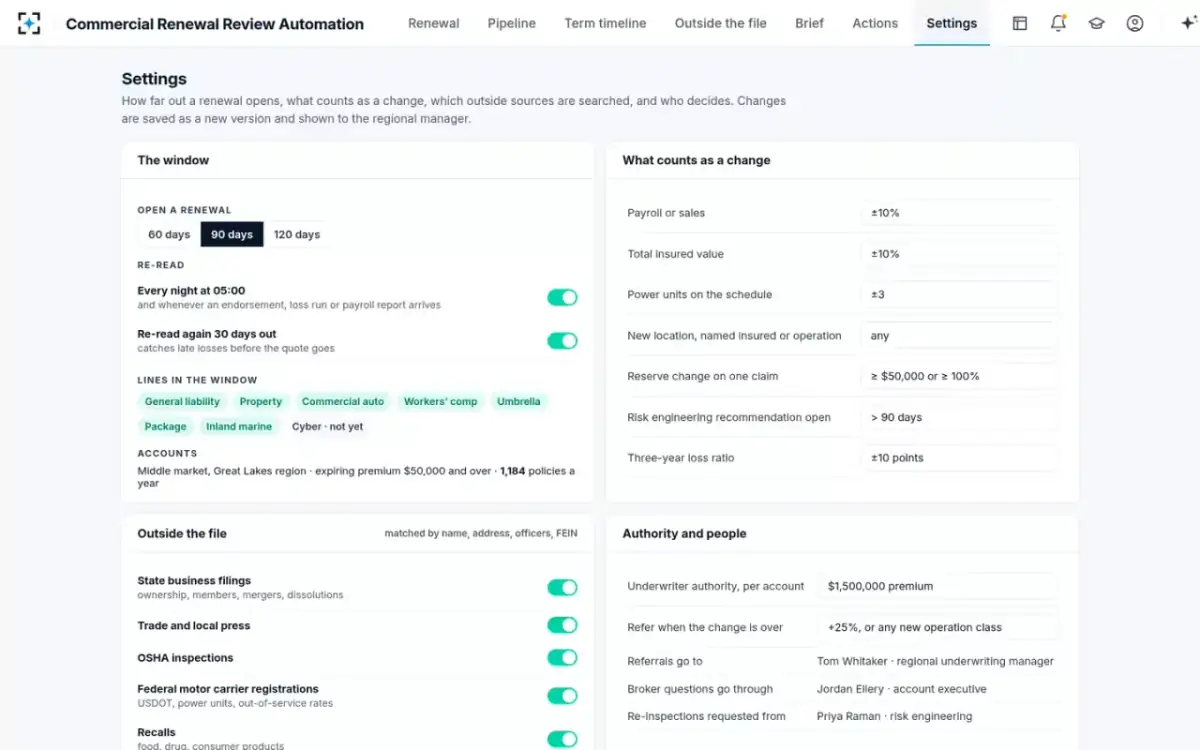
Two items deserve a decision before go-live rather than after. The first is screening: the Treasury's sanctions office asks insurers to consider screening at renewal and amendment, not only at issuance (OFAC insurance FAQs), and the names a re-read adds, new subsidiaries and named insureds, should go through the carrier's sanctions process. The second is documentation: examiners check that underwriting rests on adequate information gathered at or near inception (NAIC exam standards, chapter 21), and a renewal re-read whose changes cite their sources is that information, if the carrier keeps it with the file. How a desk adopts the re-read covers the first two renewal windows.
Questions people ask
What is a renewal questionnaire?
A renewal questionnaire is a short form a carrier asks the insured to complete before renewal, confirming or updating exposures, operations, ownership and losses since the last term. The most useful ones are specific: they ask about changes the carrier has already found and add a general declaration for anything else.
What is a submissionless renewal?
It is a renewal the carrier prices without asking the insured for a new application, from what it already holds: the expiring policy, endorsements, audits, loss runs and surveys. It works for accounts that changed little; it misses changes that happened outside the policy file, such as an acquisition, unless the carrier also searches public records.
Does the incumbent carrier need loss runs from the broker?
Not for the lines it writes; it holds its own claims history and can run it at any valuation date. It needs other carriers' loss runs for lines it does not write, and it should compare its current run with the one it used at the last renewal to see new claims and reserve changes.
How long does it take to prepare a commercial renewal submission?
No public source measures it, and it varies with the account. A full submission can take a broker weeks on a large account with many locations; a targeted request built from the carrier's own reading, a handful of specific questions, can be answered in days, which matters when notice deadlines fall 60 days before expiry.
Can a carrier renew without new payroll figures?
It can renew on the latest payroll it holds, and on auditable lines the audit will settle the actual figure after the term. But the deposit premium will be wrong if payroll has grown, and new classes of employee will not be rated until they appear; on the sample account payroll had grown 30.2%, mostly in a new manufacturing class.