To read a loss run report, work in four passes: the header (insured, carrier, policy numbers and periods, and the valuation date the figures are as of), the claim rows (claim number, date of loss, date reported, coverage, description and status), the money columns (paid, reserve or outstanding, and total incurred, with or without adjusting expense), and finally what the report leaves out. That last pass matters most, because the column a run is most likely to omit is the reserve on open claims, and without it an open claim shows only what has been paid so far. Botminds' Loss Run Analysis Automation reads runs in any layout into one set of fields, marks what each carrier did and did not report, and ties every figure to its row, so an underwriter reads the account rather than the carriers' formats.
The worked examples use a fictional sample account, Calloway Cold Freight, a refrigerated trucking and cold storage business whose five prior carriers' runs were read by the solution; every company, carrier and claim is invented. Definitions are from the Casualty Actuarial Society's ratemaking text, and the legal points from the state statutes, linked where they appear.
One open claim on two kinds of loss run: what the underwriter can and cannot see
A paid-only run: $61,250, loss and expense paid to date
A run that shows reserves: $61,250, split as $48,900 loss and $12,350 expense
A paid-only run: Not shown
A run that shows reserves: $350,750 outstanding: $318,600 loss and $32,150 expense
A paid-only run: Not shown, or shown as $61,250
A run that shows reserves: $412,000
A paid-only run: Open
A run that shows reserves: Open, in suit since 9 June 2026
A paid-only run: Paid went up; nothing says why
A run that shows reserves: $115,000 at the September 2025 evaluation, up $297,000
A paid-only run: Paid basis: $237,200 against $804,600 premium, 29.5%
A run that shows reserves: Incurred basis: $601,150 against $804,600, 74.7%
The left column is not a strawman. A run that shows paid losses on every claim, with dates, meets Florida's statutory definition of a loss run statement, and Florida, Louisiana and New York's open-claim list do not require reserves. On this claim the paid-only view understates the cost by $350,750, or 85%, and turns the worst policy year on the account into one of its better ones. The state-by-state rules are in loss run requirements by state.
What is on a loss run report?
A loss run report lists every claim a carrier recorded on an insured's policies for a period, with dates, a short description, status and money. There is no single industry layout. Maine's statute gives one of the fuller legal lists for property and casualty lines: the name of the insured, the date of the loss, "the date the claim was received by the insurer", a description, any amount paid, any amount reserved, and whether the claim is open or closed (24-A M.R.S. § 3042). Most commercial runs carry those fields and add policy numbers, coverage codes and totals.
The fields on a commercial loss run, what each means, and what to watch
| Field | What it means | What to watch |
|---|---|---|
| Valuation or run date | The date the figures are as of | The single most important date on the page; reserves and late claims move after it |
| Policy number and period | Which policy the claim fell under | Gaps between periods, and years with no policy listed |
| Claim number | The carrier’s identifier | Two numbers for one accident under two coverages |
| Date of loss and date reported | When it happened, and when the carrier heard | A long gap often means a liability or cumulative injury claim |
| Coverage or line | Auto liability, physical damage, GL, WC and so on | Codes differ by carrier: AL, LIAB, BI, PD |
| Description | What happened, in a few words | The only clue to severity on a paid-only run |
| Status | Open, closed, reopened | Closed without payment counts in frequency, not severity |
| Paid | Amounts paid to date | Whether expense is in it or in a separate column |
| Reserve or outstanding (O/S) | The carrier’s estimate still to pay | Missing entirely, or loss only without expense |
| Total incurred | Paid plus reserve | Whether it includes adjusting expense; never add one carrier’s to another’s without checking |
Read the header first: the carrier, the policies and the valuation date
The header tells you whose view of the account this is and as of when. Before any claim row, write down three things: the carrier, the policy numbers and periods covered, and the valuation date. Everything below is that carrier's estimate on that date.
On the sample account the five runs were valued on five dates: 30 September 2026, 31 August, 15 August, 30 June, and one on 1 March 2023. The last is not a mistake by the broker so much as a pattern: the same March 2023 run had been sent with the account three years running, so its policy year sat flat at $75,550 while every other year moved. A run's age is the first test of whether its reserves mean anything, and currently valued loss runs sets out how old is too old.
The policy periods are the second test. Lay them end to end against the prior carriers the application lists. On the sample, the application named an auto policy for 2021–22 that no run covered, so that year's auto losses were simply absent, and a total that adds up the runs received looks better than the account is.
Reading the claim rows: dates, descriptions and status
Read each row for what kind of claim it is before reading what it cost. The date of loss places it in a policy year; the date reported, against the date of loss, hints at the type of claim; the description says what happened; and the status says whether the money column is final.
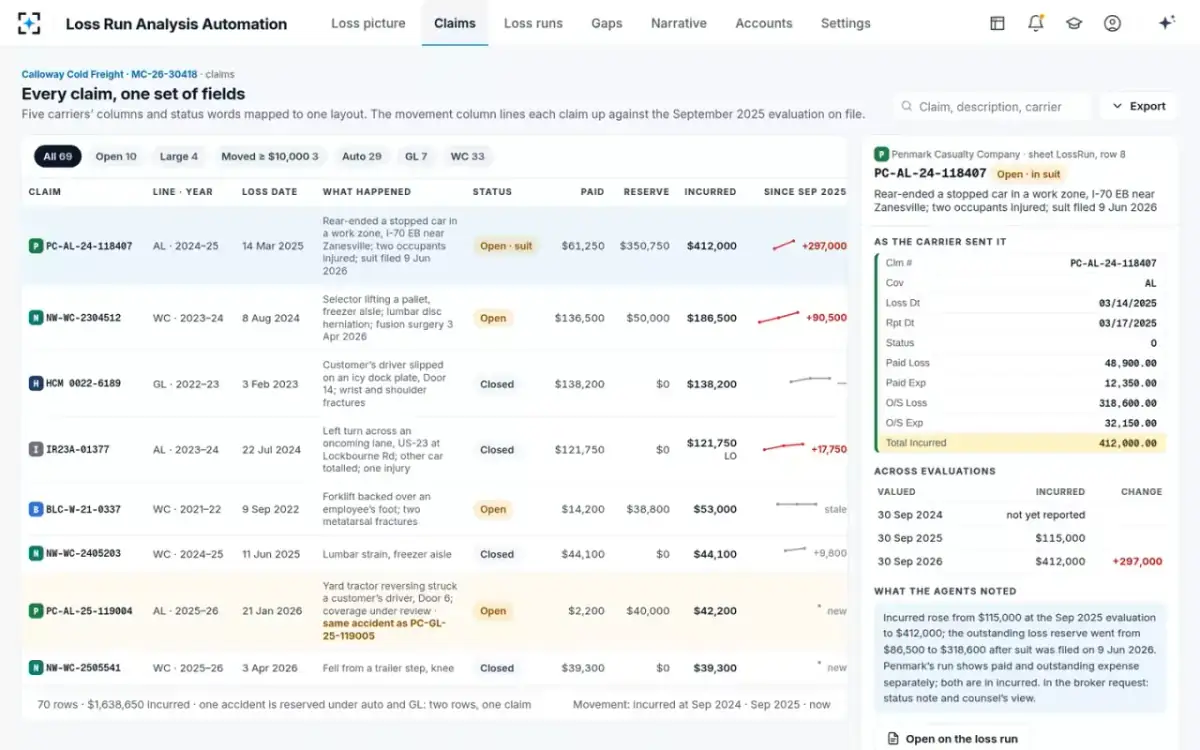
Three patterns repay attention. A claim reported months after the date of loss is often a liability or cumulative injury claim, and those tend to develop. A row closed with nothing paid still counts as a claim: on the sample desk such claims count in frequency and carry $0 incurred. And one accident can appear twice. On the sample account, a yard tractor striking a customer's driver was reserved under both auto and general liability, $69,000 together; counted twice, it would overstate frequency. The sample desk counts the accident once and keeps both coverages' reserves exactly as reported.
Every claim from five carriers in one set of fields, with the carrier's own row beside it
What does total incurred mean on a loss run?
Total incurred is what has been paid on a claim plus what the carrier still expects to pay, its case reserve. The Casualty Actuarial Society describes the case reserve as "an estimate of the amount of money required to ultimately settle that claim", and adds that "the case reserve excludes any payments already made" (Werner and Modlin, Basic Ratemaking, ch. 1). Paid plus reserve is therefore the carrier's current view of the claim's full cost, not a final figure.
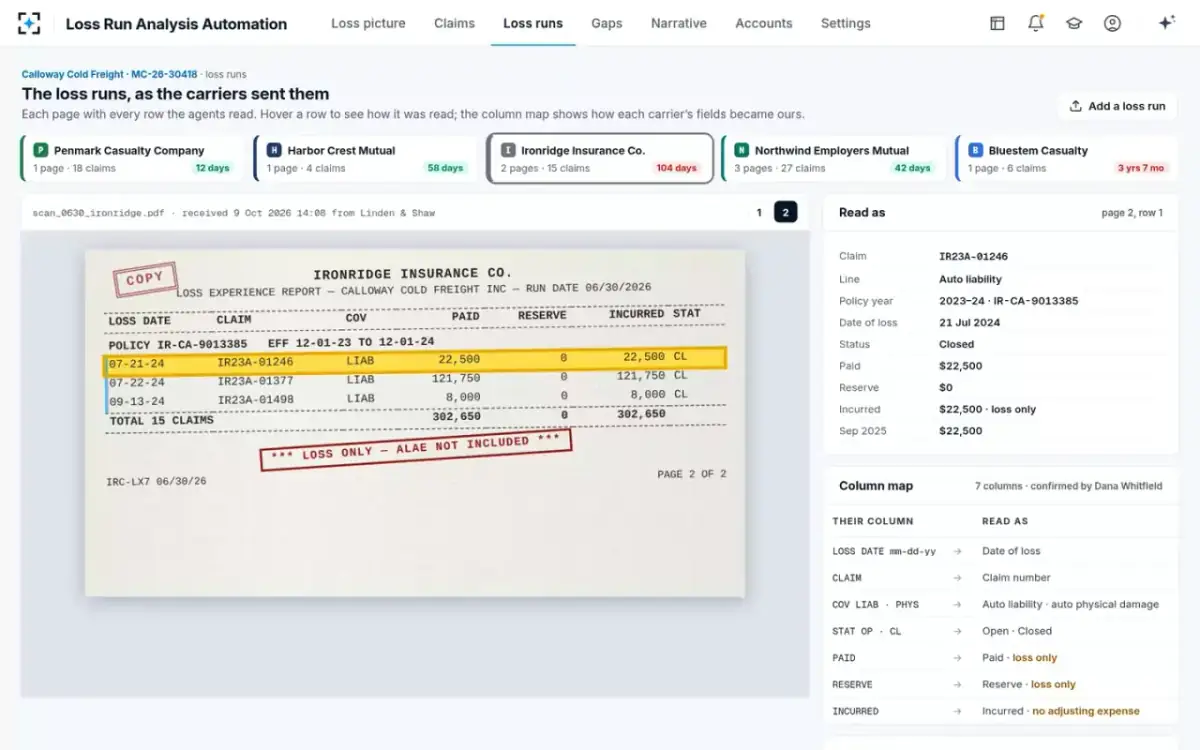
Two words on the run decide whether incurred figures can be compared. The first is "expense": many carriers include allocated adjusting expense, such as defence counsel, in paid and reserve; others show loss only. The sample's spreadsheet run printed paid expense and outstanding expense in their own columns and added them into total incurred; the scanned run carried a stamp, "loss only, ALAE not included". The second is "as of": an incurred figure is a reserve estimate on a date. The difference between paid and incurred, and how one claim's incurred figure travels into a summary, is traced step by step in incurred vs paid losses.
A scanned run that shows loss only, read row by row, with its stamp carried into the mapping
Why does my loss run show only paid losses?
Usually because the carrier chose to, and in several states the law allows it. Florida's statute defines a loss run statement around paid losses and says no reserve information is required; Louisiana's commercial-lines rule says the same; New York's list for open claims names payments and no reserve. The law also lets a carrier leave out the claim file: Florida's definition says the term "does not include supporting claim file documentation", such as investigation reports and evaluation statements (Fla. Stat. § 627.444(1)(a)).
A paid-only run is not wrong; it answers a narrower question. On a short-tailed line where most claims close within months, paid and incurred converge quickly. On auto liability, general liability and workers' compensation, where large claims stay open for years, a paid-only run reports the early, cheap part of the most expensive claims. On the sample's policy year 2024–25, four of 18 claims were still open, and $363,950 of the year's $601,150 was reserve rather than payment.
How much of each policy year a paid-only run would miss
The pattern is the general one. The most recent years are the least mature, so the share still in reserve is highest exactly where the underwriter's interest is highest. The 2021–22 bar is an exception that proves the rule: its run is more than three and a half years old, so its "current" reserve is a 2023 estimate on a claim nobody has re-checked.
Do loss runs show reserves, and what can you do when they don't?
Many do, many don't, and the law in several states leaves it to the carrier. When a run shows no reserves, the underwriter has three moves: ask the broker for a status note on each open claim that could be large, ask the prior carrier for detailed information where the state gives the insured that right, and price the remaining uncertainty openly. Of the laws reviewed, only Oregon's rule sets a freshness standard, a valuation no older than 90 days before the request (OAR 836-080-0800).
A reserve, where it exists, is still an estimate, and estimates move both ways. On the sample account, one workers' comp claim went from $96,000 to $186,500 in a year after a fusion surgery, while another auto claim moved $17,750 and closed. That is why a reserve on one run is less useful than the same claim's reserve on two runs a year apart: the movement shows how the carrier's view is changing. In Louisiana, a new insurer may not refuse an applicant solely because it cannot get reserves, which is a reason to have a written way of handling their absence rather than an informal one.
A reading order an underwriter can follow
Reading a run well is mostly reading it in the right order, so that each figure is interpreted with what it depends on already known. The checklist below is the order the sample desk's agents follow, and an order a person can use with a pen.
How to read a loss run report in ten steps
- Note the carrier, the policy periods and the valuation date
Everything else is that carrier’s view on that date.
- Lay the periods against the application’s prior carriers
A year no run covers is a gap, not a clean year.
- Check the totals foot
Add the rows on each page and compare with the page or period total; a scan can misread a figure.
- Find out whether expense is in paid, reserve and incurred
Look for separate expense columns or a "loss only" note.
- Read status before money
Open, closed, reopened, closed without payment.
- Flag every open claim and its reserve
Or its absence, if the run is paid-only.
- Look for one accident under two coverages
Same date, same description, two claim numbers.
- Compare with the last evaluation you have
What moved, what is new, what closed.
- Mark the large losses against your own threshold
And read their descriptions, not just their amounts.
- List what is missing before you summarise
Years, carriers, reserves, a current valuation.
Loss run vs loss summary: which one does the underwriter price from?
The loss run is the carrier's report; the loss summary is the underwriter's table built from all the runs, by policy year and line, with claim counts, paid, reserve, incurred, premium and loss ratio. Underwriters price from the summary, which is why the quality of the summary depends on how the runs were read. A summary that adds a loss-only run to one that includes expense, or that counts one accident twice, is precise and wrong.
In the solution the summary is built by the agents and accepted by the underwriter, and each number in it opens the row it came from. On the sample account that meant 69 claims across five policy years and three lines, $1,638,650 incurred against $3,706,400 of premium, with the missing auto year, the stale runs and the loss-only scan stated as data limits rather than smoothed over. The agents give no view on price.
Questions people ask
What does O/S mean on a loss run?
Outstanding: the amount the carrier still expects to pay on an open claim, its case reserve. Some runs split it into outstanding loss and outstanding expense. Paid plus outstanding is the claim's incurred amount as of the valuation date.
What is a reserve on a loss run?
The carrier's estimate, on the valuation date, of what remains to be paid on a claim, excluding what has already been paid. It is set by an adjuster or by formula and changes as the claim develops. A run with no reserve column cannot show how expensive the open claims are expected to be.
Can an insurer decline me because reserves are missing from my loss runs?
In Louisiana, not solely for that reason: a prospective insurer may not refuse an applicant only because it cannot get reserve information. Elsewhere the law compared here is silent, and an underwriter may ask for status notes or price the uncertainty. A broker can often avoid the question by sending a status note on large open claims with the runs.
What does closed without payment mean on a loss run?
A claim was reported and closed with nothing paid, for instance because it was not covered or was abandoned. It still shows the account generates claims, so many underwriters count it in frequency, as the sample desk does. It adds nothing to incurred.
Why do two loss runs show different totals for the same year?
Usually because they were valued on different dates, so reserves and late-reported claims differ, or because one includes adjusting expense and the other does not. On the sample account, policy year 2024–25 went from $252,850 at the September 2025 evaluation to $601,150 a year later.
Should I read the loss run or the loss summary first?
The summary first for the shape of the account, then the runs for the claims that drive it. A summary whose figures open their source rows lets you do both at once; one that was typed means re-checking the large claims against the PDFs anyway.