Loss runs for workers compensation list every injury claim on an employer's policy with its date of injury, a description, its status and, unlike most liability runs, its money split three ways: indemnity (wage-loss benefits), medical, and claim expense, each with paid and reserve. The split matters because it decides how a claim counts. A claim with no lost time is medical-only, and experience rating plans discount those, so the same $35,000 on a run can count very differently in the employer's experience modification depending on which column it sits in. Botminds' Loss Run Analysis Automation reads workers' comp runs with the three amounts kept apart, ties each claim to its policy year, and shows how each open claim moved since the last evaluation on file, so a workers' comp underwriter sees the claim as the rating plan will.
The rating examples use Washington's published experience rating formula, the one complete current plan found on an official state site, and they are illustrations: other states' plans use different values. The sample account, Calloway Cold Freight, is fictional, as are its carriers and claims.
One workers' comp claim on a loss run: three columns, and what each one feeds
Indemnity
Paid$18,400
Reserve$9,600
Incurred$28,000
Wage-loss benefits. Its presence makes this a lost-time claim, so in Washington’s plan the claim is not reduced as medical-only.
Medical
Paid$21,300
Reserve$4,700
Incurred$26,000
Treatment. The largest share of benefits nationally, and on a medical-only claim the one figure that counts.
Expense
Paid$2,100
Reserve$900
Incurred$3,000
Claim expense. Whether it is in incurred depends on the carrier’s report; whether it counts in a rating plan depends on the plan.
Claim total: $57,000 incurred, $41,800 paid, $15,200 reserve · lost time, open · if all $57,000 counted, Washington's formula gives primary $40,453 and excess $16,547
What is on a workers comp loss run?
A workers' comp run carries the same frame as any loss run, policy, period, claim number, date, description, status and valuation date, but its money columns follow the benefits. Maine's statute spells out the workers' comp version of loss information as the name of the claimant, the date and a description of the injury, and "any amount paid for medical expense, any amount paid for indemnity expense, any medical reserve, the total incurred losses and whether the claim is open or closed" (24-A M.R.S. § 2910(3)(C)). Most carriers' runs add an indemnity reserve and claim expense.
Two things are usually missing, by design. Diagnoses and medical records stay out: Oregon's rule says workers' comp loss runs "shall not include confidential worker medical and vocational claim records" (OAR 836-080-0810(2)), and a description such as "lumbar strain, freezer aisle" is as far as most runs go. And a run is a snapshot: a claim open at the valuation date may have been settled, reopened or raised since.
Where workers' comp money goes, nationally
$64.1B
workers’ comp benefits paid in the U.S. in 2023, medical and cash
47%+
of benefits paid were medical
55.6%
of benefits paid by private insurers; 25.6% by self-insured employers
What is the difference between indemnity and medical on a loss run?
Indemnity is what the claim pays the injured worker for lost wages and permanent impairment; medical is what it pays doctors, hospitals, therapy and drugs. Both are benefits, and both carry paid and reserve amounts on a good run. Expense, the cost of handling the claim, sits in a third column or inside the others, depending on the carrier.
Nationally the two are close to even. The National Academy of Social Insurance reports that medical benefits made up more than 47% of the $64.1 billion paid in 2023 (NASI, 2023 data), so cash benefits were just over half. On an individual employer's run the balance varies with the claims: a warehouse with many strains and few long absences shows mostly medical; one serious injury with surgery and months off work can be mostly indemnity.
Workers' comp benefits nationally: medical against cash
Benefits paid, 2023: $64.1 billion
- Medical · 47%
- Cash (indemnity) and other · 53%
What is a lost time claim on a loss run?
A lost-time claim is one that pays indemnity because the worker missed work beyond the state's waiting period or suffered a permanent impairment; a medical-only claim pays treatment and nothing for wages. On a run, the tell is the indemnity column: any indemnity paid or reserved makes it lost time. Some carriers print a claim-type code instead.
Washington's rating rule draws the line in its own terms: the medical-only treatment applies to "any claim without disability benefits (time loss, partial permanent disability, total permanent disability or death) either actually paid or estimated to be paid" (WAC 296-17-855). "Estimated to be paid" matters: a claim with an indemnity reserve and nothing yet paid is already lost time for rating, which is one more reason a run that shows paid amounts only can mislead on workers' comp.
Do medical only claims affect my experience mod?
Yes, but less than lost-time claims of the same size, in the plans that discount them. In Washington's 2026 plan every claim without disability benefits is first reduced by the lesser of $4,100 or its total cost before it enters the formula, and the state notes the deduction is twice the average cost of such claims and on average removes about 70% of their actual loss (WAC 296-17-855). A $3,000 medical-only claim counts as nothing; a lost-time claim of $3,000 counts in full.
Same total on the run, different weight in the mod: Washington's own examples
| Claim on the run | Type | Counted after the deduction | Primary loss | Excess loss |
|---|---|---|---|---|
| $3,000 | Medical only | $0 | $0 | $0 |
| $5,000 | Medical only | $900 | $900 | $0 |
| $5,000 | Time loss | $5,000 | $5,000 | $0 |
| $35,000 | Medical only | $30,900 | $29,751 | $1,149 |
| $35,000 | Time loss | $35,000 | $31,911 | $3,089 |
| $150,000 | Permanent partial disability | $150,000 | $54,967 | $95,033 |
The table is the case for reading the indemnity column before the total. Two $5,000 claims on the same run, one medical-only and one lost time, enter the mod at $900 and $5,000. An underwriter or broker who reads a workers' comp run like a general liability run, by total incurred alone, will overweight an employer's small medical-only claims and underweight how much its lost-time claims cost. How a mod is checked against the claims behind it is the subject of the experience mod review guide.
How the three columns feed the mod: primary and excess
Experience rating weighs the first part of each claim more heavily than the rest, because the frequency of small losses predicts an employer's future better than the size of one large one. Washington's rule describes primary loss as the first-dollar portion of claims, the part actuarial studies find more predictive of future losses, and the remainder as excess (WAC 296-17-855). The 2026 formula treats any claim up to $28,180 as entirely primary and splits larger ones.
Two $5,000 claims on the same run can enter the mod at $900 and at $5,000. The indemnity column decides which.
That formula is why a workers' comp loss run's details move premium. Each claim's total, after any medical-only deduction, is divided into primary and excess; each part is credibility-weighted against what an average employer with the same payroll by class would expect; and the ratio is the mod. A reserve that rises on an open lost-time claim raises its primary and excess loss at the next rating; a claim reclassified from lost time to medical-only falls. The mod itself is calculated by a rating organisation or, in Washington, the state fund, from the claim data carriers report, not from the run, which is why a run that disagrees with the data behind a mod is worth raising.
Why do workers comp loss runs show reserves?
Because workers' comp claims stay open for a long time and pay over months or years, so paid amounts alone describe only the start of a serious claim. The reserves on indemnity and medical are the carrier's estimate of what is still to come, and on a lost-time claim with surgery they are often most of the claim.
The sample account shows both sides. One claim, a warehouse selector's lumbar disc herniation, stood at $96,000 at the September 2025 evaluation and $186,500 a year later after fusion surgery: $136,500 paid and $50,000 still reserved, open. Another workers' comp run, valued in March 2023, showed a forklift injury open at $53,000, of which $38,800 was reserve; three and a half years later nobody on the submission knew what that claim was worth. The first is development the underwriter can see because two evaluations were lined up; the second is a stale reserve that only a fresh run can fix. Why an old valuation is the bigger risk on long-tailed lines is set out in currently valued loss runs.
Workers' comp claims beside auto and general liability, with indemnity, medical and expense kept apart
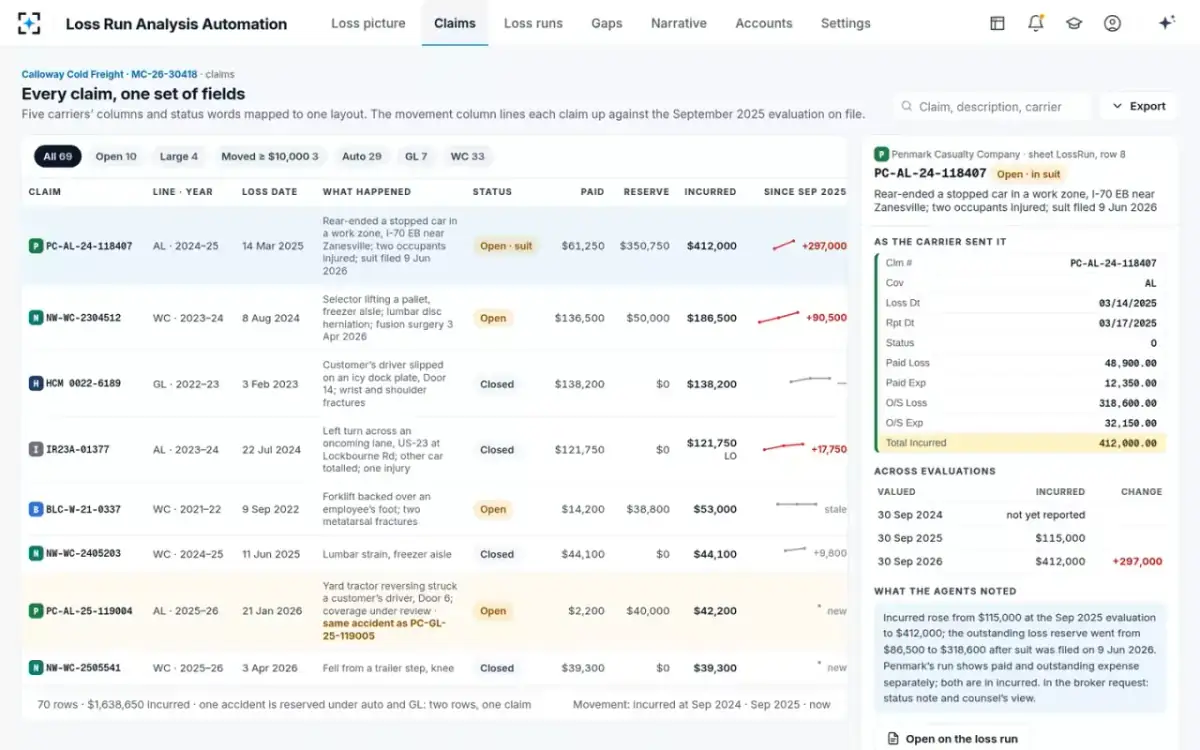
What a workers' comp underwriter reads first on the run
Open lost-time claims and their reserves come first, because they are the claims whose cost is still being decided and the ones that move the mod at the next rating. Then the count of medical-only claims, which costs little but says how often injuries happen; then the valuation date; then anything the run does not cover, such as a self-insured year or a carrier change mid-term.
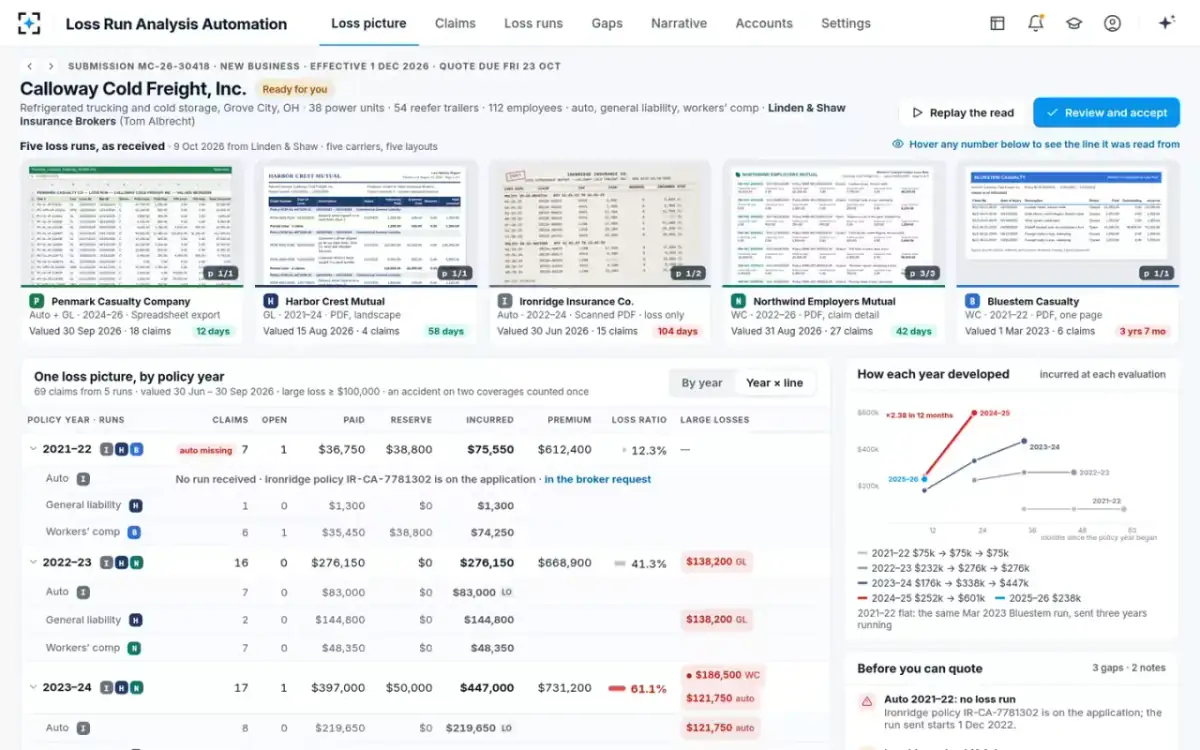
The order matters because the totals hide it. On the sample account, policy year 2024–25 carried $79,950 of workers' comp across seven claims, 99% of it already paid: a quiet year on the run. Policy year 2023–24 carried one open fusion claim whose $186,500 had nearly doubled in twelve months. A summary that ranks years by total incurred puts the two in the wrong order of concern; one that lists open lost-time claims with their movement since the last evaluation puts them in the right one. Priya, the sample desk's workers' comp underwriter, puts the question in a line: if a claim was open at the last valuation, what is it today?
How do I get workers comp loss runs?
From each carrier that wrote the policy, through the employer's broker or agent, and for self-insured years from the third-party administrator that handled the claims; in states with a monopolistic or competitive state fund, from the fund. The state laws on loss runs mostly cover workers' comp with other lines, though Oregon's rule singles out its confidentiality, and Maine defines the workers' comp contents separately. Clocks and look-backs by state are in loss run requirements by state.
Ask for the claim detail, not just the summary page. A one-page summary with totals by policy year is enough to see frequency, but not to tell lost time from medical-only or to see which reserves are open. On the sample account the workers' comp carrier's three-page claim-detail report was what let the solution keep indemnity, medical and expense apart for each of its 27 claims.
How many years of workers comp loss runs do I need?
Usually the experience rating period plus the current year: three complete years is the common rating period, and underwriters often ask for five. Washington's rule, for example, calculates expected losses for "each of the three years of the experience period" (WAC 296-17-855). The most recent year matters most to the underwriter, and a mod built on an earlier experience period may not include it at all; a current run catches the claims the mod has not seen yet.
Each policy year split by line, with the missing year shown
Questions people ask
Do loss runs affect workers comp premium?
Indirectly, through the experience mod and the underwriter's judgement. The mod is calculated by a rating organisation or state fund from claim data carriers report, and the run is the employer's and underwriter's view of the same claims. Open reserves on lost-time claims weigh most.
What is a medical-only claim?
A claim that pays treatment but no wage-loss or impairment benefits. Many experience rating plans discount them; Washington reduces each by the lesser of $4,100 or its cost before rating. On a run, a claim with nothing paid or reserved under indemnity is medical-only.
What is an indemnity reserve on a workers comp loss run?
The carrier's estimate of wage-loss and impairment benefits still to be paid on an open claim. A large indemnity reserve usually means extended time off work or a permanent impairment, and it is the figure most likely to move between evaluations.
Can workers comp loss runs include medical records?
They should not. Oregon's rule bars confidential worker medical and vocational claim records from workers' comp loss runs, and runs elsewhere typically carry a one-line description rather than diagnoses. An underwriter who needs more on a large claim asks for a status note.
Why does my workers comp loss run differ from my experience rating worksheet?
Usually because they are valued on different dates, the worksheet applies the plan's limits, splits and medical-only reductions, and the rating period may not include the most recent year. A claim can also be reported differently if it was reclassified. A difference that is not explained by those is worth taking up with the carrier.
Who handles the claims on my workers comp loss run?
The carrier's adjusters, or a third-party administrator for self-insured employers. How claims are managed is a different job from reading their history, and it is covered by Botminds' Workers' Compensation Claims Management.