Loss run requirements by state differ on every point that matters to a broker or an underwriter: how many days the prior carrier has to respond, how many years the run must cover, whether it must show reserves, whether the insured can be charged, and what happens if the carrier is late. Among the seven state laws compared here, the deadline runs from 10 days in New York to 30 days in Illinois and Maine, the look-back from three years to five, and only some require reserves at all. No federal rule applies. The run matters because commercial underwriters price from it, and a late or incomplete one holds up a quote; Botminds' Loss Run Analysis Automation reads the runs that arrive, flags the missing years and stale valuations, and drafts the request for what is still owed.
The statutes are quoted from each state's official text, and Oregon's rule from Cornell's Legal Information Institute copy of the Oregon Administrative Rules. This is a reading of the law for the desk, not legal advice; check the current text before relying on any one provision.
The same document, four different deadlines
10days
New York, on written request, under Insurance Law § 3426(g)
15days
Florida and Oregon, calendar days
20days
Kentucky, calendar days, with a fine for each day late
30days
Illinois and Maine
Which states require insurers to provide loss runs?
A minority of states put loss runs into statute or rule; the rest leave it to practice. When Florida's House staff analysed the bill that became § 627.444 in January 2020, they wrote: "Approximately 11 other states currently have statutory requirements for insurers providing loss run statements to insureds" (Florida House staff analysis, CS/CS/HB 269). That count is nearly seven years old and the staff named only two of the states, so it is a floor for orientation, not a complete list.
The seven laws below are the ones read in full for this guide. They are not a complete list, and they were chosen because each sets a different combination of clock, look-back and contents. In states with no specific statute, regulators still look at timeliness: the NAIC's market conduct examination standards include "Claims history and loss information is provided to the insured in a timely manner", and direct examiners to check whether loss information for the three previous years reached the first named insured within 30 days of a written request (NAIC Market Regulation Handbook, ch. 21, Standard 1).
Loss run requirements by state: seven laws side by side
| State and law | Who may ask | Deadline | Years | Reserves | Fee | If late |
|---|---|---|---|---|---|---|
| Florida, Fla. Stat. § 627.444 (2020, amended 2022), all lines except life | The insured, in writing | 15 calendar days after the insurer’s designee receives the request | 5 (group health 3) | Not required | One free a year | No penalty in the section |
| Louisiana, La. R.S. 22:1964(21), commercial lines | First named insured, by mail, fax or email | 10 business days; detailed information also 10 business days | 5 policy years | Not required; no refusal to insure solely for lack of them | Silent | Listed as an unfair or deceptive practice |
| Illinois, 215 ILCS 5/143.10a | First named insured | 30 days; detail incl. specific reserves within 20 days | 3 policy years | Total reserves on open claims, if any | Silent | A practice of refusing is an unfair trade practice; coverage extended day for day while detail is awaited |
| Maine, 24-A M.R.S. §§ 2910, 3042, casualty and property | Insured, agent or authorised representative, in writing | 30 calendar days; agent passes request on within 4 working days | Not stated | Amount reserved is part of the definition | Silent | No cancellation or nonrenewal for nonpayment while late, unless asked under 45 days before expiry |
| New York, Ins. Law § 3426(g), commercial lines | First-named insured or its agent or broker, in writing | 10 days | Set by regulation, or the coverage period if less | Open claims show payments only | Reasonable fee for information on request | No penalty in the subsection; every notice under § 3426 must mention loss information |
| Kentucky, KRS 304.20-100 (2012), commercial P&C | Insured or the insurer’s agent, in writing | 20 calendar days; agent copies the insured within 5 | 5 | Silent | One free | $100 to $250 a day (KRS 304.99-082) |
| Oregon, OAR 836-080-0800 to 0810 (2011), commercial property, liability, auto | Current or prior commercial policyholder | 15 calendar days | 5 | Paid amounts on all reported claims required | Silent | Unfair trade practice under ORS 746.240 |
The table shows why a request desk cannot work from habit. A broker in Louisiana can expect a commercial run in two working weeks; the same request in Illinois has a month. A Florida run need not carry reserves, a Maine one does by definition, and an Illinois one must show them on open claims if the carrier has set any. A desk that writes to every prior carrier in the same words, with the same follow-up date, is leaving the strongest lever in each state unused.
How long does an insurance company have to provide loss runs?
Between 10 days and 30 days in the states compared here, counted from receipt of a written request, with Louisiana counting business days. The precise trigger matters as much as the number. Florida's 15 calendar days run from when "an individual or entity designated by the insurer receives the insured's written request" (§ 627.444(2)), so a request sent to the wrong mailbox may not start the clock.
Days a prior carrier has to send a loss run, by state
Two states put a second clock on the people in between. Maine gives an agent who receives the insured's request four working days to transmit it to the insurer (§ 2910(2)), and Kentucky requires an agent who receives the run to give the insured a copy "within five (5) calendar days of receipt by the agent" (KRS 304.20-100(3)). On a submission with a fixed quote date, those days are part of the schedule.
New York ties the right to the renewal cycle. Every notice an insurer mails under § 3426, including a nonrenewal or conditional renewal notice, "shall advise the first-named insured and such insured's authorized agent or broker of the availability of loss information", and on written request the insurer must send it "within ten days of such request" (N.Y. Ins. Law § 3426(g)). Illinois goes further and sends the information unasked: the company "shall also send the loss information at the same time as any notice of cancellation or nonrenewal", except where the policy was cancelled for nonpayment, misrepresentation or fraud (215 ILCS 5/143.10a(1)).
How many years of loss runs must an insurer provide?
Five years in Florida, Louisiana, Kentucky and Oregon; three in Illinois; in New York a period the superintendent sets by regulation or the time the insurer has covered the account, whichever is less; and Maine's sections set no number. Where the insured has been with the carrier for less time, the laws that address it require the full history: Florida's run must cover "the preceding 5 years or, if the claims history is less than 5 years, a complete claims history with the insurer" (§ 627.444(4)).
The legal look-back and the underwriting look-back are different questions. The statute fixes what one carrier owes about its own policies. The underwriter needs every carrier for every year of the experience period, which on an account that moved its auto coverage twice in five years means three auto runs, and a gap wherever one never arrives. That gap is the item a broker request most often has to chase.
Do loss runs have to include reserves?
Not in most of the states compared. Florida says outright that "an insurer is not required to provide loss reserve information" (§ 627.444(5)); Louisiana says the same and adds a protection for the insured; New York's list for open claims names "amounts of any payments" and no reserve. Illinois requires "total reserves, if any" on open claims, and Maine's definition of loss information includes "any amount reserved for the loss".
No insurer shall be required to provide loss reserve information, and no prospective insurer may refuse to insure an applicant solely because the prospective insurer is unable to obtain loss reserve information.
Louisiana Revised Statutes 22:1964(21)(a)(ii)
The Louisiana sentence cuts both ways for an underwriter. The prior carrier may withhold reserves, and the new carrier may not decline the account for that reason alone. It does not stop an underwriter from asking for a status note on a large open claim or pricing the uncertainty. What a paid-only run hides, and how to read one, is worked through on a sample claim in how to read a loss run report.
Can an insurance company charge for loss runs?
Florida and Kentucky guarantee one free run; New York allows a fee on request; the other laws compared are silent. Florida's insurer "may not charge any fee to prepare and provide annually one loss run statement" (§ 627.444(6)), and Kentucky's insurer "shall not charge any fees to prepare and provide one (1) loss run statement" (KRS 304.20-100(6)), without Florida's annual reset. New York's insurer "may charge a reasonable fee as determined by the superintendent only for such information provided upon request", but not for information it is required to provide unasked (§ 3426(g)(3)).
Florida statute 627.444, line by line
Florida's statute is the most complete of the seven and the one brokers search for most, so it is worth reading whole. It applies to all lines of insurance except life insurers, carries its own rules for group health, and dates from 2020, amended in 2022.
Fla. Stat. § 627.444 in eight provisions
- Definition
A loss run statement contains the policy number, the period of coverage, the number of claims, the paid losses on all claims and the date of each loss; it excludes supporting claim file documentation such as investigation reports and privileged documents.
- "Provide" includes a portal
Sending a document electronically, or allowing access through an electronic portal to view or generate it, counts.
- 15 calendar days
From receipt by the individual or entity the insurer designates. For personal lines the insurer may instead explain how to get a free run from a consumer reporting agency.
- Agent of record told
When the run goes to the insured, the insurer notifies the agent of record.
- Five years
Or the complete history if shorter; three years for group health.
- No reserves required
"Notwithstanding any other provision of this section."
- One free a year
No fee to prepare and provide one statement annually.
- Scope
Not life insurers; for group health only the group policyholder may ask.
The definition is narrower than most underwriters' idea of a loss run. Paid losses on all claims, with dates, is the legal minimum; claim descriptions, open or closed status, reserves and adjusting expense are not in it. A Florida carrier that sends exactly what the statute requires has complied, and the underwriter has an account history with no view of open claims at all.
What happens if a carrier does not send loss runs?
The consequences range from a daily fine to an extension of the insured's coverage, and in several states the failure is an unfair trade practice. Kentucky fines an insurer or agent "not less than one hundred dollars ($100) nor more than two hundred fifty dollars ($250) for each day" a requested statement is not provided (KRS 304.99-082). Oregon makes a violation "an unfair trade practice for the purpose of ORS 746.240" (OAR 836-080-0810(3)), and Louisiana lists the failure among unfair or deceptive acts in the business of insurance.
Illinois and Maine protect the insured's coverage instead. In Illinois, while the insured waits for detailed information a prospective insurer asked for, coverage "shall automatically be extended at the same terms and conditions" by the days the insurer takes (215 ILCS 5/143.10a(2)), and only a failure "with such frequency so as to indicate a practice" is an unfair trade practice. Maine bars cancellation or nonrenewal for nonpayment of premium while the insurer is late, unless the insured asked fewer than 45 days before the policy expires (§ 3042(1)).
For the prospective carrier, the practical consequence is the quote date. A run that the law says is due in 15 days and has not arrived on day 20 is worth one follow-up naming the statute and the receipt date. A run that is not owed at all, such as reserves in Florida, is worth a different request: a status note on the open claims that matter.
What a request desk needs: a state table, not a habit
A desk that handles accounts in several states needs the deadline, look-back and reserve rule for each prior carrier's state in front of whoever writes the request. The request itself then states the law it relies on, the date of receipt, and exactly which years and lines are missing.
What is missing, and the request drafted with a reason for each item
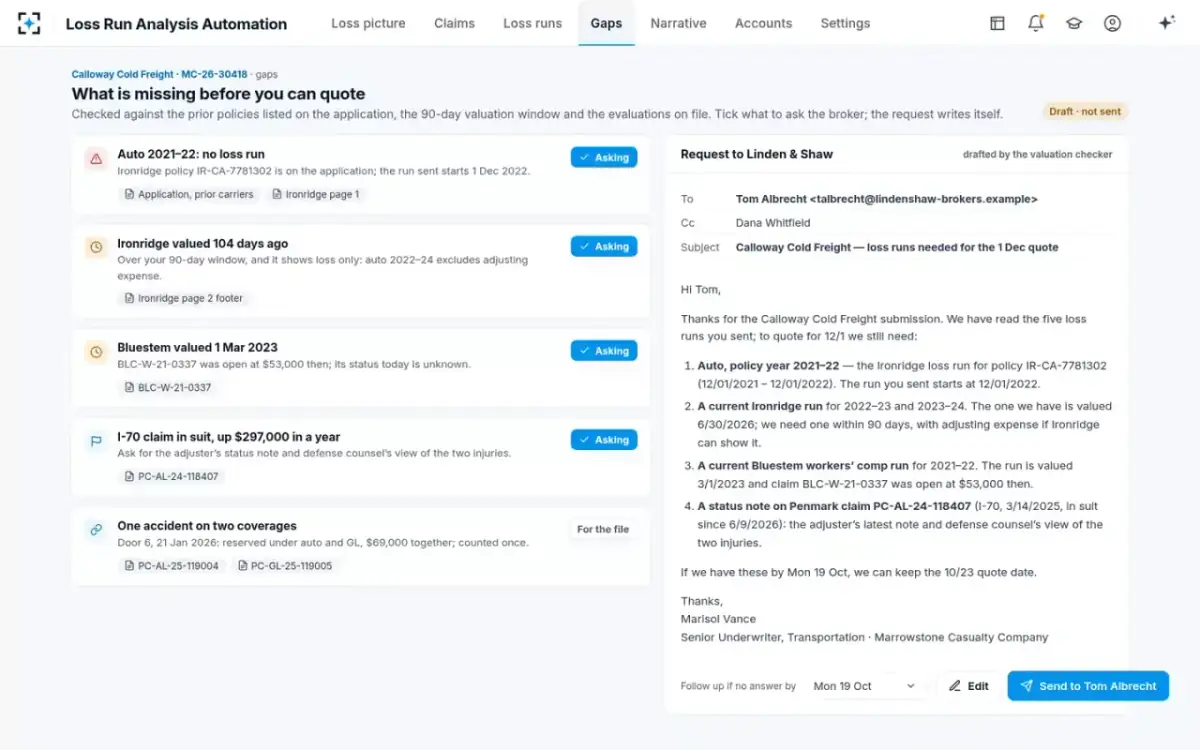
The solution's part is upstream of the law. Its agents check every run that arrives against the prior carriers listed on the application, the desk's valuation window and the evaluations on file, so the missing auto year and the two stale runs on the sample account were listed before the underwriter opened the file. It does not decide which state's statute governs a prior carrier or send anything to a broker. Why a desk's valuation window and Oregon's 90-day rule are different things is set out in currently valued loss runs.
Questions people ask
Is there a federal law requiring insurers to provide loss runs?
No federal statute requires it; loss runs are a state matter, like most insurance regulation. Where a state has no specific law, the NAIC's examination standards still direct market conduct examiners to test whether loss information reached the insured in a timely manner.
Does Louisiana require loss runs in 10 days?
For commercial property and casualty lines, yes: ten business days from receipt of the first named insured's written request, covering five previous policy years. More detailed information a prospective insurer reasonably needs is also due within ten business days, and reserves need not be given.
Do personal lines loss runs follow the same rules?
Not always. Florida's statute covers personal lines too but lets the insurer instead tell the insured how to get a free report from a consumer reporting agency. Louisiana, Kentucky and Oregon's rules in this guide apply to commercial lines only.
Who can request a loss run on behalf of a business?
The insured, and in most of these laws its agent or broker: Maine names an insurance agent or other authorised representative, Kentucky the insurer's agent, New York the insured's authorised agent or broker. Oregon's rule lets current and prior commercial policyholders ask the insurer or its appointed producer of record.
Can a loss run be sent through a portal instead of by email?
In Florida and Kentucky, yes: both define "provide" to include allowing access through an electronic portal to view or generate the document. Louisiana requires a reply by mail and, if the request came another way, by that same means.
Does a loss run have to be currently valued?
Only Oregon's rule, among the laws compared, sets a limit: the insurer's latest valuation, and never one older than 90 days at the date of the request. Elsewhere, how fresh a run must be is the prospective underwriter's requirement, not the prior carrier's duty.