Incurred vs paid losses is the difference between what an insurer has already paid on its claims and what it expects those claims to cost: paid losses are payments to date, and incurred losses are paid losses plus the case reserves set for what remains to be paid. On a closed claim the two are equal; on an open one incurred is higher, sometimes many times higher. On commercial loss runs the comparison is harder than the definition, because some carriers include allocated loss adjustment expense in both figures and others report loss only, so an underwriter adding runs together can add unlike numbers. Botminds' Loss Run Analysis Automation reads each carrier's columns into one set of fields, marks the loss-only runs, and keeps every summary figure tied to the cell it came from, which is what this guide traces on one claim.
The claim is from a fictional sample account, Calloway Cold Freight, whose five prior carriers' runs were read by the solution; every company, carrier and claim is invented. Definitions are quoted from the Casualty Actuarial Society's Basic Ratemaking by Werner and Modlin.
One figure's path: $412,000 from a carrier's row to the underwriter's summary
Agent
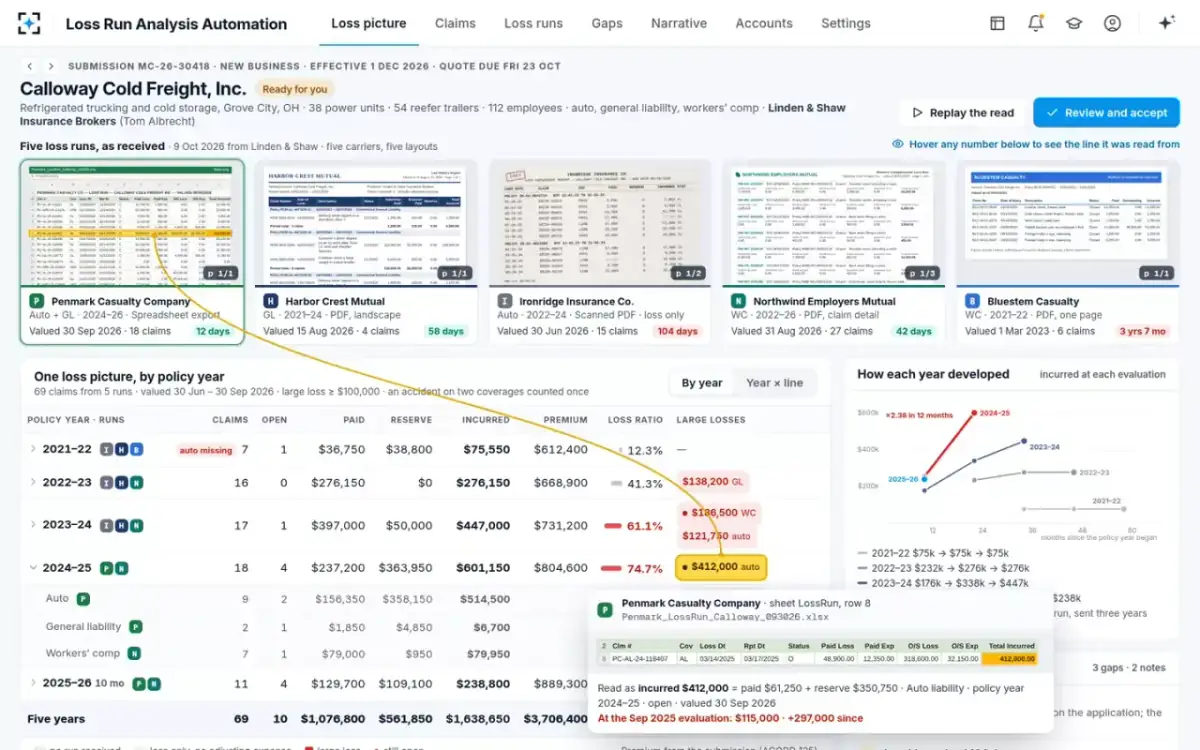
Loss run readerReads row 8 of the prior carrier’s spreadsheet: paid loss $48,900, paid expense $12,350, outstanding loss $318,600, outstanding expense $32,150, total incurred $412,000. Ties all 18 rows to the sheet total of $674,550.
Never: No figure without its sheet, row and column.
Agent
Field mapperApplies this carrier’s confirmed column map: paid loss plus paid expense is paid ($61,250); outstanding loss plus outstanding expense is reserve ($350,750); expense is included in incurred.
Never: Never assumes incurred includes expense unless the run says so.
Agent
Policy period matcherDate of loss 14 March 2025 under policy PCA-5521804 places the claim in auto liability, policy year 2024–25.
Never: A claim belongs to the policy in force on its date of loss.
Agent
Continuity checkerFinds the same claim at $115,000 on the September 2025 evaluation on file: up $297,000, now in suit.
Never: Never nets two coverages’ reserves.
Agent
Loss analystAdds it to 2024–25 auto ($514,500) and the large-loss list, and cites row 8 in the narrative.
Never: No price, credit or declination.
A person decides
UnderwriterHovers $412,000 to see row 8, reads the movement, accepts the summary and refers the account because an open claim exceeds $250,000.
What is the difference between incurred and paid losses?
Paid losses are money that has left the insurer; incurred losses are that money plus the insurer's current estimate of what is still to come on known claims. The Casualty Actuarial Society's ratemaking text puts it as an equation: "Reported loss or case incurred loss is the sum of the paid losses and the current case reserve for that claim" (Werner and Modlin, Basic Ratemaking, ch. 1). "Reported" and "case incurred" are the same thing; loss runs usually print it as total incurred.
Neither figure is the claim's final cost. The same text separates case incurred from estimated ultimate loss, which adds a reserve for claims not yet reported (IBNR) and for the shortfall that experience says case reserves will show (IBNER, development on known claims). Those reserves are actuarial and sit in the insurer's books, not on a loss run. The distinction is set out from the claims side in case reserves vs IBNR; for an underwriter reading a run, incurred means case incurred.
The sample account, five years, paid and incurred
$1,076,800
paid to date across 69 claims
$561,850
still in case reserves on 10 open claims
$1,638,650
total incurred: paid plus reserves
29% / 44%
five-year loss ratio on paid, and on incurred
What does incurred mean on a loss run?
On a loss run, incurred means the carrier's paid plus outstanding on each claim as of the run's valuation date, by that carrier's definition of what goes into each column. The phrase that matters is "by that carrier's definition". A run is a report from a claims system, not a standard form, and the same heading can cover different things.
On the sample account, the five carriers' runs used four conventions. One printed paid loss, paid expense, outstanding loss and outstanding expense in separate columns and summed them in total incurred. One carried expense inside its reserve. One scanned run carried the stamp "loss only, ALAE not included". The workers' compensation carrier split each claim into indemnity, medical and expense. All four printed a column called incurred, and two of them meant something different by it.
Hover the $412,000 and the carrier's row lights up, with last year's value
Does incurred include ALAE?
Sometimes, and the run has to say which. Allocated loss adjustment expense is, in the CAS text's words, "claim-related expenses that are directly attributable to a specific claim", with outside defence counsel as the example; unallocated expense, such as claims staff salaries, cannot be assigned to one claim and never appears on a run (Basic Ratemaking, ch. 1). Whether allocated expense sits inside paid, reserve and incurred is the carrier's choice of report.
The same claim, loss only and with allocated expense
Loss only: $48,900
Loss and allocated expense: $61,250
Loss only: $318,600
Loss and allocated expense: $350,750
Loss only: $367,500
Loss and allocated expense: $412,000
Loss only: None shown
Loss and allocated expense: $44,500, or 10.8% of incurred
Loss only: Over
Loss and allocated expense: Over
Loss only: Under
Loss and allocated expense: Over
The trouble starts when the two kinds are added together. A policy year whose auto losses come from a loss-only run looks cheaper than one whose losses include defence costs, by the expense share of every claim, and the difference is largest on litigated claims. The CAS text sets the rule for experience rating, and it holds for any comparison: "ALAE should be included in the experience component if it was included in the expected component" (Basic Ratemaking, ch. 15). In the solution, a loss-only run is marked LO in every total and never grossed up by an assumed expense ratio, so the underwriter sees the gap instead of a guess.
Why do incurred losses change?
Because a reserve is an estimate made with what the carrier knows on a date, and the carrier learns more. Payments are made, reserves are raised or cut, claims are reported late, and claims close for more or less than reserved. The CAS text calls the process loss development and notes that for long-tailed lines such as commercial general liability and workers' compensation "it may take many years for the ultimate amount to be known" (Basic Ratemaking, ch. 6).
The sample claim shows development in three readings. It was not yet reported at the September 2024 evaluation, stood at $115,000 in September 2025, and at $412,000 in September 2026, after suit was filed in June and the outstanding loss reserve went from $86,500 to $318,600. Paid moved far less over the same year. An underwriter who had only the latest run would see a large claim; one with both evaluations sees a claim whose estimate nearly quadrupled in twelve months, and asks why.
How each policy year developed, and the rows behind 2024–25
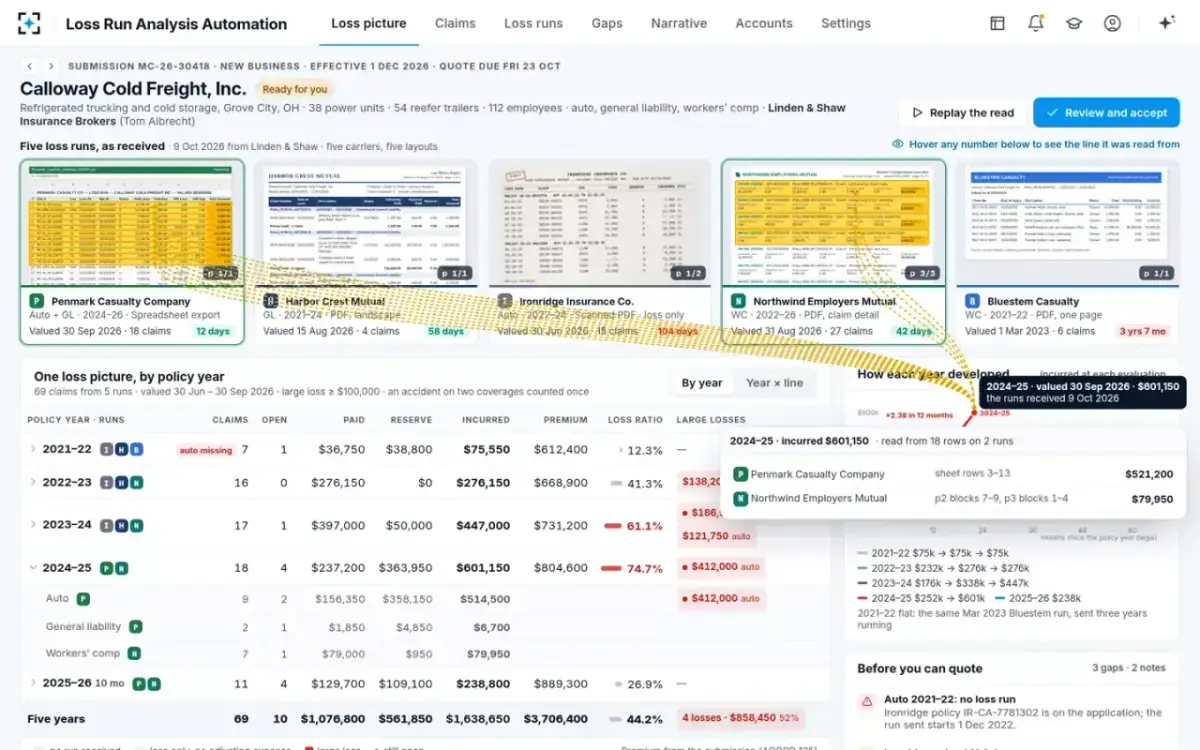
Development also explains why a flat line can be a warning. The sample's 2021–22 year sat at $75,550 on three evaluations because the same March 2023 run had been sent each time; its open workers' comp claim had not been re-valued in three and a half years. Incurred that does not change is not necessarily incurred that is right.
Incurred vs paid loss ratio: which one to price from?
For most commercial underwriting, incurred, because a paid ratio on recent years mostly measures how slowly claims pay. A paid loss ratio divides paid losses by premium; an incurred loss ratio divides paid plus reserves. The gap between them is widest on the youngest years and the longest-tailed lines, which is where the next policy's losses will come from.
Paid and incurred loss ratios, policy year by policy year
| Policy year | Premium | Paid | Paid ratio | Incurred | Incurred ratio |
|---|---|---|---|---|---|
| 2021–22 (run 3 years old) | $612,400 | $36,750 | 6.0% | $75,550 | 12.3% |
| 2022–23 | $668,900 | $276,150 | 41.3% | $276,150 | 41.3% |
| 2023–24 | $731,200 | $397,000 | 54.3% | $447,000 | 61.1% |
| 2024–25 | $804,600 | $237,200 | 29.5% | $601,150 | 74.7% |
| 2025–26 (ten months) | $889,300 | $129,700 | 14.6% | $238,800 | 26.9% |
| Five years | $3,706,400 | $1,076,800 | 29.1% | $1,638,650 | 44.2% |
Read down the paid column and the account improves sharply after 2023–24; read down the incurred column and 2024–25 is the worst year of the five. Neither is wrong as arithmetic. Only one of them is the account. A paid ratio has its uses: it involves no estimate, so it is a check on whether a carrier's reserves look plausible over time. It is a cross-check, not a basis.
Where paid and incurred part company: one policy year, three lines
The gap between paid and incurred is a property of the claims, not of the year. Split a single policy year by line and the same account shows a line that is almost fully paid next to one that is mostly reserve. The useful question for an underwriter is which line's incurred is resting on one or two estimates.
Policy year 2024–25 on the sample account, by line
| Line | Claims | Open | Paid | Reserve | Incurred | Share still in reserve |
|---|---|---|---|---|---|---|
| Auto | 9 | 2 | $156,350 | $358,150 | $514,500 | 70% |
| General liability | 2 | 1 | $1,850 | $4,850 | $6,700 | 72% |
| Workers’ comp | 7 | 1 | $79,000 | $950 | $79,950 | 1% |
| All lines | 18 | 4 | $237,200 | $363,950 | $601,150 | 61% |
The auto line's $358,150 of reserve is almost entirely one claim. Strip it out and 2024–25 auto is a modestly priced year; leave it in and the year's loss ratio is 74.7%. The workers' comp line, by contrast, is 99% paid, so its incurred figure carries almost no estimate at all. An underwriter who reads the year as one number misses that its whole story is a single reserve, which is exactly why the sample account was referred to the underwriting manager before quote.
How do you compare loss runs from different carriers?
By putting them on the same basis before adding them: the same valuation date or as close as available, the same expense treatment, the same claim-count rules, and the same policy-year boundaries. Where a basis cannot be matched, the honest move is to say so in the summary rather than adjust silently.
In practice that means four checks per run. Is expense in or out, and is it in paid, reserve or both? What is the valuation date, and how far is it from the others? Are claims closed without payment listed, and does the desk count them? Is one accident split across coverages? On the sample account the answers produced a summary with the loss-only years marked LO, two runs flagged as outside the 90-day valuation window, one accident counted once with both reserves kept, and the missing auto year shown as a gap. What a loss-only run does to a summary, and how an agent avoids filling the gap with an assumption, is covered in loss runs AI.
Accuracy means every summary figure keeps its source and its definition
A loss summary is accurate when each figure in it can be traced to a cell on a carrier's run and the definition that cell used. A total that is arithmetically right but adds a loss-only run to runs that include expense is not accurate; nor is one that cannot show where a number came from when an underwriting manager asks.
A citation in the loss narrative opens the carrier's own row
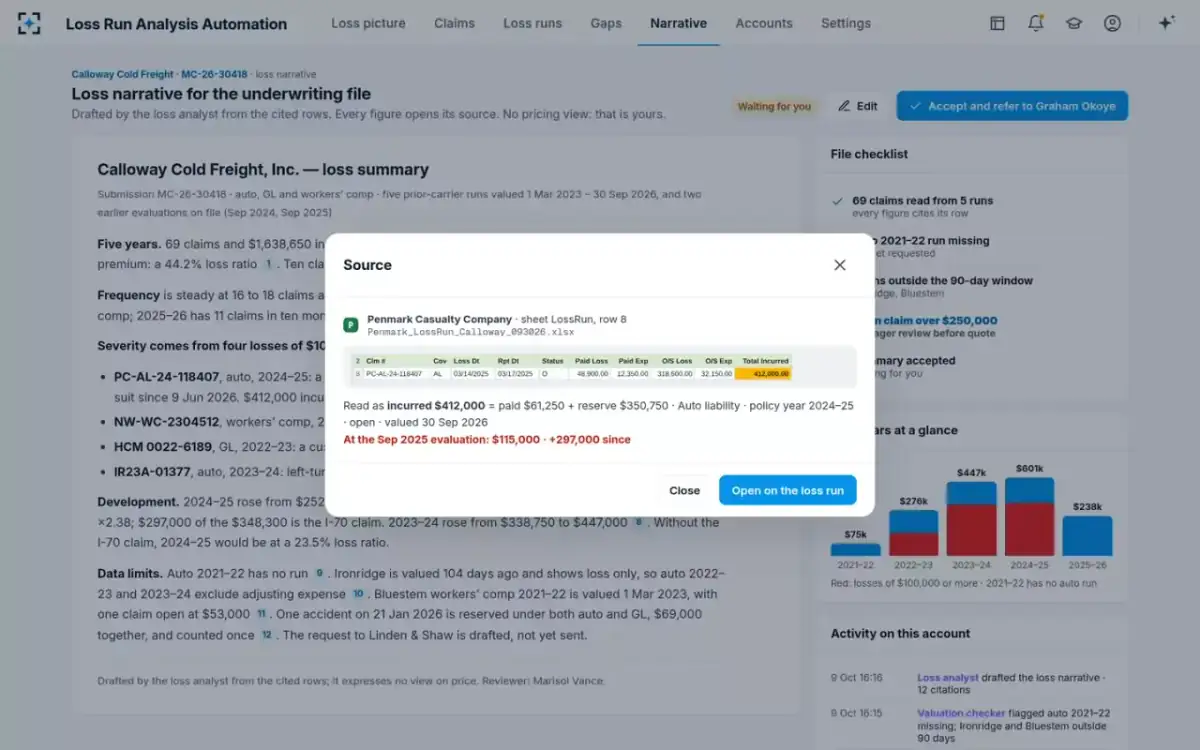
That standard is what an underwriting file needs when it is reviewed later, by a manager, an internal auditor or a market conduct examiner. It is also what makes the summary usable at renewal, when next year's runs arrive and the question is again what moved. A figure with no source has to be re-checked every time anyone relies on it.
Questions people ask
What is a case reserve?
The amount an insurer sets aside on a specific reported claim for what it expects still to pay, excluding payments already made. It is set by an adjuster's estimate or by formula and revised as the claim develops. Paid plus case reserve is the claim's case incurred.
What is net incurred on a loss run?
Usually incurred after recoveries such as subrogation, salvage or deductible reimbursements are taken off. Carriers use the term differently, so check the run's legend or ask. Where a run shows both gross and net, note which one the summary uses and use it consistently.
Is incurred the same as ultimate loss?
No. Incurred on a run is case incurred: paid plus case reserves on claims already reported. Ultimate also allows for claims not yet reported and for the expected shortfall in case reserves, which only development over time or an actuarial estimate can supply.
What is allocated loss adjustment expense?
Claim expense that can be assigned to one claim, such as defence counsel fees, experts or independent adjusters on that claim. Unallocated expense, such as claims department salaries, cannot be assigned and does not appear on loss runs. On the sample claim, allocated expense was $44,500 of $412,000 incurred.
Why can incurred go down?
Because reserves can be cut when a claim settles for less than expected, and because recoveries such as salvage and subrogation reduce the loss. The CAS text notes development factors can fall below 1.00 when early case reserves are set too high. A falling incurred figure is as worth a question as a rising one.
Should a loss summary use paid or incurred?
Incurred, with the valuation date and expense treatment stated, and paid alongside as a check. On the sample account the five-year ratio is 29.1% on paid and 44.2% on incurred, and the recent years differ most.