A commercial lines underwriting assistant is the person who turns a business insurance submission into a file an underwriter can price: logging it, checking what is missing, requesting and chasing the prior carriers' loss runs, keying each run into a loss summary, and flagging stale or missing years. The loss runs are the hard part, because every prior carrier sends its own layout, valued on its own date, and the assistant re-keys them so the underwriter can see frequency, severity and open claims. Botminds' Loss Run Analysis Automation exists for that step: six agents read every run in any layout into one loss summary with each number traced to its row, so the assistant's week moves from typing to checking, chasing and confirming.
The examples follow a fictional sample: Marrowstone Casualty's transportation desk working one new-business submission, Calloway Cold Freight, through the solution. Every person, company, carrier and claim in it is invented. The labour figures come from the U.S. Bureau of Labor Statistics, and the legal clocks from the state statutes, linked where they appear.
The underwriting workforce the assistant supports
125,600
insurance underwriter jobs in the U.S. in 2025
$81,370
median annual wage for insurance underwriters, May 2025
52%
of underwriters work at property and casualty carriers; 24% at agencies and brokerages
−4%
projected change in underwriter employment, 2025 to 2035
What does a commercial lines underwriting assistant do?
A commercial lines underwriting assistant prepares and maintains the underwriting file so the underwriter's time goes to judgement. On a new submission that means clearing it, checking the application against what the broker sent, requesting what is missing, and building the loss picture from the prior carriers' loss runs. On a renewal it means ordering the current run, lining it up with last year's, and noting what moved. Between the two sit endorsements, certificates, premium audit follow-ups and broker calls, which vary by carrier.
The loss runs deserve a section of their own because they are the one input the assistant cannot copy from the application. A run is a claims history report written by a prior insurer, usually one per carrier, per line, for three to five years. Florida's statute gives the plainest legal definition: a report "that contains the policy number, the period of coverage, the number of claims, the paid losses on all claims, and the date of each loss" (Fla. Stat. § 627.444). Everything an underwriter wants beyond that, reserves, expense, status and claim descriptions, depends on what the carrier chose to print.
On the sample account the assistant's inbox held five runs from five carriers: a spreadsheet export, a landscape PDF grouped by policy period, a two-page scan stamped "loss only", a workers' comp claim-detail report and a one-page PDF valued three years and seven months earlier. Five layouts for one trucking account is what a buyer that has changed carriers line by line produces.
The loss run passes four seats, and the friction is in the handoffs
A loss run touches four people before a quote goes out: the broker who obtains it, the assistant who keys and checks it, the underwriter who prices on it, and the manager who signs above the underwriter's authority. Each seat has a question the run must answer, and most of the delay sits between seats, while one waits for another.
Four seats on one account's loss runs: what each holds today, and with agents reading the runs
Today
Logs the runs, re-keys every claim row into a spreadsheet, maps each carrier’s column names, ties claims to policy years, compares last year’s evaluation and drafts the gaps list.
With agents
Confirms a new carrier’s column map once, corrects any faint figure the reader marks, checks the gaps list and keeps the broker request moving.
Still theirs: what to ask the broker for, and the judgement that a run looks wrong
Today
Asks each prior carrier for its runs, forwards them as they arrive, and answers the carrier’s follow-ups one email at a time.
With agents
Receives one request per account, each item with its reason: a missing year, a stale valuation, a status note on a large open claim.
Still theirs: the relationship with the insured and the prior carriers
Today
Waits for the spreadsheet, then re-checks the claims that matter most against the PDFs because a typed number cannot be trusted.
With agents
Opens a loss picture by policy year, hovers any number to see its row, and reads what moved since the last evaluation.
Still theirs: price, credits, declinations and acceptance of the summary
Today
Is shown a total and asks for the reserve history on the large claim, which sends the file back down the line.
With agents
Gets every account with a large open claim referred with a cited narrative and the claim’s history across evaluations.
Still theirs: authority above the underwriter’s letter and the desk’s reading rules
The table hides a dependency that new assistants learn the hard way. The underwriter cannot start until the summary exists, the summary cannot be finished until the runs are complete, and the runs are complete only when the broker has them. An assistant who keys for an hour and then finds a missing year has spent the hour on a file that still cannot be quoted. That is why the solution reads first and lists the gaps at once: on the sample account the missing auto run for 2021–22 was flagged by the agents that read the runs, before anyone had keyed a row, not discovered at the end of the keying.
Who requests loss runs, the broker or the carrier?
The insured owns the right to its loss history, and in practice its broker or agent asks for it; the prospective carrier's assistant asks the broker. State laws are written that way. Kentucky's statute, for example, makes an insurer provide a loss run "within twenty (20) calendar days of receipt of a written request submitted by the insured or the insurer's agent", and gives the agent five calendar days to pass a copy to the insured (KRS 304.20-100). Maine requires an agent who receives the request to send it on to the insurer "within 4 working days" (24-A M.R.S. § 2910).
How a loss run reaches the assistant's desk, and the clock at each hop
A person decides
Prospective carrier’s assistantLists the runs the submission lacks: each prior carrier, each line, each policy year in the look-back.
A person decides
Broker or agentAsks each prior carrier in writing for the insured. Maine: request passed on within 4 working days.
A person decides
Prior carrierSends the run. Florida 15 calendar days; Kentucky 20; Illinois and Maine 30; Louisiana 10 business days.
Never: None of these five statutes makes the prior carrier send the run to the next insurer; it goes to the insured or its producer.
A person decides
Broker or agentForwards the run. Kentucky: a copy to the insured within 5 calendar days. Florida: the insurer tells the agent of record it sent one.
Agent
Loss run reader and five more agentsRead the run as it arrives, add it to the loss picture and update the gaps list.
Never: Never send anything to the broker; the assistant or underwriter sends.
Two details change how an assistant writes the request. Illinois lets the insured ask that "the company shall send the loss information directly to the insured's producer" (215 ILCS 5/143.10a), which saves a hop if the request says so. And Kentucky puts a price on delay: a fine of $100 to $250 a day on an insurer or agent that fails to provide a requested statement (KRS 304.99-082). A request that names the statute and the date it was received is a stronger request. The full set of clocks, state by state, is in loss run requirements by state.
Where the assistant's hour goes on one account
On a five-carrier, three-line account, Botminds estimates about 75 minutes of keying and checking by hand before the underwriter reads anything, and almost half of it is re-typing claim rows. The rest is the work that makes the typed rows comparable: mapping column names and status words, tying each claim to a policy year, lining up last year's evaluation and writing the summary.
Loss Run Analysis Automation's target: 75 minutes of keying become about 4
By hand, five carriers and three lines: about 75 minutes (estimated)
- Re-keying claim rows · 47%
- Mapping columns and status words · 13%
- Tying claims to policy years · 13%
- Lining up last year’s evaluation · 13%
- Writing the summary · 14%
With the solution: about 4 minutes (design target)
- Reading the runs · 38%
- Mapping · 12%
- Policy years · 12%
- Last evaluation · 13%
- Drafting the narrative · 25%
The estimate is an estimate, and an assistant's own week will differ by how many runs arrive as spreadsheets rather than scans. What does not differ is the shape. Re-keying is the step that scales with the number of claim rows, and it produces nothing an underwriter can use until it is checked. Every other step is checking, which is where an experienced assistant earns the title.
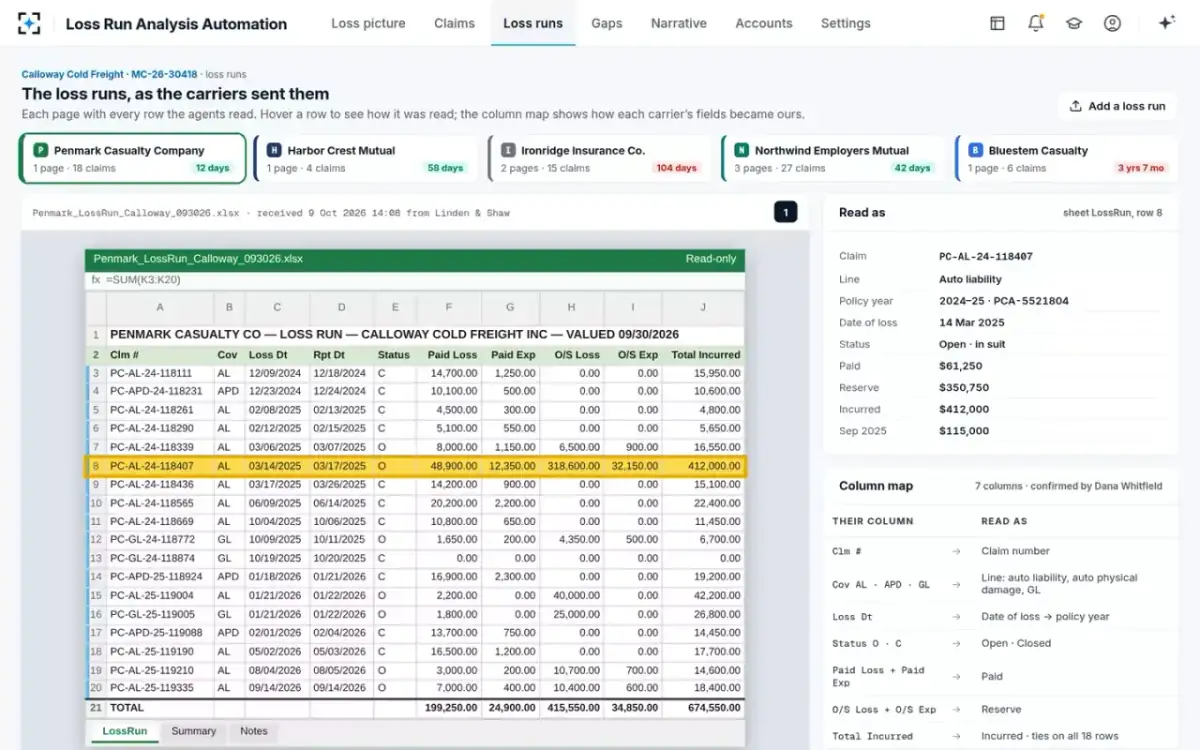
A carrier's run as it arrived, every row read, and the column map an assistant confirmed
What is the difference between an underwriting assistant and an underwriter?
The underwriter decides; the assistant prepares and checks. BLS describes underwriters as the people who evaluate applications, decide whether to offer insurance and determine premiums and coverage amounts (BLS, Insurance Underwriters). An assistant has no authority to bind, price or decline, and in most carriers works under a named underwriter or a team.
Underwriting assistant and underwriter on the same loss runs
| Task on the runs | Underwriting assistant | Underwriter |
|---|---|---|
| Requesting missing or stale runs | Builds the list and drafts the request | Sends it or approves it; decides whether to quote without it |
| Keying and mapping | Owns it; signs off a new carrier layout | Reviews the claims that matter to the price |
| Faint or unreadable figures | Checks against the page total and corrects | Asks for a clean copy when the figure is material |
| Open claims and reserve movement | Flags what moved since the last evaluation | Judges whether the reserve is believable and asks for a status note |
| Large-loss threshold, valuation window | Applies the desk’s settings | Proposes changes; the manager sets them |
| Price, credits, declination | None | All of it, within the letter of authority |
The split matters for the file as much as for the org chart. A state market conduct examiner tests underwriting files, and one of the NAIC's examination standards for property and casualty insurers asks whether underwriting and rating rest on adequate information gathered at or near the policy's inception (NAIC Market Regulation Handbook, ch. 21, Standard 8). A loss summary someone typed, with no way to see where each number came from, is weaker evidence of adequate information than one whose figures open the carrier's own page.
Commercial lines underwriting assistant salary and outlook: what BLS does and does not say
BLS does not publish a separate wage for underwriting assistants, so any salary figure for the title comes from job boards rather than official statistics. What BLS does publish is the ladder above: insurance underwriters earned a median $81,370 in May 2025, the lowest tenth under $55,530 and the highest tenth over $145,160, and underwriters at property and casualty carriers a median $80,210 (BLS, Insurance Underwriters, Pay).
The outlook is the more useful number for someone choosing the role. BLS projects underwriter employment to fall 4% from 2025 to 2035 and attributes the decline to automated underwriting software, while still projecting about 6,800 openings a year as people retire or move. The same page notes that complex lines such as workers' compensation lean more on an underwriter's analytical insight. Read together, the path is toward the analytical end of the work: the assistant who can read a loss run critically is building the skill the underwriter role keeps.
What skills does an underwriting assistant need for loss runs?
The skills that matter are reading skills: knowing what each column on a run means, noticing when two carriers mean different things by the same word, and knowing when a run is too old or incomplete to price on. Typing speed matters less every year.
Three are worth naming. First, the money columns: paid, reserve (often printed as outstanding, or O/S), incurred, and whether adjusting expense sits inside them. A run that shows loss only, without expense, cannot be added to one that includes it, and incurred vs paid losses traces one claim through exactly that problem. Second, valuation: every run is a snapshot as of a date, and a reserve that was right a year ago may be a quarter of the claim today. On the sample account, one open auto claim stood at $115,000 at the September 2025 evaluation and $412,000 a year later. Third, the law: which state's clock applies, whether the carrier must show reserves at all, and what the insured can be charged.
A new assistant can learn the first two from a dozen real runs read slowly, with how to read a loss run report beside them. The third is a reference table, not a memory test.
Will AI replace underwriting assistants?
The evidence points to a change in what the seat does rather than its removal. The agents in Loss Run Analysis Automation read, map, match and draft; they do not decide what to ask a broker, confirm that a new layout was read correctly, or judge whether a run looks wrong. In the sample, every new carrier layout is kept only once a person confirms its column map, and anyone on the account can correct a faint figure, with the correction logged under their name.
The best field evidence on AI assistants at work is outside insurance, and it says something about who benefits. A study of customer-support agents found access to an AI assistant raised issues resolved per hour by 14% on average and by 34% for novice and low-skilled workers (Brynjolfsson, Li and Raymond, NBER Working Paper 31161). That is not an underwriting result, and no allowed study measures one. But its pattern, the largest gain for the least experienced, fits a desk where the hardest thing for a new assistant is knowing what a carrier's column means.
Who decides what, written down as settings
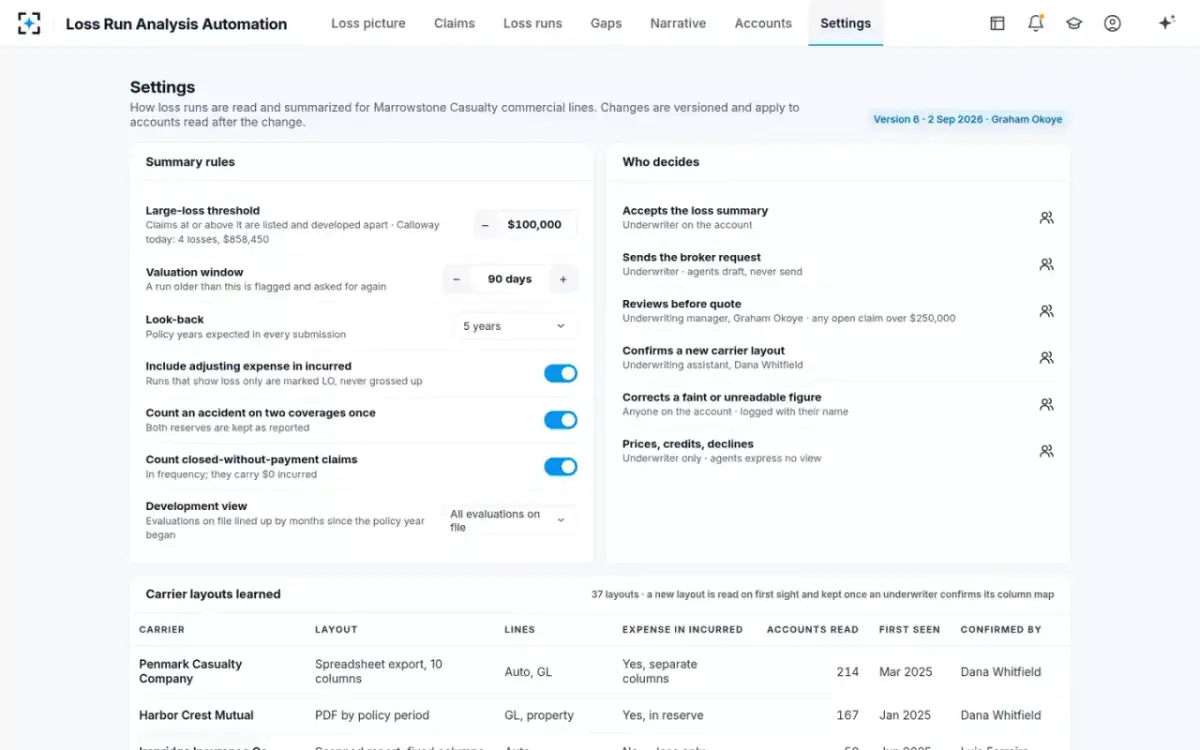
What leaves the seat is the part nobody hired an assistant for. What arrives is the part that makes the file defensible: the confirmed mapping, the corrected figure with a name on it, the broker request that lists every missing item with its reason. For a desk lead deciding how to staff, the question is less how many assistants and more what each one checks, a question taken up in the six-week go-live plan.
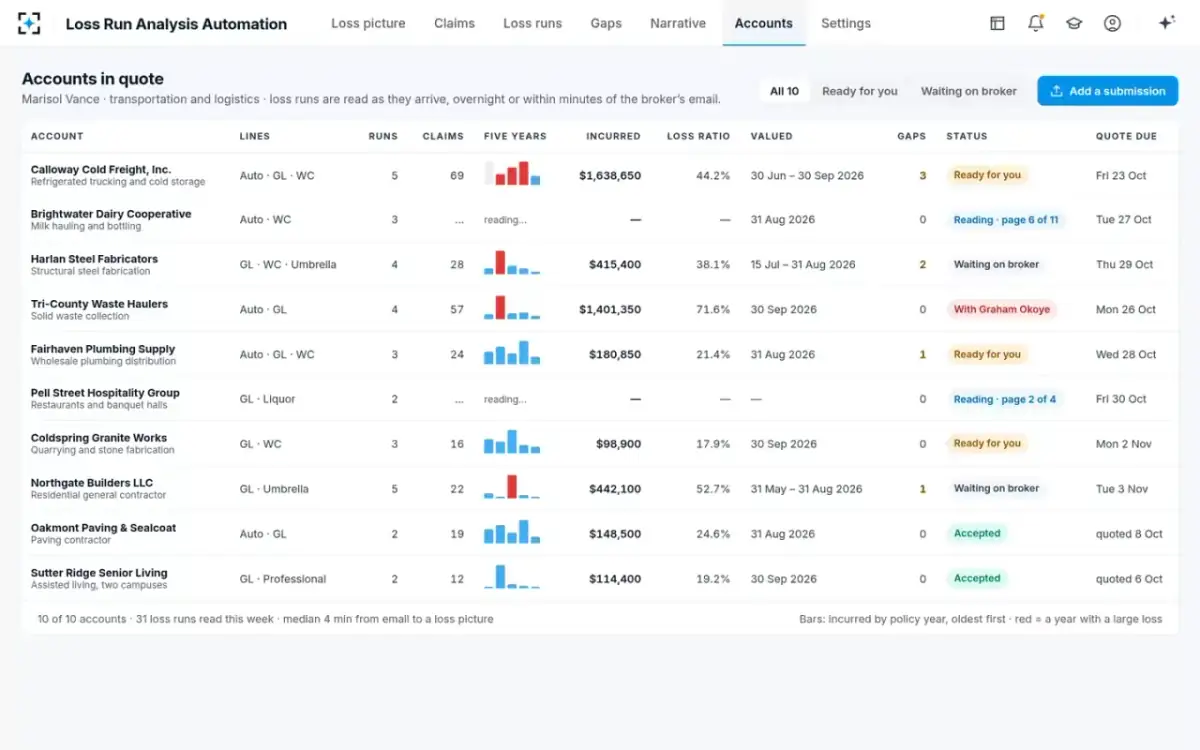
An underwriter's ten accounts in quote, with the runs already read
Questions people ask
What does an underwriting assistant do day to day?
On a commercial desk the day is submissions and renewals: logging and clearing new business, checking applications, requesting and chasing loss runs, building loss summaries, and handling endorsements and broker calls. The loss runs are usually the longest single task on a new account, because each prior carrier sends its own layout. With agents reading the runs, the same day shifts toward confirming mappings, correcting flagged figures and chasing what is missing.
Is underwriting assistant a good path to becoming an underwriter?
It is the usual one in commercial lines, because the assistant sees every part of the file the underwriter relies on. BLS projects about 6,800 underwriter openings a year to 2035 even as total employment falls 4%. The assistants who move up tend to be the ones who read the runs critically rather than just key them.
How many loss runs does an underwriting assistant handle?
No government or academic source counts them, so any figure is a desk's own. The arithmetic is accounts times prior carriers times lines: a five-year look-back on an account that changed auto carriers twice is three auto runs before general liability or workers' comp. The sample underwriter's desk read 31 runs in one week across ten accounts in quote.
Can an underwriting assistant work remotely?
Many do, because the work is documents and email; the BLS profile describes underwriters as spending much of their time alone at a computer. Remote work raises the value of a loss summary whose figures open the source page, since the underwriter cannot lean over and ask where a number came from.
What should a new underwriting assistant learn first about loss runs?
The difference between paid and incurred, what the valuation date means, and how to spot a run that shows loss without adjusting expense. Those three explain most mistakes in a typed summary. After that, the state rules on how quickly a prior carrier must send a run and whether it must show reserves.
Does the assistant or the underwriter send the broker request?
It depends on the carrier; on the sample desk the underwriter sends it and the assistant is copied. In the solution the valuation checker drafts one request per account, every item with its reason, and only a person sends it. The draft on the sample account listed four items: a missing year, two stale runs and a status note on a claim in suit.