Loss runs AI is software that uses AI models to read prior carriers' loss runs, whether spreadsheets, PDFs or scans, into structured claim rows, map each carrier's columns to common fields, and assemble a loss summary an underwriter can price from. The test of any such tool is not whether it produces a table but whether every number in the table can be traced to the cell it came from, ties to the carrier's own totals, and was left blank or flagged when the page could not be read cleanly. Botminds' Loss Run Analysis Automation is built on that test: its reader agent keeps the page, row and column of every figure, ties rows to each run's totals, shows faint figures instead of filling them, and hands off to five more agents that map, match and summarise, while the underwriter decides.
The page examples come from a fictional sample account, Calloway Cold Freight, whose five prior carriers' runs were read by the solution; every company, carrier and claim is invented. Regulatory guidance is linked where it appears.
One row on a carrier's run, read cell by cell, every figure with its address
Penmark_LossRun_Calloway_093026.xlsx · sheet LossRun · row 8
A8 · Clm #
PC-AL-24-118407
Claim number
C8 · Loss Dt
03/14/2025
Date of loss → policy year 2024–25
E8 · Status
O
Open
F8 · Paid Loss
48,900.00
Paid, loss
G8 · Paid Exp
12,350.00
Paid, expense
H8 · O/S Loss
318,600.00
Reserve, loss
I8 · O/S Exp
32,150.00
Reserve, expense
J8 · Total Incurred
412,000.00
Incurred, checked: F + G + H + I
In the summary: paid $61,250 (F8 + G8) · reserve $350,750 (H8 + I8) · incurred $412,000 (J8), auto liability, 2024–25, open · at the September 2025 evaluation on file: $115,000
Can AI read loss runs in every format carriers send?
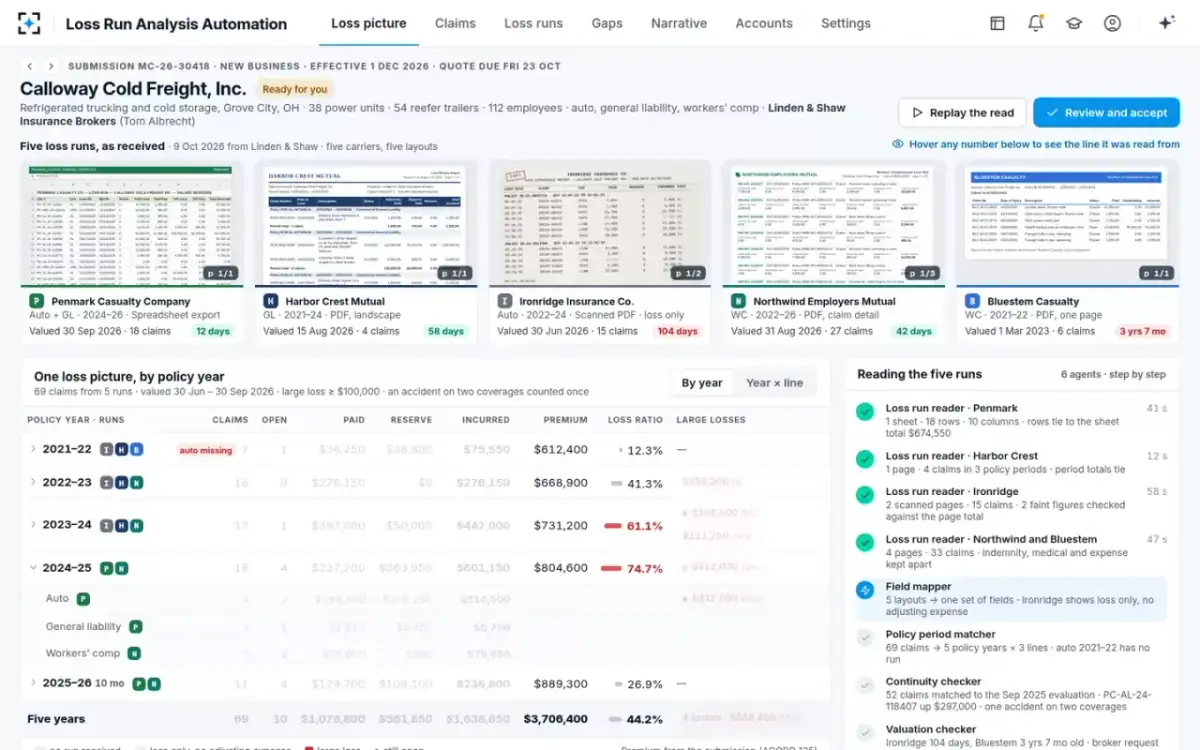
Yes, in the sense that matters: modern document AI can turn spreadsheets, text PDFs and scanned images into rows. The harder part is that carriers do not agree on a layout, so reading the characters is the easy half and reading the meaning is the rest. On the sample account the five runs came in five layouts: a ten-column spreadsheet export, a landscape PDF grouped by policy period, a two-page scan stamped loss only, a three-page workers' comp report in claim-detail blocks rather than rows, and a one-page PDF.
The law is pushing formats toward electronic delivery. Florida and Kentucky both define "provide" to include letting the insured view or generate the run through an electronic portal (Fla. Stat. § 627.444; KRS 304.20-100), and portals tend to export spreadsheets or text PDFs. Scans will not disappear, though: an insured that kept a paper run, a broker who prints and re-scans, and older carriers' fixed-width reports all arrive as images.
Five layouts on one account, and what each asks of the reader
| Layout | Example on the sample account | What makes it hard | What the reader does |
|---|---|---|---|
| Spreadsheet export | Penmark, 10 columns, 18 claims | Expense in separate columns; formulas in the total row | Reads cells, recomputes the total row, maps paid and outstanding expense |
| Text PDF by policy period | Harbor Crest, landscape, 4 claims in 3 periods | Subtotals per period between claim rows | Ties each period’s rows to its subtotal |
| Scanned image | Ironridge, 2 pages, 15 claims, loss only | Faint digits; a stamp that changes the meaning of the columns | Checks faint figures against the page total; carries the stamp into the column map |
| Claim-detail blocks | Northwind workers’ comp, 3 pages, 27 claims | One claim spread over several lines: indemnity, medical, expense | Keeps the three amounts apart and the claim together |
| One-page summary | Bluestem, 6 claims, valued March 2023 | Old valuation date, easily missed | Reads the date as carefully as the money |
Inside the reader agent: what it does with every page
The reader agent's job is narrow on purpose: turn every page into rows and prove the rows are complete. It does not decide what a column means across carriers, assign claims to policy years or summarise; those belong to the agents after it, each with its own limits.
The reader agent's five steps on a run, and the hand-offs around it
Agent
Find the run’s structurePages, header, valuation date, policy periods, column headings or block labels, totals and subtotals.
Agent
Read every claim rowEach cell or block value with its page, row and column.
Never: No figure without a source cell.
Agent
Tie rows to the run’s own totalsSum the rows per page, period or sheet and compare with the carrier’s printed total, and report whether they tie.
Agent
Mark what it could not read cleanlyA faint or ambiguous figure is shown as faint and checked against the page total.
Never: Faint figures are shown, never filled.
Agent
Hand to the field mapperThe mapper applies the carrier’s confirmed column map, or proposes one for a new layout.
Never: Never assumes incurred includes adjusting expense unless the run says so.
A person decides
Underwriting assistantConfirms a new carrier’s column map once, and corrects any faint figure; the correction is logged with their name.
The tie-out is the step most worth asking a vendor about. A row that was dropped, read twice or misread by a digit changes the page total, so comparing the rows with the carrier's own printed total catches most extraction errors without anyone checking the rows by hand. On the sample account the reader tied Penmark's 18 rows to the sheet total of $674,550 and the Harbor Crest rows to each policy period's total, and on the Ironridge scan checked two faint figures against the page total before passing them on.
Replay the read: each agent's steps on the five runs, with times
Can AI read scanned loss runs?
Yes, with one discipline that separates a usable tool from a risky one: a figure the model cannot read with confidence must be shown as uncertain, not completed with the most likely digits. A scan of a fixed-width carrier report, photocopied once and stamped, has exactly the digits that a model will read plausibly and wrongly: a 3 that could be an 8, a faded leading digit that turns 12,150 into 2,150.
The scanned run, row by row, with the carrier's own stamp carried into the column map
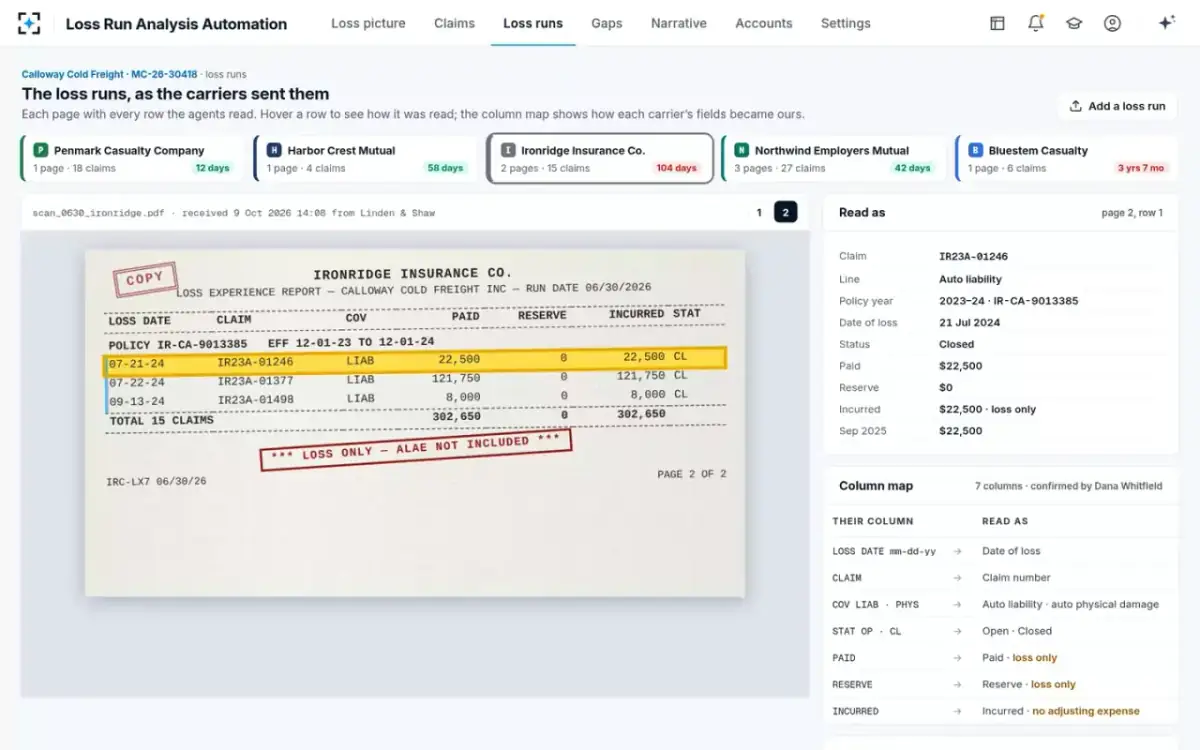
The stamp on the sample scan is the second lesson. "Loss only, ALAE not included" sits at the foot of page two, below the totals, and it changes the meaning of every money column on both pages. A tool that reads rows but not stamps, footers and legends will add these losses to runs that include defence costs and report a total that is precise and wrong. The sample's field mapper read Paid and Reserve as loss only and Incurred as excluding adjusting expense, and the auto years from that run are marked LO in every total rather than grossed up by an assumed expense ratio. Why that matters to the totals is traced in incurred vs paid losses.
What happens when a loss run column is unclear?
The tool should say so and ask a person once, then remember the answer. In the solution a new layout is read on first sight and kept once someone confirms its column map; after that, every account from the same carrier is read with the confirmed map. On the sample desk 37 carrier and third-party administrator layouts are learned this way, each with who confirmed it and how the carrier treats expense: "Yes, separate columns" for one, "Yes, in reserve" for another, "No, loss only" for the scan.
What the field mapper will not do is resolve an ambiguity by assumption. If a run prints a column called incurred and nothing says whether expense is in it, the mapper does not assume it is; the question goes to the person confirming the layout. If a status code is new, it is listed rather than translated. These refusals cost seconds on a new layout and prevent the most common silent error in multi-carrier summaries: adding unlike numbers.
How accurate is AI loss run extraction, and how do you measure it?
No independent public benchmark measures loss run extraction, so any accuracy figure a vendor quotes is its own, on its own documents. The defensible approach is to measure on yours: a sample of past submissions whose runs a person has already read, run through the tool, compared field by field. Three measures cover most of what matters.
First, tie-out: the share of runs whose extracted rows sum to the carrier's printed totals, page by page. Second, field accuracy on the money columns and dates, against the person's reading, counting a figure the tool flagged as faint separately from one it got wrong. Third, mapping accuracy: on how many runs the tool treated expense, status and coverage the way the carrier meant. A tool that is 99% right on characters and wrong about expense on one carrier in five is not 99% accurate for an underwriter. How to run such a test as a parallel run before go-live is set out in loss run automation: a six-week go-live plan.
What to ask before buying AI for loss runs
Ask how the tool proves each number, what it does when it cannot, and who signs off. Regulators already expect insurers to answer the same questions about any AI system they rely on. The NAIC's model bulletin on insurers' use of AI asks an insurer's written program to cover due diligence on third-party AI systems and data, including contract terms for audit rights and cooperation with regulators (NAIC Model Bulletin, section 4). New York's circular letter on AI in underwriting adds that an insurer cannot point to a vendor's proprietary methods to excuse a vague explanation of an adverse underwriting decision (NY DFS Circular Letter No. 7, 2024). How a carrier applies those is a compliance question; the checklist below is the desk's version.
Ten questions to ask a loss run AI vendor
- Can every summary figure open the cell it came from?
Page, row and column, in the carrier’s own layout, not a re-typed copy.
- Does it tie rows to the carrier’s printed totals?
And what happens when they do not tie.
- What does it do with a figure it cannot read?
Shown as uncertain and checked, or filled with a best guess.
- How does it decide whether incurred includes expense?
From the run itself, or by a default assumption.
- Does it ever gross up a loss-only run?
If so, by what ratio, and is that visible in the summary?
- How is a new carrier layout confirmed, and by whom?
And is the confirmation kept for the next account?
- Can it line up earlier evaluations on file?
Reserve movement is the detail a single run cannot show.
- What does it check runs against?
The application’s prior carriers, the look-back, a valuation window.
- Does it give any view on price, credit or declination?
And can that be switched off, or is it absent by design?
- Is every correction and acceptance logged with a name?
An underwriting file is reviewed long after the quote.
Should AI price an account from loss runs?
Not in this solution. Its loss analyst agent builds the summary by year and line, the development view, the large-loss list and loss ratios, and writes a narrative in which every sentence with a figure carries a citation; it expresses no view on price, credit or declination, and says so in the narrative. Pricing, credits and declines stay with the underwriter, within the carrier's referral rules.
That boundary is a design choice, not a limitation of the technology. The reasons are practical. An underwriting decision draws on far more than the runs, from the inspection to the schedule of values to the broker relationship. And a price suggested by a system tends to anchor the person reviewing it. Keeping the agents on reading, matching and drafting keeps the underwriter's judgement where the carrier's letter of authority puts it. The step from runs to an expected loss, which is the underwriter's, is worked through in loss pick insurance.
Where Loss Run Analysis Automation fits, and where it does not
The solution fits a commercial underwriting desk that receives multi-carrier runs with submissions and renewals and wants a cited loss picture before the underwriter starts. It reads the runs it is given, checks them against the application and the evaluations on file, flags missing and stale runs, and drafts the broker request.
It does not obtain runs from prior carriers, send anything to a broker, decide which state's loss run statute governs, or replace a claim file review on a large open claim; the status note on the sample's claim in suit was something the agents asked for, not something they could supply. It cannot recover a year that no run covers, and it will not fill one. And its figures are only as current as the runs: a reserve on a run valued three years ago is a three-year-old estimate, however cleanly it was read.
Questions people ask
Can AI read loss runs from any carrier?
It can read any layout it is given, but meaning has to be confirmed once per new layout. In the solution a new carrier's run is read on first sight and its column map is kept once a person confirms it; the sample desk has 37 such layouts.
Does AI loss run software replace underwriting assistants?
It replaces the re-keying, not the checking. Someone still confirms new layouts, corrects flagged figures, chases missing runs and decides what to ask the broker. Botminds estimates the keying and checking on a five-carrier, three-line account at about 75 minutes by hand, against a design target of about 4 minutes with the solution.
How long does AI take to read a set of loss runs?
On the fictional sample account, six agents read five runs in five layouts in 3 minutes 52 seconds. The design target is 4 minutes from received runs to a loss picture; scans and long multi-page reports take longest.
What is the difference between OCR and AI for loss runs?
OCR turns an image into characters; it does not know that a column called O/S Exp is outstanding expense or that a stamp makes a run loss only. Reading a loss run needs both: the characters, and the structure and meaning of the page. A tool should be judged on the second, by whether its rows tie to the carrier's totals and its mapping matches what the carrier meant.
Can the extracted data be exported?
Yes: the summary exports to a spreadsheet and the narrative goes into the carrier's file template. Every figure keeps its source, so an exported number can still be traced.
What if a loss run has an error the AI copies?
Then the summary shows the carrier's figure, cited, and the tie-out to the carrier's own totals will usually reveal an arithmetic error on the run. A wrong reserve or a misdated claim is the carrier's error; the remedy is a corrected run or a status note, which the drafted broker request can ask for.