The definition of currently valued loss runs is loss runs whose valuation date, the date as of which the carrier's paid amounts, reserves and claim counts are stated, is recent enough to price from; in the commercial market that is usually read as within about 90 days of the request or the quote. It is a market convention rather than a legal term, with one exception: Oregon's insurance rule requires loss runs valued no more than 90 days before the request. Underwriters insist on it because reserves are raised, claims are reported late and open claims settle after the valuation date, and the youngest policy years move most. Botminds' Loss Run Analysis Automation ages every run against the desk's valuation window, flags the stale ones and drafts the request for a current run, so an old run is caught before it is priced on rather than after.
The examples follow a fictional sample account, Calloway Cold Freight, with an effective date of 1 December 2026, whose five prior carriers' runs arrived on 9 October; every company, carrier and claim is invented. The sources are the Casualty Actuarial Society's ratemaking text, the NAIC's examination standards and Oregon's rule, linked where they appear.
Four loss runs on one account: how old each was when it arrived, and when the policy starts
- Age on arrival9 d
- Arrival to effective date53 d
- Age on arrival39 d
- Arrival to effective date53 d
- Age on arrival55 d
- Arrival to effective date53 d
- Age on arrival101 d
- Arrival to effective date53 d
What does currently valued loss runs mean?
It means the figures on the run are stated as of a recent date. Every loss run is a snapshot: the carrier's claims system prints what had been paid, what was reserved and which claims were open on one day, the valuation date. The Casualty Actuarial Society defines the term for any loss data: "The valuation date, which can be different than the end of the accounting period, is the date as of which the losses are evaluated for analysis" (Werner and Modlin, Basic Ratemaking, ch. 6).
"Currently valued" adds a judgement about how recent is recent enough, and the market's usual answer is 90 days. A request for "five years of currently valued loss runs" therefore asks each carrier for a claims history covering five policy years, all stated as of a date within about the last three months. The two halves are separate: a run can cover five years and be stale, or be fresh and cover only two.
What is a loss run valuation date, and how do you find it?
The valuation date is the "as of" date for every figure on the run, usually printed in the header as valued as of, evaluation date, or run date. It is not the date the run was printed, emailed or received, and when a header shows several dates, the one the money is stated as of is the one that counts.
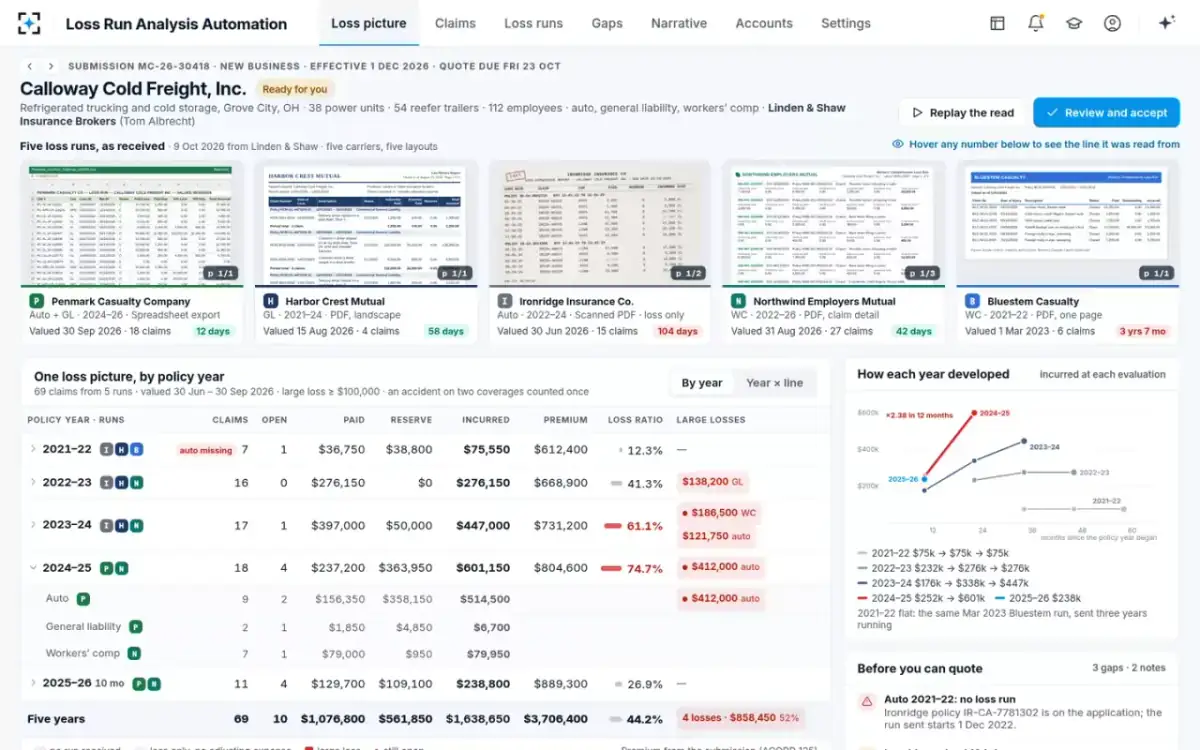
On the sample account the spreadsheet carried its date in the title row, "valued 09/30/2026", while the scanned report printed only a "run date 06/30/2026" in its heading. The scan's run date was also its valuation date; on some carriers' reports a run date is only the print date and the valuation is a month-end before it. When the header is ambiguous, the safest reading is the earliest plausible date, and the right next step is to ask.
Is there a legal definition of currently valued?
Oregon's is the only one found among the state laws reviewed for this series. The rule defines loss runs for commercial property, liability and auto as information including paid amounts on all reported claims, and adds a freshness standard.
Such losses shall be valued as of the insurer's most current valuation date, but not more than 90 days prior to the date of the request for loss runs.
Oregon Administrative Rules 836-080-0800, effective 1 March 2011
Note what the rule measures from: the request, not the quote or the effective date. A run requested in July and valued in May complies, yet by a December effective date its figures are seven months old. Other states regulate the clock for sending a run rather than its age; a request in Maine made fewer than 45 days before the policy expires loses one of the insured's protections, which is a reason to ask early rather than a freshness rule (24-A M.R.S. § 2910). The full set of state rules is in loss run requirements by state.
Regulators also care about the underwriter's side of the timing. One of the NAIC's examination standards for property and casualty insurers, rated essential, has examiners check that underwriting and rating rest on adequate information developed at or near the inception of coverage, not near expiration or after a claim (NAIC Market Regulation Handbook, ch. 21, Standard 8). A loss history valued months before inception is weaker evidence of adequate information than one valued close to it.
Why do carriers want loss runs within 90 days?
Because the figures most likely to have moved since the valuation date are the ones that drive the price: reserves on open claims in the youngest policy years, and claims not yet reported when the run was printed. The CAS text gives the example of an experience rating plan whose losses are evaluated at 31 March for a policy effective 1 July, three months earlier (Basic Ratemaking, ch. 15), which is about where the 90-day convention sits.
How much each policy year moved in twelve months, September 2025 to September 2026
The 2024–25 bar is mostly one claim. A work-zone rear-end was not yet reported at the September 2024 evaluation, stood at $115,000 in September 2025, and at $412,000 a year later after suit was filed. The rest of the year's movement was ordinary development: six claims reported after September 2025 added $23,100, and six others developed by $28,200. A run valued in September 2025 would have shown 2024–25 as a quiet year, at a 31% loss ratio.
Every run's valuation date and age, before any figure
How long are loss runs valid for? Do loss runs expire?
Loss runs do not expire in any legal sense; their usefulness decays, and how fast depends on what is still open. A run on a policy year whose claims have all closed changes little after the last payment, so an old valuation of a mature, closed year is often fine. A run on the most recent year of a liability or workers' compensation account goes stale within months, because that is where reserves are still being set.
That suggests reading a run's age against the claims on it rather than against a single number. On the sample account the Harbor Crest general liability run was 58 days old and covered years with no open claims: current enough. The Ironridge auto run was 104 days old and covered 2022–23 and 2023–24; its claims were closed, but it showed loss only, so a new run was worth asking for with adjusting expense included. The Bluestem workers' comp run was three years and seven months old with a claim open at $53,000 on it, and no one knew what that claim was worth today.
One summary, five valuation dates: what to do with the mix
A loss summary built from several carriers almost always mixes valuation dates, and the honest summary says so rather than presenting one total as if it were stated on one day. The sample account's summary was built from runs valued between 1 March 2023 and 30 September 2026, a spread of three and a half years, and its narrative states the range in its first line.
Three practices keep a mixed summary usable. First, carry each run's valuation date into every figure read from it, so a policy-year total can show which parts are current and which are not. Second, never "age" an old reserve forward by an assumed development factor inside the summary; that is a pricing judgement, and it belongs in the underwriter's loss pick with its assumptions visible, not hidden in a total. Third, state the limits in words: the sample narrative's data limits paragraph names the missing auto year, the Ironridge run 104 days old and loss only, and the Bluestem run valued in March 2023 with one claim open at $53,000.
The alternative, quietly summing runs of different ages, produces the flat 2021–22 line in the chart above: a policy year that looks settled because no one has looked at it since 2023. Where an old valuation must be priced on, the step from a run's figures to an expected loss with development and trend made explicit is set out in loss pick insurance.
How many years of loss runs are needed?
Usually three to five policy years, ending with the most recent complete year, plus the current partial year. Experience rating plans in the CAS text use two to five years, trading responsiveness against stability, and the state laws that set a look-back mostly require five years from the prior carrier. Larger accounts and long-tailed lines push toward five; small accounts and short-tailed property lines toward three.
A "five-year currently valued loss run" request combines both: five policy years from every carrier that wrote them, each valued recently. On an account that changed auto carriers twice, it means three auto runs. The sample desk's look-back setting is five years, with three and seven as alternatives, and the policy period matcher checks the years received against the prior carriers on the application. That is how the sample's missing 2021–22 auto year was found.
A rule for when to ask for a fresh run
A desk needs a written rule so that every underwriter asks for the same thing for the same reasons, and so the broker hears one request per account rather than three. The 90-day window is the starting point; the claims on the run decide the exceptions.
When to ask the broker for a currently valued run
- The run is older than the window at the quote date
The sample desk’s window is 90 days, settable from 30 to 180.
- It covers the latest complete policy year or the current one
These years move most; even a 60-day-old run can miss a new claim.
- Any open claim on it is large, litigated or a serious injury
Ask for a status note as well as a new valuation.
- It is the same run you saw last year
A flat year across evaluations may mean nobody asked for a new one.
- It shows loss only, or no reserves
Ask whether a version with adjusting expense or reserves is available.
- Do not ask when every claim is closed and the year is mature
Say in the summary that the run is old and why that is acceptable.
Stale runs on the gaps list, each with its reason, and the request drafted
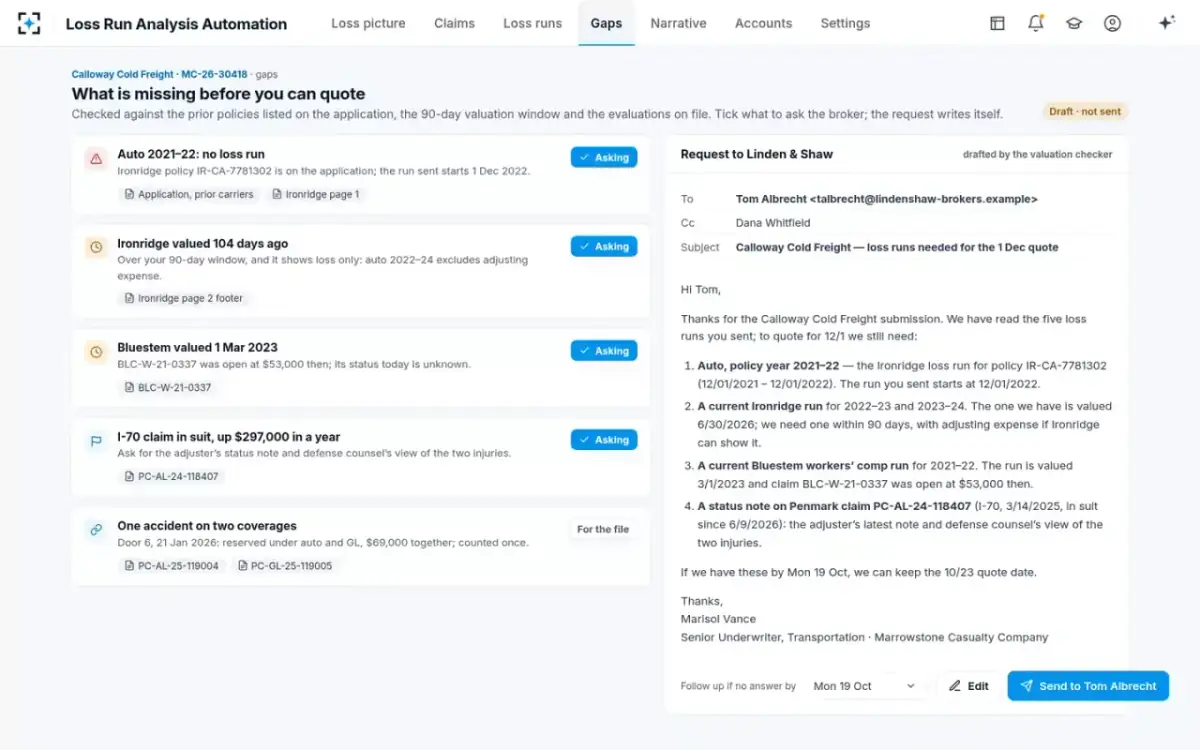
The draft on the sample account shows the rule in use. It asked for a current Ironridge run because the one received was 104 days old and loss only, and a current Bluestem run because a claim on it was open three and a half years ago; it did not ask for a new Harbor Crest run. How those runs then enter the summary, and why a stale reserve and a loss-only figure must stay marked, is set out in incurred vs paid losses.
Questions people ask
What is considered currently valued loss runs?
In practice, runs valued within about 90 days of the request or the quote date, though carriers set their own windows. Oregon's rule is the only legal standard found: losses valued no more than 90 days before the request. A run inside the window can still be worth refreshing if it covers the latest policy year.
What is the difference between a loss run's valuation date and its run date?
The valuation date is the date the figures are stated as of; the run date is when the report was produced. On many reports they are the same day. Where they differ, the valuation date is the one that tells you how current the reserves are.
Can a broker send loss runs from last year's renewal?
They can send them, but last year's runs will not show claims reported since or how open reserves moved. On the sample account, one claim stood at $115,000 on the earlier evaluation and $412,000 on the current one. Old runs are useful alongside current ones, because together they show development.
How often should loss runs be updated during a long quote?
When the quote date drifts past the desk's window from the valuation date, or when a large open claim is known to be moving. A run that was current when the submission arrived can be stale by the time a complex account binds.
Do currently valued loss runs need to include reserves?
Not by law in most states, and Oregon's rule speaks of paid amounts. Underwriters still want them, because a current valuation of a paid-only run tells you little about open claims. Where reserves are withheld, a status note on large open claims fills part of the gap.
Why does my underwriter want loss runs again if I sent them a month ago?
Usually because the quote or effective date has moved, a large claim on the run is open, or the run they have is older than it looked: a run sent a month ago may have been valued three months before that.