The commercial insurance submission process is the sequence a carrier runs between a broker's email and a quote: log the submission, key the applications and schedules, clear it against the carrier's own book, check it against appetite and authority, ask the broker for anything missing, rank it, and underwrite it. Each step has an owner, and several carry checks a regulator expects to see in the file. On Botminds' estimate, most of the elapsed time is not spent in any step but in the waits between them, which is why a submission that needs an hour of real work can take days to reach an underwriter. Botminds' Commercial Submission Intake & Clearance is an agentic solution that runs the first six steps as each email arrives, so that the seventh, the underwriting, starts the same business day.
The examples follow a fictional sample carrier, Keelwater Insurance Group, through Monday 12 October 2026 at its Central region; every broker, insured and person is invented, and the hours below are Botminds' estimate or sample data, labelled where used. The rules cited are real and linked.
Where a submission's hours go before an underwriter opens it
- Logging1 h
- Keying4 h
- Clearance1 h
- Appetite1 h
- Request1 h
- Waiting for an underwriter16 h
- Read, key, clear, check, request1 h
- Waiting2 h
What is the commercial insurance submission process? Seven steps, seven owners
The commercial insurance submission process has seven steps: log, key, clear, check appetite and authority, request what is missing, rank, and underwrite. The first six prepare the file and the seventh uses it. Where the work is done by hand, the first six belong to a submission desk or underwriting assistants, and the seventh to an underwriter with written authority.
Seven steps from a broker's email to a quote, and who owns each
Agent
1. LogReceive the email in a shared mailbox, split it, sort each attachment and route anything that is not a submission to the team that handles it.
Never: replies to a broker
Agent
2. KeyEnter the applicant, locations, values, coverages, prior carrier and losses from the application, schedule and loss runs, with each value’s source.
Never: fills a blank by guessing
Agent
3. ClearSearch every office’s accounts, open submissions and in-force policies for the same insured and apply the carrier’s clearance rule.
Never: decides between two brokers
A person decides
Submission desk leadDecides any clearance conflict and signs the notice to the brokers.
Agent
4. Appetite and authorityTest class, state, size, insured values and loss history against the appetite guide; route anything above the underwriter’s authority.
Never: declines on its own
Agent
5. RequestScore completeness by line and draft a request for exactly what is missing.
Never: sends without a person
Agent
6. RankOrder what is ready by fit, size and days to the effective date.
A person decides
7. UnderwriteReview, decide quote, need information or decline, price and set terms.
The order matters more than it looks. In the hand process Botminds' estimate describes, the search and the appetite check wait until the forms are keyed, because both need the keyed data; so a duplicate or a prohibited class is found only after four hours of typing. Moving clearance and appetite to the moment the email lands, while the submission is still being keyed, is the change that shortens the process most for the submissions that should never reach an underwriter at all.
What does a commercial submission include?
A commercial submission is made up of a general application, a section for each line of coverage requested, a schedule of values for property, several years of loss runs from prior carriers, the insured's financial statements, and supplements for any special hazard. A broker's covering email adds the effective date, the expiring premium and what the insured wants quoted.
The sample submission shows the shape. Fenmore Specialty Brokers, a wholesaler acting for a retail agency, sent Redwater Cold Storage, LLC with seven attachments: the general application, the general liability and property sections, a schedule of values in a spreadsheet, loss runs from two prior carriers and the 2025 financial statements. The email itself gave the insured values, $48,640,000 across three locations, the expiring premium of $486,000 and the effective date of 1 December 2026, and asked for options on an ammonia exclusion. A refrigerated warehouse with ammonia systems also needed a supplement on process safety, and that is where the file's first gap was.
For some lines the law sets the minimum contents. Florida, for example, requires its workers' compensation application rules to call for information on the employer, the type of business, past and prospective payroll, estimated revenue, previous workers' compensation experience, employee classification and employee names, and requires a "sworn statement by the employer attesting to the accuracy of the information". Elsewhere the contents are set by the carrier's appetite guide and the forms the trade has standardised.
What are ACORD 125, 126 and 140, and why do submissions use them?
ACORD 125, 126 and 140 are standard commercial insurance application forms published by ACORD, the insurance industry's forms and data standards body: the 125 is the general commercial application with the applicant's details, the 126 is the general liability section and the 140 is the property section. Other numbers cover other lines, such as business auto and workers' compensation.
Standard forms help because every carrier can read the same boxes. They do not remove the keying, because a form arrives as a PDF or a scan and its values still have to get into the carrier's system; and they do not make the data right, because the same insured's name or address can be written differently on the 125 and on the schedule of values. In the sample, the keyer read 186 fields from Redwater's forms and schedule, each linked to the page and box it came from, and marked two as missing. The difference between the 125 and the 126, and what a broker should check on each before sending, is set out for brokers in the underwriting submission checklist.
What happens after a broker submits? The first hour, step by step
After a broker submits, the email lands in a shared mailbox, waits to be opened, is logged and keyed, and only then can the carrier tell whether it already has the account or wants the risk at all. In the sample, the same first hour ran as follows, with the agents doing the work and people deciding.
One submission's first minute, on the sample Monday
08:47
the wholesaler’s email arrives in the Central region mailbox
14.2s
to key 186 fields, each linked to its page
38s
to a red clearance light: already submitted to another office
30days
the first broker’s hold under the carrier’s rule, to 8 November
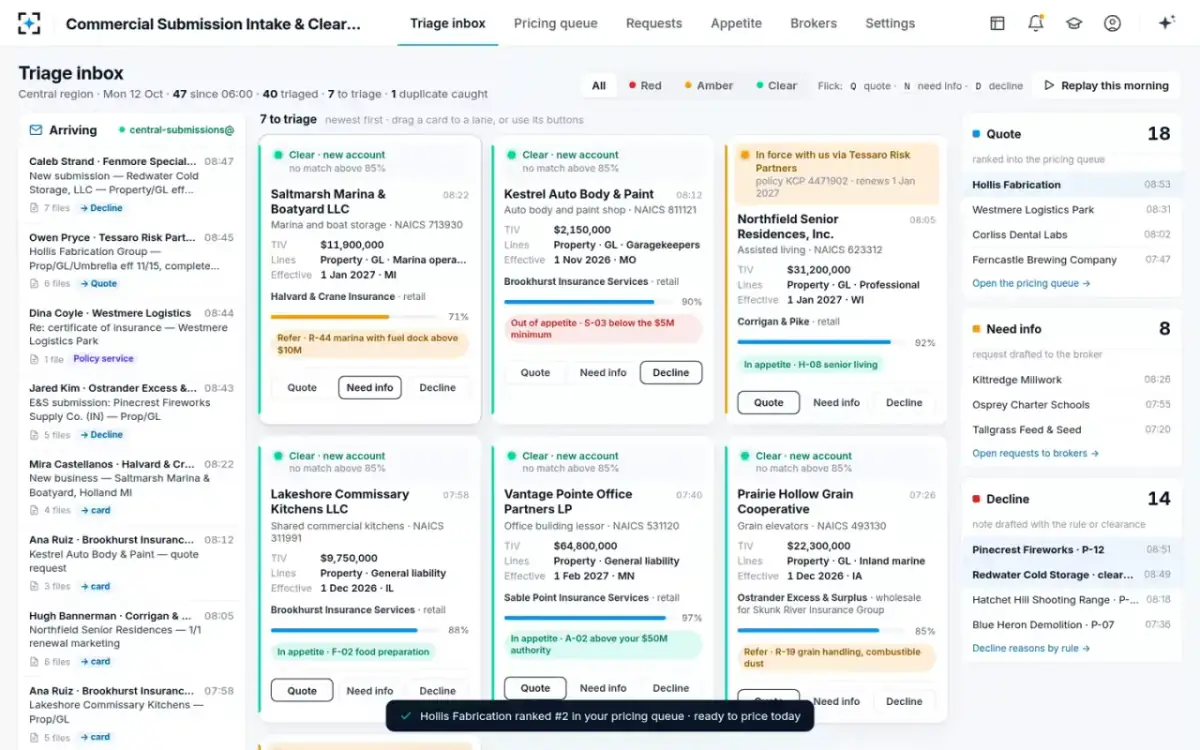
The rest of that morning shows the other paths. A fireworks distributor that arrived at 08:43 hit a prohibited-class rule and had its decline note drafted with the rule cited; the underwriter sent it. A structural steel fabricator arrived at 08:45 complete, cleared and in appetite, and went straight into the pricing queue at number two. A marina arrived at 08:22 at 71% complete and had a request drafted listing three missing items. By 08:47 the region had received 47 submissions since 06:00 and triaged 37 of them.
Commercial Submission Intake & Clearance after the morning's decisions
Who reviews a commercial submission first?
At a carrier with a submission desk, the first person to review a commercial submission is not an underwriter but someone on that desk or an underwriting assistant, who logs it, keys it and checks it is complete and cleared. The underwriter sees it after that preparation, which is why the preparation sets the pace for everything after.
The federal description of underwriting shows how much of the job assumes that preparation. Underwriters, the BLS explains, enter an applicant's information into software, and "The program then provides recommendations on coverage and premiums. Underwriters evaluate these recommendations and decide whether to approve or reject the application." Every part of that sentence depends on the information having been entered correctly first. The intake steps are where that happens, and where it goes wrong.
Why do commercial quotes take so long?
Commercial quotes take long mostly because submissions wait: for someone to open the email, for the forms to be keyed, for the search and the appetite check that need the keyed data, for the broker to send what is missing, and for an underwriter to have time. The work in each step is hours; the waits between steps are days.
Botminds' own estimate makes the proportion plain. Of the 24 working hours a typical middle-market submission spends before an underwriter opens it by hand, 16 are waiting; the eight hours of desk work are themselves mostly keying. With the agents, the desk work falls to about an hour and the wait to about two, because the file is ready the moment it is ranked. The step the agents do not remove is the broker's reply to a request, which is why the sample's requests list only what is missing and chase at 24 and 48 hours.
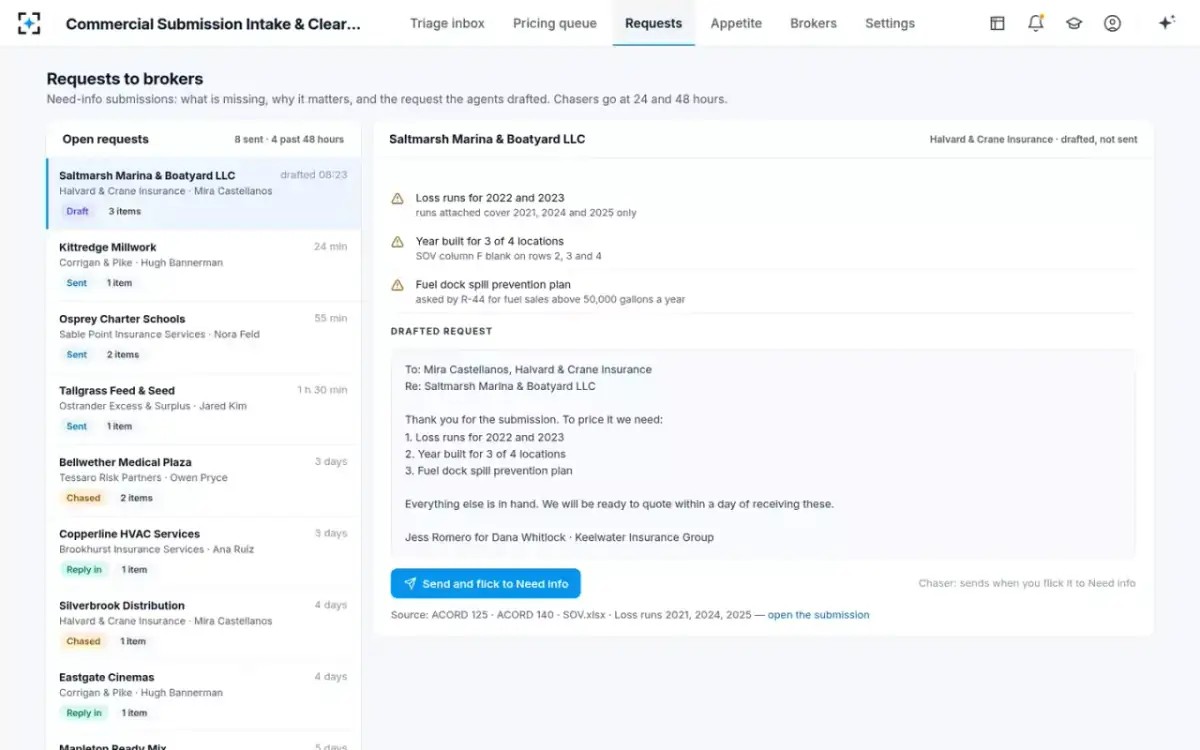
Commercial Submission Intake & Clearance asks the broker only for what is missing
What is a complete submission? Complete for the line, not for the form
A complete submission is one an underwriter can price without asking the broker anything, for each line requested. Completeness is therefore per line: a property quote needs the schedule of values and construction details, a liability quote needs the operations and exposures, and a submission can be complete for one and not the other.
The sample marina shows why. Saltmarsh Marina & Boatyard was 71% complete: two years of loss runs were missing, the year built was blank for three of four locations, and the carrier's marina rule asked for a fuel dock spill prevention plan above 50,000 gallons a year. A submission that is 100% complete on the general application and 71% complete for the line that carries the fuel dock is not ready, however full the first page looks. And completeness is not accuracy, as underwriting data quality sets out: a complete file can still carry a wrong value.
The checks a regulator expects along the way
Several steps of the submission process carry checks a regulator expects to see in the file: that the producer is licensed and appointed, that the applicant was screened for sanctions, that underwriting followed the carrier's guidelines, that coverage did not start before it was bound, and that the file is kept. None of them is underwriting judgement; all of them belong to the intake steps.
Which step carries which check, and the rule behind it
| Step | Check | Rule behind it |
|---|---|---|
| Log | Is the producer licensed, and appointed with the carrier where the state requires it? | NAIC Producer Licensing Model Act: licence required to sell, solicit or negotiate; appointment notice within 15 days of the first application |
| Clear | Is the applicant or its owner a sanctioned person? | OFAC: sanctions bar issuing a policy to a blocked person; routine screening recommended |
| Appetite and authority | Was the risk selected under the carrier’s own written guidelines? | NAIC examination standards: examiners test whether the carrier follows its underwriting guidelines |
| Request | Were requests for more information made consistently? | NAIC examination standards: inconsistent requests for supplemental information can be unfair discrimination |
| Underwrite and bind | Does coverage start on or after the bind? | New York OGC Opinion 03-12-01: a commercial policy may not be backdated |
| Every step | Is the file kept, including applications that never became policies? | New York 11 NYCRR 243.2: six calendar years, or until the examination report is filed |
The guideline check is easily mistaken for a pure underwriting matter, and the examination standard places it squarely in the file: examiners check that the insurer follows its own underwriting guidelines and that those guidelines are lawful and not unfairly discriminatory (NAIC exam standards; the underwriting audit checklist works through them). An appetite verdict that cites the rule and the guide version is the evidence that answer needs. On sanctions, OFAC's insurance guidance is practical rather than prescriptive: "Routine screening of all issued policies, policyholders, beneficiaries, and other relevant counterparties improves an insurer’s ability to comply with applicable OFAC regulatory requirements." Intake is the first point at which there is anyone to screen.
How long does commercial underwriting take? Measure the two halves separately
No government or research body publishes how long commercial underwriting takes, and averages from other carriers would not transfer anyway. Measure it in two halves from timestamps you control: email received to ready to price, which is intake; and ready to price to quote issued, which is underwriting.
In the sample, the intake half had a median of 5 hours 40 minutes over the week, against a target of the same business day, and eight submissions were ready for the senior underwriter to price, $1,516,300 in estimated premium. The underwriting half is the underwriter's, and depends on the risk. Splitting the clock tells a manager which half to work on, and the funnel each half feeds is priced in the quote to bind ratio and the KPIs behind it. To see the seven steps on your own submissions, start from Commercial Submission Intake & Clearance.
Questions people ask
Should brokers send submissions to a shared mailbox or to an underwriter?
To the mailbox the carrier names, such as a regional or line mailbox. A submission sent only to one underwriter can sit unseen during absence, and clearance cannot find what it cannot search. In the sample, the reader sweeps the region's shared mailbox every five minutes.
What is the difference between a submission and an application?
The application is the signed form or forms describing the applicant and the coverage asked for; the submission is everything the broker sends with it, including schedules, loss runs, financials, supplements and the covering email. Carriers keep both, and New York requires the application to be kept even when no policy is issued.
Can a carrier quote before clearance is finished?
It can, but it should not. A quote issued before clearance risks quoting an account another office or broker already holds, which is the outcome the first-in rule exists to prevent. In the sample, the ranker holds any submission whose clearance is red out of the pricing queue.
How many submissions does an underwriter see in a day?
No public figure exists. The sample's senior underwriter starts the day with 40 to 60 new submissions for her region, which is why the intake steps, not her, decide which ones she reads first.
What is triage in commercial underwriting?
Sorting submissions into those to quote, those needing information and those to decline, as early as possible. In the sample, each submission arrives with its clearance light and appetite verdict, and the underwriter moves it into one of the three lanes with a key press.