In commercial insurance, a blocked market means a carrier has declined to work a broker's submission because the same account is already in its hands through another broker; the first broker is said to have blocked that market. The term describes a carrier's clearance practice, not a legal right. New York's insurance regulator has said in writing that no state statute or regulation addresses an insurer quoting one account to more than one broker, so how long a block lasts, what lifts it and who decides are all set by the carrier's own rule and the contracts behind it. That makes the rule worth writing carefully. Botminds' Commercial Submission Intake & Clearance applies such a rule as each submission arrives, showing the evidence for every match and leaving the decision to a named person on the submission desk.
The examples follow a fictional sample carrier, Keelwater Insurance Group, and two fictional wholesalers who sent it the same cold-storage account three days apart. The law and regulation cited are real and linked where they appear.
The decision tree behind a blocked market, written as the desk should apply it
| Question the desk asks | If yes | If no |
|---|---|---|
| 1. Does the new submission match an account, open submission or in-force policy above the match threshold? | Go to 2. Show every field that matched. | Clear. The submission goes on to appetite and triage. |
| 2. Is it the same broker sending more of the same submission? | Add it to the existing file; no conflict. | Go to 3. Two brokers want the same account. |
| 3. Was the first submission complete, and is it still inside the hold period? | Go to 4. The first broker holds the account for now. | The first claim has lapsed or never started; the desk lead may let the second broker proceed and tells the first. |
| 4. Has the insured signed a broker-of-record letter naming the second broker, inside the carrier’s window? | Switch, after the checks a broker-of-record change needs. | Go to 5. |
| 5. Is a release requested and approved by the manager the rule names, with a recorded reason? | Release. Both brokers are told, and the reason stays on file. | Decline the second submission as blocked by clearance, not by appetite, and tell both brokers. |
What does blocked market mean in insurance? First in line, and what it covers
A blocked market means the carrier is closed to a broker for one account, not for all business: the carrier will not quote that insured through that broker because it already has a submission for the same insured from someone else. Brokers also speak of being first or second in line, or of the first broker having the market; the sample carrier's desk calls the same event a clearance conflict.
The block attaches to the account and the carrier, and, in rulebooks that set one, to a period of time. It says nothing about the risk. A blocked submission may be perfectly in appetite; in the sample, Redwater Cold Storage, LLC was in appetite under the carrier's refrigerated warehousing rule and still blocked, because another wholesaler had sent it to the carrier's Atlanta office on a Friday afternoon and the second wholesaler sent it to the Chicago office on Monday morning. Nothing about the warehouse changed between the two emails. Only the order did.
The searches people make show the confusion. "Market blocking insurance" and "blocked market insurance meaning" are both typed into search engines by brokers who have just been told no and want to know whether that is allowed. The short answer is yes, as a carrier practice; the longer answer is that the practice is only as fair as the rule behind it, and some rules are better than others.
Is a blocked market legal? What New York's regulator wrote
In New York, a blocked market is lawful in the sense that no statute or regulation forbids it and none requires it. New York's Insurance Department addressed the question directly in a 2003 opinion and concluded that the practice is a matter of industry custom and contract, which the Department does not regulate.
There are no statutes or regulations in New York that address the provision of quotes to more than one broker, nor are there any notification requirements relating thereto.
New York State Insurance Department, Office of General Counsel, Opinion 03-12-01
The opinion went on to say why: "Such procedures were developed by the insurance industry as a means of transacting business." A broker who believes a carrier treated it unfairly "would need to refer to the contract it made with the insurer to determine if any of the terms were breached." In other words, the first broker's claim to a market is as strong as its agreement with the carrier and the carrier's own written rule, and no stronger.
The opinion is New York's, and other states may see things differently, but the logic travels. Where the law is silent, examiners and courts look at what the carrier wrote and whether it followed it. That is the reason to treat a clearance rule as a controlled document, versioned and applied the same way in every office, rather than as a habit the desk carries in its head.
Can a carrier quote two brokers on the same risk?
No New York statute or regulation stops a carrier from quoting two brokers on the same risk, and the 2003 case shows that it happens. What constrains it is the carrier's own clearance rule, its contracts with the brokers, and for an admitted carrier the rate law that applies to every quote it gives.
The facts of the opinion are worth reading closely. A New York excess line broker obtained quotes of $90,000 and $70,000 from two non-admitted insurers for a commercial general liability policy, and the insured ordered coverage bound with the $70,000 quote. The insured then went to a second excess line broker, who obtained a quote of $45,000 from the insurer that had quoted $90,000 to the first. The insurer told the second broker it would not bind without a broker-of-record letter; one was submitted and coverage was bound. The Department offered no opinion on the widely differing premiums because the rate article of New York's Insurance Law did not apply to the unauthorized insurer.
Two lessons follow for a clearance desk. The first is that quoting the same account twice, at two prices, to two brokers is exactly the outcome a clearance rule exists to prevent; even where it is lawful, it hands each broker a reason to distrust the carrier. The second is that the insurer in the case reached for a broker-of-record letter as its tie-breaker, which is the mechanism the sample carrier's rule uses too, and the one a broker of record letter, and what the carrier checks before it switches, walks through step by step.
Why is my insurance market blocked? The reasons a carrier gives
A market can be blocked because another broker submitted the same insured first, because the insured is already in force with the carrier through another producer, because another office declined the insured recently, or because the broker cannot place business with that carrier at all. Each reason calls for a different response, which is why a good clearance notice says which one applies.
The first reason is the one the decision tree above handles. The second, an in-force policy through another producer, is a renewal conflict: the incumbent broker has a placed policy and, as New York's regulator has described the case law, absent an agreement to the contrary earned its commission when the policy was placed. The third is a prior decline. The sample carrier marks any insured declined by any of its offices in the last 12 months in amber, a prompt to look before working the file again, not an automatic block. The fourth is an appointment problem, which no clearance rule can solve; in states that require appointment, the producer must be appointed before acting as the carrier's agent.
One reason belongs in a category of its own because the law, not the carrier, imposes it. If the applicant is a sanctioned person, the Treasury's Office of Foreign Assets Control is explicit that "OFAC sanctions prohibit the insurer from issuing the policy, unless authorized or exempt". That is the one blocked market at intake that no broker-of-record letter can lift.
Commercial Submission Intake & Clearance drafts the notice; the desk lead signs it
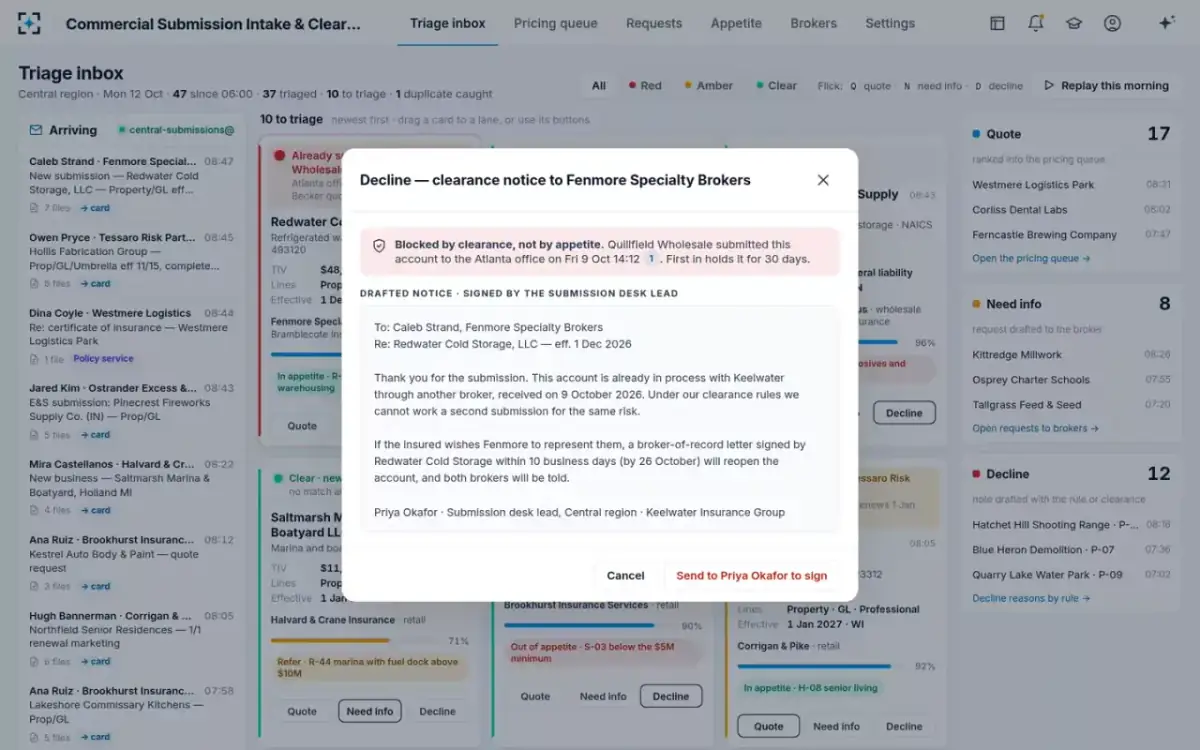
How long does a market stay blocked?
A market stays blocked for as long as the carrier's rule says, because no law sets the period. A rule can tie it to the first submission's life: a fixed hold from the date the first complete submission arrived, extended while a quote is open, and ending when the policy binds elsewhere, the quote lapses or the effective date passes.
The sample carrier sets a 30-day hold from the first complete submission, a setting it can change to 15, 45 or 60 days. Quillfield Wholesale sent Redwater to the Atlanta office on Friday 9 October, so the hold ran to 8 November. Two details in that rule are deliberate. The clock starts at the first complete submission, so a broker who fires off a name and an address to claim an account does not block anyone. And the hold is measured from a received timestamp the carrier controls, not from a date in the broker's email, which settles most arguments about who was first before they start.
The length of the hold is a trade. Too short and the first broker, who did the work of assembling the account, loses it to a competitor who copied the submission; too long and an insured that has moved on from its broker cannot reach the carrier at all. Whatever the figure, it should be the same in every office and visible to the brokers it binds.
How do you unblock a market?
A market is unblocked in one of four ways: the insured signs a broker-of-record letter naming the new broker, the hold expires, the first broker withdraws or loses the account, or the carrier releases it under its own rule. The first is the only one the insured controls, which is why it is the route the sample carrier's rule points to.
The sample notice is precise about it: a broker-of-record letter signed by Redwater Cold Storage within ten business days, by 26 October, reopens the account, and both brokers are told. The insured's signature is what turns two brokers' competing claims into the insured's choice. A release without that letter is the exception, and the sample carrier treats it as one: it needs the regional underwriting manager's approval and a reason that stays on file.
What does not unblock a market is pressure. A broker who resubmits under a slightly different name, or through a different office, is creating exactly the duplicate a clearance search exists to find. In the sample, the clearance checker matched "Red Water Cold Storage, L.L.C." to "Redwater Cold Storage, LLC" because it compared the FEIN, the addresses, the three locations and the contact together, not the name alone.
Blocked is not declined: why the difference matters to an E&S broker
A blocked submission and a declined one look alike to the broker who receives them, and they are not the same thing. A decline says the carrier will not write the risk; a block says the carrier is already working it through someone else. For a broker placing business in the surplus lines market, the difference can be material.
New York's excess line regulation, for example, bars an excess line broker from placing a risk with a non-admitted insurer for a New York home-state insured "unless the risk has been declined by at least three authorized insurers" that the broker had reason to believe might write it. Declinations from affiliated insurers do not count unless the affiliates operate as distinct and autonomous entities and compete for the business, and the brokers must "maintain files supporting declinations". Whether a clearance block can serve as a declination is a question for the broker's counsel and the regulator, not for this page; what a carrier can do is say plainly which one it is sending.
Blocked by clearance and declined on appetite tell the broker different things
Blocked by clearance: We are already working this account through another broker or office.
Declined on appetite: We will not write this class, state, size or loss history, through anyone.
Blocked by clearance: A broker-of-record letter signed by the insured, the hold expiring, or a release under the carrier’s rule.
Declined on appetite: A change in the risk or in the carrier’s appetite guide; not a letter.
Blocked by clearance: The date the first submission arrived, the hold period and the window for a signed letter.
Declined on appetite: The appetite rule that applied, in words the broker can act on.
Blocked by clearance: Asks the insured whether it wants to change brokers, or moves on.
Declined on appetite: Takes the risk to another market, and keeps the decline if the placement needs it.
In the sample, the two letters are different documents with different signatures. A clearance notice is drafted when the underwriter moves a duplicate to decline, and the submission desk lead signs it. A decline for a prohibited class, such as the fireworks distributor that arrived at 08:43 the same morning, is drafted with the appetite rule cited, and the underwriter sends it. Neither goes without a person, and the broker can tell from the first line which one it is reading.
Writing a clearance rule that survives an examiner and an angry broker
A clearance rule survives scrutiny when it is written before the conflict, applied the same way in every office, and leaves a trail showing what was matched and who decided. The NAIC's examination standard for underwriting points examiners at the places a rule fails: it tells them to "Review interoffice memoranda for evidence of anti-competitive behavior." An email between two offices agreeing to favour one wholesaler over another is exactly what that instruction is looking for.
What a written clearance rule should state
- What counts as the same account
Which fields are compared (named insured, trading names, FEIN, mailing and location addresses, contact) and the match threshold, with who may change it.
- What starts the hold
The first complete submission, by the carrier’s received timestamp, not the first email with a name in it.
- How long the hold lasts
A fixed number of days, the same in every office, and what extends or ends it (open quote, bind elsewhere, lapse).
- How a second broker reopens it
A broker-of-record letter signed by the insured, within a stated window, and the checks the switch needs.
- Who decides, and who approves exceptions
A named role for conflicts and a higher one for any release without a signed letter, with the reason kept on file.
- Who is told, and how
Both brokers, in writing, with the reason in plain words: blocked by clearance, or declined on appetite.
- Which offices the search covers
Every office that can quote the same insured; a rule that searches one region invites duplicates between regions.
- How changes are controlled
Each change saved as a new version with who made it and when, so the rule in force on any date can be shown.
The last item is the hardest to reconstruct after the fact. When a broker complains that it lost an account it brought first, the carrier's best answer is the rule as it stood on the day, the timestamps of both submissions, the fields that matched and the name of the person who decided. In the sample, each of those is kept with the submission, and a setting change is saved as a new rule version on the audit trail.
Where the duplicates come from, broker by broker
Duplicates cluster. Over 30 days the sample carrier's Central region received 1,002 submissions from ten brokers and wholesalers and caught 14 duplicates, nine of them between two wholesalers and none quoted twice. Every one of the 14 involved a wholesaler; the retail brokers that sent business directly accounted for only one, on an account a retail broker and a wholesaler were both working for the same insured.
Commercial Submission Intake & Clearance shows each broker's duplicates for the month
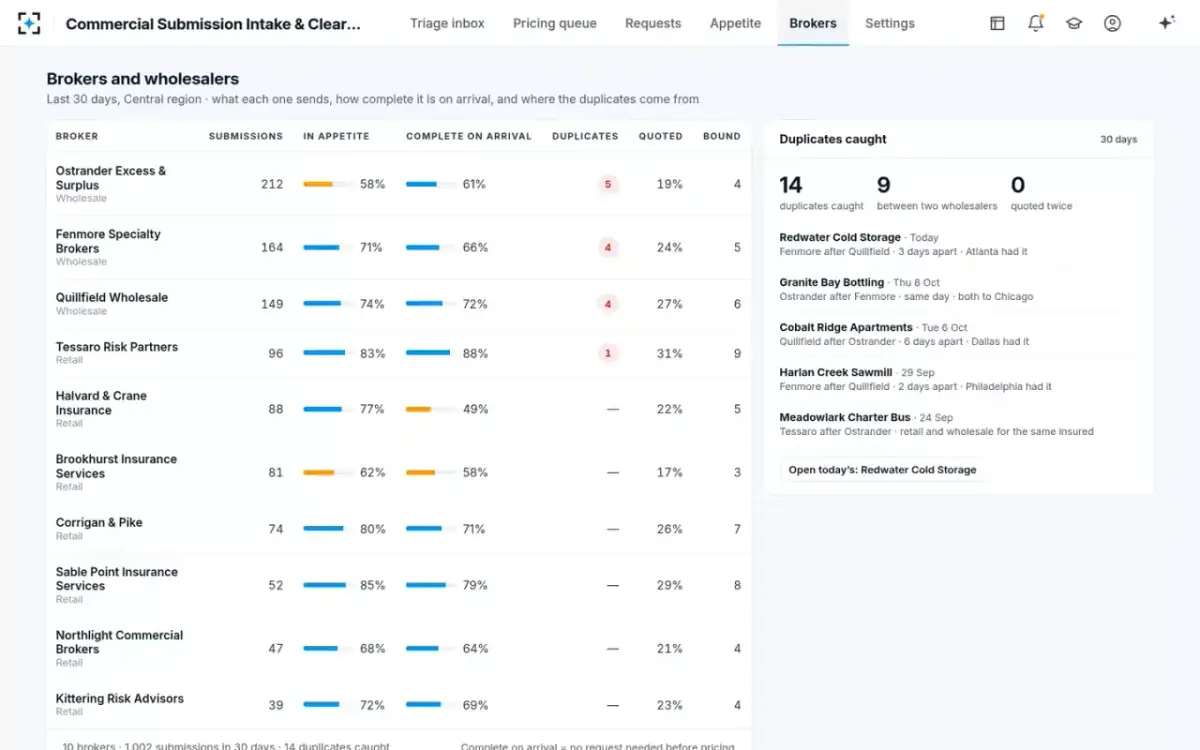
That pattern is the practical case for a written rule. In the sample, wholesalers sent the same account to the same carrier through different offices, on behalf of different retail agents who each believed they represented the insured. A carrier that sees only its own office's mailbox will block some of them and quote others, depending on which office happens to look. A carrier that searches every office the minute the email arrives blocks them all the same way. The full sequence, from the second email to the signed notice, is in what a submission clearance specialist does, and the solution itself is at Commercial Submission Intake & Clearance.
Questions people ask
Does a broker of record letter unblock a market?
It does where the carrier's rule says so. The sample carrier's rule makes a letter signed by the insured naming the new broker the way to reopen a blocked account, subject to its checks on the new producer, and in the 2003 New York case the insurer told the second broker it would not bind without one. No New York statute requires a carrier to accept or act on the letter in any particular way.
Can a wholesaler keep a market blocked after the retail agent changes?
It can, if the carrier's contract says so. In a 2007 opinion New York's regulator found no law stopping an insurer from requiring a new retail broker to keep placing an account through the original wholesale broker, calling it "a contractual matter". The answer sits in the carrier's agreement with the wholesaler.
What if the first broker's submission was incomplete?
That depends on whether the rule starts the hold at the first email or the first complete submission. The sample carrier's rule holds an account only from the first complete submission, so a name and an address sent to stake a claim block nothing. Writing the trigger down is what stops the argument.
Do admitted and surplus lines carriers block markets the same way?
The clearance practice is the same; the law around the quote is not. In the 2003 New York opinion the rate article that requires rates not to be excessive, inadequate or unfairly discriminatory did not apply to the non-admitted insurer, so the Department offered no view on its three very different quotes. An admitted carrier's quotes sit under that article.
Should a carrier tell the first broker that a second one has submitted?
No New York law requires it; the 2003 opinion found no notification requirements for quotes to more than one broker. Telling both is still the safer practice, because each broker then hears the rule from the carrier rather than from the insured. The sample carrier's notice tells both.