A commercial auto underwriter decides whether to insure a business's vehicles and at what price: who drives them, what they weigh, how far they go from the yard, what the operator's roadside record and losses say, and which drivers or conditions the policy should carry. On a fleet account that judgement rests on dozens of driver records, a vehicle schedule, a radius the insured states and five years of loss runs, and the work of gathering them is spread across an underwriting assistant, a risk-control consultant, a manager above the underwriter's authority and the producer. Botminds' Commercial Auto Fleet Underwriting is an agentic solution built for that desk: its agents read every driver's motor vehicle record, every VIN, the fuel-tax miles, the public safety record and the losses, so the people in each seat spend their time on the decisions only they can make.
The examples come from a fictional sample account as it runs through the solution: Harlan Creek Building Supply Co., a Fort Worth building-supply company renewing on 1 December 2026 with 38 power units, 52 drivers and $498,200 of expiring premium. The industry figures come from federal agencies and state regulators, linked where they appear.
One fleet renewal, from the producer’s email to the manager’s co-signature
A person decides
ProducerSends the applications, the vehicle schedule, a driver list in the insured’s own layout and five years of loss runs.
A person decides
Underwriting assistantKeys the driver list, orders motor vehicle records and chases the ones that do not come back.
Agent
The agentsRead every record, decode every VIN, compare the stated radius with fuel-tax miles and trips, read inspections and losses.
Never: exclude a driver or change the schedule.
A person decides
UnderwriterDecides exclusions, conditions and price within authority, and signs.
A person decides
ManagerCo-signs above the underwriter’s authority and on every named-driver exclusion.
What does a commercial auto underwriter do?
A commercial auto underwriter selects and prices the auto liability and physical damage risk of a business: trucks, vans, pickups and the people who drive them. The core questions are the same on a five-truck plumber and a 300-tractor carrier. Are the drivers qualified and is their recent driving acceptable? Are the vehicles what the schedule says, and in the right size class? How far from the garaging address do they run? What has the operator's roadside and loss history been? What price, deductible, exclusions and conditions make the account acceptable?
The federal description of the job is short and still accurate. Underwriters key an applicant's details into software, the Bureau of Labor Statistics says, then weigh the program's recommendations and approve or reject (BLS Occupational Outlook Handbook; the submission process guide quotes it). What the summary leaves out is how much of a fleet file has to be read before anything can be entered: the record behind each driver, the weight rating behind each VIN, the miles behind the stated radius.
The decision itself is a set of smaller ones. On the sample renewal the underwriter, Nora Whitfield, has to decide whether to exclude three drivers by endorsement, keep a fourth on a training condition, accept a fix that swaps two drivers between trucks, re-rate nine tractors to a longer radius, and make the quote conditional on a driver record from Oklahoma that has not yet come back. Each of those is a judgement with a reason, and each moves the price.
How is commercial auto underwriting different from personal auto?
Commercial auto underwriting prices a business's operation rather than a household, so the unit of risk is a roster of drivers you never meet and a schedule of vehicles rated by weight, use and radius. Three things change the work.
First, the drivers are employees, and many are regulated. A driver of a vehicle rated at 10,001 pounds or more in interstate commerce falls under the Federal Motor Carrier Safety Regulations, which require the employer to pull every driver's record at hire and every year. A commercial auto underwriter can use that regime as evidence: the driver qualification file a regulated carrier must keep says a good deal about its hiring.
Second, the vehicle and its route carry the rate. A heavy truck that runs 190 miles from its yard is a different exposure from the same truck making local deliveries, and the stated radius is one of the least verified numbers on an application. Checking the stated radius against fuel-tax returns and trip data is a commercial auto skill with no real personal-lines equivalent.
Third, the operator has a public safety footprint. Inspections, out-of-service orders and crashes for carriers with a USDOT number are published by the Federal Motor Carrier Safety Administration, and an underwriter who reads them alongside the driver roster sees things neither shows alone.
Most fleets are small: what FMCSA's carrier counts mean for the desk
Most commercial auto insureds with federal operating records are small. Of the 787,189 interstate and intrastate hazardous-materials carriers with recent activity at the end of 2023, 418,526 ran a single power unit and only 5,062 ran more than 100. Counting the one-, two- and three-to-ten-unit carriers together gives 710,386, about 90% of the total by our arithmetic.
Nine in ten federally registered motor carriers run ten power units or fewer
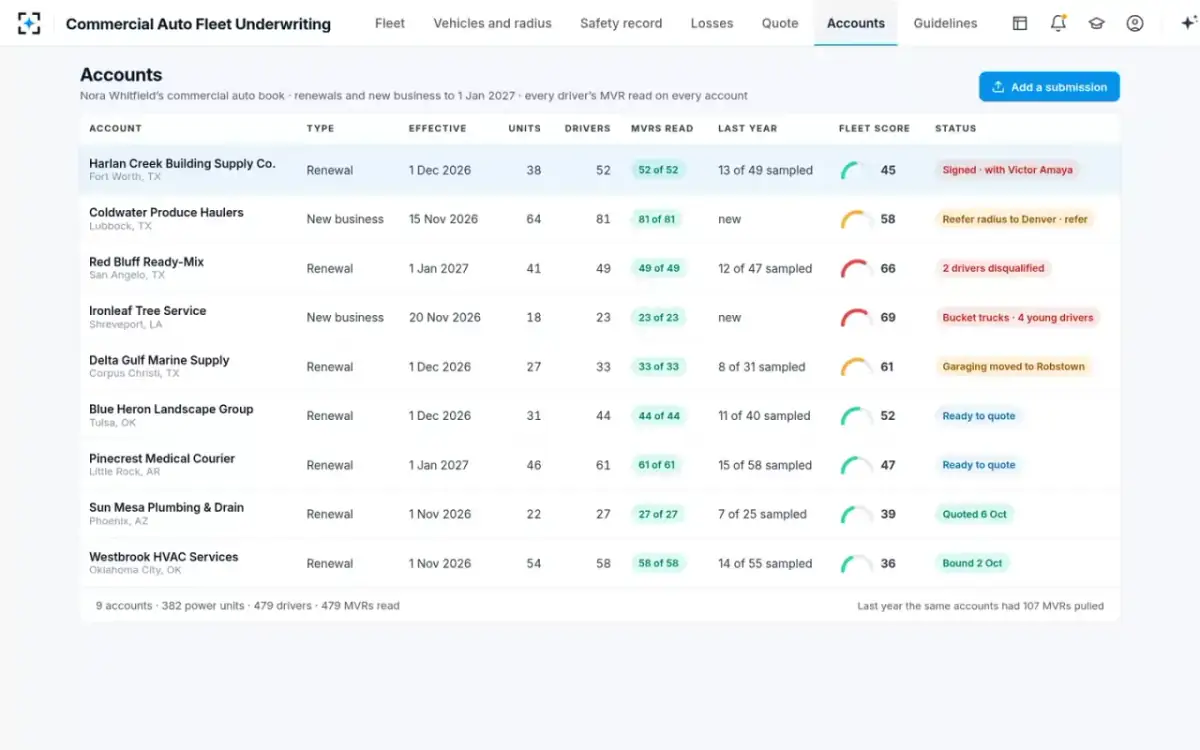
For the desk this has a practical meaning. A commercial auto book is many small and mid-size accounts, each with its own broker spreadsheet, its own mix of vehicles and a handful to a few dozen drivers. The time per account is short and the reading per account is fixed: every driver still has a record and every truck still has a VIN. That is why sampling crept in. The sample underwriter's book is nine fleet accounts averaging 53 drivers each, and every one of those drivers has a record to read.
An underwriter's fleet book: nine accounts, 479 drivers, every record read
Seat by seat: who carries a fleet account
A fleet account is carried by five people, and each sees a different part of it. The underwriter owns the decision. The others hold pieces of evidence the underwriter needs, and much of the elapsed time on a renewal is spent moving those pieces between seats.
The four insurer seats on one fleet renewal, before and after the reading is done for them
Today
Read 13 of 49 driver records on this account last year; the other 36 drivers went into the price unread.
With agents
Sees all 52 drivers on one roster and prices each exclusion before deciding.
Still theirs: Every exclusion, condition and signature.
Today
Spends half the week re-keying driver lists into the record-ordering portal.
With agents
Gets one roster built from the broker’s own layout and every record ordered; chases what is still pending.
Still theirs: The follow-up on missing records and documents.
Today
Knows the radius on the application is a guess and the fuel-tax return is not.
With agents
Sees where the trucks go against the 50- and 200-mile rings, with miles and trips behind every re-rate.
Still theirs: The visit, the safety program and the telematics review.
Today
Wants to see who is excluded, why, and what it did to the price, on one page.
With agents
Co-signs from a review note that names each exclusion, its reason and the score and premium after it.
Still theirs: Authority above the underwriter’s limit.
Where a fleet account stalls between seats
A fleet renewal tends to stall in the handoffs rather than inside one seat. Four are predictable, and each costs days rather than minutes.
The driver list. It arrives in the insured's own spreadsheet, with names, dates of birth and licence numbers in whatever columns the broker used. Someone has to key it before a single record can be ordered, and someone has to match each driver to a unit, because a Class C licence is fine in a pickup and a problem in a 33,000-pound boom truck.
The records that do not come back. A driver licensed in another state, a name that does not match, a record still pending: the assistant chases, the underwriter waits, and the decision is often made with a gap the file never mentions. On the sample account one Oklahoma-licensed driver's record was still pending when the rest were read, and the quote carries it as a condition: the record must come back clean before binding.
The radius. The application says 50 miles. The insured's fuel-tax return, which the risk-control consultant may never see, says otherwise. In the sample, the return showed 41,880 miles in Oklahoma for the second quarter of 2026, 11.6% of the fleet's miles, and tracker trips put all nine tractors between 111 and 196 miles from the Fort Worth yard.
The roadside record. FMCSA publishes a carrier's inspections and out-of-service results, but few desks read them against the driver roster. On the sample account three roadside violations named drivers who were already failing the guidelines on their records. The guide to FMCSA out of service rates shows how to read that public record without over-reading it.
What do commercial auto underwriters look for in a fleet submission?
Commercial auto underwriters look for evidence that the drivers are qualified, the vehicles are what the schedule says, the radius is true, and the operator's own record supports the price. In practice that is eight checks, each with a document behind it.
Eight checks a fleet file should answer before a price is set
- Every listed driver’s motor vehicle record, three years
Majors, at-fault accidents, suspensions and disqualifications, coded the same way across states. A sample leaves the rest priced on trust.
- Licence class against the unit each driver drives
A single vehicle rated at 26,001 lb or more needs a Group B commercial licence; a combination at that weight, towing more than 10,000 lb, needs Group A.
- Every VIN decoded and its check digit tested
The ninth character exists to catch transcription errors; the weight rating sets the size class.
- Stated radius against fuel-tax miles and trips
Miles by jurisdiction on the quarterly return, and trips from the garaging address, are independent of the application.
- The operator’s inspections, out-of-service results and crashes
Public for carriers with a USDOT number, on a 24-month window.
- Five years of loss runs, each claim tied to a unit and a driver
Frequency, severity and loss ratio by term, and whether the large losses sit with drivers still on the roster.
- The insured’s own driver files and hiring practice
A carrier must pull a three-year record at hire and review every driver’s record each year.
- A reason for every credit, exclusion and condition
Examiners look for documentation of each deviation from the manual rate.
The broker's half of the same problem, what to send so a file gets quoted first, is set out in the underwriting submission checklist. The underwriter's half is above: the checks that turn a complete file into a priced one.
Why commercial auto is a hard line to write in 2026
Commercial auto is a hard line because claims have outrun premium for years, and the gap is closing only through rate. The NAIC's 2025 full-year analysis reports that the commercial auto liability pure net loss ratio "improved 3.0-points to 71% due to continued rate increases driven by higher claims" (NAIC 2025 P&C report). The Federal Insurance Office reports a 9.3% rise in commercial auto liability premium written in 2025, ahead of other liability at 8.0% and commercial multiple peril at 4.4%.
Commercial auto, by the regulators' numbers
71%
commercial auto liability pure net loss ratio, 2025
NAIC
+9.3%
commercial auto liability premium written, 2025
Federal Insurance Office
+48.5%
fatal crashes involving large trucks, 2013 to 2022
FMCSA; our arithmetic
The NAIC also names the cause the desk feels on every large claim: liability lines "continued to experience profitability issues stemming from social inflation." For a fleet underwriter the practical consequence is that a single unread record matters more than it used to. On the sample account the three largest claims, $894,800 of $1,092,700 incurred over five years, involve two drivers who were already failing the guidelines, one of them with a claim still open at $610,000 and an attorney involved.
What an examiner reads in a commercial auto file
A state market conduct examiner reads a sample of commercial auto files for rating accuracy, documentation and producer appointments, and the errors found are ordinary. In a 2020 North Carolina examination of two affiliated insurers, examiners drew 50 of 651 active commercial auto policies; seven, or 14%, "had a total of eight rating errors": three incorrect territories, two wrong physical-damage symbols, two missed dumping factors and one incorrect size factor (North Carolina DOI examination). Fifteen files, 30%, lacked the required proof of residency taken at application.
None of those errors is a judgement call. A territory comes from the garaging address, a size factor from the weight rating, a dumping factor from the vehicle's use. They are reading errors, and the NAIC's examination standard explains why they matter: examiners expect a policy's rating and classification to rest on adequate information gathered at or near inception (NAIC Market Regulation Handbook). A fleet file that never decoded the VIN or checked the radius did not have adequate information at inception, whatever the underwriter's judgement.
Where Commercial Auto Fleet Underwriting fits on the desk
Commercial Auto Fleet Underwriting fits between the producer's submission and the underwriter's decision: its seven agents do the reading and the arithmetic, and every exclusion, condition and signature stays with a person. On the sample renewal the agents read the submission, ordered all 52 drivers' records (51 came back, the Oklahoma record was pending), checked 38 VINs, the fuel-tax return, the inspection record and five years of losses in 6 minutes 12 seconds.
Where a mid-size fleet renewal's hours go, by hand and with Commercial Auto Fleet Underwriting
By hand · 13.5 h
- Keying lists · 14.8%
- Records · 29.6%
- VINs, radius · 14.8%
- Safety, losses · 14.8%
- Pricing, exclusions · 14.8%
- Review note · 11.2%
With the agents · 1.15 h
- Reading checked · 34.8%
- Pricing, exclusions · 43.5%
- Review note · 21.7%
What changes is where the underwriter's hour goes. By hand, deciding exclusions and pricing is about a seventh of the work; with the reading done, it is most of it. The fleet scorer recomputes the score and the indicated premium each time a driver is excluded, put back or reassigned, so the underwriter sees the price of each decision before making it. The agents never exclude a driver, never change the vehicle schedule and never send a quote to the broker before both signatures.
Every driver on one roster, the failing five at the top
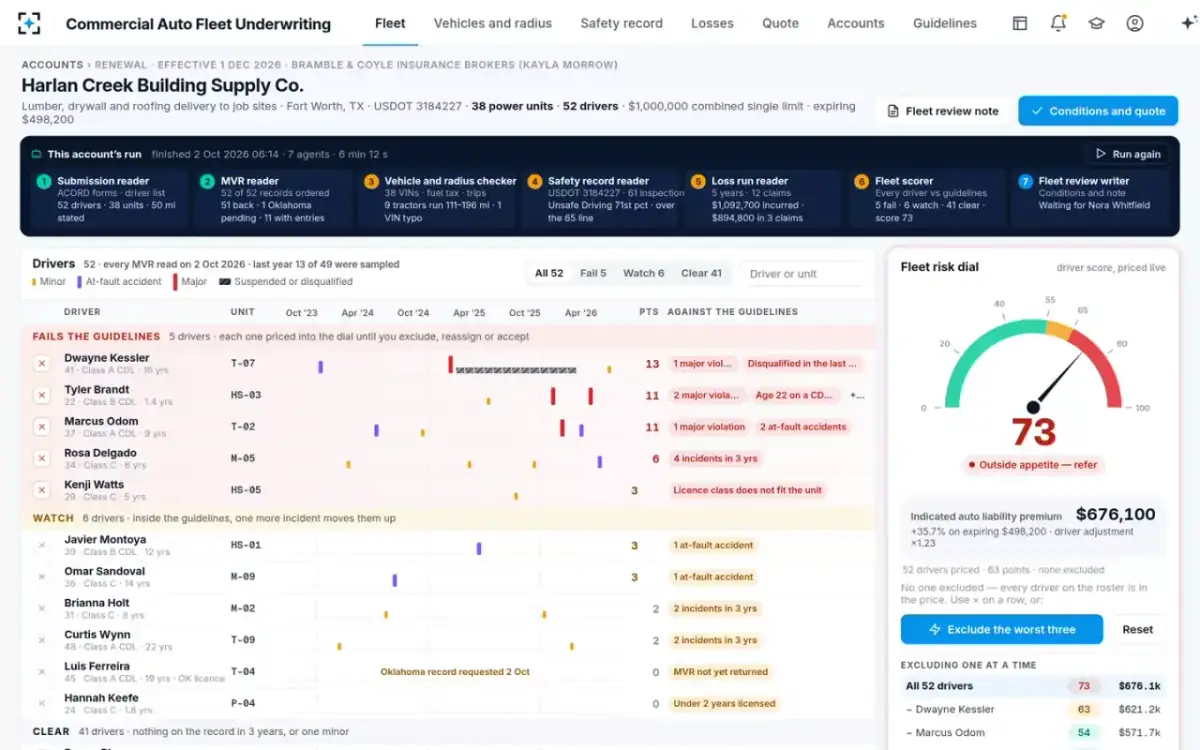
It does not replace the seats. The assistant still chases what is missing, the risk-control consultant still visits and still judges the safety program, the manager still co-signs, and the producer still has the conversation with the insured about three drivers who will be excluded. The Commercial Auto Fleet Underwriting page shows the whole renewal screen by screen; the guide to running an MVR on every driver traces the record-reading step in detail.
The skills that still decide a fleet account
The skills that decide a fleet account are the ones software does not supply: knowing what an operation's routes and cargo imply, reading a driver's record for pattern rather than count, and deciding when a fix beats an exclusion. The BLS is blunt about the rest of the job: it expects automated underwriting software to cut the need for underwriters, and it projects underwriter employment to fall 4% from 2025 to 2035, with about 6,800 openings a year.
The sample account shows the difference between processing and judgement. The agents found that Kenji Watts held a Class C licence on a 33,000-pound boom truck, and that another driver on the roster held a Class B licence on a smaller unit; swapping them fixes both without excluding anyone. Whether the insured will actually swap them, and whether to make it a condition, is the underwriter's call. So is keeping Rosa Delgado, with four minor incidents in three years, in the price on a training condition rather than excluding her.
Questions people ask
What does a commercial auto underwriter do day to day?
Reviews new and renewal submissions for business vehicles: reads driver records and vehicle schedules, checks radius, operations and losses, sets the price and the conditions, and decides which drivers, if any, to exclude. Above a set premium authority, a manager co-signs. Much of the day goes to chasing and reading documents rather than deciding.
How many vehicles make a fleet in commercial auto insurance?
There is no federal definition: "fleet" is a rating term set by each insurer's rules or a state plan's manual. Texas's residual-market plan, for example, publishes separate fleet and non-fleet tables for trucks and tractors. FMCSA counts carriers by power units instead, and about nine in ten registered carriers run ten or fewer.
How much do commercial auto underwriters make?
The BLS does not publish pay for commercial auto underwriters separately. For insurance underwriters as a whole, the median was $81,370 a year, or $39.12 an hour, in May 2025. Pay varies with line, authority level and employer.
Can an insurer pull a driver's record without the driver's consent?
Federal law allows it for underwriting: the Driver's Privacy Protection Act lets an insurer use motor vehicle record information for rating and underwriting, as well as claims and antifraud work (18 U.S.C. § 2721(b)(6); the MVR guide quotes it). States set their own ordering procedures and fees, and an insurer should order only for drivers listed on the account.
Is commercial auto underwriting harder than other commercial lines?
It is among the least profitable: the NAIC puts commercial auto liability's 2025 pure net loss ratio at 71%, against 48% for workers' compensation. The reading load is also heavy, because every driver and every vehicle is its own piece of evidence. The judgement is learnable; the volume is what makes the desk hard.
What does risk control do for a fleet account?
A risk-control consultant visits the operation or reviews its data to test what the submission claims: the safety program, the hiring and driver-file practice, the vehicles' condition and where they actually run. Their findings feed the underwriter's conditions. On the sample account, the consultant's question was the radius, and the fuel-tax return answered it.