To run an MVR on drivers, collect each driver's full name, date of birth, licence number and licensing state; order the motor vehicle record from that state's licensing agency, in the form it prescribes, for a purpose the law permits; then read every entry, code it the same way across states, and set it against your guidelines. For an insurer the permitted purpose is underwriting, and for a fleet the hard part is not ordering one record but reading dozens, which is why underwriters have long sampled a fleet's drivers instead of reading them all. Botminds' Commercial Auto Fleet Underwriting is an agentic solution built to remove that trade-off: its agents order and read a three-year record for every listed driver, and the underwriter decides what to do about the ones that fail.
The example is a fictional sample renewal as it runs through the solution: Harlan Creek Building Supply Co. of Fort Worth, 52 drivers on 38 power units. Last year, on the same account, 13 of 49 drivers' records were read. This year all 52 were ordered.
One roster, traced: where the agents order and read, and where a person decides
Agent
Submission readerBuilds one roster from the broker’s driver list, in its own layout, and matches 52 drivers to 38 units.
Never: alter a submitted figure; it reports the difference.
Agent
MVR readerReuses any record ordered in the last 90 days, orders a three-year commercial record for every other listed driver, and codes each state’s entries as minor, major, at-fault accident or suspension, citing the line behind each.
Never: order for anyone not listed on the account, or infer a violation the record does not show.
Agent
Fleet scorerScores every driver against the guidelines: five fail, six to watch, 41 clear.
Never: exclude a driver.
A person decides
Underwriting assistantChases the one record still pending, from Oklahoma, and the documents the agents flagged as missing.
A person decides
UnderwriterDecides each exclusion, swap or condition, with a reason, and signs.
How do you run an MVR on a driver?
You run an MVR by requesting the driver's record from the state licensing agency, directly or through an authorised channel, with the driver's identifiers and a stated permissible purpose, and paying the state's fee. For a motor carrier hiring a driver, the federal rule spells out the request: an inquiry "to each driver's licensing authority where the driver held or holds a motor vehicle operator's license or permit during the preceding 3 years, to obtain that driver's motor vehicle record covering that driver's prior 3-year driving history" (49 CFR 391.23(a)(1)), made "in the form and manner each authority prescribes."
An underwriter can follow the same pattern for a fleet account, in four steps:
- Identify every listed driver. Name, date of birth, licence number and state, from the driver list. Each mismatch at this step becomes a "no record found" later.
- Order from the right states. The licensing state holds the record; a driver who moved recently may have history in another. For commercial licence holders, convictions in other states should already be on the home record, because the convicting state must notify the licensing state within ten days.
- Read every entry. Status, class, endorsements, medical certification status for commercial licence holders, convictions, accidents and withdrawals, each with its date.
- Code and compare. Turn each state's descriptions into one set of types, count them over your look-back periods and set them against the driver's unit and your guidelines.
The ordering is the easy part. Many states sell records online and some deliver at once: Texas's own online service makes a record "available to print immediately after successful payment" (Texas DPS). Reading 52 of them, each with its own state's codes and layout, is where the hours go, and where the guide to what MVR checks cost finds most of the real price.
What is the DPPA permissible use for insurance?
The Driver's Privacy Protection Act lets an insurer obtain personal information from state motor vehicle records for underwriting. The permitted use reads: "For use by any insurer or insurance support organization, or by a self-insured entity, or its agents, employees, or contractors, in connection with claims investigation activities, antifraud activities, rating or underwriting" (18 U.S.C. § 2721(b)(6)).
Two limits follow from the wording. The purpose is the insurer's own rating or underwriting, so a record should be ordered for a driver listed on the account being underwritten, not for anyone the insured once employed. And the record is personal information held for that purpose, so a sensible practice is to reuse a recent record rather than order the same driver twice in a season. On the sample renewal the MVR reader orders only for listed drivers and reuses any record ordered in the last 90 days. Each record it reads carries its purpose on its face: "3-year commercial record · ordered 2 Oct 2026 for underwriting (DPPA permissible use)."
How far back does an MVR go?
An MVR goes back as far as the record type you order: the standard histories in the states compared below cover three years, some states sell longer or complete histories, and the federal rules for commercial licence holders require states to keep convictions on the record for at least three years. The look-back you need depends on your guidelines; a five-year look-back for majors needs a record that reaches five years.
How far back a driving record reaches depends on the record you order
| Record | Period covered | Who it is for |
|---|---|---|
| Texas Type 2 driving history | Accidents and violations in the past 3 years | The driver, ordered online ($6.50) |
| Texas Type 3 complete history | All accidents and violations in the record | The driver, ordered online ($7.50) |
| Pennsylvania 3-year driver record | Actions and violations for the past 3 years | On request, form DL-503 ($15) |
| Pennsylvania 10-year driver record | Actions and violations for the past 10 years | Employment purposes only ($15) |
| Carrier’s hiring inquiry, 49 CFR 391.23 | Prior 3-year driving history, from every state licensed in | A motor carrier, within 30 days of hire |
| Carrier’s annual inquiry, 49 CFR 391.25 | At least the preceding 12 months | A motor carrier, every 12 months |
| CDLIS driver record, 49 CFR 384.225 | Convictions and disqualifications kept at least 3 years | States must keep it for commercial licence holders |
The table also explains a common mismatch. An annual inquiry under the carrier rules only has to reach back twelve months (49 CFR 391.25(a)), so a copy of the insured's latest annual record may not reach back far enough for an underwriter's three-year incident count, let alone a five-year look-back for majors.
What is on a commercial driver MVR?
A commercial driver's MVR shows licence status, class and endorsements, medical certification status, and the convictions, accidents, suspensions and disqualifications on record, each dated. For commercial licence holders the record also carries convictions from any vehicle: states must post "All convictions, disqualifications and other licensing actions for violations of any State or local law relating to motor vehicle traffic control (other than parking, vehicle weight, or vehicle defect violations) committed in any type of vehicle" (49 CFR 384.225(a)(1)).
That last phrase matters in practice. The sample account's worst driver, Dwayne Kessler, was convicted of driving while intoxicated in his own car, not a truck. It is on his commercial record, and it disqualified his commercial licence for a year.
A certified Texas abstract, every line the agent used highlighted
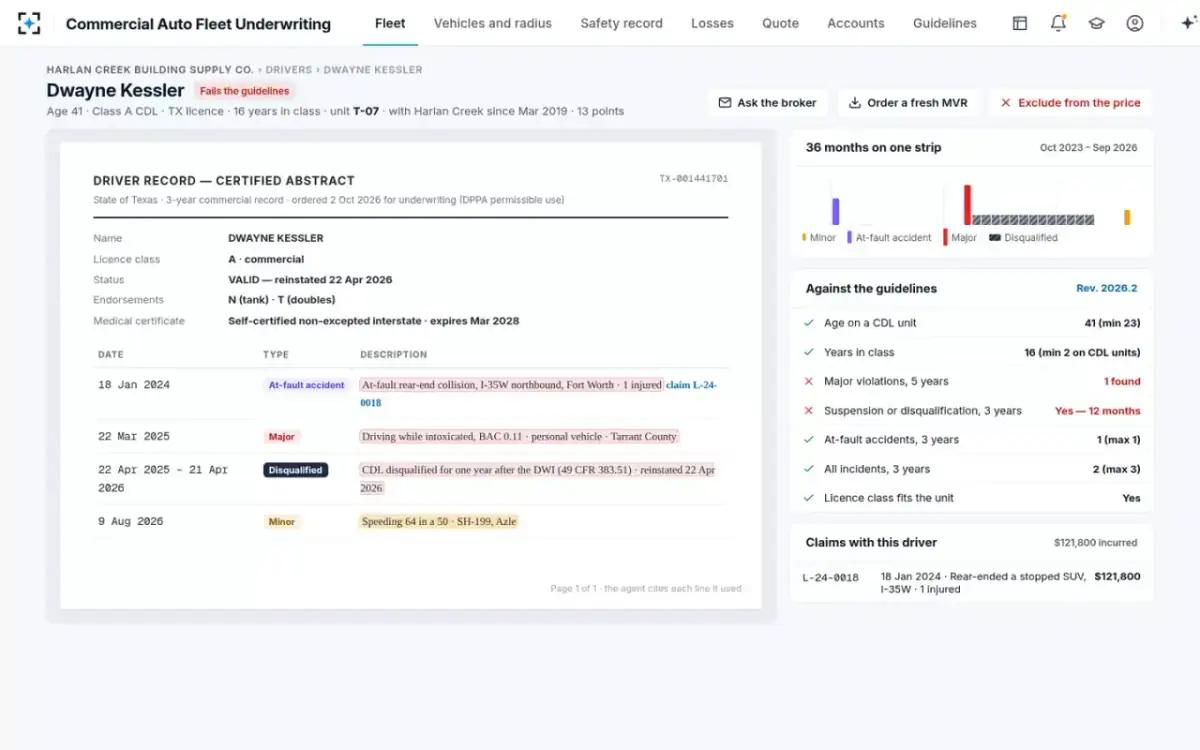
Medical status is the other line underwriters skip. For commercial licence holders the carrier rules require the medical certification to come from the driver's record itself: where the record "contains medical certification status information, the motor carrier employer must meet this requirement by obtaining the CDLIS motor vehicle record" (49 CFR 391.51(b)(6)(ii)). A non-excepted interstate commercial licence holder whose record carries no certification status is designated not-certified.
Which violations disqualify a commercial driver?
Federal rules disqualify a commercial licence holder for major offences, such as driving under the influence or leaving the scene of an accident, and for repeated serious traffic violations within three years. The periods are set out in two tables in 49 CFR 383.51, and the vehicle matters: some offences count only in a commercial vehicle, others in any vehicle.
Disqualification periods for the offences an underwriter sees most
| Offence | First conviction | Second or later |
|---|---|---|
| Under the influence of alcohol, in a commercial vehicle | 1 year (3 years if carrying hazardous materials) | Life |
| Under the influence of alcohol, in a personal vehicle (licence holder) | 1 year | Life |
| Speeding 15 mph or more over the limit | No disqualification for one | 60 days for a second in 3 years; 120 days for a third |
| Reckless driving; improper lane change; following too closely | No disqualification for one | 60 days for a second in 3 years; 120 days for a third |
| Driving a commercial vehicle without the proper licence class or endorsement | No disqualification for one | 60 days for a second in 3 years in a commercial vehicle; 120 days for a third |
| Texting or using a hand-held phone while driving a commercial vehicle | No disqualification for one | 60 days for a second in 3 years; 120 days for a third |
Two details change how a record is coded. "Speeding excessively" for disqualification purposes means "any speed of 24.1 kmph (15 mph) or more above the regulated or posted speed limit" (49 CFR 383.51(c)). Kessler's 64 in a 50 is 14 over: a minor under the sample guidelines, and not a federal serious violation. And a disqualification ends; the licence comes back. Kessler's was reinstated on 22 April 2026, which is why an underwriter's guidelines, not the federal tables, decide whether a five-year-old DWI still keeps a driver off a tractor.
For the carrier itself, the annual review rule tells it what to weigh: it "must give great weight to violations, such as speeding, reckless driving, and operating while under the influence of alcohol or drugs, that indicate that the driver has exhibited a disregard for the safety of the public" (49 CFR 391.25(b)(2)). An underwriter's points table is a written version of the same instruction, and the guide to the driver qualification file checklist shows what the carrier must keep from its own review.
One roster of 52, traced step by step
Traced through the sample renewal, running an MVR on every driver is six steps, four of them done by agents and two by people. The agents' part finishes in minutes; the people's part is the decisions and the one record that did not come back.
The sample renewal's records, in four numbers
52of 52
drivers’ records ordered on 2 Oct 2026
51
records returned and read; one Oklahoma record pending
13of 49
drivers’ records read on the same account a year earlier
5
drivers who fail the sample guidelines on their records
Build the roster. The submission reader takes the broker's driver list as it arrives and matches each driver to a unit. Matching matters: Kenji Watts holds a Class C licence and drives HS-05, a 33,000-pound boom truck, which needs a Group B commercial licence. His record is nearly clean. His assignment is the problem.
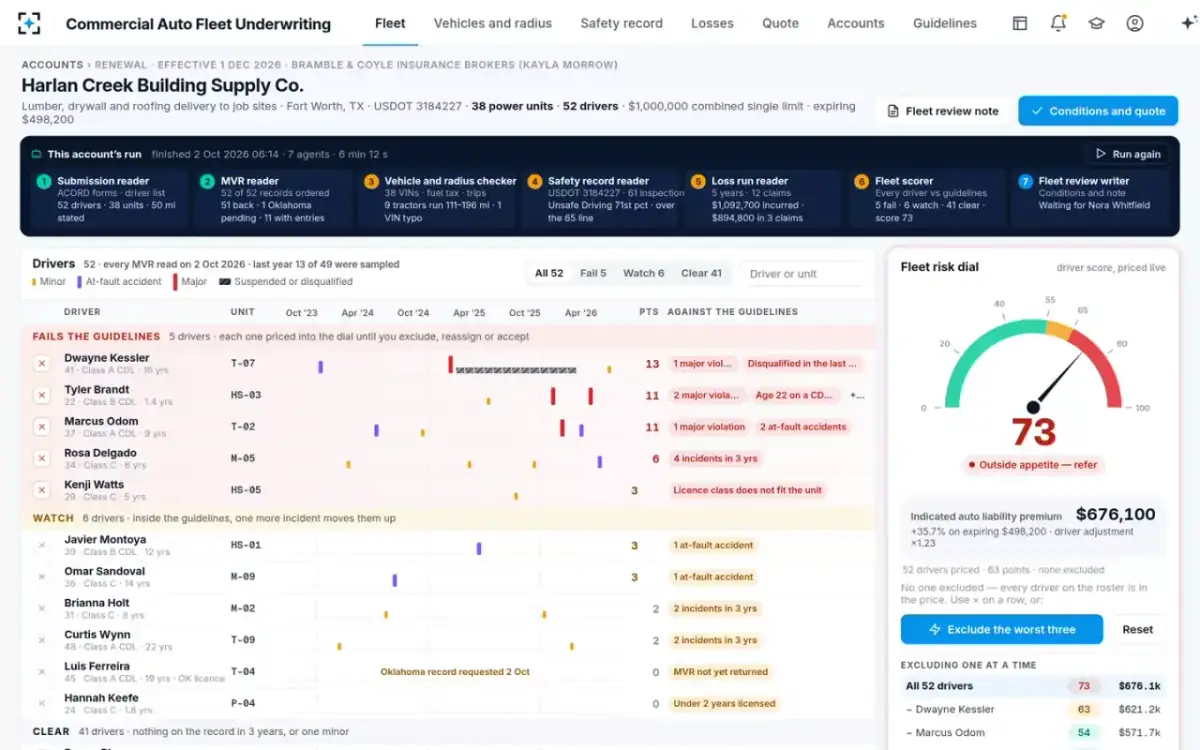
Order. The MVR reader checks for a record ordered in the last 90 days and orders a three-year commercial record for every other listed driver. Fifty-one came back. Luis Ferreira holds an Oklahoma licence; his record was requested on 2 October and was still pending when the roster was scored, so he sits on the roster at zero points with "MVR not yet returned," not silently clear.
Read and code. Each state describes the same offence in its own words and codes. The reader turns them into four types (minor violation, at-fault accident, major, suspension or disqualification) and highlights the line behind each, so the underwriter can check a coding decision in one click. It never infers an entry the record does not show.
Score. The fleet scorer applies the guidelines: minor 1 point, at-fault 3, major 4, suspension or disqualification 5, a licence class that does not fit the unit 2, under the minimum age or years in class 1 each. Five drivers fail, six are one incident from failing, 41 are clear.
Chase. The assistant follows up the Oklahoma record. The quote later carries it as a condition: the record must return clean before binding.
Decide. The underwriter excludes three drivers by named-driver endorsement, keeps one on a training condition and offers the insured a swap that fixes Watts without excluding him. Each decision has a reason, and the indicated premium moves with each.
Why a sample of 13 misses the drivers that matter
A random sample of a quarter of a fleet's records will usually miss most of the drivers who fail, because failures are rare and concentrated. The arithmetic is simple to check on the sample roster: 52 drivers, five of whom fail the guidelines. Draw 13 records at random, as last year's file did, and the chance of seeing each number of failing drivers follows directly.
Read 13 of 52 records at random and you most likely find one of the five failing drivers
The chance of missing Dwayne Kessler alone is 75%. The chance of the sample containing none of the three drivers later excluded is 41%, and two of those three are behind the account's three largest claims, 82% of five years' incurred losses. A sample chosen by rule of thumb instead, such as the newest hires or the drivers with recent claims, has a blind spot of its own: a 16-year veteran with a DWI in his own car.
Reading every record changes the question from "did the sample catch anyone?" to "what do we do about the five?". That second question is the one an underwriter is paid to answer, and the one the sample hid.
Where Commercial Auto Fleet Underwriting reads the record, and where a person decides
Commercial Auto Fleet Underwriting orders, reads and codes the records and recomputes the score; a person decides every exclusion, reassignment and acceptance. The division is deliberate, because each step on the record side can be checked and each step on the decision side needs a reason.
What to check on every driver record, whoever reads it
- The record matches the driver
Name, date of birth and licence number agree with the driver list; a mismatch is a missing record, not a clean one.
- Status and class fit the unit
Valid, not suspended; a single unit rated at 26,001 lb or more needs a Group B licence or higher.
- Medical certification is current
For commercial licence holders, the certification status sits on the record itself.
- Every entry is dated and typed
Minor, major, at-fault accident, suspension or disqualification, counted over the look-back your guidelines set.
- Convictions in any vehicle are counted
For a commercial licence holder, a DWI in a personal car is on the record and disqualifies.
- Every state licensed in the past three years is covered
A recent move can leave history in a state nobody ordered from.
- Pending and missing records are visible
A driver with no record back is shown as pending, never as clear.
The solution does not change what the carrier must do for itself: the hiring inquiry and the annual review stay the insured's obligation, and the underwriter's read is a separate, independent one. It also does not decide that a record is clean when it is missing. Between renewals, the guide to motor vehicle record monitoring compares the options for seeing a new conviction before the next renewal.
All 52 drivers on one roster, each with a 36-month strip
Questions people ask
Can an insurer pull an MVR without the driver's consent?
Federal law permits an insurer to obtain motor vehicle record information for rating or underwriting under the Driver's Privacy Protection Act, 18 U.S.C. § 2721(b)(6). States add their own procedures, and some require the requester to state the purpose or hold an account. California's employer program, for example, needs a driver's written authorisation to enrol a driver the state does not already require the employer to enrol.
How often should commercial driver MVRs be checked?
A motor carrier must obtain and review each driver's record at least once every 12 months, and must pull a three-year record from every licensing state within 30 days of hire (49 CFR 391.23 and 391.25). An underwriter reads them at least at each renewal; between renewals, monitoring programs report new events as they post.
How long does an MVR check take?
From some states, seconds: Texas's online service makes a record available to print immediately after payment. Others take days, especially for out-of-state or mailed requests. On the sample renewal 51 of 52 records came back in the agents' run, and one Oklahoma record was still pending.
Does a DWI in a personal car count against a commercial licence?
Yes. Under Table 1 of 49 CFR 383.51 a commercial licence holder convicted of driving under the influence in a non-commercial vehicle is disqualified from commercial driving for one year on a first conviction, and for life on a second. The conviction appears on the commercial driver's record.
What if a state does not return a driver's record?
For a carrier hiring a driver, the rule is to document a good-faith effort to get the record from any state that does not answer (49 CFR 391.23(b)). An underwriter should treat the driver as pending, not clear, and decide whether to bind before it arrives.