MVR checks cost from $2 to $47 per record in state fees in the states compared below, depending on the state and the kind of record, and FMCSA's own paperwork estimate uses a $9 median state fee plus $1 for processing: $10 a record. For a commercial auto underwriter the fee is the small part. Reading each record, coding every entry the same way across states and setting it against the driver's unit and the guidelines takes minutes per driver, and on a 50-driver fleet that is hours of underwriting time per renewal. Botminds' Commercial Auto Fleet Underwriting is an agentic solution that takes the reading off the underwriter: the state fees stay the same, but the cost of reading every driver falls to about the cost of reading a sample, which removes the reason to sample at all.
The worked example below prices one fictional sample account three ways: Harlan Creek Building Supply Co. of Fort Worth, with 52 drivers, read as a 13-record sample, read in full by hand, and read in full by the solution's agents. The fee figures come from state agencies and FMCSA; the time figures are our assumptions, stated where they are used, so you can replace them with your own.
Reading every driver by hand costs four times the sample; with agents reading, the fees are most of what is left
How much does an MVR check cost?
An MVR check costs the state's fee for the record plus any processing or vendor charge: from $2 in Oregon to $47 for a certified Pennsylvania record, with $10 a reasonable national planning figure. That figure is FMCSA's. In its 2022 rule removing the drivers' annual list of violations, the agency explained that its approved paperwork estimate "provides that SDLAs assess motor carriers a $10 fee to obtain MVRs consisting of a $9 median fee charged by 51 SDLAs, plus a $1 third-party processing fee" (87 FR 13192). SDLAs are the state driver licensing agencies.
The fee depends on what you order. A three-year history is cheaper than a certified one; a status check is cheaper than either. The record an underwriter needs for a fleet driver is a three-year history with convictions, accidents and withdrawals, and for a commercial licence holder the medical certification status. The step-by-step guide to running an MVR on drivers covers what each line means.
Are MVR fees the same in every state?
No. State fees for a driving record vary by more than twenty times, and within a state by record type and by who is asking. The figures below are each agency's own, as published in 2026.
What one driving record costs, by state and record type
Two details change the arithmetic on a real fleet. Out-of-state drivers mean out-of-state fees: on the sample account one driver's record had to come from Oklahoma, and it was the one still pending when the rest were read. And channels differ: a state's online service for drivers' own records is cheap and instant, while the channels open to employers and insurers can need an account, an approved purpose and, in some states, a vendor.
Who pays for MVR reports?
Whoever orders them pays: the motor carrier for its own hiring and annual reviews, the insurer for underwriting, and the employer for any monitoring program it joins. The obligations do not overlap as much as they seem to.
A regulated carrier must pull a three-year record from every licensing state when it hires a driver and an updated record at least once every 12 months. That cost sits with the carrier. An insurer that wants its own read of the same drivers orders under the Driver's Privacy Protection Act's underwriting purpose (18 U.S.C. § 2721(b)(6)) and pays its own fees. Some insurers ask the insured for copies from its driver files instead; those are free to the insurer, but they may be up to a year old, may cover only the preceding 12 months, and come in whatever form the carrier kept them.
State monitoring programs are paid by the employer that enrols. California charges "$5 for each enrolled driver" and "$1 for each annually generated report and each action/activity report" (California DMV); New York's service charges $7 to add a driver and $1 per notification (New York DMV).
The real cost is reading: one roster priced line by line
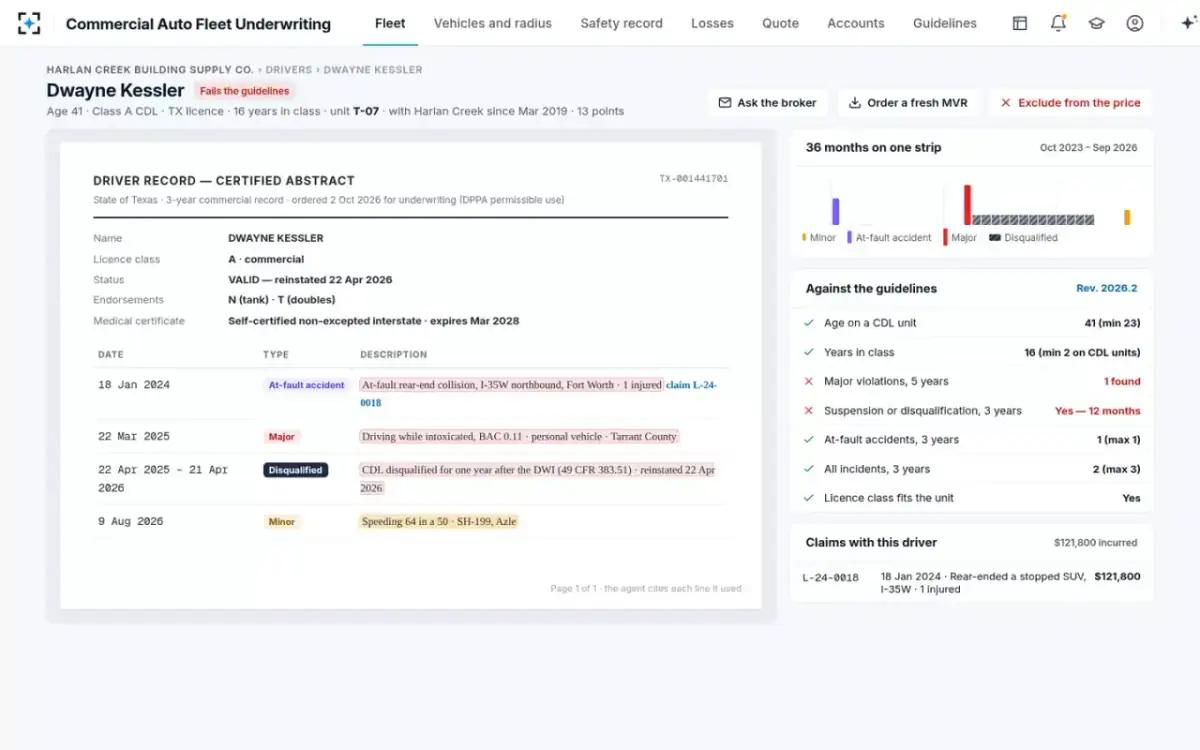
The real cost of an MVR check on a fleet is the underwriting time to order, read and code each record, not the fee. Priced line by line on the sample roster, the fees for all 52 drivers are $520, and the time to read them by hand, at our assumption of eight minutes per record, is almost seven hours.
Cost per roster for one 52-driver renewal, three ways
| Line | Sample of 13, by hand | All 52, by hand | All 52, agents reading |
|---|---|---|---|
| Records ordered | 13 | 52 | 52 |
| State fees at $10 each | $130 | $520 | $520 |
| Underwriting time | 1.7 h (8 min × 13) | 6.9 h (8 min × 52) | 0.1 h to check |
| Time at $39.12 an hour | $68 | $271 | $4 |
| Cost per roster | $198 | $791 | $524 |
| Drivers priced unread | 39 | 0 | 0 |
Change the assumptions and the shape holds. At 15 minutes per record, reading all 52 by hand costs $1,029; at 5 minutes, $690. In every case the full read by hand costs several times the sample, and the full read by agents costs about what the fees cost. The last row is the one that matters: the sample prices 39 drivers on trust.
One record, read and coded: four lines, 13 points, one click to the source
Why do insurers only pull some driver MVRs?
Insurers pull only some drivers' records because reading them is slow and the time comes out of the same underwriter's day, not because the fees are high. On the sample account the file shows 13 of 49 drivers read the year before. At $10 a record, reading the other 36 would have cost $360 in fees; the real constraint was the hours.
The sample hides more than it seems. With 52 drivers of whom five fail the guidelines, a random draw of 13 finds no failing driver at all 22% of the time and finds only one 41% of the time, by our arithmetic. The step-by-step guide works through the odds. A sample also leaves no trace of what it missed: the file says the account was reviewed, not that three-quarters of it was not.
Is it worth checking every driver on a fleet?
Yes, on almost any assumption, because the cost of reading the rest of the roster is small against a single loss from a driver who should not have been in the price. Commercial auto liability is the line where that asymmetry is sharpest: the NAIC reports its 2025 pure net loss ratio at 71%, after rate increases "driven by higher claims" (NAIC 2025 report).
What reading every driver found on one sample renewal
$520
state fees to order all 52 records at $10 each
$894,800
the three largest claims in five years, all involving two drivers who fail the guidelines
$153,900
difference between the indicated premium with everyone in and with three named-driver exclusions
The figures cut both ways. Reading every record found the drivers behind most of the account's losses, and it also gave the underwriter a way to write the account rather than decline or surcharge it: exclude three named drivers, keep a fourth on a training condition, and quote 4.8% above expiring instead of 35.7%. A random sample of 13 would most likely have shown one of the five failing drivers, and no way to price the choices.
How much do MVR monitoring services cost?
State-run monitoring costs a few dollars per driver a year plus about a dollar per notice; private services set their own prices. California's Employer Pull Notice program and New York's License Event Notification Service publish theirs, and they make a useful benchmark.
Two state monitoring programs, priced: a few dollars a driver and a dollar a notice
California Employer Pull Notice: $5 per enrolled driver
New York License Event Notification Service: $7 per driver added
California Employer Pull Notice: $1 per annual report and per action or activity report
New York License Event Notification Service: $1 per notification; $7 for an additional record
California Employer Pull Notice: $260 to enrol, then $52 a year for annual reports, plus $1 per event
New York License Event Notification Service: $364 to add, plus $1 per event
California Employer Pull Notice: Employers, for drivers they employ
New York License Event Notification Service: Organisations that employ or regulate drivers
Against those, re-pulling every driver's record each quarter at $10 costs $2,080 a year for the same 52 drivers. Monitoring is cheaper and faster for an employer that wants to know about a new conviction; it does not replace a full read at renewal, as the guide to motor vehicle record monitoring explains.
What to ask before you buy an MVR reading service
Ask how the service is priced per roster, not per record, and what it does with the records after it reads them. A low per-record price that leaves the reading to the underwriter changes nothing; a service that reads and codes but cannot show its sources changes the wrong thing.
Eight questions for any MVR ordering or reading service
- Are state fees passed through at cost, and itemised?
You should see each state’s fee, and any processing charge, per record.
- Does it reuse a recent record?
A record ordered for the same driver in the last 90 days should be reused, not bought again.
- Does it cover every state your drivers hold licences in?
An out-of-state record comes through a different agency; on the sample account it was the one still pending.
- Does it order only for listed drivers, for a stated purpose?
The underwriting purpose under the federal privacy act should be logged with each order.
- Is every coded entry linked to the line it came from?
A coding decision you cannot check in one click is one you will have to re-do by hand.
- Does it ever infer an entry?
It should never add a violation the record does not show, or mark a missing record clear.
- Does it show the effect on price?
A coded roster is half the job; the score and premium after each exclusion is the other half.
- Who decides exclusions?
The underwriter, with a reason on the file; the service should never exclude a driver itself.
Where Commercial Auto Fleet Underwriting fits, and where it does not
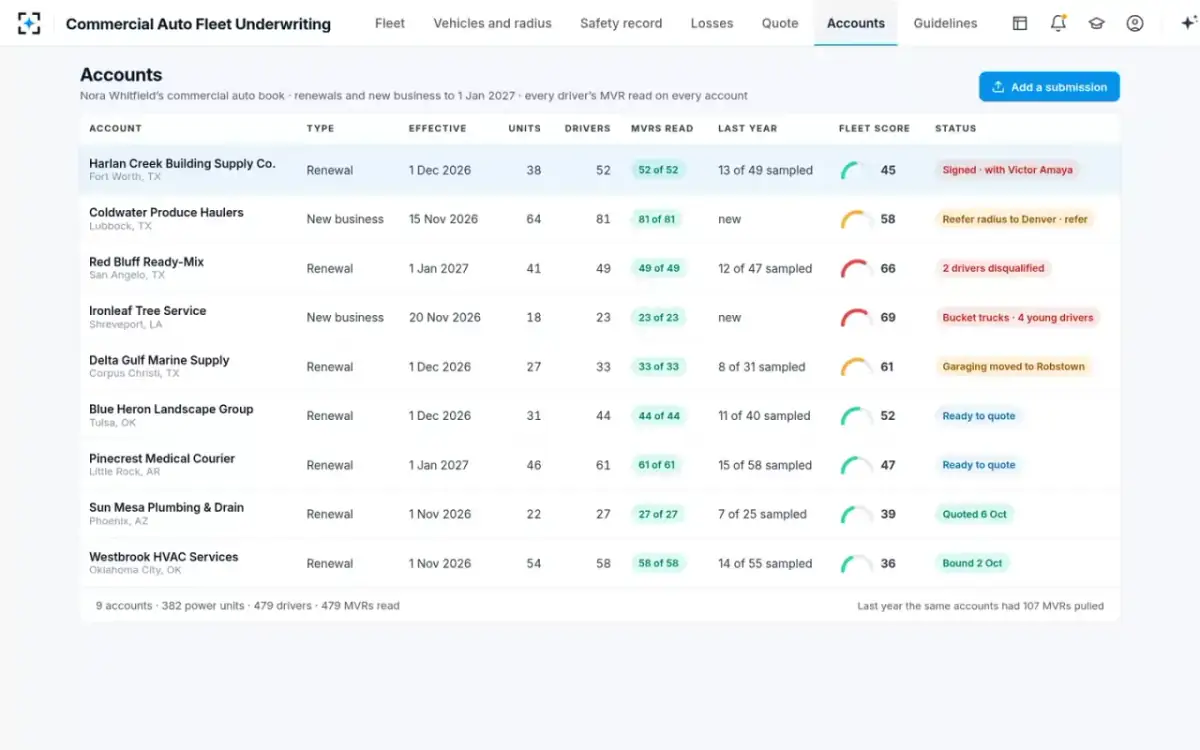
Commercial Auto Fleet Underwriting fits where the reading cost is: it orders every listed driver's record, reads and codes each one with a citation, and prices the roster live, so the underwriter's time goes to the five drivers who fail rather than the 47 who do not. On the sample account the agents read all 52 drivers' records, together with the VINs, the fuel-tax return, the inspection record and five years of losses, in a run of 6 minutes 12 seconds. The design target is ten minutes from a complete submission to a priced, cited fleet review.
It does not lower state fees, which are set by law and paid per record whoever reads them. It does not replace the insured's own obligations to pull and review its drivers' records each year. And it does not decide anything: the fleet scorer is deterministic and the guide to the driving risk score shows how to test it, but every exclusion, swap or acceptance is the underwriter's, with a reason, and above authority the manager co-signs.
Every driver read, on every account in the book
Questions people ask
How much does a single MVR cost?
From about $2 to $47 in state fees, depending on the state and the record type: Oregon charges $2 for a certified three-year employment record, Pennsylvania $47 for a certified driver record. FMCSA plans on $10, a $9 median state fee plus $1 processing, and vendors may add their own charge.
How many MVRs does an underwriter order on a fleet?
No rule sets a number; it is each insurer's choice. On the fictional sample account 13 of 49 drivers' records were read the year before; in Commercial Auto Fleet Underwriting every listed driver's record is ordered, and any record ordered in the last 90 days is reused.
Can the insured supply its own drivers' MVRs instead?
It can supply copies from its driver qualification files, which a regulated carrier must keep. They cost the insurer nothing but may be nearly a year old and need only cover the preceding 12 months, so an underwriter should check each copy's date and coverage before relying on it.
Do I need a certified MVR for underwriting?
Usually not. Certification proves the copy came from the agency, which some uses require; Texas, for example, marks its certified complete history as acceptable for a defensive driving course and its certified three-year history as not. What matters for underwriting is that the record comes from the licensing agency, covers the look-back your guidelines use and is recent. Certified records cost more: $12 against $6.50 for a Texas three-year history.
Is MVR monitoring cheaper than re-pulling records?
For an employer, usually: California charges $5 to enrol a driver and $1 per report, New York $7 and $1 per notification, against $10 or more for each fresh record. Monitoring only reports events as they post, though; a full read is still needed when the account is underwritten.