A commercial auto radius of operation is the distance a vehicle regularly travels from its principal garaging location, and rating plans sort it into classes: in the Texas residual-market plan, local is up to 50 miles, intermediate 51 to 200 miles, and long distance over 200. The class carries a rating factor, so a truck rated local that actually runs 150 miles from its yard is under-priced from the first day of the policy. Yet the radius on an application is the insured's own figure, and nothing else on the application checks it. Botminds' Commercial Auto Fleet Underwriting is an agentic solution that checks it: its vehicle and radius checker compares the stated radius for every unit with the miles on the fleet's fuel-tax return and the trips from its garaging address, and shows the evidence for any re-rate, while the underwriter decides what to do.
The example is a fictional sample renewal as it runs through the solution: Harlan Creek Building Supply Co., a Fort Worth building-supply company with 38 power units, every one stated on the application at 50 miles.
Stated versus driven: five sources that can check a radius, and what each showed on one renewal
| Source | What it showed on the sample account | Strength and limit |
|---|---|---|
| The application and vehicle schedule | 50 miles stated for all 38 units; two garaging addresses, Fort Worth (31 units) and Waco (7) | The claim being tested; the garaging address is the starting point for every measurement |
| Quarterly fuel-tax (IFTA) return | 41,880 miles in Oklahoma in Q2 2026, 11.6% of the fleet’s miles | Independent of the application, a quarterly tax filing, but fleet-wide and for qualified motor vehicles only |
| Tracker trips from the garaging address | All nine tractors ran 111 to 196 miles from the yard, 1 Apr to 30 Sep 2026; the other 29 units stayed local | Unit by unit, so it settles the class; depends on the insured sharing the export |
| Electronic logging device records | Not used on the sample account; the tracker trips answered the question | Hourly positions to about ±1 mile, but none for drivers exempt under the 150 air-mile rule |
| Loss runs and roadside inspections | Claims and inspections carry places and dates | Show where a unit was on one day, not how often it goes |
What is radius of operation in commercial auto?
Radius of operation is the farthest distance a vehicle regularly travels from its principal garaging location during the policy period, and in commercial auto rating it is used to place each truck, tractor or trailer in a radius class. The class is per vehicle, not per fleet: on the sample account nine tractors that run to Oklahoma City and Austin belong in a different class from the pickups that stay within 50 miles, even though the application gave all 38 units the same figure.
The radius is one of the few rating inputs that changes with the insured's business rather than its equipment: a new customer two hundred miles away changes the class of every truck that serves it. Rating plans charge more for the same truck in a longer class, as the factors below show, so a radius that drifts upward between renewals drifts the premium out of date with it.
What is local, intermediate and long-haul radius?
Local is up to 50 miles from garaging, intermediate is 51 to 200 miles, and long distance, often called long haul, is over 200 miles. Those are the classes printed in the Texas Automobile Insurance Plan Association's commercial auto rate bulletin, which the Texas Department of Insurance publishes, and they are the classes the sample guidelines use. The bulletin also shows how much each class moves the rate for each size of vehicle and type of business use.
How radius moves the rating factor for trucks in one state plan
| Size class (business use: commercial) | Local, up to 50 miles | Intermediate, 51–200 miles | Change, local to intermediate |
|---|---|---|---|
| Light trucks, up to 10,000 lb GVW | 1.30 | 1.60 | +23% |
| Medium trucks, 10,001–20,000 lb GVW | 1.40 | 1.70 | +21% |
| Heavy trucks, 20,001–26,000 lb GVW | 1.45 | 1.80 | +24% |
| Heavy truck-tractors | 1.80 | 2.25 | +25% |
Two points from the table matter beyond Texas. The step from local to intermediate is large for every size class, a fifth to a quarter of the primary factor. And in that plan long distance for medium and heavy units is rated differently altogether, by zones rather than a single factor, so the rate depends on where the truck runs, not only how far.
Does radius affect commercial auto premium?
Yes, directly: the radius class sets a rating factor for each vehicle, so a vehicle rated in the wrong class carries the wrong premium for the whole policy term. On the sample renewal, re-rating the nine tractors from local to intermediate added $54,900 to the base premium, before any driver adjustment.
One class change on nine tractors, priced
$23,500
per tractor rated local (our arithmetic from the re-rate)
$29,600
per tractor rated intermediate on the sample quote
+$54,900
added to the base for the nine tractors
The rest of the fleet did not move. The six heavy flatbeds, twelve medium box and stake trucks and eleven pickups stayed local, because their trips stayed inside 50 miles. That is the point of checking per unit: a fleet-wide adjustment would have over-charged 29 units to catch nine.
Stated versus driven: the evidence an underwriter can use
The evidence that can check a stated radius is anything that records where a vehicle went without depending on the application: the fuel-tax return, trip or tracker data, logging-device records, and the places and dates in loss runs and roadside inspections. The table at the top of this page ranks five such sources by what each can and cannot prove.
The order of use is practical. Start with the fuel-tax return, because a fleet that files one has it, and it shows at once whether the fleet's miles leave the home state. If they do, ask for trips or logging-device records for the units likely to be involved, usually the heaviest. Read the loss runs and inspections for places as a cross-check. The sample account followed exactly that path: the return showed Oklahoma miles; the trips showed which units drove them.
Where the trucks go, against the 50- and 200-mile rings
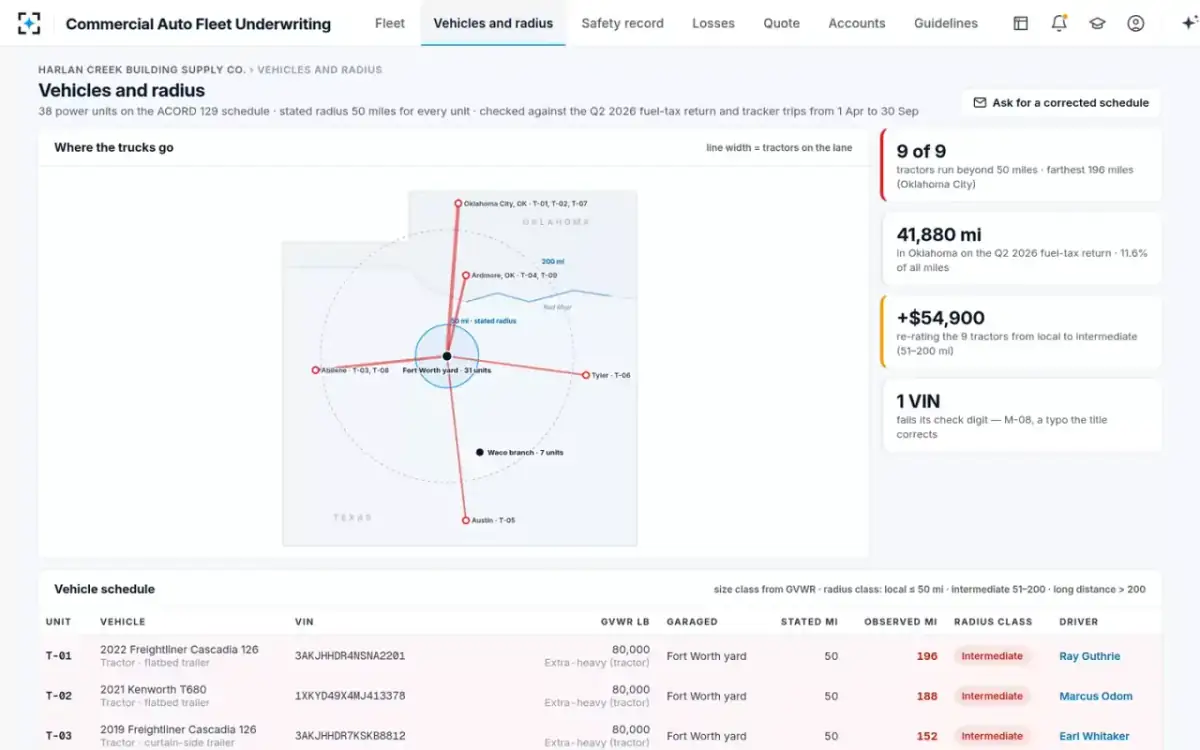
Can IFTA reports show radius?
An IFTA return can show that a fleet's vehicles leave the home state and how much they drive elsewhere, but not which vehicle drove those miles or how far from home it went. The return reports "the Total IFTA Miles traveled in IFTA jurisdictions by all qualified motor vehicles in your fleet" (Texas Comptroller), jurisdiction by jurisdiction, every quarter.
The fuel-tax return says how much left the state; trips say which trucks and how far
Quarterly fuel-tax (IFTA) return: Fleet miles and fuel in each jurisdiction
Tracker or trip data: Each vehicle’s trips, stops and distances
Quarterly fuel-tax (IFTA) return: Only qualified motor vehicles, such as any vehicle with three or more axles
Tracker or trip data: Whatever carries a device
Quarterly fuel-tax (IFTA) return: No
Tracker or trip data: Yes, from the garaging address
Quarterly fuel-tax (IFTA) return: A tax filing the insured must keep records for, for four years
Tracker or trip data: The insured’s own operational data
Quarterly fuel-tax (IFTA) return: 41,880 Oklahoma miles, 11.6% of the quarter’s total
Tracker or trip data: Nine tractors at 111 to 196 miles; 29 units local
Two limits keep the return honest as evidence. "Only the operations of "qualified motor vehicles" should be reported on IFTA tax returns" (Texas Comptroller), so lighter trucks that never qualify never appear, whatever their radius. And a fleet that runs entirely within one state may file no return at all. For heavy units crossing state lines, though, the return is the strongest single document an underwriter can ask for, and the insured must keep its records for four years.
What is the 150 air-mile rule?
The 150 air-mile rule is the federal short-haul exemption from hours-of-service record-keeping: a driver who "operates within a 150 air-mile radius (172.6 statute miles) of the normal work reporting location", returns there within 14 hours and has the required off-duty time need not keep logs or use an electronic logging device, as long as the carrier keeps time records for six months (49 CFR 395.1(e)). It is a safety-records rule, not an insurance radius, and its 150 air miles are not the 200 miles of the intermediate class.
It still matters to a radius check in two ways. A fleet that runs entirely inside 150 air miles may have no logging-device data at all, so the underwriter should not expect it. And a truck that regularly runs beyond 150 air miles cannot rely on the exemption on those days, so its driver should have logs for them. On the sample account Oklahoma City lies more than 172.6 statute miles from Fort Worth in a straight line, which means the drivers of those tractors would ordinarily be logging those trips; the trackers made asking for the logs unnecessary.
How is radius measured for insurance?
Radius for insurance is measured from the vehicle's principal garaging location, the address on the schedule where it is kept, to the farthest point it regularly reaches. Three choices in that measurement change the answer, and a good radius check states each one.
Six steps to check a stated radius, unit by unit
- Fix the garaging address for each unit
From the schedule; a fleet with two yards needs two centres. The sample fleet has 31 units at Fort Worth and 7 at Waco.
- Decide straight-line or road miles, and say which
Road distance is never shorter than the straight line, and the two can fall in different classes near a boundary.
- Use regular operation, not the one-off trip
A single delivery to a distant customer does not make a local truck intermediate; a weekly run does.
- Use a full period
At least a quarter, matched to the fuel-tax return; the sample used six months of trips.
- Check the fleet total against the return
If trips show no out-of-state running but the return shows out-of-state miles, something is missing.
- Keep the evidence with the re-rate
The trips and miles behind every class change, cited, so the insured and an examiner can see why.
The choice of distance needs most care near 50 and 200 miles. The sample's farthest run, to Oklahoma City, is 196 miles from the Fort Worth yard: comfortably intermediate either way. A run that measures 195 miles by road and less in a straight line would not move; one that measures 210 by road and 190 in a straight line would, depending on the rule. The rule should be the insurer's, written in its guidelines, and the same for every account.
What happens if the stated radius is wrong?
If the stated radius is wrong, the vehicle is rated in the wrong class and the premium is wrong, and the time to find out is before the policy starts, not after a loss. The NAIC's examination standard expects underwriting, rating and classification to rest on adequate information gathered at or near inception (NAIC Market Regulation Handbook), and rating inputs taken on trust are exactly what market conduct examiners find: in one 2020 North Carolina examination, three of the eight commercial auto rating errors were incorrect territories, another location-based input (North Carolina DOI).
Correcting it does not need an accusation. Operations change: the sample insured may simply have taken on job sites in Oklahoma since it last filled in an application. The practical sequence is to show the evidence, ask the insured or producer for a corrected schedule, re-rate the units the evidence supports, and, where the data is good, add a condition to check again at mid-term. On the sample renewal the quote re-rated the nine tractors with the evidence cited in the review note, and added a telematics radius report at mid-term using the trackers already fitted.
The re-rate on the quote: nine tractors intermediate, was local
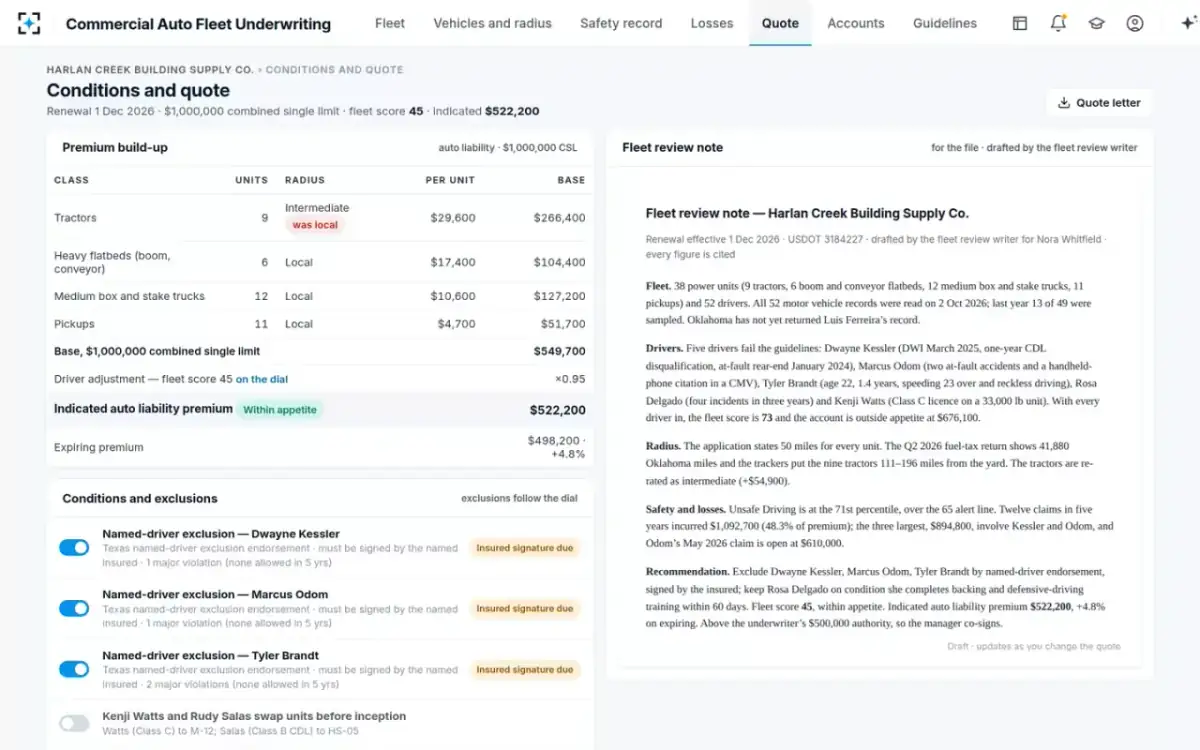
How Commercial Auto Fleet Underwriting checks the radius
Commercial Auto Fleet Underwriting fits as the reader of the evidence: its vehicle and radius checker compares the stated radius with fuel-tax miles by state and with trips from each unit's garaging address, sets the class the evidence supports, and prices the difference. It never changes the vehicle schedule; it shows the evidence for every re-rate, and the underwriter decides whether to re-rate, ask for a corrected schedule or set a condition.
On the sample fleet, the stated radius was right for 29 units and wrong for 9
It depends on the data the insured shares. Without trips, the fuel-tax return can raise the question but not settle it unit by unit, and a fleet that runs locally may have no return and no logs at all. The guide to commercial auto telematics sets out which fleet data can settle which question, and the guide to GVWR classes and the VIN covers the other half of each vehicle's rating line, its size class.
Questions people ask
What is intermediate radius in trucking insurance?
Intermediate radius usually means a vehicle regularly operates more than 50 and up to 200 miles from its garaging location. In the Texas residual-market plan bulletin, moving a commercial-use truck-tractor from local to intermediate raises its primary rating factor from 1.80 to 2.25, about 25%.
How do insurers verify radius of operation?
By comparing the stated radius with evidence the insured did not write for the application: fuel-tax returns showing miles by state, tracker or logging-device trips from the garaging address, and places and dates on loss runs and inspections. Commercial Auto Fleet Underwriting reads the fuel-tax return and trip data next to the schedule.
Does radius apply to the whole fleet or each vehicle?
Each vehicle. Rating plans place each truck, tractor or trailer in its own radius class, so a fleet can have local pickups and intermediate tractors on the same policy. On the sample account only the nine tractors changed class.
Is the 150 air-mile rule the same as a local radius?
No. The 150 air-mile rule (172.6 statute miles) is a federal exemption from hours-of-service logs for short-haul drivers, under 49 CFR 395.1(e). Insurance radius classes are set by rating plans, typically local up to 50 miles, intermediate to 200 and long distance beyond.
What if the insured's operations change mid-term?
Then the radius may change mid-term too, and the policy may need an endorsement and a re-rate. A condition requiring a radius report from the fleet's own trackers at mid-term, as on the sample quote, gives the underwriter a scheduled check rather than a surprise at renewal.