A driver qualification file is the record a motor carrier must keep for every driver of a commercial motor vehicle, and under 49 CFR 391.51 it holds eight things: the driver's employment application, the three-year motor vehicle records obtained at hire, the road test certificate or its equivalent, the motor vehicle record from each annual inquiry, a note of each annual review, the medical examiner's certificate, any medical variance, and, for drivers without a commercial licence, a note verifying the medical examiner's registration. The checklist below states each in plain words, with when it is due and how long it is kept. For a commercial auto underwriter the file is the cheapest test there is of the safety program a submission describes, and Botminds' Commercial Auto Fleet Underwriting, an agentic solution for fleet accounts, reads every driver's record independently so the underwriter can set the carrier's own reviews against what the records show.
The rules quoted are the current electronic Code of Federal Regulations. The underwriting examples use a fictional sample account as it runs through the solution, a Fort Worth building-supply company with 52 drivers.
The driver qualification file, item by item, in plain words
- 1. The employment application
Completed and signed by the driver, with three years of addresses, accidents, convictions and employers, and for commercial licence applicants seven more years of commercial driving employers, as 391.21 sets out. Kept for the length of employment plus three years.
- 2. The motor vehicle record from every state licensed in, at hire
A three-year history from each licensing authority the driver held a licence with in the preceding three years, requested within 30 days of hire. If a state sends nothing, a record of the good-faith effort.
- 3. The road test certificate, or its accepted equivalent
Issued after a road test in the type of vehicle the driver will drive, or a licence or certificate the carrier accepted in its place.
- 4. The motor vehicle record from each annual inquiry
At least once every 12 months, covering at least the preceding 12 months, from each state that licensed the driver for commercial vehicles in that period.
- 5. A note of each annual review
Who reviewed the driver’s record and when, after weighing violations such as speeding, reckless driving and driving under the influence.
- 6. The medical examiner’s certificate
Renewed at least every 24 months. For a commercial licence holder, the carrier meets this by obtaining the CDLIS motor vehicle record that carries the medical certification status.
- 7. Any medical variance or skill performance evaluation certificate
Only for drivers qualified through an FMCSA variance or a federal medical exemption program.
- 8. A note verifying the examiner is on the National Registry
For drivers not required to hold a commercial licence; the requirement for commercial licence holders ended on 22 June 2025.
What goes in a driver qualification file?
A driver qualification file contains the eight items in the checklist above, and the regulation lists them in one sentence: "The qualification file for a driver must include" the application, the motor vehicle records from hire and from each annual inquiry, the road test certificate, a note of each annual review, the medical certificate, any variance, and the medical examiner registry note (49 CFR 391.51(b)). The file may be combined with the driver's personnel file.
Two related records sit outside it. The investigation of the driver's safety performance history with previous employers goes in a separate, access-controlled file under 49 CFR 391.53. And drug and alcohol testing records, including the queries of FMCSA's Drug and Alcohol Clearinghouse that an employer must run before hiring and at least once a year for drivers subject to testing (49 CFR 382.701), are kept under part 382. FMCSA's own checklist lists the pre-employment testing documents alongside the qualification file because a carrier assembles them at the same time.
The rules apply to drivers of commercial motor vehicles as the federal rules define them: in interstate commerce, a vehicle with a weight rating or weight "of 4,536 kg (10,001 pounds) or more, whichever is greater", or one built or used to carry more than a set number of passengers (49 CFR 390.5). That reaches far below the tractor-trailer: a loaded box truck or a pickup towing a trailer can be a commercial motor vehicle. States set their own rules for intrastate carriers; check the state's own adoption.
When each record is due
Each item in the file runs on its own clock, and an underwriter reading a file should check the clocks, not just the contents. The hiring records must be in place within 30 days; the annual record and review recur every 12 months; the medical certificate lasts up to 24 months; and the whole file outlives the driver's employment by three years.
A driver file runs on four clocks, from 30 days to three years
The 30-day clock at hire is easy to miss in a growing fleet, because it starts when employment begins rather than when the paperwork does. The rule requires the motor vehicle record inquiry "within 30 days of the date the driver's employment begins" to each state that licensed the driver in the past three years, and if a state does not answer, "the motor carrier must document a good faith effort to obtain such information" (49 CFR 391.23).
How often must a carrier review driver MVRs?
At least once every 12 months. A carrier must obtain each driver's motor vehicle record covering at least the preceding 12 months from every state that licensed the driver for commercial vehicles in that time, review it, and put a note in the file naming the reviewer and the date (49 CFR 391.25). The review is not a formality. The carrier has to weigh heavily the violations that show a disregard for public safety, naming speeding, reckless driving and driving under the influence (49 CFR 391.25(b)(2); the MVR guide reads a record that way).
The review also has to answer one specific question: whether the driver "is disqualified to drive a commercial motor vehicle pursuant to § 391.15." A one-year disqualification for driving under the influence, even in a personal car, is exactly what an annual review is meant to catch. On the sample account, the driver whose record shows a one-year CDL disqualification after a DWI in March 2025 is still on the insured's roster; whether the insured's annual review caught it, and what it did, is a question the underwriter can put to the insured with the file in hand.
FMCSA's own checklist still lists a rule that is gone
FMCSA's downloadable Driver Qualification File Checklist, revised in July 2017, still lists a "Driver’s Certification of Violations – Annual — 49 CFR 391.27": a list each driver had to give the carrier every year of all traffic convictions in the previous 12 months (FMCSA checklist). That rule no longer exists. FMCSA rescinded it in a final rule published on 9 March 2022 and effective 9 May 2022, explaining that the requirement was "largely duplicative of a separate rule" requiring the carrier's own annual record inquiry (87 FR 13192). Section 391.27 is now marked reserved.
The annual list of violations, retired in 2022
9 May2022
the date drivers’ annual lists of violations stopped being required
$24.9M
FMCSA’s estimate of cost savings over ten years at a 7% discount rate
6.8M
driver population FMCSA used in its analysis
The practical lesson for an underwriter is to read the file against the current rule, not a form. A carrier still collecting annual violation lists is doing harmless extra work; a carrier that relies on the driver's own list instead of pulling the record is missing the part that remains required. And the same rule left the annual record itself as the carrier's single source for a driver's convictions, which makes the record, and whether anyone actually read it, more important than before.
How long must driver qualification files be kept?
A driver qualification file must be kept for as long as the driver is employed and for three years afterwards, although the recurring items can be removed three years after they were made. The rule is precise about which items can go.
How long each part of the driver file is kept
| Record | Keep for | Rule |
|---|---|---|
| Driver qualification file as a whole | Employment plus three years | 49 CFR 391.51(c) |
| Application, hiring motor vehicle records, road test certificate | Employment plus three years | 49 CFR 391.51(c) |
| Annual motor vehicle records and review notes | May be removed three years after execution | 49 CFR 391.51(d)(1)–(2) |
| Medical certificate, CDLIS record, variance, registry note | May be removed three years after execution | 49 CFR 391.51(d)(3)–(5) |
| Previous employers’ safety performance history, for a driver hired | Employment plus three years | 49 CFR 391.53(c) |
| Clearinghouse queries and responses | Three years | 49 CFR 382.701(e) |
For a renewal underwriter the useful consequence is depth. A carrier that kept its files properly can show three annual records and three review notes for any driver employed that long. Asking for them for a handful of drivers, chosen from the roster rather than by the insured, shows whether the reviews happened and what they found.
Does a DQ file need a 3-year MVR?
Yes, at hire. The carrier must obtain each new driver's motor vehicle record covering the past three years of driving from every licensing authority the driver held a licence with during the preceding three years, and place it in the file within 30 days (49 CFR 391.23(a)(1) and (b)). After that, the annual record need cover only the preceding 12 months.
That difference matters when an insured offers its files instead of new records. The hiring record shows three years but may be years old; the latest annual record is recent but may show only one year. Neither is a substitute for a current three-year record, which is what an underwriter's look-back usually needs. The guide on how to run an MVR on drivers covers ordering and reading one.
Why do insurers ask for driver qualification files?
Insurers ask for driver qualification files because the file shows whether the carrier's safety program works in practice: whether it checks drivers before they drive, reviews them every year and acts on what it finds. A submission can describe a program; the file shows it. And the rules give the insurer a direct claim on part of it.
"In addition, the motor carrier's insurer may have access to the data, except the alcohol and controlled substances data."
49 CFR 391.53(a)(1), on the file of previous employers' safety performance history
The exception matters as much as the access. An insurer can see what previous employers reported about a driver's accidents, but not their drug and alcohol testing history; the same section says the data "must only be used for the hiring decision." An underwriter's view of a driver's drug and alcohol history therefore comes from what shows on the motor vehicle record, such as a conviction for driving under the influence, not from the carrier's testing files.
The carrier's driver file and the insurer's own read answer different questions
The carrier’s driver qualification file: Is this driver qualified to drive for us, and did we check?
The underwriter’s read of every driver: Should this driver be in the price, on this unit?
The carrier’s driver qualification file: Three years at hire; at least 12 months each year since
The underwriter’s read of every driver: A current three-year record for every listed driver
The carrier’s driver qualification file: Federal qualification and disqualification rules
The underwriter’s read of every driver: The insurer’s own guidelines, which can be stricter
The carrier’s driver qualification file: Testing files and Clearinghouse queries, kept separately
The underwriter’s read of every driver: Only what convictions show on the record
The carrier’s driver qualification file: Whether the carrier’s reviews happened
The underwriter’s read of every driver: What the reviews should have found
What happens if a DQ file is incomplete?
An incomplete driver qualification file is a violation the carrier can be cited for, and it can count against the carrier in FMCSA's Driver Fitness category; more seriously, a driver with a missing or failed item may not be qualified to drive at all. FMCSA's safety measurement methodology lists the Driver Fitness category's example violations as "failing to have a valid and appropriate commercial driver's license (CDL), being medically unqualified to operate a CMV, failing to maintain driver qualification files" (SMS methodology).
The qualification rule itself is direct: "a motor carrier shall not require or permit a person to drive a commercial motor vehicle unless that person is qualified to drive a commercial motor vehicle" (49 CFR 391.11(a)). Qualification includes being at least 21, physically qualified, not disqualified, holding a valid licence and having passed a road test.
A licence that does not fit the unit: the gap a driver file can miss
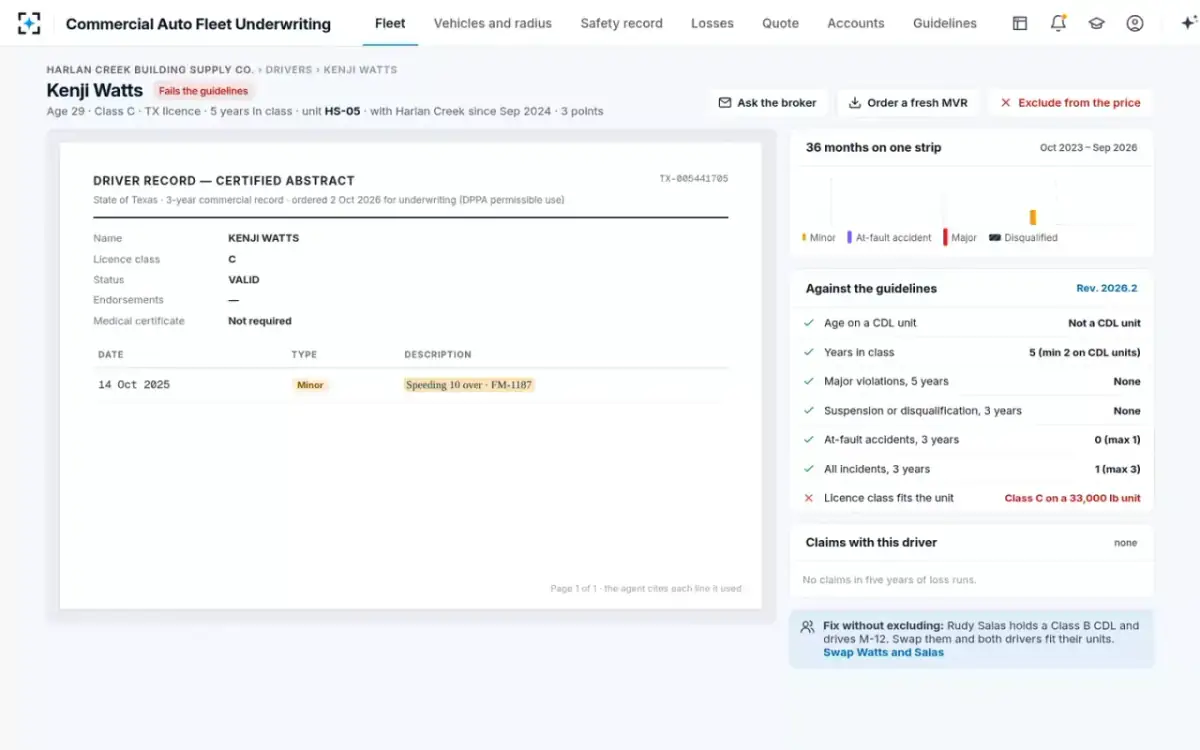
The sample account shows the kind of gap a complete-looking file misses. Kenji Watts has one minor violation and a valid licence. But it is a Class C licence, and he drives a 33,000-pound boom truck that needs a Group B commercial licence. Under the federal disqualification rules, driving a commercial vehicle without the proper class is itself a serious traffic violation (49 CFR 383.51, Table 2). The solution found the fix in the roster: another driver holds a Class B licence and drives a smaller unit, and swapping them makes both fit. The weights behind licence classes are set out in the guide to GVWR classes and the VIN.
Commercial Auto Fleet Underwriting beside the carrier's own files
Commercial Auto Fleet Underwriting does not audit a carrier's driver files; it gives the underwriter an independent read of every driver to set against them. Its MVR reader orders a three-year record for every listed driver, codes every entry and cites the line behind it; its fleet scorer checks each driver against the insurer's guidelines, including whether the licence class fits the unit; and the underwriter decides what to ask the insured for, and what to do.
What the annual review should have found, on one record
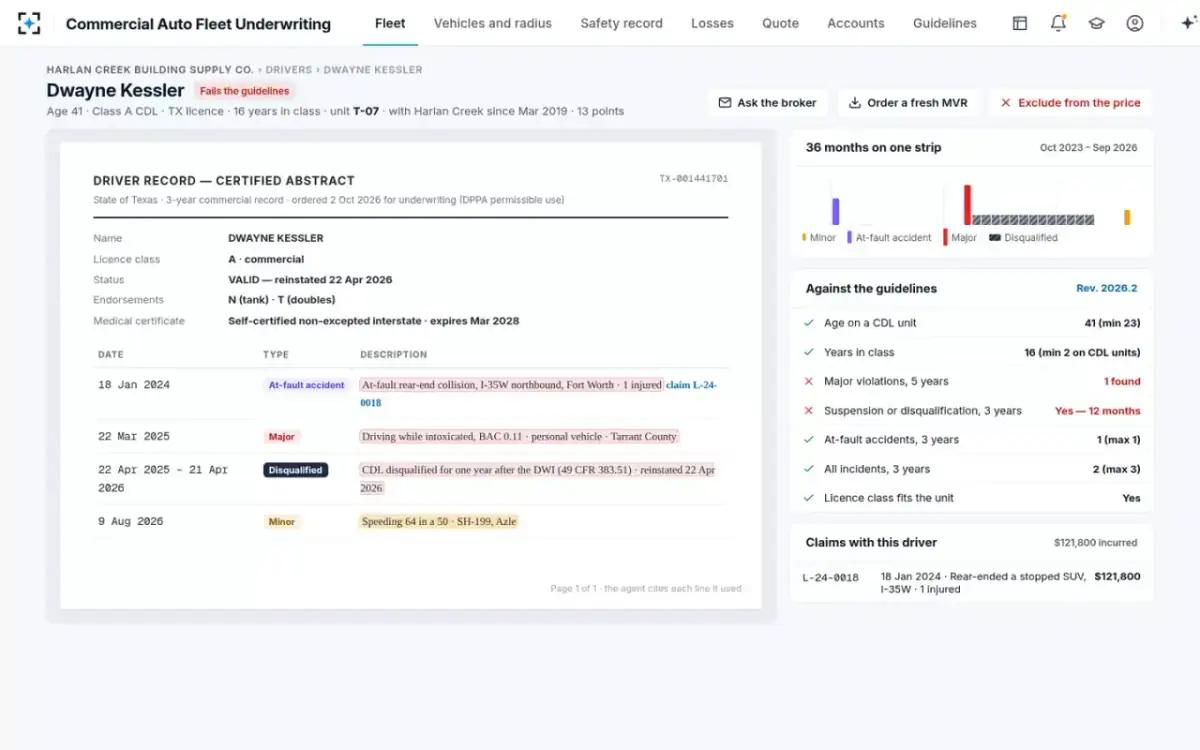
The combination is what makes the file useful. The solution shows which drivers fail and why; the insured's file shows whether its own reviews saw the same thing. Where they disagree, the underwriter has a precise question for the insured and a reason for a condition, such as monitoring every driver's record between renewals, which the guide to motor vehicle record monitoring compares with the alternatives.
Questions people ask
What is 49 CFR 391.51?
It is the federal rule that requires every motor carrier to keep a driver qualification file for each driver it employs, lists the eight items the file must contain, and sets how long the file and its parts are kept: the file for the length of employment plus three years, with the annual items removable three years after they were made.
Does a driver qualification file need the annual list of violations?
No longer. FMCSA rescinded 49 CFR 391.27, the drivers' annual certification of violations, in a rule effective 9 May 2022, because the carrier's own annual record inquiry duplicated it. FMCSA's downloadable checklist dated July 2017 still lists the old item.
Can an insurer see a driver's drug test results?
Not from the carrier's investigation file: 49 CFR 391.53 lets the motor carrier's insurer have access to the previous employers' safety performance history, "except the alcohol and controlled substances data." An insurer sees a driver's alcohol-related convictions on the motor vehicle record.
Do intrastate carriers need driver qualification files?
The federal rule covers carriers operating commercial motor vehicles in interstate commerce, with exceptions in subpart G of part 391. States decide whether and how to apply similar requirements to intrastate carriers; check the state's own rule.
How often does a commercial driver need a medical exam?
At least every 24 months under 49 CFR 391.45(b), and more often for some drivers, for example every 12 months for drivers certified under the insulin-treated diabetes standard. For commercial licence holders, the carrier confirms certification through the motor vehicle record's medical certification status.