Motor vehicle record monitoring is a service that enrols an employer's drivers with a state licensing agency or a vendor and sends a notice when a new event, such as a conviction, a suspension or an expiry, posts to a driver's record. It differs from the annual pull, the once-a-year record that federal rules require regulated motor carriers to obtain and review for every driver, and from the full read an underwriter does at renewal, when every driver's record is ordered and priced into the account. Each answers a different question: monitoring asks "has anything changed?", the annual pull asks "is this driver still qualified?", and the renewal read asks "what is this roster worth?". Botminds' Commercial Auto Fleet Underwriting is an agentic solution for the third: it reads every listed driver's motor vehicle record at underwriting, and leaves the underwriter to decide whether to require monitoring between renewals as a condition.
The costs and mechanics below come from state licensing agencies and federal rules; the underwriting example is a fictional sample renewal as it runs through the solution, a Fort Worth building-supply fleet with 52 drivers.
Three ways to watch a fleet's drivers, and the question each one answers
| Annual pull and review | Continuous monitoring | Underwriter reads every MVR | |
|---|---|---|---|
| Question it answers | Is the driver still qualified, and did the carrier check? | Has anything posted to the record since we last looked? | Should this driver be in the price, on this unit? |
| Who does it | The motor carrier, for its own drivers | The employer, through a state program or a vendor | The insurer, under its underwriting purpose |
| How often | At least once every 12 months | Whenever an event posts | At new business and each renewal |
| What it covers | At least the preceding 12 months | New events after enrolment | Typically three years |
| Cost per driver | One record fee a year; FMCSA plans on $10 | California $5 to enrol and $1 a report; New York $7 to add and $1 a notice | One record fee per read, plus the time to read it |
| What it misses | Anything between pulls, for up to a year | History before enrolment; anything the program does not report | Anything that happens after the read |
What is motor vehicle record monitoring?
Motor vehicle record monitoring is enrolment of drivers in a service that watches their licence records and reports changes, instead of re-ordering each record on a schedule. Some states run their own programs for employers, and California's and New York's descriptions are the clearest definition there is.
California's Employer Pull Notice program works by attaching the employer to each driver's record: "If an employee’s driver record is updated due to a reportable action or activity, and if a pull notice is on file, an updated driver record is generated and sent to the employer to make them aware" (California DMV). New York's License Event Notification Service "can notify you about the following events when they post to your drivers’ license records": reportable crashes, convictions, expirations, hazardous-materials endorsement changes, medical certification status changes, point-reduction course completions, licence status changes, and suspensions and revocations (New York DMV). New York lists "preparation for DOT & Insurance audits" among the uses.
Private services offer monitoring too; in California, DMV-approved agents can manage an employer's pull-notice account and its reports. A service's coverage and timing in each state depend on that state's own arrangements, which is the first thing to ask about any of them.
How does continuous MVR monitoring work?
Continuous monitoring works by flagging a driver's licence record so that any new posting generates a notice to the enrolled employer. The speed depends on how fast the event reaches the record, and for commercial licence holders federal rules set that clock: a state that convicts a driver licensed elsewhere must notify the licensing state "within 10 days of the conviction" (49 CFR 384.209(c)), and the licensing state must make the information available on the driver's record within 10 days of receiving it, or of the conviction if it happened in that state (49 CFR 384.225(c)).
How long a new conviction can stay unseen, by approach
- 3 wk
- Watched for the rest of the year
- Posted, but not looked at until the next annual inquiryup to 12 months
- Posted, but not looked at until the next renewalup to 12 months
The clock starts at conviction, not at the offence. A speeding stop or a drink-driving arrest may take weeks or months to reach a conviction, and nothing posts until then. Monitoring is fast from conviction to notice; it cannot be faster than the courts.
Is MVR monitoring better than annual MVR checks?
Monitoring is faster than an annual check at catching a new event, and usually cheaper per driver than pulling records more often; it is not a replacement for the annual check where the law requires one, or for a full read when an account is priced. The comparison table at the top of this page shows why: each approach misses what another catches.
The annual pull leaves a gap of up to a year. A driver convicted the week after the carrier's annual inquiry drives on that conviction, unseen, until the next one. The federal rule makes the annual record the carrier's main source: when FMCSA removed the drivers' own annual list of violations in 2022, it did so because the annual record inquiry already covered the same ground (driver qualification file checklist; 87 FR 13192). Monitoring closes that gap for new events. It does not show a driver's history from before enrolment, which is why a new hire's three-year record, and an underwriter's read, are still needed.
Does FMCSA allow MVR monitoring instead of the annual review?
The federal rule requires the annual inquiry and review in its own terms, and it does not mention monitoring. Each regulated carrier "shall, at least once every 12 months, make an inquiry to obtain the motor vehicle record of each driver it employs, covering at least the preceding 12 months", must review it, and must keep "A note, including the name of the person who performed the review of the driving record" and the date (49 CFR 391.25).
Some monitoring programs produce an annual record as part of the service: California generates one "annually for currently enrolled drivers" (California DMV FAQ). Whether a given program's output meets the federal inquiry for a given driver is a compliance question for the carrier; what it does not do on its own is produce the review and the note, which need a person. For an underwriter the practical test is the file: an annual record for each driver, and a dated, named review of it.
How fast does monitoring catch a violation?
Monitoring catches a violation as fast as the conviction posts to the driver's record and the program delivers its notice. For commercial licence holders the federal deadlines add up to about 20 days from conviction for an out-of-state conviction, and 10 days for one in the licensing state, before the program's own delivery time. That is the timeline above: weeks, against up to a year for the annual pull or the renewal read alone.
Two practical limits apply. Monitoring is only as complete as the enrolment: drivers hired since the last update and not yet enrolled are not watched, which is why the sample quote's condition sends new hires before they drive. And not every event type is reported by every program by default; New York's service, for example, lets the employer choose the notification types.
What does MVR monitoring cost?
State-run monitoring costs a few dollars per driver plus about a dollar per notice. California charges $5 a year for each enrolled driver and $1 for each report it generates (California DMV; the MVR cost guide compares states); New York charges $7 to add a driver, $1 per notification and $7 for an additional record, from a prepaid account (New York DMV). Private services price their own plans.
Watching the sample fleet's 52 drivers for a year, three ways
$312
California program: $260 to enrol plus $52 of annual reports, before event notices
$364
New York program: $7 to add each driver, before $1 event notices
$2,080
Re-pulling every record quarterly at FMCSA’s $10 planning figure
The reading cost goes the other way. A monitoring notice is one event about one driver, quick to read; a re-pulled record is a whole history to read again. The guide to what MVR checks cost prices that reading time line by line.
Can insurers use employer MVR monitoring?
Not directly, in the state programs described here: they are employer programs, and their records come with use restrictions. California's security requirements say "DMV information may only be used for the purpose for which it was approved. It may not be combined with any other information", and for drivers an employer enrols voluntarily, "DMV information may not be shared and must be for the exclusive business use of the employer" (California DMV FAQ).
An insurer has its own route to the record: the Driver's Privacy Protection Act allows an insurer to use the record for rating and underwriting (18 U.S.C. § 2721(b)(6); see how to run an MVR on drivers). The practical split is that the insurer orders and reads its own records for underwriting, and makes the insured's monitoring a condition of the policy: enrol every driver, enrol new hires before they drive, act on the notices. On the sample renewal the underwriter did exactly that.
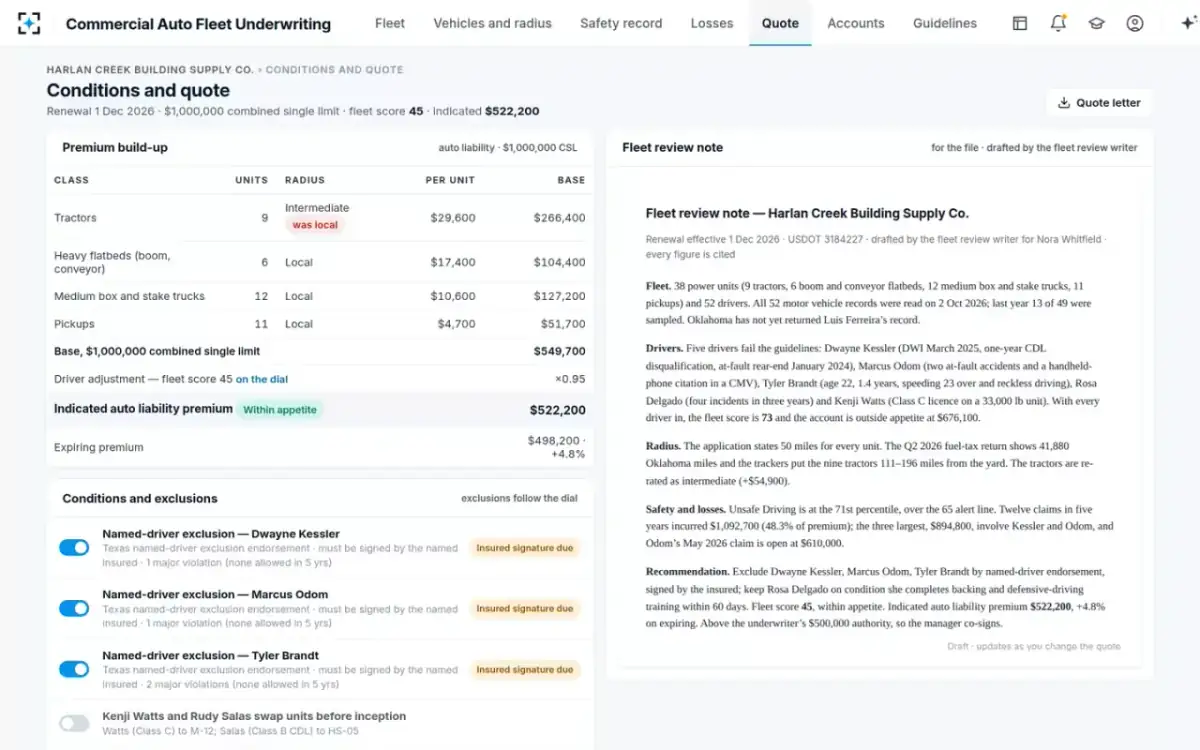
Monitoring as a condition on the quote, not a substitute for the read
What is the difference between an MVR and a CDLIS record?
An MVR is the state's report of a driver's licence record; a CDLIS record is the version kept for commercial licence holders under federal rules, linked through the Commercial Driver's License Information System so that convictions in any state reach the licensing state. For commercial licence holders the state must post every conviction, disqualification and licensing action for traffic violations in any vehicle, keep them for at least three years, and include medical certification status (how to run an MVR on drivers quotes the rule; 49 CFR 384.225).
A state driving record and the CDLIS record kept for commercial licence holders
State motor vehicle record (any driver): As the state records them; varies by state and record type
CDLIS driver record (commercial licence holders): All traffic convictions in any vehicle, other than parking, weight or defect
State motor vehicle record (any driver): Depends on the state’s exchange arrangements
CDLIS driver record (commercial licence holders): Must be sent by the convicting state within 10 days
State motor vehicle record (any driver): Set by the state
CDLIS driver record (commercial licence holders): At least three years for convictions and disqualifications
State motor vehicle record (any driver): Depends on the state and record type
CDLIS driver record (commercial licence holders): Status included; the carrier uses it for the driver’s medical record
State motor vehicle record (any driver): Under state law and the federal privacy act
CDLIS driver record (commercial licence holders): Among others, a motor carrier or prospective carrier, after notifying the driver
For an underwriter the distinction matters for commercial licence holders: the record ordered should be the commercial one, with its medical status and its convictions from every state. The guide on how to run an MVR on drivers covers what to check on each line.
Choosing among the three
The three approaches fit together rather than compete: the carrier pulls and reviews every driver every year because the law requires it, the carrier monitors because a year is too long to wait for bad news, and the insurer reads every driver at renewal because that is when the price is set. A buyer should judge each on the question it answers.
What to ask of any monitoring program or MVR service
- Which states does it cover, and how?
Enrolment in a state program, or periodic re-pulls where there is none; the method sets the lag.
- Which events does it report?
Convictions, suspensions, expiries, medical status, crashes; and whether you choose them.
- How are new hires enrolled?
Before they drive, or at the next batch update; the gap is where unseen drivers sit.
- Does it produce the annual record?
And who writes the review note the federal rule requires.
- What may the information be used for?
State programs restrict use and sharing; an insurer orders its own records.
- What does a notice cost to read?
An event notice is quick; a full re-pulled record is a full read.
Where Commercial Auto Fleet Underwriting sits among the three
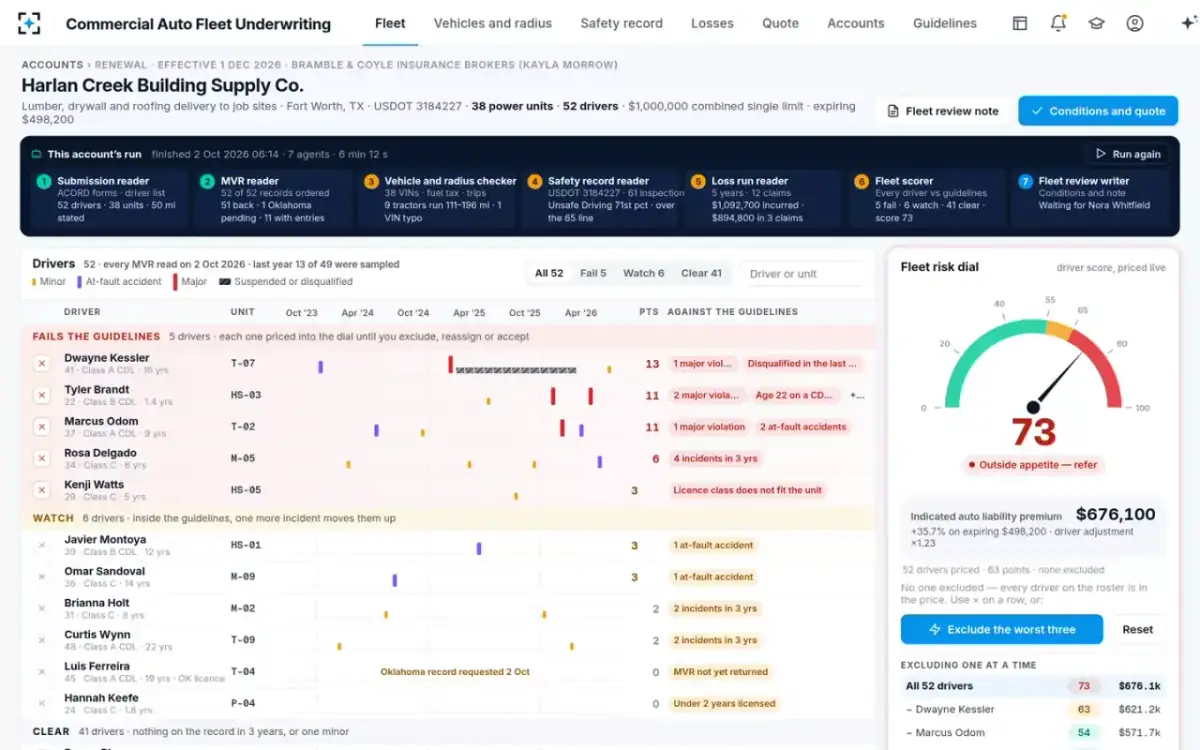
Commercial Auto Fleet Underwriting fits the third approach: it orders a three-year record for every listed driver at underwriting, reads and codes each line, reuses any record ordered in the last 90 days, and prices the roster. It is not a monitoring service, and it does not replace the carrier's annual review. What it changes is the starting point: an underwriter who has read every driver can set monitoring as a targeted condition, knowing which drivers are already in the watch band, instead of as a blanket request.
The roster after every record was read: five fail, six to watch
Questions people ask
Is continuous MVR monitoring required by FMCSA?
No federal rule requires continuous monitoring; 49 CFR 391.25 requires a regulated carrier to obtain and review each driver's record at least once every 12 months. Some states run employer programs, and California requires employers to enrol the drivers its Vehicle Code section 1808.1 covers, including those of fleets that need commercially licensed drivers.
How much does MVR monitoring cost per driver?
In state programs, a few dollars a year plus about a dollar per notice: California charges $5 per enrolled driver and $1 per report, New York $7 per driver added and $1 per notification. Private services set their own prices, often by plan.
What does an MVR monitoring alert show?
The event that posted to the driver's record. New York's service can report reportable crashes, convictions, expirations, hazardous-materials endorsement changes, medical certification changes, licence status changes, and suspensions and revocations; California sends an updated driver record when a reportable action posts.
Should an insurer require MVR monitoring as a condition?
Often worth considering on fleets with drivers near the guidelines' limits, because the gap between renewals is up to a year. On the sample renewal the underwriter set quarterly MVR monitoring for every driver, with new hires before they drive, after reading every driver's record first.
Does monitoring replace a pre-hire MVR?
No. Monitoring reports events after enrolment; a new hire's history before that comes only from a record. Federal rules require a three-year record from every state the driver held a licence in during the preceding three years, within 30 days of hire.