Commercial auto telematics is the data a fleet's vehicles record about themselves (location, miles, time of day, speed and harsh events) and in insurance it is used two ways: to price a usage-based program from driving behaviour, and, more simply, to check what an application states against what the trucks actually did. For most commercial auto underwriters the second use is the immediate one, and it rarely needs a new device: interstate trucks already log duty status on federally specified devices, many fleets track their vehicles for dispatch, and the fuel-tax return already reports miles by state. Botminds' Commercial Auto Fleet Underwriting is an agentic solution that reads that existing data, the fleet's tracker export and its fuel-tax return, next to the vehicle schedule, and shows the underwriter where the stated radius and the driven one disagree.
The example is a fictional sample renewal as it runs through the solution: Harlan Creek Building Supply Co. of Fort Worth, 38 power units, every one stated on the application at a 50-mile radius. The federal rules and regulator texts are linked where they are cited.
From the fleet's own export to a priced re-rate, with people at the two decisions
A person decides
Producer and insuredShare the tracker export for the period asked for and the latest quarterly fuel-tax return.
Agent
Vehicle and radius checker: the scheduleDecodes every VIN, tests its check digit and sets each unit’s size class from its weight rating.
Agent
Vehicle and radius checker: the tripsMeasures each unit’s trips from its garaging address, compares them with the stated radius and with fuel-tax miles by state, and sets the radius class the evidence supports.
Never: change a vehicle on the schedule; it shows the evidence for every re-rate.
A person decides
Risk controlChecks the pattern makes sense for the operation and asks the insured about anything that does not.
A person decides
UnderwriterDecides whether to re-rate, ask for a corrected schedule or set a telematics condition for mid-term; the fleet scorer prices whatever is decided.
How is telematics used in commercial auto insurance?
Telematics is used in commercial auto insurance to verify exposure (miles, radius, garaging and use), to price usage-based programs from driving behaviour, and to reconstruct what happened in a claim. The NAIC's research center lists what the devices capture: "Telematics devices measure a number of elements of interest to underwriters: miles driven; time of day; where the vehicle is driven (Global Positioning System or GPS); rapid acceleration; hard braking; hard cornering; and air bag deployment" (NAIC CIPR).
The same page states the pricing case in fleet terms: "Linking insurance premiums more closely to actual individual vehicle or fleet performance allows insurers to more accurately price premiums." It also states the constraint that applies to anything beyond verification: "Many states require insurers to obtain approval for the use of new rating plans." A usage-based fleet program is a rating plan; using a fleet's trip data to confirm that a tractor belongs in the intermediate radius class it already sits in the filed manual is not.
That distinction matters for buying decisions. A verification use can start with the data the insured already has, because it changes no rates, only which filed class a vehicle sits in. A behavioural pricing program needs devices, data agreements and, in many states, a filing.
Is ELD data the same as telematics?
No. An electronic logging device records a driver's hours of service to a federal specification; telematics is any vehicle data a fleet chooses to collect. They often run on the same hardware, but the ELD's content, precision and retention are fixed by regulation, and the rest is not.
The logging device records hours to a federal specification; trackers record what the fleet chooses
Electronic logging device (ELD): Federal hours-of-service rule; required since 18 Dec 2017 for drivers who must keep records of duty status, with exceptions
Fleet telematics or trackers: The fleet’s own choice: dispatch, fuel, maintenance, safety, theft
Electronic logging device (ELD): At each duty-status change and at least every hour in motion, to about ±1 mile; to about a 10-mile radius during authorised personal use
Fleet telematics or trackers: As often and as precisely as the device is set, often continuous
Electronic logging device (ELD): From the engine’s odometer message, in whole miles
Fleet telematics or trackers: From GPS or the engine, depending on the device
Electronic logging device (ELD): Not recorded: the required event record carries no speed, braking or cornering values
Fleet telematics or trackers: Often recorded: speed, harsh braking, cornering, idling
Electronic logging device (ELD): The carrier, which must keep it at least six months
Fleet telematics or trackers: The fleet and its vendor, under their contract
Electronic logging device (ELD): Among others, short-haul drivers within 150 air miles who meet the time-record conditions
Fleet telematics or trackers: No one; and no one is required to have it
Three details in the ELD specification matter to an underwriter. When a truck is moving and nothing else has been logged in the previous hour, "the ELD must record a new intermediate log event", so even a quiet driver's day leaves an hourly trail. The specification says the combined accuracy "implies that position reporting accuracy will be on the order of ±1mile of absolute position" (ELD appendix A), more than enough to tell a 50-mile operation from a 190-mile one. And during authorised personal use the location is recorded only "approximately within a 10-mile radius", so trips flagged as personal conveyance are coarse by design.
FMCSA's FAQ adds the line that separates the two kinds of data: "Real-time tracking of CMVs is not required in the ELD rule. However, a motor carrier may use technology to track its CMVs in real time for business purposes" (FMCSA ELD FAQs). A fleet with trackers has more than the ELD requires; a local fleet may have neither.
What telematics data do underwriters use?
Underwriters use telematics and related fleet data mainly for exposure: how far each vehicle runs from its garaging address, how many miles, in which states, and at what hours. Each source answers some of those questions well and others not at all.
Which fleet data verifies which part of the application
| Data | What it can verify | What it cannot |
|---|---|---|
| Tracker trips from the garaging address | Each unit’s farthest regular distance, so its radius class; where it parks overnight | Who was driving, unless drivers log in |
| ELD intermediate logs and duty-status events | Hourly positions to about ±1 mile and engine miles per driver and unit | Anything for drivers exempt under the 150 air-mile short-haul rule |
| Quarterly fuel-tax (IFTA) return | Fleet miles in each jurisdiction, and the share driven out of state | Which unit drove them; vehicles that are not qualified motor vehicles |
| Odometer readings on the schedule or at service | Annual miles per unit | Where the miles were driven |
| Harsh-event and speed data | Behaviour trends by driver or unit, if the device records them | Exposure; and its use in pricing may need a filed plan |
| Roadside inspection locations | That a unit was in a state on a date | How often; inspections are a sample of trips |
The fuel-tax return is the most underused line. It is filed every quarter, it reports the miles the whole fleet's qualified vehicles drove in each IFTA jurisdiction (Texas Comptroller), and the insured must keep the records behind it "for four years from the due date of the return or the date the return is filed, whichever is later" (Texas Comptroller FAQ). It cannot place a mile on a particular truck, but it can show that a fleet stated at 50 miles drove a tenth of its miles in another state.
Can telematics verify radius of operation?
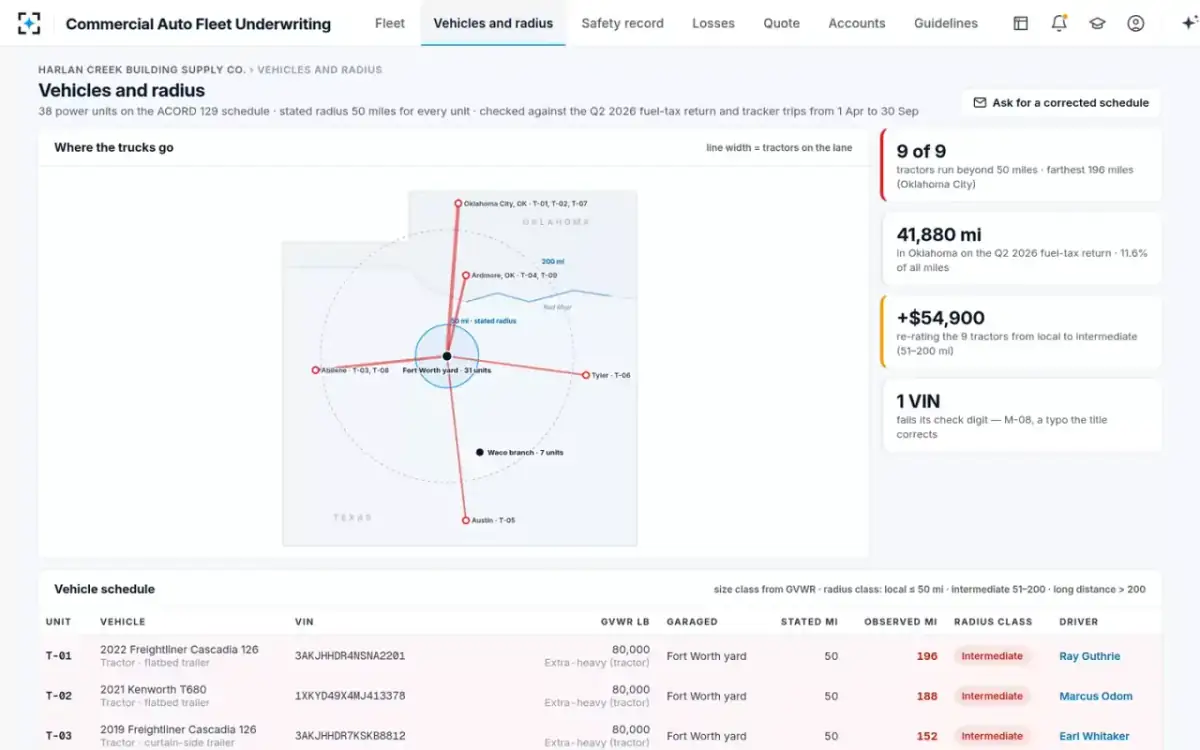
Yes: trip data measured from each vehicle's garaging address is the most direct evidence of radius there is, and it settles the question unit by unit, which a fuel-tax return cannot. On the sample renewal the application stated 50 miles for all 38 units. The second-quarter 2026 fuel-tax return reported 41,880 miles in Oklahoma, 11.6% of the fleet's miles, which proves some trucks left Texas but not which. The tracker trips from 1 April to 30 September answered that: all nine tractors ran between 111 and 196 miles from the Fort Worth yard, to Oklahoma City, Ardmore, Abilene, Tyler and Austin, while the flatbeds, box trucks and pickups stayed local.
What the fleet's own data showed on one sample renewal
9of 9
tractors running beyond the stated 50 miles
196mi
farthest regular run from the yard, to Oklahoma City
11.6%
of the fleet’s miles in Oklahoma on the quarter’s fuel-tax return
+$54,900
added to the base by re-rating the tractors from local to intermediate
The method is short. Take each unit's trips, measure the distance of each stop from the garaging address on the schedule, look at the farthest distances the unit reaches regularly rather than once, and compare with the stated radius class. The full method, and the other evidence that can stand in when there is no tracker, is in the guide to checking a commercial auto radius of operation.
Where the trucks go, against the 50- and 200-mile rings
Do insurers require telematics for fleets?
Federal rules require logging devices for hours of service, not for insurance; whether an insurer asks for telematics data is its own underwriting decision, set out in its guidelines or as a condition on a quote. The ELD requirement has applied since 18 December 2017 (49 CFR 395.8), but drivers who stay within 150 air miles of their reporting location and meet the rule's time-record conditions are exempt (49 CFR 395.1(e)), so a local fleet may have no ELD data at all.
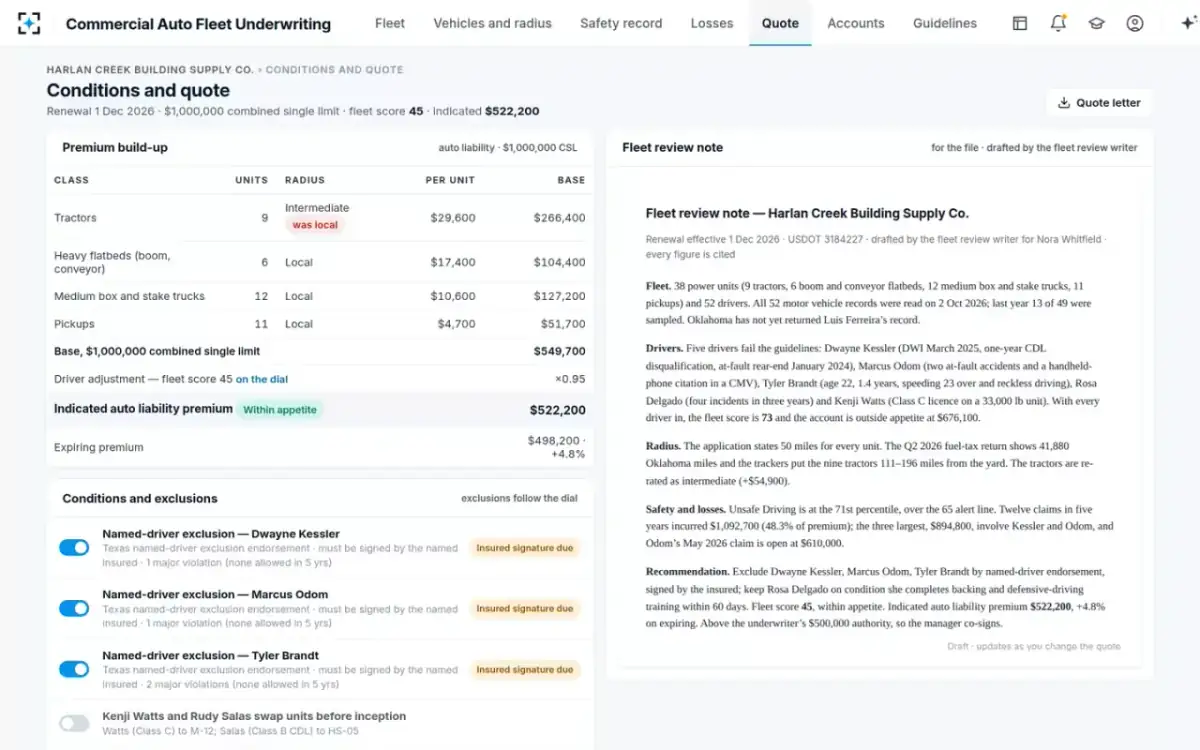
A condition is often the better tool than a requirement. On the sample account the underwriter did not make the renewal depend on new devices; she re-rated the tractors on the evidence the fleet already had and added a condition for a telematics radius report at mid-term, since trackers were already fitted to all nine tractors. That turns a one-off check into a second look six months later at no cost to the insured.
Who owns fleet telematics data?
The fleet and its device vendor hold telematics data under their own contract; an insurer sees only what the insured agrees to share. For ELD records the federal rule sets a floor: the carrier must keep records of duty status and supporting documents "for a period of not less than 6 months from the date of receipt" (49 CFR 395.8(k)), and FMCSA's FAQ says a carrier "is free to use this data as long as it does not engage in harassment" of its drivers.
For the underwriter, three practical points follow. Ask for a defined period and a defined set of fields, not "the telematics data". Put in writing what the insurer will use it for and keep. And check whether any state where you write treats the data as external consumer data: New York's 2024 letter defines that term to include data used "to supplement traditional medical, property or casualty underwriting or pricing", and while it expressly excludes a motor vehicle report, it does not list telematics among its exclusions (NY DFS Circular Letter No. 7). The NAIC notes, more broadly, that "some states have enacted legislation requiring disclosure of tracking practices and devices."
How do insurers read a telematics export?
An insurer reads a telematics export by mapping each device to a vehicle on the schedule, measuring trips from that vehicle's garaging address, and summarising each unit's regular range and miles for the policy period, keeping the trips behind every conclusion. The hard part is the mapping, not the measuring: exports name units by the fleet's own numbers, schedules by VIN, and the two lists rarely match without work.
On the sample renewal the trips came keyed to the fleet's own unit numbers, T-01 to T-09 for the tractors, the same numbers the schedule uses beside each decoded VIN. The vehicle and radius checker measured them from the garaging address on the schedule, which matters because the fleet has two yards: 31 units at Fort Worth and seven at a Waco branch. A unit measured from the wrong yard is re-rated on the wrong evidence. The decoded VIN matters too, since the schedule line is where the weight class comes from, as the guide to GVWR classes and the VIN explains line by line.
Fitting the export into the systems you already run
A telematics export fits into existing underwriting systems as one more document in the submission, read alongside the schedule and the fuel-tax return, with the findings flowing into the rating worksheet and the file note you already use. No device program, data warehouse or new policy system is needed for verification.
Before you read a fleet's telematics export: seven things to settle
- The period
At least a full quarter, matching the fuel-tax return you also ask for; the sample used six months of trips.
- The fields
Unit, date and time, position or stop, odometer; behaviour fields only if you have a use for them.
- The unit key
A unit number or VIN that matches the vehicle schedule, or a mapping table from the insured.
- The garaging address per unit
From the schedule, and checked against where units park overnight.
- The format as delivered
Accept the fleet’s own spreadsheet or export; re-keying it defeats the point.
- Use and retention in writing
What the insurer uses it for and how long it keeps it, agreed with the insured.
- The question it answers
Radius, miles and garaging for pricing; behaviour scoring is a separate, filed program.
Does telematics lower commercial auto premiums?
It can, where a filed usage-based program credits measured behaviour, but verification data moves the premium whichever way the evidence points. The NAIC describes the general case: closer links between premium and "actual individual vehicle or fleet performance" let insurers price more accurately, which lowers the price for some fleets and raises it for others. On the sample renewal the fleet's own data raised it: nine tractors stated as local were re-rated as intermediate, adding $54,900 to the base. The account was still quoted within appetite at 4.8% above expiring, after three driver exclusions.
The re-rate in the premium build-up, and a mid-term telematics condition
What Commercial Auto Fleet Underwriting reads, and what it is not
Commercial Auto Fleet Underwriting fits as the reader of fleet data the insured already has: tracker trips and the fuel-tax return, compared with the schedule's stated radius, unit by unit, with the evidence kept for every re-rate. The vehicle and radius checker never changes the schedule; the underwriter decides whether to re-rate, ask for a corrected schedule or set a condition.
It is not a telematics program. It does not install devices, stream live data or score drivers from harsh-braking and speed events; driver scores in the solution come from motor vehicle records under the insurer's guidelines. An insurer that wants a behaviour-based fleet discount needs a filed plan and a device program; this solution will read that program's output as one more document, but it does not replace it.
Questions people ask
Can an insurer require a fleet to install telematics?
An insurer can make telematics a condition of its quote, and the insured can decline the quote. What an insurer does with the data for pricing may need a filed rating plan in many states, as the NAIC notes. Many interstate trucks already carry federally required logging devices, so asking for existing data is often easier than requiring new devices.
How long does a fleet keep ELD data?
At least six months: 49 CFR 395.8(k) requires a carrier to keep records of duty status and supporting documents for not less than six months from receipt. Trip data from other trackers is kept as long as the fleet and its vendor choose, and fuel-tax records for four years.
Can ELD data prove where a truck went?
Largely, yes. An ELD records a position at every duty-status change and at least hourly in motion, to about ±1 mile. During authorised personal use the position is recorded only to about a 10-mile radius, and drivers exempt under the short-haul rule may not use an ELD at all.
Is an IFTA report the same as telematics data?
No. An IFTA return is a quarterly tax filing of a fleet's total miles and fuel by jurisdiction, covering only qualified motor vehicles. It shows how much a fleet drove in each state, not which truck drove it or how far from home, so it complements trip data rather than replacing it.
What telematics data should an underwriter ask for?
For pricing an existing filed class: unit, date, time and position or stops, and odometer, for at least a full quarter, keyed to the vehicle schedule. Behaviour fields such as harsh braking matter only if the insurer has a program that uses them.