A driving risk score is a number that summarises how risky a driver is from evidence such as their motor vehicle record, licence and experience, or from telematics data on how they drive; a fleet risk score combines the drivers on a roster into one figure that sets appetite and price. Whether the score is a hand-set points table or a machine-learned model, the reviewer's questions are the same: what goes in, how the number is made, whether the same roster always gets the same score, whether every point can be traced to a source, and whether it predicts losses on your own book. Botminds' Commercial Auto Fleet Underwriting uses a deterministic points score built from the insurer's own guidelines, and this guide uses it to show what good answers look like and where any score, including this one, still needs testing.
The worked figures come from a fictional sample account as it runs through the solution, Harlan Creek Building Supply Co., with 52 drivers on 38 trucks. The regulatory texts are linked where they are quoted.
Ten questions a model reviewer asks of a driving risk score, and the evidence each needs
| The question | Evidence to ask for | How the sample fleet score answers |
|---|---|---|
| 1. What is the score, exactly? | The formula and every weight, in writing | Fleet score = 20 + 44 × average points of the drivers priced; points per event in the guidelines |
| 2. Does the same roster always give the same score? | A re-run on frozen inputs, with the result compared | Deterministic by design; a re-run reports what changed since the last one |
| 3. Can every point be traced to a source? | For any driver, the record lines behind each point | Each point cites the motor vehicle record line it came from |
| 4. Who approved the rules, and when did they change? | A version history with approver and date | Guidelines rev. 2026.2, approved by the underwriting manager on 1 Jul 2026; every change a new version |
| 5. Which inputs are used, and could any act as a proxy? | A data dictionary, with the business reason for each input | Record events, licence class against the unit, age and years in class on commercial-licence units |
| 6. What does the score decide? | The mapping from score to appetite and price | Bands 0–54 within appetite, 55–64 with conditions, 65+ refer; a driver adjustment on the premium |
| 7. What can a person override, and is it recorded? | The override log, with reasons | Only a person excludes, reassigns or accepts a driver, with a reason, on the audit trail |
| 8. Does it predict losses on our book? | A back-test of bands against loss frequency and severity | Not answerable from one account; needs your own book |
| 9. How will we know if it drifts? | A monitoring plan with thresholds | Watch the share of drivers in each band and the failing share by account over time |
| 10. Where does outside data enter, and who answers for it? | The source of each input and the contract behind it | State motor vehicle records ordered for underwriting; the insurer answers for the result |
What is a driving risk score?
A driving risk score is a single number, or a band, that ranks drivers by how likely they are to cause a loss, built from evidence about their past driving. In commercial auto underwriting the evidence is usually the three-year motor vehicle record, the licence held and the vehicle driven, and the purpose is practical: decide who is acceptable on which unit, and what the account should pay.
Two families of score are in use, and reviewers should not confuse them. A points score assigns fixed points to recorded events (a speeding conviction, an at-fault accident, a disqualification) and adds them up. A predictive model learns weights from historical data, often including telematics measures such as hard braking or speed. The first is a written rule an underwriter can apply by hand; the second is a fitted function that has to be validated, monitored and explained. Most of the review questions apply to both, but the evidence differs.
A fleet risk score sits one level up. It aggregates the drivers on the roster into one figure for the account, so that an underwriter can see appetite and price at a glance and see what happens when a driver is excluded.
How are driver risk scores calculated? A worked fleet score
A points-based driver risk score is calculated by assigning each recorded event the points the guidelines set and summing them over a look-back period; a fleet score then turns the drivers' points into one number. In the sample guidelines a minor violation is 1 point, an at-fault accident 3, a major violation 4, a suspension or disqualification 5, a licence class that does not fit the unit 2, and a driver under the minimum age or years in class 1 each.
One driver's 13 points, each traced to a line on his record
| Record line | Date | Type | Points |
|---|---|---|---|
| At-fault rear-end collision, I-35W northbound, one injured | 18 Jan 2024 | At-fault accident | 3 |
| Driving while intoxicated, BAC 0.11, personal vehicle | 22 Mar 2025 | Major violation | 4 |
| Commercial licence disqualified for one year under 49 CFR 383.51 | 22 Apr 2025 – 21 Apr 2026 | Suspension or disqualification | 5 |
| Speeding 64 in a 50, SH-199 | 9 Aug 2026 | Minor violation | 1 |
| Total for Dwayne Kessler, tractor T-07 | 18 Jan 2024 – 9 Aug 2026 | Four entries | 13 |
The fleet score is a linear function of the average: 20 plus 44 times the average points of the drivers priced. The sample roster carries 63 points across 52 drivers, an average of 1.21, so the score is 20 + 44 × 63 ÷ 52 = 73.3, shown as 73. That sits in the refer band, 65 and above, and the account's indicated premium carries a driver adjustment of ×1.23 on a base of $549,700: $676,100, or 35.7% above the expiring $498,200.
The useful property for a reviewer is that every move is arithmetic. Exclude Kessler and the roster has 50 points across 51 drivers: 63.1. Exclude Marcus Odom, with 11 points, and it is 39 across 50: 54.3. Exclude Tyler Brandt, also 11, and it is 28 across 49: 45.1, within appetite, with the driver adjustment at ×0.95 and the indicated premium at $522,200.
Three exclusions take the sample fleet score from refer to within appetite
Are driver risk scores regulated?
Driver risk scores are regulated indirectly: no rule prescribes a scoring formula, but rating rules, examination standards and AI guidance all reach how an insurer uses one. Three texts matter most to a commercial auto reviewer.
Rating and examination standards. Where a score moves the premium it works like a rating modification, and examiners look for consistency and documentation. The NAIC's examination standard asks whether credits, debits and deviations are applied consistently and without discrimination, and whether the reason for each is on file (NAIC Market Regulation Handbook; see underwriting authority levels). The Casualty Actuarial Society's ratemaking text adds that "documentation is often required to support the application of each credit and debit" (CAS Basic Ratemaking).
The NAIC AI model bulletin. Adopted on 4 December 2023 and, by the NAIC's own map, adopted in 29 jurisdictions as of 8 October 2026, the bulletin asks insurers to keep a written program for AI systems, including management of predictive models with assessments of "interpretability, repeatability, robustness, regular tuning, reproducibility, traceability, model drift, and the auditability of these measurements" (NAIC model bulletin). It defines a predictive model as one that mines historic data with algorithms or machine learning to find patterns and predict outcomes. A points table written by underwriters is not mined from data, so whether a given score is in scope is a question for the insurer's compliance function. The assessments are good practice either way.
New York's Circular Letter No. 7. New York's 2024 letter on external data and AI in underwriting excludes the motor vehicle record from its definition of external data: "ECDIS does not include an MIB Group, Inc. member information exchange service, a motor vehicle report, prescription drug data, or a criminal history search" (NY DFS Circular Letter No. 7). That does not take a score out of scope, because the Department says it intends "to cover AIS utilization and models regardless of whether they leverage ECDIS." A score built only from motor vehicle records still needs governance if the system that produces it is an AI system.
The reviewer's questions, and the evidence for each
A reviewer's questions about a driving risk score fall into four groups: definition, reproducibility, traceability and performance. The table at the top of this page lists ten; the evidence behind them is what separates a score that can be defended from one that can only be described.
Definition is the formula, the weights and the bands, in writing, versioned. Reproducibility is a re-run: freeze a roster, score it twice, compare. Traceability is a sample of drivers whose points can each be followed to a record line. Performance is the hard one, because it needs outcomes: losses by score band across enough accounts to mean something.
Two questions matter most when the score comes from a vendor. The first is ownership of the method. New York's letter is explicit that "An insurer may not rely on the proprietary nature of a third-party vendor’s algorithmic processes to justify the lack of specificity related to an adverse underwriting or pricing action." A score whose weights the insurer cannot see cannot support a declination letter or an exclusion. The second is the override path: who can change a driver's status, whether the reason is recorded, and whether the score recomputes from the change rather than being edited by hand.
Can a fleet score be audited?
A fleet score can be audited when three things hold: the formula is written down, the inputs are kept with their sources, and the same inputs always produce the same score. The sample score passes all three by construction. The guidelines are a versioned document, the inputs are the coded record lines with their citations, and the fleet scorer is deterministic: the same roster always gives the same score.
The guidelines as settings: change one, see how many drivers fail
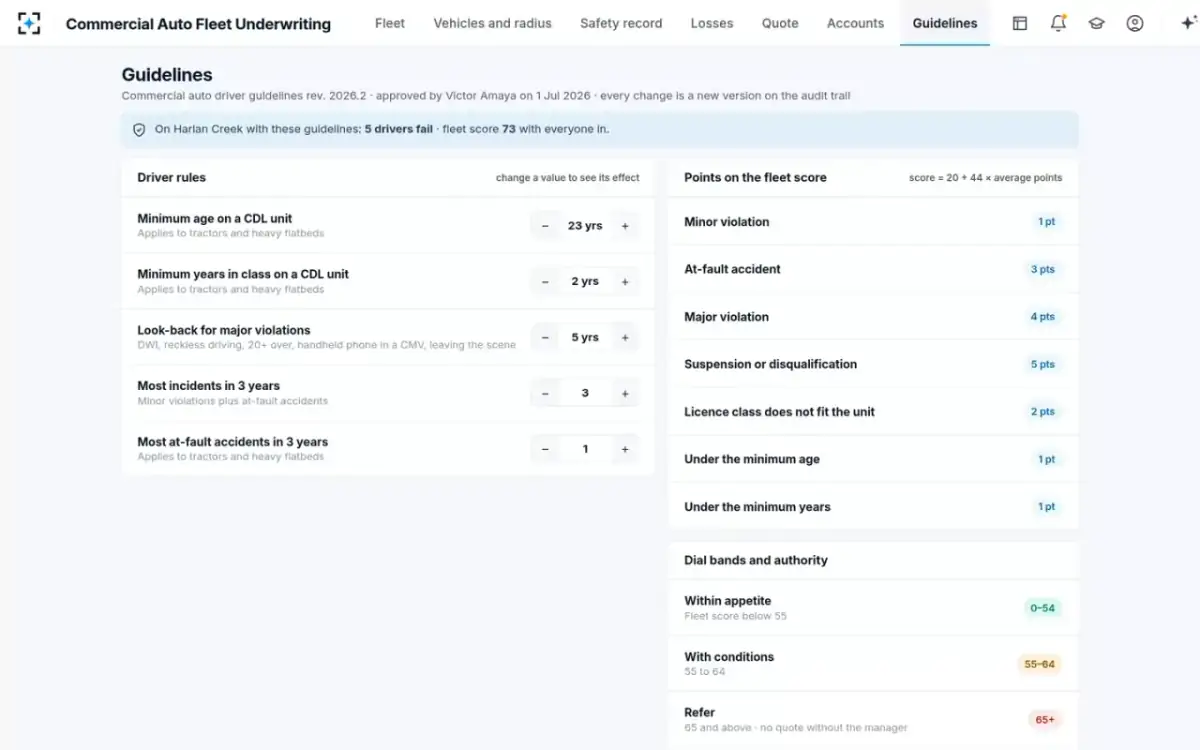
An audit of a deterministic score is a re-performance. Take any account's roster at a past date and the guidelines version in force at that date, recompute, and compare with the score recorded in the file. A difference means either an input changed (a record came back, a driver was excluded) or the method did, and both should be visible in the history. A score that cannot be re-performed from kept inputs, such as one fetched from a vendor at quote time and not stored with its reasons, can only be audited by trusting it.
What data goes into a driver score, and what stays out
A driver score should use data with a clear safety reason and a reliable source, and leave out anything that adds no information about driving or stands in for a characteristic the insurer may not use. For a commercial auto score the core inputs are the record's events, the licence class and endorsements against the unit's weight rating, and experience on the unit. Each has a federal anchor: a carrier must give heavy weight to speeding, reckless driving and driving under the influence when it reviews a driver each year (49 CFR 391.25(b)(2)).
Age deserves the reviewer's attention. Federal rules set 21 as the minimum for interstate commercial driving (49 CFR 391.11(b)(1)); the sample guidelines set 23 on commercial-licence units, a stricter appetite choice that adds 1 point under it. That is defensible as experience on heavy units, but it should be written down as a reason, tested for effect, and kept off units where it has no safety basis. The same goes for any input a vendor adds: a reviewer should ask what each one measures and why it belongs.
Double counting is the other trap. The CAS warns, in the context of experience and schedule rating, that a risk characteristic already reflected in the experience modification must not be counted again in schedule rating (CAS Basic Ratemaking; the experience mod review guide works through it). A fleet whose losses already push its experience up should not be charged again for the same accidents through the driver score without a deliberate decision to do so.
How do you validate a driver scoring model?
You validate a driver scoring model by testing whether its bands separate accounts or drivers with different loss outcomes, on data it was not built from, and by repeating that test as the book changes. The NAIC bulletin describes the shape: validation "can take the form of comparing model performance on unseen data available at the time of model development to the performance observed on data post-implementation, measuring performance against expert review, or other methods."
Six validation tests for a driving risk score
- Re-performance
Recompute a sample of past scores from stored inputs and the guidelines version then in force; every difference explained.
- Trace test
For a random set of drivers, follow each point to a record line; no orphans.
- Band separation
Claim frequency and severity by score band across your book; higher bands should lose more, with enough exposure to tell.
- Expert review
Senior underwriters score a blind sample by hand and compare; disagreements show where the rules are unclear.
- Stability
The share of drivers in each band, by month and by account type; a jump without a cause is drift or a data change.
- Effect of each rule
Turn one rule off and rescore the book; know what each rule does to who fails and to premium.
One account is not validation. On the sample renewal the three largest claims, $894,800 of $1,092,700 incurred over five years, involve two of the three drivers the score ranks highest, and that is a reassuring anecdote rather than evidence. The evidence is the same comparison across hundreds of accounts.
Points or a predictive model: what changes for the reviewer
A points score and a predictive model answer the same question with different risks: the first can be wrong in ways anyone can see, the second can be right in ways nobody can explain. The review should match the kind of score.
A points score fails in plain sight; a fitted model can fail out of sight
Points score from records: Written by underwriters in guidelines; changed by version
Predictive model, often with telematics: Fitted to historical data; changed by retraining
Points score from records: Record events, licence, unit, experience
Predictive model, often with telematics: Records plus behaviour such as speed, braking, hours and location
Points score from records: List the events and their points
Predictive model, often with telematics: Needs attribution methods, and still may not satisfy an adverse-action question
Points score from records: Weights set by judgement may not match loss experience
Predictive model, often with telematics: Overfitting, drift and proxies hidden in features
Points score from records: Exact, if inputs are kept
Predictive model, often with telematics: Exact for a frozen model; breaks across retrains unless versions are kept
Points score from records: Consistent application and documentation of each adjustment
Predictive model, often with telematics: The same, plus AI-program expectations on data, testing and vendors
Where Commercial Auto Fleet Underwriting fits, and what it leaves to you
Commercial Auto Fleet Underwriting computes a deterministic points score from your own guidelines, traces every point to a record line, recomputes the score and premium after every exclusion, and never excludes a driver itself. Those properties answer the definition, reproducibility, traceability and override questions on the page. They do not answer whether your points and bands predict losses on your book; that test needs your own loss data, and the solution's role is to keep the inputs and versions that make the test possible.
What the sample score shows a reviewer on one account
63pts
across 52 drivers priced; average 1.21
73 → 45
fleet score before and after three named-driver exclusions
5
drivers who fail the guidelines, each with cited record lines
The dial after three exclusions: 45, within appetite
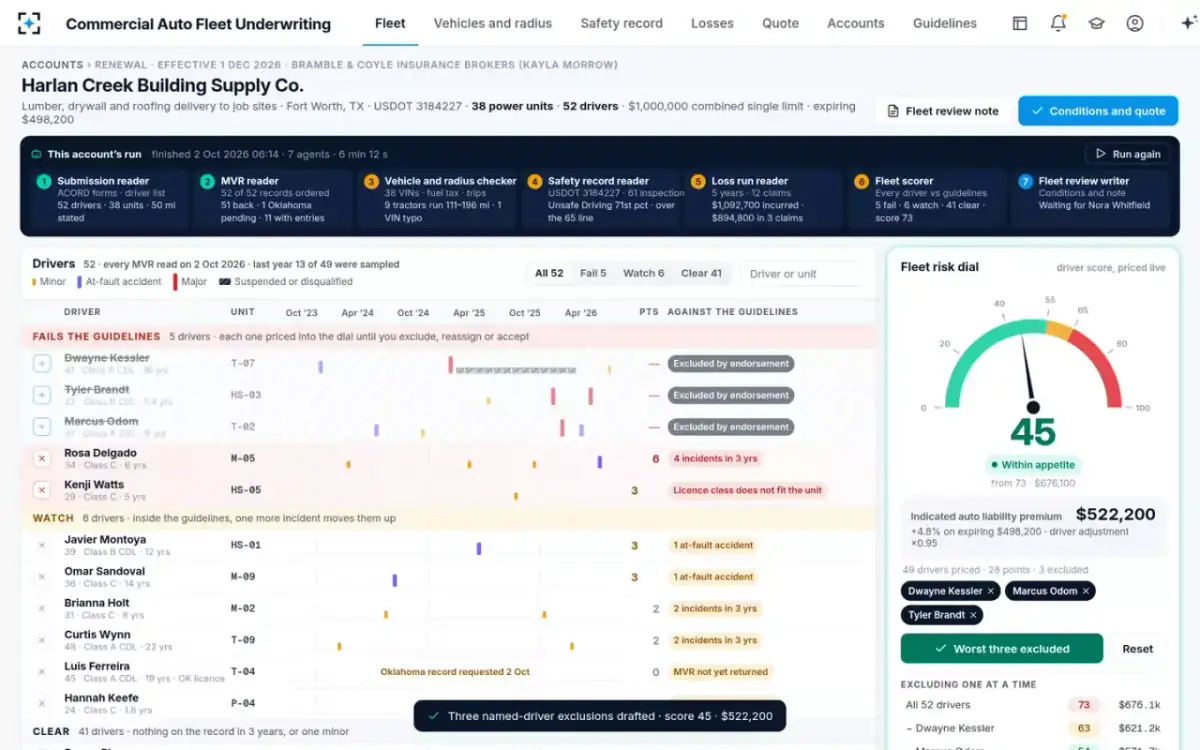
Two other guides in this series sit on either side of the score. The inputs come from reading every driver's record, traced in how to run an MVR on drivers; keeping those inputs current between renewals is the subject of motor vehicle record monitoring.
Questions people ask
Is a motor vehicle record considered external consumer data?
Not under New York's Circular Letter No. 7, which states that its definition of external consumer data and information sources "does not include" a motor vehicle report. The letter's governance expectations for AI systems can still apply to a system that uses motor vehicle records. Other states' rules differ; check the ones where you write.
Who is responsible for a vendor's driver score?
The insurer. New York's letter says an insurer "may not rely on the proprietary nature of a third-party vendor’s algorithmic processes" to justify a lack of specificity in an adverse decision, and the NAIC bulletin expects due diligence and contract terms for third-party AI systems and data. Ask for the weights, the inputs and the right to audit before you rely on one.
What is a good fleet risk score?
Whatever your bands say: a score only means something against the appetite it was built for. In the sample guidelines, 0 to 54 is within appetite, 55 to 64 is acceptable with conditions, and 65 or above is referred; the sample account moved from 73 to 45 after three exclusions.
Does excluding a driver change the fleet score?
In a score built on the average points of the drivers priced, yes, and by a predictable amount. Excluding the sample account's highest-scoring driver, with 13 of the roster's 63 points, moved the score from 73 to 63 and the indicated premium from $676,100 to $621,200. The exclusion takes effect only when the insured signs the endorsement.
How often should a driver scoring model be revalidated?
No rule fixes a schedule; the NAIC bulletin expects validation, testing and retesting "as necessary" and monitoring for drift. A practical trigger is any change to the guidelines, the record sources or the mix of business, plus an annual comparison of loss experience by band.