GVWR classes group vehicles by their gross vehicle weight rating, the manufacturer's maximum loaded weight for a single vehicle: under the federal VIN rule, Class 3 is 10,001 to 14,000 pounds, Class 4 to 16,000, Class 5 to 19,500, Class 6 to 26,000, Class 7 to 33,000, and Class 8 is 33,001 pounds and over, with eight lettered bands, A to H, below 10,001. For a commercial auto underwriter the weight rating on each line of the vehicle schedule does three jobs: it sets the vehicle's size class for rating, it decides whether federal motor carrier rules apply, and it decides which commercial licence its driver needs. A wrong weight, or a VIN keyed with a typo, carries through all three. Botminds' Commercial Auto Fleet Underwriting is an agentic solution whose vehicle and radius checker decodes every VIN, tests its check digit and sets the size class from the weight rating, so each schedule line is checked before the account is priced.
The examples come from a fictional sample account as it runs through the solution: Harlan Creek Building Supply Co. of Fort Worth, with 38 power units from pickups to tractors. The VIN worked through below is made up for this page.
One schedule line, field by field: what each field decides and the error it can hide
| Field | On the sample line | What it decides | The error it can hide |
|---|---|---|---|
| Unit number | HS-05 | Links the vehicle to its driver, its trips and its claims | Two units sharing a number, so trips or losses land on the wrong one |
| Year, make and model | Boom truck (make and year on the schedule) | A first check on everything else on the line | A model that cannot have the weight rating the line shows |
| VIN | Seventeen characters, ninth a check digit | The vehicle’s identity; decodes to its make, type and weight rating | A one-character typo, caught by the check digit |
| GVWR | 33,000 lb | Federal Class 7; the rating size class; a commercial licence for its driver | A combination rating entered as a single-vehicle rating |
| Body and use | Boom truck delivering to job sites | The business-use and secondary classification | A use that changes the rate, such as dumping, left out |
| Garaging address | From the schedule | Rating territory and the centre for measuring radius | A unit garaged at a second yard rated from the first |
| Stated radius | 50 miles | Radius class: local, intermediate or long distance | A guess the trips do not support |
| Assigned driver | Kenji Watts, Class C licence | Whether the driver may lawfully drive the unit | A licence class that does not fit the weight rating |
What are the GVWR classes?
The GVWR classes are the weight bands the federal VIN rule uses when manufacturers report a vehicle's gross vehicle weight rating to NHTSA: lettered bands A to H up to 10,000 pounds, and Classes 3 to 8 above. They appear as Table II of 49 CFR 565.15.
The GVWR classes in the federal VIN rule
| Class | Gross vehicle weight rating | Typical commercial auto examples |
|---|---|---|
| A to H | Up to 10,000 lb, in eight bands of about 1,000 lb | Pickups, vans and light service trucks |
| Class 3 | 10,001–14,000 lb | Heavier pickups and cab-chassis service trucks |
| Class 4 | 14,001–16,000 lb | Larger walk-in and box vans |
| Class 5 | 16,001–19,500 lb | Bucket and box trucks |
| Class 6 | 19,501–26,000 lb | Single-axle box and stake trucks |
| Class 7 | 26,001–33,000 lb | Heavier straight trucks, such as boom trucks |
| Class 8 | 33,001 lb and over | Tandem-axle straight trucks and road tractors |
The table's boundaries are not arbitrary for an underwriter: two of them are the same weights at which federal rules change. At 10,001 pounds a vehicle in interstate commerce becomes a commercial motor vehicle under the Federal Motor Carrier Safety Regulations, and at 26,001 pounds, the start of Class 7, a single vehicle needs a driver with a Group B commercial licence.
What does GVWR mean?
GVWR, gross vehicle weight rating, is the manufacturer's figure for the most a single vehicle may weigh when loaded, including itself, its fuel, its driver and its cargo. The federal motor carrier rules define it as "the value specified by the manufacturer as the maximum loaded weight of a single motor vehicle" (49 CFR 390.5). It is a rating, not a weighing: a truck rated at 33,000 pounds is a Class 7 truck whether it runs empty or full.
Two related terms matter on a schedule. Gross vehicle weight is the actual weight on the day. Gross combination weight rating covers a power unit and what it tows; the same section defines it as the greater of the value the power unit's manufacturer shows on its federal certification label and the sum of the weight ratings of the units in the combination. A tractor's schedule line should therefore carry its own rating and, separately, the combination it pulls, because rules key on one or the other: a single vehicle's licence group on its GVWR, a combination's on its GCWR.
What is a class 8 truck?
A Class 8 truck is any vehicle with a gross vehicle weight rating of 33,001 pounds or more; the federal table reads "Class 8—Greater than 14968 kg. (33,001 lbs. and over)" (49 CFR 565.15). On the sample account the nine road tractors, the units that run to Oklahoma City, Ardmore, Abilene, Tyler and Austin, are the ones whose radius changed the price; their schedule lines need both a single-vehicle and a combination rating.
A Class 7 truck is one step down, 26,001 to 33,000 pounds, and the difference matters less for licensing than people expect. A single vehicle in either class needs a Group B commercial licence; a combination needs Group A once the combined rating reaches 26,001 pounds and the towed unit is rated over 10,000.
The weights where rules change
Four weights on a vehicle schedule decide which rules apply to a vehicle and its driver: 10,001 pounds, 26,000 pounds for fuel-tax reporting, 26,001 pounds for a commercial licence, and the size-class boundaries of the rating plan. They do not line up neatly with each other or with the GVWR classes, which is why the weight rating has to be read for each purpose.
The same weight rating answers four different questions
| Weight | What changes | Rule |
|---|---|---|
| 10,001 lb and over | A commercial motor vehicle under the federal motor carrier rules, in interstate commerce | 49 CFR 390.5 |
| 10,001 lb and over, for-hire | $750,000 minimum public liability for interstate for-hire carriers of non-hazardous property | 49 CFR 387.9 |
| Over 26,000 lb in combination, or three or more axles | A qualified motor vehicle for fuel-tax (IFTA) reporting | Texas Comptroller IFTA FAQ |
| 26,001 lb and over | A single vehicle needs a Group B commercial licence; a combination with a towed unit over 10,000 lb needs Group A | 49 CFR 383.91 |
| 10,000 / 20,000 lb | Light, medium and heavy size classes for rating in one state plan | Texas residual-market plan bulletin, 2012 |
The size classes are the boundary underwriters use most and examiners check. In one 2020 North Carolina examination, one of the eight commercial auto rating errors found was "an incorrect size factor" (North Carolina DOI). A truck rated at 19,500 pounds and one rated at 20,500 sit in neighbouring federal classes, 5 and 6, and in different size classes in the Texas plan, medium and heavy. A weight keyed wrongly by a thousand pounds can change the premium on the line.
How do you find GVWR from a VIN?
You find a truck's weight rating from its VIN by decoding the vehicle-descriptor section, characters 4 to 8, with the manufacturer's published key or a decoder that uses it, such as NHTSA's public VIN decoder. The VIN rule requires that for a truck those characters let a reader decipher, among other things, the "gross vehicle weight rating"; it does not require the class letter or number to appear in the VIN itself: "The use of these designations within the VIN itself is not required" (49 CFR 565.15(b)).
So a VIN gives the weight rating only through the manufacturer's coding, and the coding differs by manufacturer and model year. In practice an underwriter checks three things agree: the GVWR on the schedule, the GVWR decoded from the VIN, and the model, since a given model has a known range of ratings. Where they disagree, the schedule is usually the one that is wrong.
What is the VIN check digit?
The VIN check digit is the ninth character, computed from the other sixteen by a fixed formula so that a mistyped VIN can be detected; the rule calls it "the check digit whose purpose is to provide a means for verifying the accuracy of any VIN transcription" (49 CFR 565.15(c)). Each character gets a value (digits keep their value; letters get the values in the rule's Table III, which has none for I, O or Q), each value is multiplied by its position's weight, the products are added, and the total is divided by 11. The remainder is the check digit, with 10 written as X.
Checking a VIN by hand: 4ZZJBWD85RPLW4821
| Positions | Characters | Value × weight | Products |
|---|---|---|---|
| Positions 1–4 | 4 Z Z J | 4×8 + 9×7 + 9×6 + 1×5 | 32 + 63 + 54 + 5 = 154 |
| Positions 5–8 | B W D 8 | 2×4 + 6×3 + 4×2 + 8×10 | 8 + 18 + 8 + 80 = 114 |
| Position 9 | 5 | The check digit: weight 0 | — |
| Positions 10–13 | R P L W | 9×9 + 7×8 + 3×7 + 6×6 | 81 + 56 + 21 + 36 = 194 |
| Positions 14–17 | 4 8 2 1 | 4×5 + 8×4 + 2×3 + 1×2 | 20 + 32 + 6 + 2 = 60 |
| Total | All but position 9 | 154 + 114 + 194 + 60 | 522 ÷ 11 = 47, remainder 5 |
The check catches most of the errors people make keying a VIN, a wrong character or two neighbouring characters swapped, but not all: a letter with the same value as a digit, such as J and 1, slips through, and the check says nothing about whether the VIN belongs to the vehicle on the line. On the sample account the solution flagged unit M-08, whose VIN fails its check digit; the vehicle's title showed the correct VIN, and the schedule was the one with the typo.
What weight class requires a CDL?
A commercial driver's licence is required for a single vehicle with a GVWR of 26,001 pounds or more, which is Class 7 and Class 8, and for a combination of 26,001 pounds or more where the towed unit is rated over 10,000 pounds. The federal licence groups read: "Heavy Straight Vehicle (Group B)—Any single vehicle with a GVWR of 11,794 kilograms or more (26,001 pounds or more)" (49 CFR 383.91). Smaller vehicles need a commercial licence too if they are designed to carry 16 or more passengers including the driver, or carry hazardous materials as the licensing rules define them, which is Group C.
A Class C licence on a 33,000-pound unit, and the fix in the roster
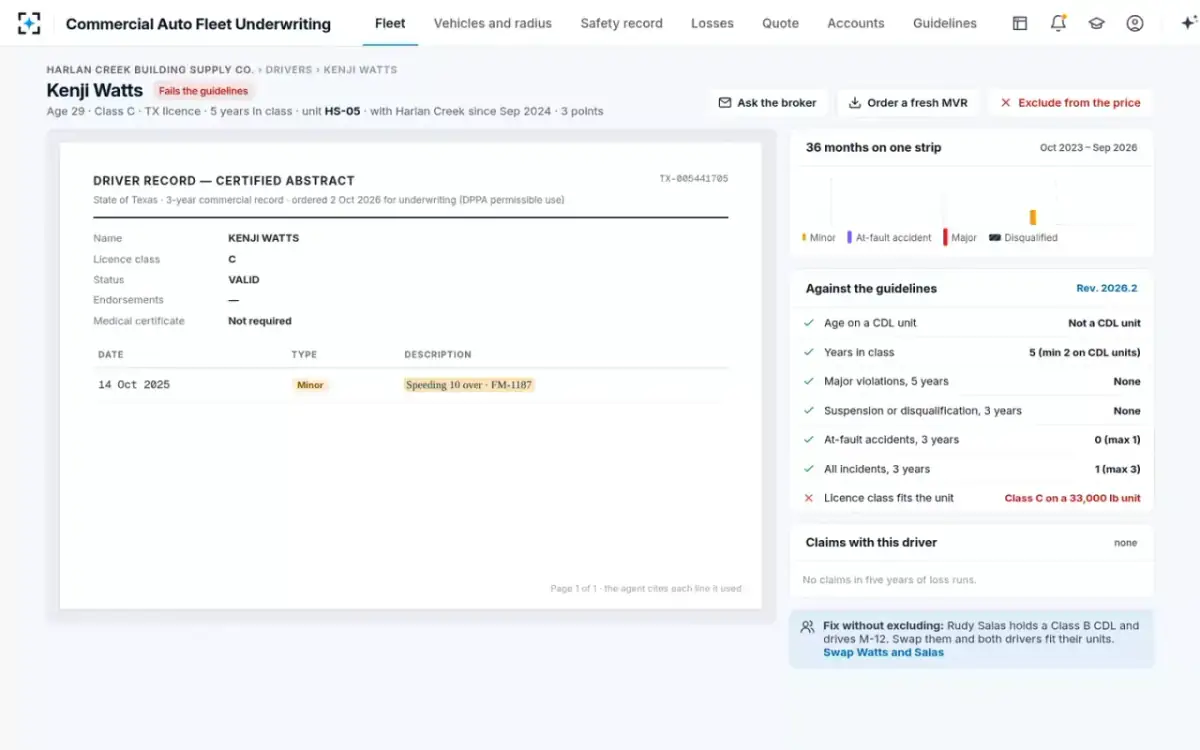
On the sample account the boom truck HS-05 is rated at 33,000 pounds, so it needs a Group B licence, and its driver, Kenji Watts, holds Class C. Driving a commercial vehicle "without the proper class of CLP or CDL" is a serious traffic violation under 49 CFR 383.51 Table 2 (49 CFR 383.51), and in the sample guidelines a licence that does not fit the unit costs 2 points. The schedule line's weight, read against the roster's licences, found the problem; the roster also had the fix, another driver with a Class B licence on a smaller unit.
Does GVWR affect commercial auto insurance?
Yes: the weight rating sets the vehicle's size class, and the size class carries its own rating factor. In the Texas residual-market plan's 2012 bulletin, the local, commercial-use factor rises from 1.30 for a light truck to 1.40 for a medium truck, 1.45 for a heavy truck and 1.80 for a heavy truck-tractor, before any other adjustment.
Heavier units carry higher size-class factors, before radius or anything else
The sample premium build-up shows the same order in dollars: $4,700 a unit for pickups, $10,600 for medium box and stake trucks, $17,400 for heavy flatbeds and $29,600 for tractors, the last after re-rating to intermediate radius. Size and radius multiply, which is why the guide to commercial auto radius of operation is the natural companion to this one.
One sample fleet, by size class, as priced
11
pickups at $4,700 a unit
12
medium box and stake trucks at $10,600
6
heavy boom and conveyor flatbeds at $17,400
9
tractors at $29,600, rated intermediate
How Commercial Auto Fleet Underwriting checks every schedule line
Commercial Auto Fleet Underwriting reads every line of the schedule: its vehicle and radius checker decodes every VIN and checks its check digit, sets the size class from the weight rating, and compares the stated radius with fuel-tax miles and trips. It never changes a vehicle on the schedule; it shows what it found and why, and the underwriter or the insured corrects the line.
Five checks for every line of a commercial auto vehicle schedule
- The VIN passes its check digit
A failure is a typo until proved otherwise; the title or registration settles it.
- The decoded vehicle matches the line
Make, model, type and weight rating from the VIN agree with what the schedule says.
- The weight rating is the single-vehicle rating
Tractors carry a combination rating as well; the two belong in different fields.
- The size class follows from the rating
The rating plan’s boundaries, not the federal classes, decide the factor.
- The driver’s licence fits the unit
Group B from 26,001 lb for a single vehicle; Group A for a heavy combination.
The schedule beside the map: weight rating, size class and radius for each unit
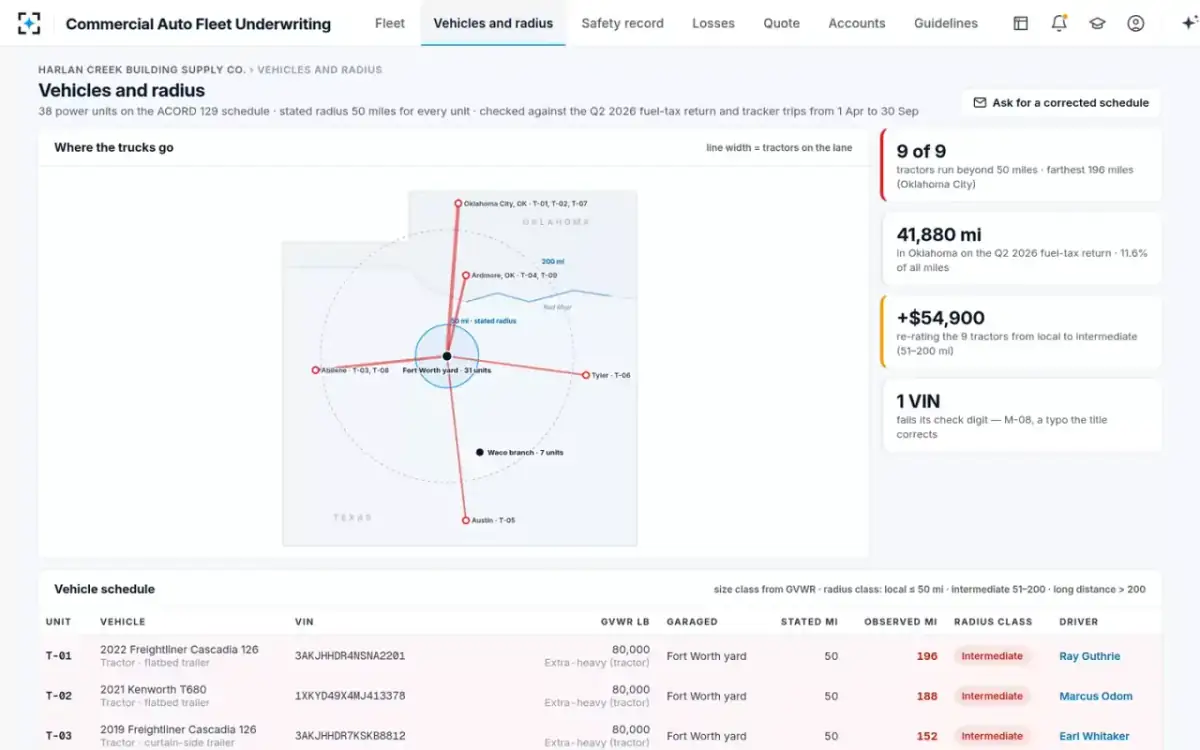
Where the line is right, the check costs nothing; where it is wrong, it changes the rate, the licence the driver needs or the federal rules that apply. The guide to the driver qualification file checklist covers what the carrier must hold for the drivers of those vehicles.
Questions people ask
What is a Class 3 truck?
A vehicle with a gross vehicle weight rating of 10,001 to 14,000 pounds, under Table II of 49 CFR 565.15. Because it is over 10,000 pounds, a Class 3 truck used in interstate commerce is a commercial motor vehicle under the federal motor carrier rules, even though its driver usually does not need a commercial licence.
Is a pickup truck a commercial motor vehicle?
It can be. Under 49 CFR 390.5, a vehicle used in interstate commerce with a weight rating, combination rating or actual weight of 10,001 pounds or more is a commercial motor vehicle, so a heavy pickup, or a lighter one towing a trailer, may qualify. For fuel tax, Texas treats a pickup that exceeds 26,000 pounds when towing as a qualified motor vehicle.
What is the minimum insurance for a truck over 10,001 lbs?
For a for-hire carrier hauling non-hazardous property in interstate commerce, $750,000 of public liability under 49 CFR 387.9, with $1,000,000 or $5,000,000 for oil and certain hazardous materials. Private carriers of non-hazardous property are not in that table; state law and the shipper's or customer's contracts may still set a minimum.
Does the VIN show the weight class?
Not directly. The VIN rule requires a truck's weight rating to be decipherable from characters 4 to 8 using the manufacturer's coding, but it does not require the class designation to appear in the VIN. Decode it with the manufacturer's key or a decoder such as NHTSA's, and compare it with the schedule.
What is the difference between GVWR and GCWR?
GVWR is the manufacturer's maximum loaded weight for a single vehicle; GCWR is the rating for a power unit and the units it tows, under 49 CFR 390.5 the greater of the power unit manufacturer's labelled value and the sum of the units' ratings. Licence groups for single vehicles key on GVWR, and for combinations on GCWR.