Premium audit software is the system an insurer's audit team uses to run workers' compensation and general liability audits after each policy year: requesting the insured's records, reconciling payroll, sales and subcontract cost to class codes, rating the audited exposure, and producing the audit report and the bill. Older tools track the queue and hold the auditor's worksheet; newer ones read the records themselves. What to look for is the same either way: the software should reconcile to independent records, test classifications and certificates the way regulators read them, explain every change in a form the insured can follow, and leave every decision and signature with a named auditor. Botminds' Premium Audit Automation is one of the newer kind: six agents chase the records, tie the payroll register to the Forms 941, test class codes and check certificates, so the auditor starts from a cited draft. The fairest way to judge it, or any rival, is to replay last year's closed audits through it and compare.
The examples come from a fictional sample audit run through the solution, a framing contractor called Brightwater Framing & Carpentry; its people and figures are sample data, its rates illustrative. Regulatory requirements are quoted from state regulators and the NAIC, with links.
Premium Audit Automation's class-code board, with the evidence beside every block of payroll
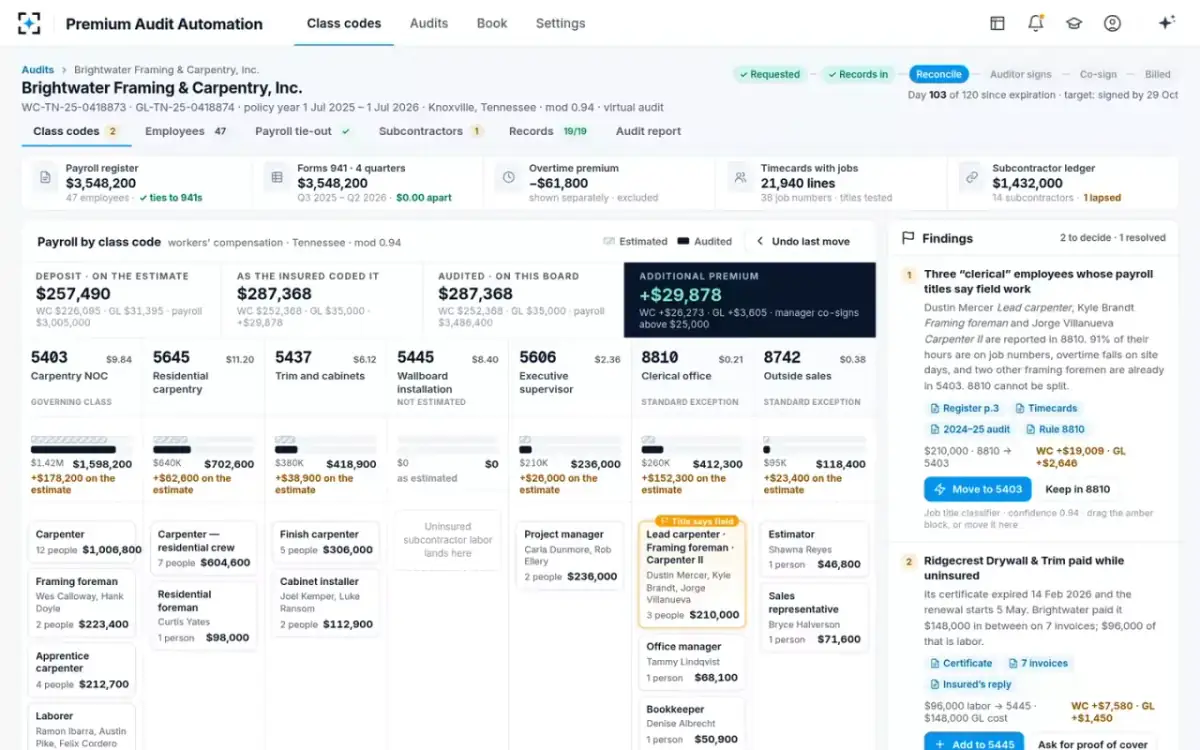
What is premium audit software?
It is software for the audit after the policy year, and it comes in three layers that buyers often confuse. The first is workflow: assigning audits to staff or outside firms, scheduling, tracking status and days open. The second is the auditor's worksheet: entering payroll by class, applying rates, producing the report. The third, newer, layer does the reading: it takes the registers, returns, timecards, invoices and certificates the insured sends, extracts the figures, reconciles them and proposes findings. A carrier can buy them separately or together.
The layers fail in different ways. A workflow tool can show a perfect queue while audits close on stale estimates. A worksheet tool calculates exactly the premium on whatever payroll was typed in. A reading layer is only as good as its tests and its citations. Ask which layers a vendor actually supplies, and which it expects your auditors or your other systems to cover.
What should premium audit software do?
It should do what the regulators ask of the audit, and show its working. Oregon's audit rules give a usable specification. They require auditors to examine payroll "from the most complete and accurate records", to make "sufficient test checks to establish the audit's accuracy and compliance with Basic Manual rules when using summary type records as the payroll source", to reconcile total payroll with records not used to build it, to check overtime, the standard exception codes, officers, locations and uninsured contract labour, and to explain any class that differs from the policy.
What premium audit software should do, and the rule behind each requirement
| Requirement | What good looks like | The rule behind it |
|---|---|---|
| Get the records in | One record list per insured, reminders that name what is missing, every message on the file. | Alaska’s insurance division lists the records an insurer may request, from Forms 941 to subcontractor certificates. |
| Reconcile to independent records | Register tied to the quarterly returns, with every reconciling item named, such as pre-tax deferrals. | Oregon requires reconciliation with records not used in the original tabulation. |
| Treat overtime by the rules | Overtime premium excluded only where shown separately and allowed. | Oregon: exclusion “as allowed by Basic Manual rules”. |
| Test the standard exceptions | Each employee in 8810, 8742 or 7380 tested on duties and workstation, never split. | Oregon requires verifying the use of 8810, 8742 and 7380. |
| Check certificates by date | Every subcontractor payment matched to a certificate in force on its date. | Florida’s physical audits must use certificates of insurance covering subcontractors. |
| Explain every change | A report and letter that show payroll reviewed, classes applied, adjustments and the full calculation. | Delaware’s 2026 bulletin expects all calculations and supporting documentation with the audit bill. |
| Keep the signature with a person | Drafts marked as drafts; signatures, including electronic ones, by named people. | Florida requires the auditor and the employer to sign the audit document. |
| Record why an audit closed on the estimate | The attempts made and the basis, kept on the file. | NAIC examiners verify that the basis for waiving an audit is reasonable. |
The explanation requirement deserves weight in a buying decision, because it is where disputes are won or lost. Delaware's insurance department said in February 2026 that carriers are not required to hand over internal worksheets, but "they should supply clear, comprehensive, and PII-free materials that fully support the audited premium determination." It added that "Carriers must retain the full audit worksheet internally for regulatory review". Software that produces a premium but not its reasons leaves the auditor to write both documents by hand.
Ten questions to ask a premium audit software vendor
Ask questions whose answers can be checked on your own files, not on the vendor's demo audit. Each question below has an answer a vendor can show in an hour, if the product does what it says.
Ten questions for any premium audit software vendor
- Can it read our insureds’ records as they arrive?
Scanned registers, payroll-service exports, Forms 941 as PDFs, timecards with job numbers, invoices and certificates, not a template the insured must fill in.
- How does it tie the register to the 941s?
By quarter, with page and line, and with named reconciling items such as 401(k) deferrals, which are left out of line 2.
- What does it do when a page is missing?
Ask for the page, or tie on partial data? Only the first is right.
- How does it test 8810 and 8742?
Ask to see the rule text it applies, the evidence it reads and how it handles the no-split rule.
- How does it decide a subcontractor was covered?
By certificate dates against payment dates, and by state exemption registrations for sole proprietors.
- Who moves payroll, and who signs?
If the software moves payroll or finalises premium on its own, ask who answers for the result.
- Where do state rules live?
Overtime treatment, officer limits, reminder days and approval limits should be versioned settings with an approver, not code.
- Can every figure in the report be traced to a source?
Click any line of the draft; it should open the record it came from.
- What happens to an audit that never gets its records?
The attempts, the basis for closing on the estimate and who decided should be on the file.
- Will it replay our closed audits before we sign?
A vendor confident in its product will run last year’s audits blind and let you score the result.
Does premium audit software replace auditors?
No, and the rules assume it does not. Florida requires the employer or an officer and the auditor to print and sign their names on every completed audit and attach proof of identity (Fla. Stat. § 440.381(3)). Its rule names an Auditor's Statement and lets insurers accept electronic signatures within the state's electronic signature law; it does not contemplate an audit without an auditor. Oregon's rules require the auditor to contact a principal of the insured who knows the operation, because classification turns on what the business actually does.
Responsibility stays with the insurer whatever the tool. New York's financial regulator, writing about AI and outside data in underwriting and pricing, said it expects insurers to oversee their third-party vendors properly (NY DFS Circular Letter No. 7), and that the responsibility for what the vendor's tools produce stays with the insurer. A premium is a pricing outcome. What software can remove is the clerical load: in Botminds' estimate for an audit the size of the fictional sample, about 19 auditor hours by hand become about 5, and the hour of review and signature does not shrink. That estimate is ours, and a pilot is how to test it.
The same audit, by hand and with Premium Audit Automation
By hand: Emails and calls over weeks; the auditor tracks what is missing.
With the agents: One list, reminders on day 14 and day 28 naming what is missing, targeted questions, every reply on the file.
By hand: Register re-keyed into a worksheet, 941s added by hand.
With the agents: Register read and tied to each 941 by quarter, with page and line, before the auditor opens the file.
By hand: Titles read when time allows; prior audits looked up if remembered.
With the agents: Every title, timecard share and prior audit note tested against the standard exceptions, with a suggestion and evidence.
By hand: Certificates in a folder, compared with payments when time allows.
With the agents: Every payment matched to a certificate in force on its date; uncovered labour quantified.
By hand: Written last, often summarised.
With the agents: Drafted with one plain line per change and its citation, and a letter to the insured.
By hand: The auditor’s.
With the agents: Still the auditor’s: moves, additions and signatures; above $25,000 a manager co-signs in the sample settings.
How do you run a premium audit software pilot on last year's closed audits?
Replay audits your auditors have already signed, without telling the software the answers, and adjudicate every difference. Closed audits are the right test set because the records, the result and the auditor who decided are all known. The disagreements show two things at once: where the software is wrong, and where last year's audit was. Both are worth knowing before a contract is signed.
A replay pilot on last year's closed audits
A person decides
Choose the auditsSelect signed audits that look like the book: contractors and non-contractors, virtual and physical, additional and return premium, at least one dispute.
A person decides
Assemble the recordsGather the records exactly as the insureds sent them, before any auditor’s notes, plus the policy, rates and settings.
Agent
Replay blindThe software drafts each audit: payroll tie-out, classes, subcontractors, general liability bases, premium and report.
Never: Sees the signed result.
Agent
Line-upEach draft is set beside the signed audit, line by line, with every difference listed and sized.
A person decides
AdjudicateSenior auditors mark each difference: software wrong, audit wrong, or both defensible. The audit manager signs off the scores.
Include the awkward audits. An audit that ended in a dispute is valuable because the insured has already argued the other side. An audit that closed on the estimate shows whether the software would have got the records in; replay the request side, not just the reconciliation. A Florida construction audit tests whether the software knows the state's physical-audit and signature rules. And include a few clean, unremarkable audits, because a tool that finds problems everywhere is as costly as one that finds none.
How do you measure premium audit software accuracy?
Measure agreement line by line and premium within a stated tolerance, and count the false findings. Oregon's test audit rule offers a tolerance any carrier can borrow: a difference is significant when it is more than $500 of premium or more than 2% of total standard premium, whichever is greater (OAR 836-043-0145; worked through in premium audit standards). Below that, the regulator's own re-audit would close without change.
What to compare when the replay lines up against the signed audit
| Compare | Count as agreement when | What a disagreement can mean |
|---|---|---|
| Total payroll by quarter | Within the reconciling items both sides name. | Missed return page, unnamed deferrals, or a register the auditor corrected by hand. |
| Payroll by class | Every employee in the same class. | A class question one side missed; adjudicate on the rule text and the evidence. |
| Overtime excluded | Same amount excluded on the same basis. | Overtime not shown separately, or a state rule set wrongly. |
| Subcontractors added | Same payments treated as uninsured, same labour amount. | A certificate one side did not have, or a lump-sum invoice read differently. |
| General liability exposure | Same base and amount per class. | A rating base the policy does not use. |
| Final premium | Within $500 or 2% of standard premium, whichever is greater. | The sum of the differences above; check that no two offset each other. |
| Findings raised | Each finding matches one the auditor made or would accept. | A false finding costs auditor time and insured goodwill; a new one may be real. |
Report the results by finding type, not as one percentage, and keep the software's genuinely new findings separate. If the replay finds that three signed audits left supervisors in clerical codes, that is not a software error; it is premium the carrier gave away, and the size of it is part of the business case. To test the hardest cases deliberately, plant them: the method is in premium audit standards.
Records from the insured, with the agents' questions and her replies on the file
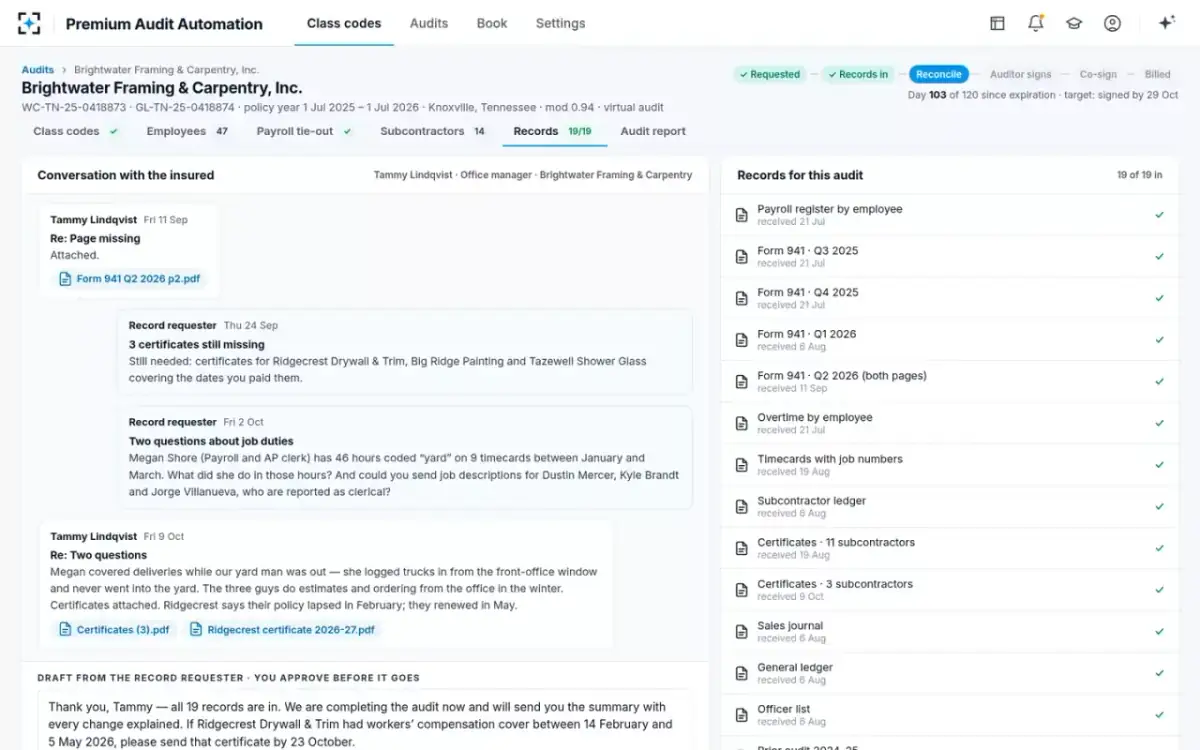
What a premium audit software pilot needs from you
Mostly what you already hold. For Premium Audit Automation, the build starts from the carrier's record lists, rating tables, report and letter templates and a sample of past audits, and the solution is shown on those audits before anything goes live. For the replay itself, each audit needs the records as the insured sent them, the policy with its estimated exposure by class, the rates and experience mod in force, and the signed audit and any dispute file. If part of the book is audited by an outside firm, include some of its audits in the replay too; how to oversee that work is set out in premium audit vendors.
What to bring to a replay pilot
- The audits
A set of signed audits chosen to look like the book, with their dispute files.
- The records as received
Registers, Forms 941 and state returns, timecards, invoices, certificates and correspondence, before any auditor’s annotations.
- Policy and rating
Estimated exposure by class, rates, experience mods and general liability rating bases for each policy.
- Your rules
Reminder days, approval limits, overtime treatment by state, the standard exceptions you test, subcontractor rules.
- Your documents
The audit report and the letter to the insured, as you send them today.
- Adjudicators
Senior auditors with time to rule on every difference, and an audit manager to sign off the scores.
Where Premium Audit Automation fits, and where it does not
It fits a carrier or audit team that runs virtual, mail, desk and physical workers' compensation and general liability audits, has a heavy load of contractors with subcontractors, and wants every audit to start from a cited draft. Its agents read the records insureds already keep, work with the policy system for estimated exposure and rates, and pass signed audits to billing and class mixes to underwriting. Its rules, from the 120-day target to the classifier thresholds, are settings an audit manager approves.
It does not fit every need, and a buyer should know where its edges are. It does not inspect premises; where a state requires a physical audit, a person still makes the visit, and the solution prepares the file for it. It does not find payroll that appears in no record. It does not decide: it will not move payroll between classes, add a subcontractor, apply a noncompliance charge, sign or bill. It does not replace the rating bureau's own inspections and test audits. And its state rules are settings, so a carrier writing in a new state must configure that state's treatment of overtime, officers and certificates before the agents apply it.
Signature: the auditor signs, the manager co-signs above the limit, billing waits
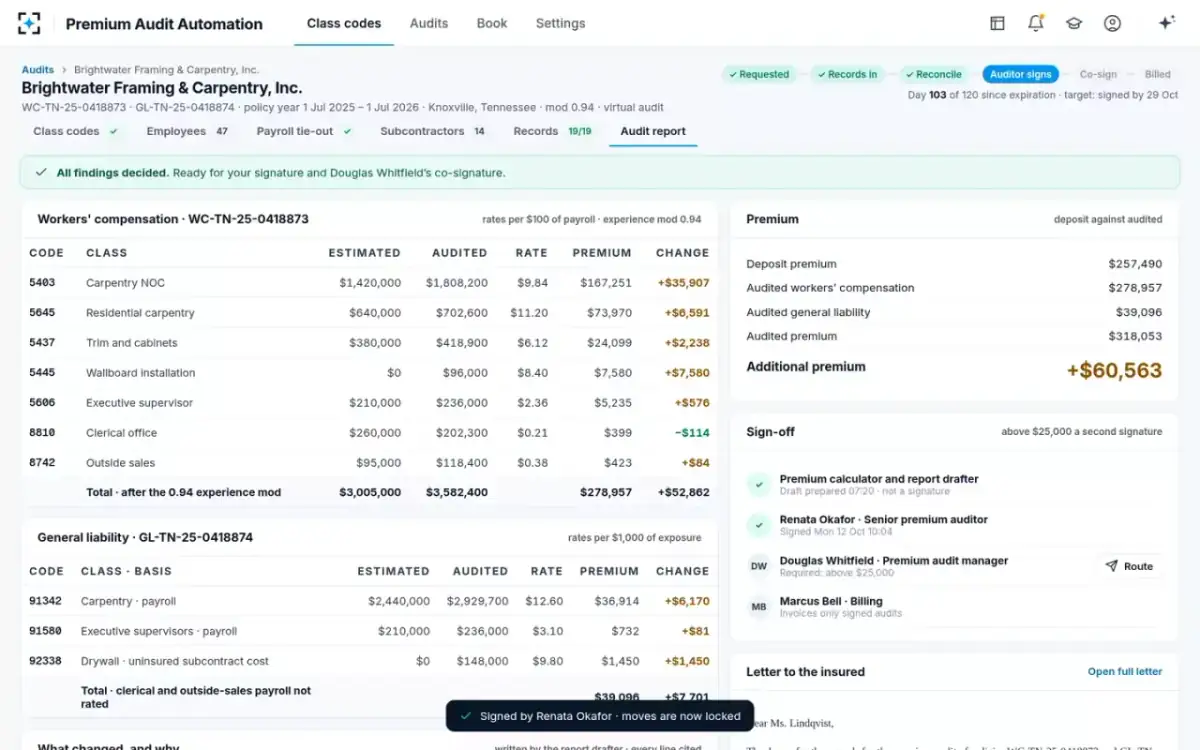
Questions people ask
What does premium audit software cost?
Vendors price in different ways, by seat, by audit or by premium audited, and no regulator or research source publishes a market price. The useful comparison is against auditor hours: Botminds estimates about 19 hours by hand and about 5 with the agents for an audit the size of its fictional sample, an estimate a replay pilot can confirm or correct on your own book.
Can software read payroll registers and Forms 941?
Yes, including scans and payroll-service exports, and it should tie them by quarter. The tie has to respect what the forms contain: line 2 of Form 941 carries only amounts that also go in box 1 of the W-2s, so pre-tax retirement deferrals appear as a named reconciling item rather than a payroll difference.
How long does a premium audit software pilot take?
The software's part is the quick one; in the fictional sample audit, the agents went from first payroll line to a cited draft in eight minutes. Most of a pilot's calendar goes on gathering the closed audits' original records and on senior auditors adjudicating the differences, so plan their time first.
Does premium audit software work for general liability audits?
It should, on whatever base each policy uses. In Premium Audit Automation a general liability exposure reader builds exposure on the policy's own rating bases, such as carpentry payroll, supervisor payroll and uninsured subcontract cost in the sample, and never rates on a base the policy does not use.
What should the software produce for the insured?
A bill with its reasons. Oregon's rules treat a billing as complete only if it contains the audit results, the premium difference and, where people were reclassified from contractors to employees, each person's name, duties and the basis. Delaware's 2026 bulletin expects the full premium calculation and an explanation of every change from the estimate.
Can an insurer rely on the vendor's software for compliance?
It can use it, but the obligations stay with the insurer. NAIC exam standards expect an insurer to monitor anyone performing a function on its behalf, and New York's regulator has said the responsibility for outside AI tools' results stays with the insurer. Keep the evidence of your own testing, such as a replay pilot's scores.