Premium audit standards are the rules regulators use to judge whether an insurer's audits set the right final premium. The NAIC's market conduct handbook, the guide state examiners work from, holds that audits, when required, are "conducted accurately and timely", and a separate workers' compensation standard verifies premium audit accuracy and the use of rating factors. Oregon goes furthest: its rules have the rating bureau re-audit a random sample of every insurer's policies each quarter and count those whose premium differs by more than $500 or two percent of standard premium. Those rules say what accurate means in practice, and they supply the fairest way to judge audit software: plant errors you know the answer to in closed audits, run the tool, and score what it finds against the same tolerance. Botminds' Premium Audit Automation, in which agents reconcile payroll, test class codes and check certificates for a premium auditor to decide, is built to be tested that way.
Where this guide uses examples, they come from a fictional sample audit of a framing contractor run through the solution, and its people and figures are sample data. The regulatory text is quoted from the NAIC, Oregon's administrative rules and Alaska's insurance division, with links.
How large a difference must be before Oregon counts it: $500 or 2% of standard premium
What are premium audit standards?
They are the market conduct examination standards state regulators apply to an insurer's audit work, plus the audit rules some states write into regulation. The NAIC's 2024 summary of examination standards lists, for underwriting and rating, "Verification of premium audit accuracy and the proper application of rating factors." and "Audits, when required, are conducted accurately and timely." The handbook is guidance, not law: it says its use "should be adapted to reflect each state’s own laws and regulations".
The workers' compensation accuracy standard has a stated purpose: "The purpose of this review is to determine that the final premium charged to the employer is being applied correctly, fairly and consistently." Examiners compare the sampled audits with the statistical reports and the company's rating plan, checking premiums by classification code, payroll exposure, schedule rating, discounts, expense loading and the application of the correct experience modifier. The examiner's question is never whether the audit looks thorough. It is whether the final premium is right.
What does the NAIC exam standard say about premium audits?
Standard 9 asks examiners to check that the insurer has a system, a waiver policy, a time frame and an answer for who does the audits, and that refunds arrive. The review procedures are short enough to quote in full. Examiners verify "that all auditable commercial policies have a structured system for conducting payroll or other audits used to verify final premium." They verify the procedure for waiving audits and "that the basis is reasonable." They note that "Companies typically have a time frame for the completion of an audit following expiration." They check whether the insurer's own auditors or independent auditors do the work, and they "Perform an independent verification to ensure that return premiums are received by insureds in a timely manner."
Two of those lines are easy to fail without noticing. A waiver is an audit not done, and an audit that never gets its records and closes on the estimate is a waiver in all but name; the examiner will ask what the basis was. And return premium is a customer's money: an audit desk that is fast on additional premium and slow on refunds has a pattern an examiner can see in a sample. Both are measured in the guide to premium audit tracking.
How do regulators test premium audits? Oregon's test audit program
Oregon re-performs a sample of each insurer's audits and counts the errors. Its rules set up the premium audit system for, among other purposes, an audit program that "ensures an adequate proportion of an insurer's earned premium is audited and focuses on operations where accurate reporting may be difficult or where misreportings are more likely", and a continuing test audit program of all insurers. The test audits are meant "To check the accuracy and reliability of each insurer's audits, verify the classifications assigned, and assure that the premiums charged are based upon filed rates".
The sample is drawn at random. Each quarter the bureau selects policies from the insurer's entire workers' compensation book, at sampling rates that depend on the insurer's premium mix and its error ratio, defined as "the number of policies found to have audit errors divided by the total number of policies test audited during the latest six quarters." That ratio is credibility-weighted against the statewide error ratio, so a small insurer's sampling rate does not swing on a handful of files. The insured gets at least ten days' written notice, and the bureau must complete each test audit within six months of selection.
What Oregon's test auditors re-perform on every sampled audit
- Reconcile payroll with independent records
Chargeable payroll is reconciled with the state unemployment insurance and FICA quarterly reports, not with the insured’s own register.
- Find contract and casual labour
A review of the cash disbursements journal to develop what was paid to contract and casual labour.
- Check one pay period in detail
At least one pay period is reviewed in detail to verify classification.
- Check overtime on the time cards
Time cards are reviewed to verify how overtime pay was treated.
- Test divisions of payroll
Original entry records are checked where a single employee’s payroll was divided between classes.
- List every standard exception
Everyone placed in 8810, 8742 and the other standard exceptions is listed by name, duties and earnings, or spot-checked on large risks.
- List the officers
Covered executive officers, partners and individuals by name, title, duties and earnings.
- Summarise the differences
A summary by class of chargeable payroll and of the differences from the insurer’s audit.
Oregon is not the only state where this happens. Alaska's insurance division described the rating organization's "test audit program" in a 2018 bulletin as one that lets it "check the accuracy and reliability of carriers' audits, verify the classifications", and acknowledged its authority to run it. What Oregon adds is the arithmetic, written into rule.
What is a significant audit difference?
In Oregon, a test audit result is significant when it differs from the insurer's audit by "in excess of $500 in premium or in excess of two percent of the total standard premium, whichever is greater". Below that, the bureau closes the test audit without change. Above it, the bureau sends a report explaining the difference. The insurer must close it within sixty days unless the bureau extends the time, correcting its statistical report if it agrees, or appealing to the advisory committee and then the director if it does not. The rule also catches offsetting errors: when the net difference is small but "a single difference is sufficiently large to qualify as an error prior to any offsetting premium amounts", the insurer gets an advisory notice.
The tolerance is generous on small policies and tight on large ones. On a $5,000 policy, $500 is ten percent of the premium; from $25,000 upward the two percent test governs. The advisory rule matters just as much for testing software: a tool that misses a $3,000 class error and, by luck, also misses a $2,800 overtime credit has a small net error and two real misses.
The consequences fall on the insurer. An insurer that fails the minimum standard for six consecutive quarters must meet the director and give "a detailed explanation of the remedial measures" it is taking; if it still fails, "the director may impose a penalty, including possible suspension of the insurer's certificate of authority." Results are kept confidential, so there is no published table of insurers' error ratios to compare against.
What errors are common in workers comp audits?
The rules list the places errors hide, even where no one publishes how often each occurs. Oregon's audit procedure rule tells insurers to give particular attention to: officers and their payroll limits, the source record and the record used to reconcile it, every possible source of earnings, uninsured contract labour included (Oregon's audit procedure rule), overtime, out-of-state work, the clerical, outside sales and driver codes, changes from the policy's classes, locations, rate splits, construction on the insured's own premises, new operations and divisions of payroll. It also tells auditors to read the insured's first reports of injury when classification is in doubt: an injury report describing a fall from a ladder sits badly with a clerical code.
Some errors are structural rather than careless. Line 2 of Form 941 carries only what goes in box 1 of the W-2s, per the IRS instructions, so pre-tax retirement deferrals open a gap between the register and the return that a careless tie-out either forces or flags as fraud. And some exposure leaves no trace at all: Minnesota's legislative auditor called its own misclassification estimate conservative because it missed employers that operate in the "hidden" or "cash" economy. No audit, by hand or by software, finds payroll that appears in no record.
How do you test premium audit software? Plant errors you know the answer to
Take audits you have already closed, plant errors whose correct result you know, and count what the software finds. A seeded-error test turns a vendor's demo into evidence, because every finding can be scored against an answer key the vendor never saw. It also tests the opposite failure: traps, cases that look wrong but are right, measure how often the tool raises findings a careful auditor would not. Field supervisors reported in 8810 belong in every library, alongside a genuine clerk with a few yard hours who should stay where she is.
A planted-error library for a premium audit software test
| Planted error | How to plant it | What a correct result looks like |
|---|---|---|
| Field supervisor reported in 8810 | Move a foreman’s payroll to 8810 on the register, title unchanged, timecards on job numbers. | A finding to move the whole salary to the governing class, citing title, hours and the no-split rule. |
| Genuine clerk with yard hours (trap) | Add a few hours coded to the yard on a clerk’s timecards, with a reply explaining them. | A question to the insured, or no finding. Moving her is a false finding. |
| Lapsed subcontractor certificate | End one certificate before the last few payments to that subcontractor. | The payments in the gap flagged; covered payments left alone. |
| Labour hidden in a lump-sum invoice | Merge labour and materials into one price on an uninsured subcontractor’s invoices. | The whole price added, under the carrier’s rule for invoices that do not show labour. |
| Overtime premium not shown separately | Fold overtime premium into regular pay on the register. | No overtime exclusion, with guidance on keeping overtime records, as Oregon’s rule asks. |
| A missing page of a Form 941 | Remove page 2 of one quarter’s return. | A targeted request for the page, not a tie-out on partial data. |
| Retirement deferrals (trap) | Add 401(k) deferrals so line 2 sits below gross wages. | A named reconciling item, not a payroll difference. |
| Payroll in a class not on the policy | Add a wallboard crew to a framing contractor’s register. | The new class added at audit, with its rate and the reason. |
The library should look like the carrier's book, not the vendor's demo. A contractor-heavy book needs more subcontractor and supervisor cases; a staffing book needs more payroll-division and officer cases. Plant before the files leave the building, record the planted premium effect of each error at the carrier's own rates, and include a few untouched audits so the tool's own discoveries can be checked by an auditor afterwards.
A seeded-error test in five steps
A person decides
Audit managerPicks closed, signed audits that look like the book, and writes the answer key.
A person decides
PlantingSeeds the errors and traps into copies of the records, and logs each one’s premium effect at the carrier’s rates.
Agent
The software, run blindReads the seeded records and drafts each audit with its findings and citations.
Never: Sees the answer key.
Agent
ScoringMatches each finding to the key: found, missed, or raised where nothing was planted.
A person decides
Auditors adjudicateReview every miss, every false finding and every unplanted finding, and decide which are real.
How to score the test: recall, false findings and the tolerance
Score by error type, not overall, and use the regulator's tolerance for premium. Four measures cover it. Recall by type is the share of planted errors of each type the tool found. The false-finding rate is the share of traps and clean files on which it raised a finding an auditor rejects. Premium accuracy is the share of seeded audits whose drafted final premium lands within Oregon's significance tolerance, $500 or two percent of standard premium, whichever is greater, of the answer key. Citation accuracy is the share of findings that point to the right page and line.
Rules that keep a seeded-error test honest
- Score each error type on its own
An overall rate lets ten easy overtime cases hide two missed supervisors.
- Count false findings as errors
A tool that flags every clerk with a yard hour costs auditor time and insured goodwill.
- Judge premium against a stated tolerance
Oregon’s $500 or 2% is a defensible line; write down whatever line you use before the run.
- Check offsetting errors one by one
Oregon’s advisory notice exists because two errors can cancel out in the total.
- Check every citation
A right answer pointing to the wrong page will not survive a dispute.
- Time the run, and the review
The saving is the auditor’s hours to a signed audit, not the software’s minutes.
- Keep the answer key away from the vendor
Otherwise the test measures the vendor’s preparation.
Run the test on Premium Audit Automation the same way. The agents read the register, the 941s, the timecards, the invoices and the certificates, and every finding carries its citation, so the scoring can be done line by line. The solution is designed to raise findings, not to settle them: in the sample carrier's settings, the classifier raises a finding at a confidence of 0.85 and asks the insured between 0.60 and 0.85, and those thresholds can be tuned on the test's results. How to run the same idea as a buying pilot on last year's audits is set out in premium audit software.
What Premium Audit Automation is built to catch, and what it is not
The agents are built for the errors that live in records: a register that does not tie to the returns, overtime not separated, a title that does not fit its code, a payment outside a certificate's dates, labour hidden in a lump sum, a general liability base the policy does not use. They are not built to catch what records cannot show. They do not walk a site, so an operation the insured never mentions and never pays through its books will not appear. They do not decide: every class move, every added subcontractor and every charge is the auditor's.
The class-code board: the evidence an auditor would want, before a single dollar moves
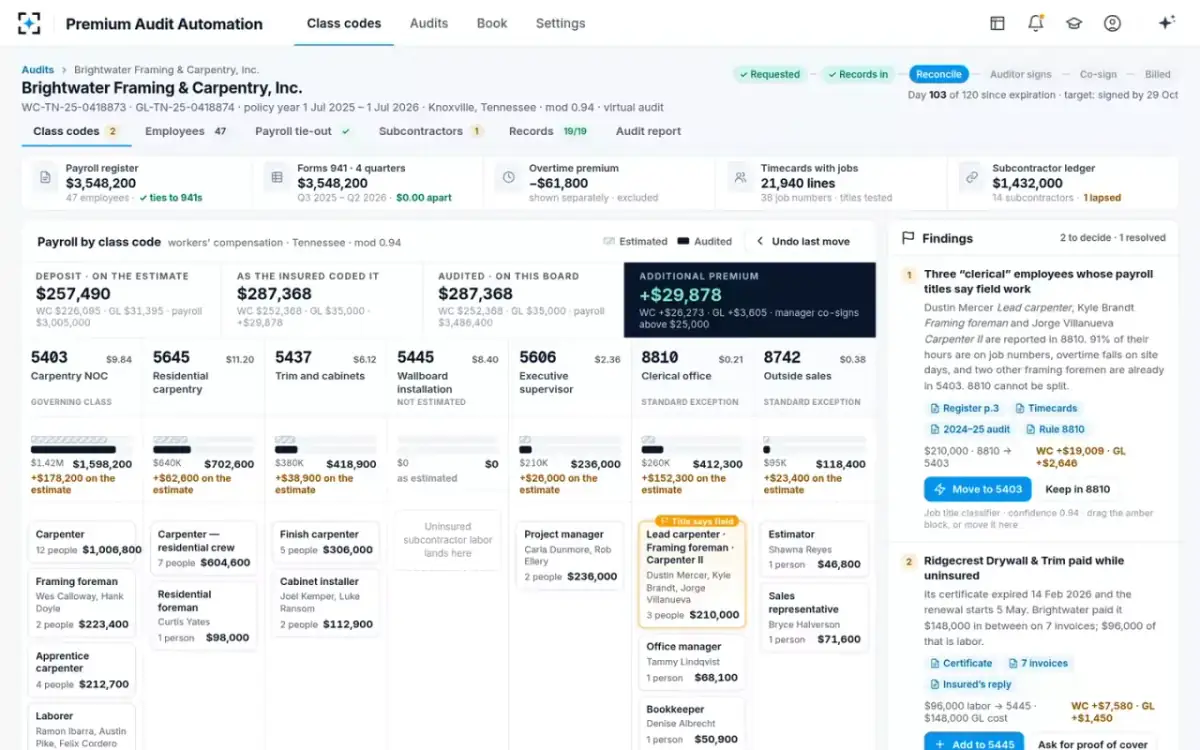
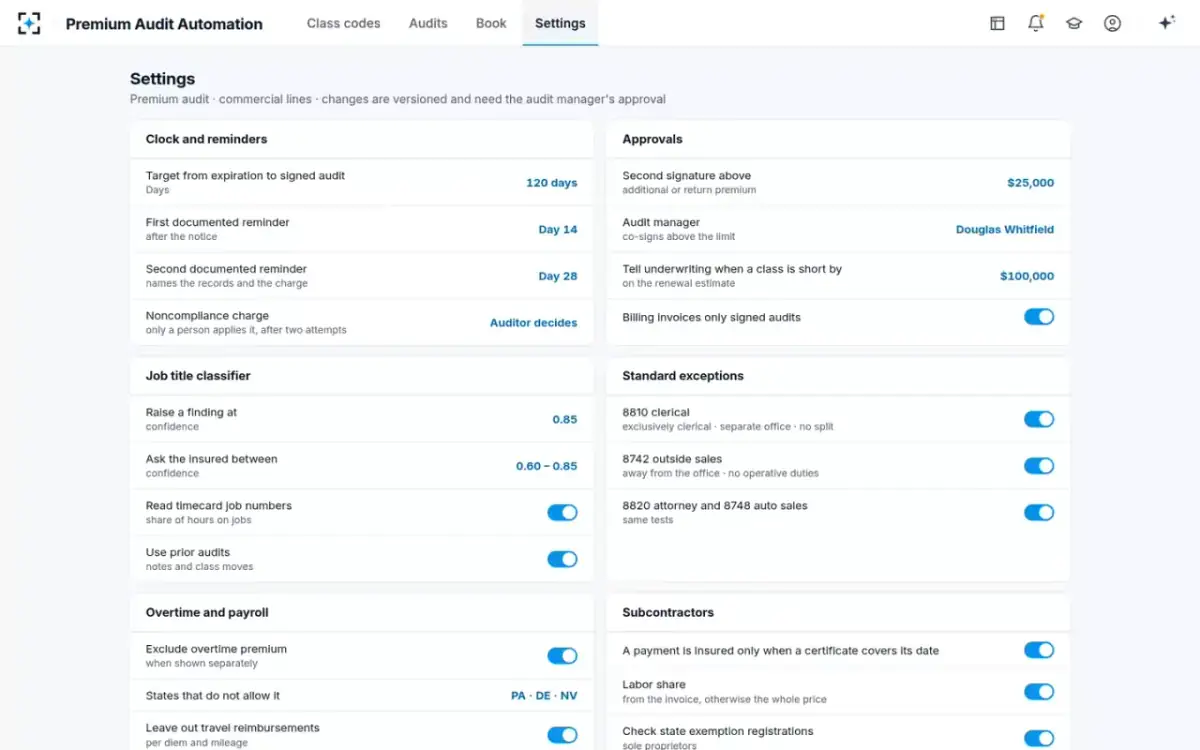
State rules are settings, and a test should check them. Whether overtime premium may be excluded, which standard exceptions are tested, the reminder days and the second-signature limit are all configured, versioned and changed with the audit manager's approval. A seeded test run in two states with different rules should produce two different, correct results.
Audit rules as settings in Premium Audit Automation, each change approved by the manager
Questions people ask
How accurate are premium audits?
No national figure is published. Oregon measures each insurer's error ratio from its test audits every quarter, but the rule makes individual insurers' results confidential data under ORS 731.264. A carrier that wants its own number can sample its closed audits and re-perform them against the same $500 or two percent tolerance.
Who performs test audits?
In Oregon the rules give the job to the state's licensed rating organization, and the director monitors that organization's compliance. Alaska's insurance division acknowledged the same organization's authority to run test audits and classification inspections in its Bulletin B 18-06 of 2018.
Can a test audit raise my premium?
Not directly. Oregon's rule says findings from test audits "shall not be utilized in any action by an insurer to enforce premium collections." The insurer corrects its statistical reporting, and the finding can still shape how future policies are classified.
How often are insurers examined on their audit programs?
In Oregon, the director must examine every insurer at least once every three years for compliance with the statistical reporting rules, the premium audit program rules and the insured education rules. Elsewhere, audit practices come up in market conduct examinations, which use the NAIC standards as their guide.
What is a seeded-error test?
A test in which known errors are deliberately planted in real records so that a reviewer, human or software, can be scored against a known answer. For premium audits, the errors are the ones regulators look for, such as a supervisor in a clerical code or a payment outside a certificate's dates, mixed with traps that look wrong but are right.
Does the NAIC standard apply in my state?
The NAIC handbook is guidance for state examiners, based on NAIC models rather than any one state's law. It tells examiners to adapt it to each state's own laws and regulations, so the binding rules are your state's statutes, regulations and approved manuals.