A statement of values, in commercial insurance, is the insured's list of every location to be covered, one row per building, giving its address, construction, occupancy, protection, surroundings and the values to insure: building, contents and business income. It is also called a schedule of values, or SOV. The underwriter uses it to set limits and price the account, the catastrophe modeling analyst uses it to model the account, and after a loss it is often the document the claim is measured against. It is slow to process because it is written by one party and checked by four: in our illustration of a multi-location renewal it changes hands sixteen times between the insured, the broker, the underwriting assistant, the cat modeling analyst and the underwriter before a quote. Botminds' Schedule of Values Validation takes most of those handoffs out by doing the mapping, placing and checking in one pass and sending the broker one email of questions, each with its evidence.
The handoff count below is our illustration of a common pattern, not a survey. The examples come from the solution's sample data, a fictional 42-location Gulf Coast logistics renewal.
One renewal schedule, handoff by handoff: today and with agents
Today: 16 handoffs
- 1
Insured Broker
Values and building details, in the insured’s spreadsheet
- 2
Broker Assistant
The schedule, in the broker’s layout, with the submission
- 3
Assistant Broker
Questions about columns that will not map
- 4
Broker Assistant
Answers, sometimes a revised file
- 5
Assistant Analyst
The schedule re-keyed into the carrier’s layout
- 6
Analyst Assistant
Addresses that will not place, construction that will not code
- 7
Assistant Broker
Those questions, forwarded
- 8
Broker Insured
The same questions, forwarded again
- 9
Insured Analyst
Answers, back through broker and assistant
- 10
Analyst Underwriter
Model results on the corrected schedule
- 11
Underwriter Assistant
Value and survey questions after reading the file
- 12
Assistant Broker
A second round of questions
- 13
Broker Assistant
A revised schedule, in the broker’s layout again
- 14
Assistant Analyst
Re-keyed again, for a second model run
- 15
Analyst Underwriter
Revised results
- 16
Underwriter Broker
The quote
With agents: 7 handoffs
- 1
Insured Broker
Values and building details
- 2
Broker Carrier
The schedule, in any layout; the agents map, place and check it
- 3
Underwriter Broker
One email of questions, each with its evidence and its effect on value
- 4
Broker Insured
The questions that need the insured’s knowledge
- 5
Broker Underwriter
Answers; the agents re-check what they change
- 6
Underwriter Analyst
A model-ready exposure file, unknowns marked unknown
- 7
Underwriter Broker
The quote
What is a statement of values in commercial insurance?
It is the insured's declaration of what is being insured and where, at the level of each building. Maine's insurance regulator states the principle behind it: "A separate limit must be determined for each building or structure, and for the business personal contents of each building or structure" (Maine Bureau of Insurance, Commercial Insurance FAQs). On a multi-location account, the statement of values is where each of those separate figures is written down.
The columns vary by carrier and broker, but they always cover three things: where the building is, what it is (the construction, occupancy, protection and exposure underwriters call COPE), and what it is worth. A small account may fit on a page; a national account runs to hundreds of rows across several tabs. The columns an SOV template needs lists them with the source that can check each one.
What is a statement of values used for?
Four things, and each one makes the schedule's errors more expensive. It sets the limits and premium, because each location's declared value is the base the rate is applied to. It drives the catastrophe model, which reads the location, construction and value of every row. It decides coinsurance and distribution clauses at claim, which compare the declared value with the value at the time of loss. And on some policies it caps the claim outright.
The premium for this Policy is based upon the Statement of Values provided. In the event of loss under the Policy, the liability of the Insurer(s) shall be limited to the least of the following: A. The amount of the loss; B. 125% of the total stated value for each location or item of property insured … as shown on the latest statement of values or other documentation on file with the Insurer(s)
Margin clause quoted in Commonwealth Insurance Co. of America v. Colony North Apartments, U.S. District Court for the District of Delaware, memorandum order of 21 December 2012
That clause, quoted in a federal court order on a discovery dispute, ties recovery at each location to the statement of values on file. In the case, the insurer had written to the insured that under its reading of the clause the claim, for a bridge collapse caused by flooding, was limited to $312,500; the order dealt with what the parties had to disclose, not with what the clause meant (D. Del., C.A. No. 11-1019). Whatever a court finally decides about a given clause, the lesson for the desk is the same: on such a policy, a location's stated value is a ceiling, and an under-stated value is under-insurance at that address.
Why the catastrophe model needs every address on the schedule
Because the model knows only what the schedule tells it, location by location. Modeling makes the same demand as the margin clause from another direction. Among the questions the NAIC's catastrophe modeling primer suggests a regulator ask about an insurer's modeled data: "Is the commercial property insured in a single location or does it have multiple locations? If it is a multi-location policy were all addresses included in the model?" (NAIC Catastrophe Modeling Primer, exposure draft, December 2024). The statement of values is the only place those addresses come from.
The schedule's errors pass straight into the model's answer. A building listed twice is modeled twice: in the sample renewal, a New Orleans warehouse appeared as two rows, putting $17.77M of flood-zone value into the model that does not exist. A building missing from the schedule is not modeled at all. And a building on the schedule without a floor elevation is modeled on the model's own assumption, which is the honest outcome only if the blank reaches the model as a blank; in the sample, 35 of 41 locations have no known floor elevation, and the exposure file says so.
Who prepares the statement of values?
The insured, usually with the broker's help, because the values and many building details are the insured's to know and to declare. The broker assembles the schedule, often by updating last year's, and sends it with the submission. The carrier does not prepare it, but the carrier's people turn it into something they can use: the underwriting assistant maps it, the cat modeling analyst places and codes it, a risk engineer's survey checks parts of it, and the underwriter decides what to accept.
That split is the root of the handoffs. The people who know the buildings write the schedule; the people who need it exact are three or four steps away. Every question about a column, an address or a value has to travel back along the same chain, and the answer has to travel forward again.
Where the time goes: waiting, re-keying and re-asking
Most of the elapsed time is not work; it is waiting at handoffs. The work itself is real enough. The product team's estimate for one 42-location schedule, done by hand, is about 20 working hours, two and a half days: six re-keying the broker's layout, four geocoding and fixing addresses, five checking COPE against records, permits and surveys, three checking values against rebuild cost, and two writing the questions. But each of the sixteen handoffs in the illustration above also waits in someone's inbox, and two of them, the ones that go back through the broker to the insured, can wait for days.
One renewal schedule, by hand and with agents
≈20 h
of work to scrub and check a 42-location schedule by hand (the product team’s estimate)
≈1 h
to a clean, geocoded schedule with the agents (design target)
16 → 7
handoffs in our illustration of one renewal
10
questions to the broker in one email, in the sample renewal
Re-keying is the handoff that multiplies. Each time a broker sends a revised schedule in their own layout, the assistant maps it again and the analyst re-runs the geocoding on rows that may have moved. A schedule that goes round twice is mapped twice, geocoded twice and modeled twice. The remedy is not a faster assistant; it is a mapping that is remembered and a check that re-runs only what changed.
Why do brokers resubmit SOVs?
Because questions arrive in pieces, and each piece produces a revised file. The assistant asks about columns, the analyst about addresses, the underwriter about values and sprinklers, each when they reach the schedule. The broker forwards each round to the insured, who answers what was asked and sends the whole schedule back. Nobody asked everything at once, because nobody saw everything at once.
In the sample renewal, the questions reach the broker in one email: five building values under 80% of rebuild, sprinklers that a 2025 risk engineering survey found only in the office of a Pasadena warehouse, a Beaumont freezer addition a 2021 permit shows, a construction class that changed between years, and a New Orleans row that is the same building as the one above it. The twelve small corrections the agents made are listed for the broker to see, not asked. Beside the draft, the underwriter sees what the answers would change: +$29.99M of building value on the five under-valued locations, −$17.77M for the duplicate, $34.71M into flood Zone AE.
Every question in one email, with its evidence and what the answer changes
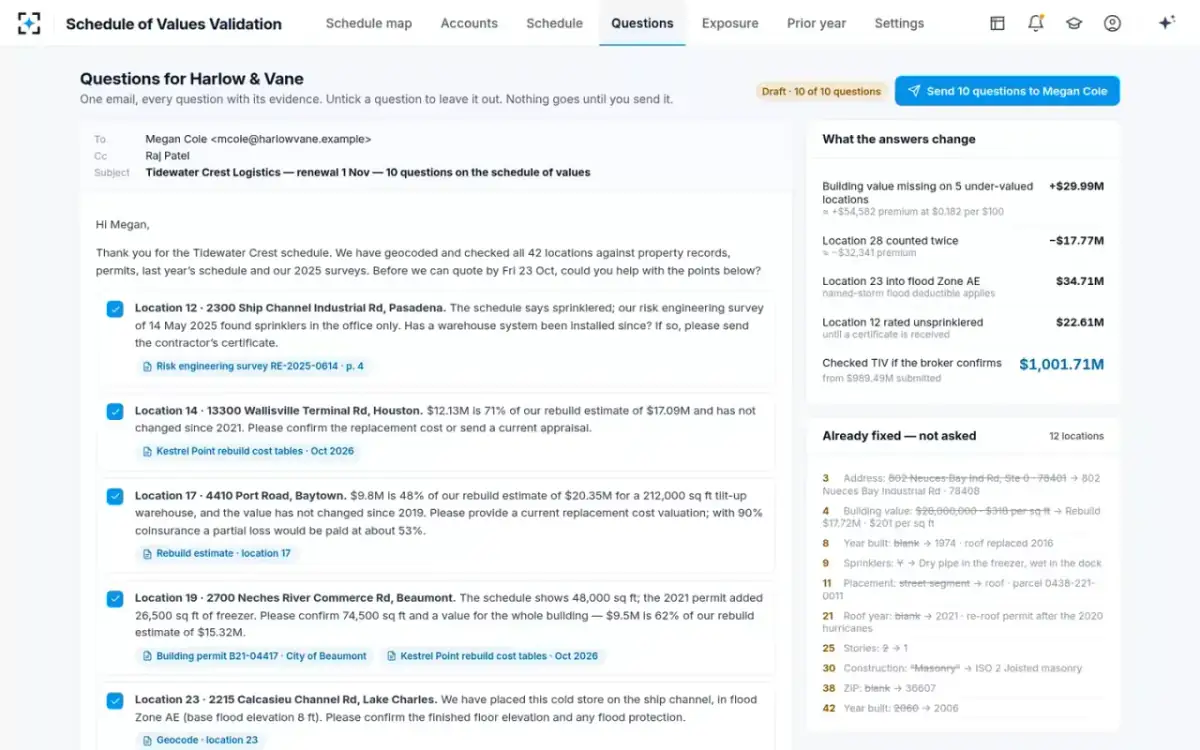
Which handoffs disappear when every change is proposed, cited and visible
The internal ones. Re-keying disappears because the schedule reader maps the broker's layout directly, starting from last year's confirmed mapping for that broker. The analyst-to-assistant-to-broker loop for addresses disappears because the geocoder finds the likely building and the underwriter moves the pin in one drag. The second round of questions disappears because the underwriter, the analyst and the risk engineer are looking at the same checked schedule before the first email goes. What remains are the handoffs that carry knowledge only the insured has, and the quote.
Five seats around one statement of values, before and after
Today
Prices renewals on whatever survived the scrub, and chases the broker in several separate emails.
With agents
Opens a map that shows which rows to stop believing, fixes pins by dragging them and decides each finding with its source in view.
Still theirs: Every value decision, every limit and the email to the broker
Today
Re-keys every schedule into the carrier layout: thirty-odd columns, several tabs, year built in the comments.
With agents
Confirms a mapping the agents already made, using last year’s for this broker, and chases one email of answers.
Still theirs: The relationship with the broker’s team
Today
Geocodes the schedule, finds locations on postal-code centres, and sends the questions back up the chain.
With agents
Receives a file with every location’s placement shown, the pins still to fix named, and blanks sent as unknown.
Still theirs: The model, its settings and what its output means
Today
Writes a survey that says the warehouse is not sprinklered, while the schedule still says it is.
With agents
Has the survey page cited against the schedule row, and asked about in the same email as everything else.
Still theirs: The survey and its recommendations
Today
Co-signs large accounts on the values the broker’s schedule gives him.
With agents
Sets the value thresholds himself, and every change to them is versioned and logged.
Still theirs: The co-signature above the threshold
What happens to an SOV after the account is bound
It becomes the record the policy is measured against. The values go into the premium and, on policies that carry them, into the coinsurance, distribution or margin terms that apply at claim. The exposure file built from it goes into the carrier's portfolio models and the reinsurance submissions. And it becomes next year's starting point, which is how a value left unchanged in 2019 is still on the schedule in 2026.
That last step is the one worth breaking. North Carolina's state property fund, which insures the state's own buildings, adjusts building values for inflation every year and tells agencies that it "will reimburse the agency or university for no more than the values reported for insurance purposes" (NC Office of State Fire Marshal, State Property Fire Insurance Fund). A commercial statement of values has no fund doing that work. Unless someone compares this year's schedule with last year's, building by building, an old value rolls forward until a claim tests it. How far a 2020 value has slipped against the construction cost index shows the size of that gap.
Every schedule that came in, with the agents' confidence in each location
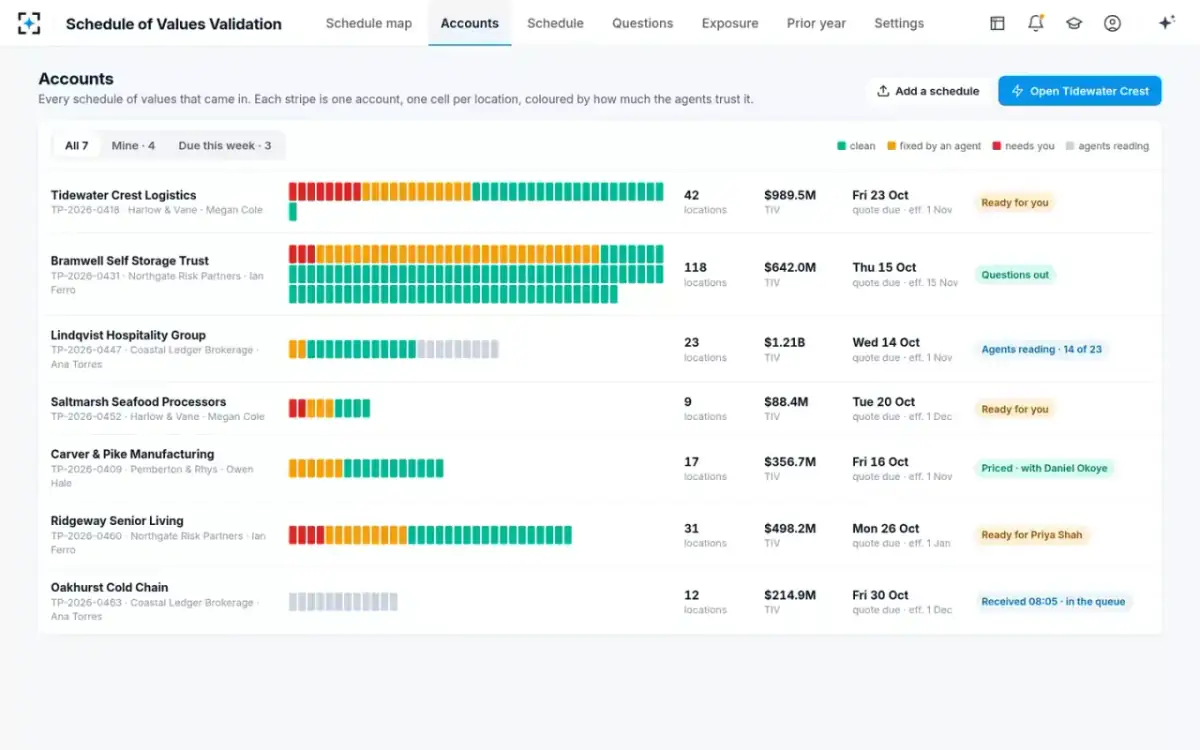
To follow the sample renewal from the broker's file to the quote, start from Schedule of Values Validation, or see which of its 24 fields an agent may change.
Questions people ask
What is the difference between an SOV and a schedule of values?
None, in commercial property insurance: statement of values and schedule of values are two names for the same list of insured locations and their values, and SOV abbreviates either. In construction, a schedule of values is something else entirely, the breakdown of a contract price used for progress billing.
How long does it take to process an SOV?
No public source measures it, and it depends on the number of locations, the layout and how much is missing. The product team's estimate for a 42-location sample schedule is about 20 working hours by hand, spread over several days by the handoffs; the design target with agents is about an hour, plus the time the broker takes to answer one email.
What is a margin clause in property insurance?
A margin clause limits recovery at a location to a percentage of the value stated for it on the statement of values, such as 125% in the clause quoted in a 2012 Delaware federal court order. It makes each location's stated value a ceiling, so an under-stated value limits the claim even when the policy's total limit is large.
Is a statement of values the same as an exposure file?
No. The statement of values is the insured's declaration, in whatever layout the broker sends. The exposure file is the carrier's version for the catastrophe model: every location placed with its precision recorded, construction and occupancy coded, values checked, and unknowns marked unknown. One is the input to underwriting; the other is the input to the model.
Why do underwriters ask for a new SOV every year?
Because buildings are bought, sold, extended and re-roofed, and costs move. A renewal schedule is the insured's chance to declare what changed; in the sample renewal, last year's schedule had 40 locations and this year's 42, with two new locations, one sold, one duplicated and three values unchanged for five to seven years.