An 80% coinsurance clause on commercial property requires the insured to carry a limit of at least 80% of the building's value, measured as replacement cost or actual cash value at the time of the loss, not when the policy was bought. If the limit falls short, the insurer pays only the ratio of the limit carried to the limit required on every partial loss, less the deductible. The Maine Bureau of Insurance puts it in one line for small businesses: "HAVE ÷ SHOULD x LOSS = the amount that the company will pay minus your deductible." The clause is easy to satisfy on the day a value is set and easy to fail six years later: building construction prices rose about 50% from January 2020 to September 2026, and a value rolled forward at a few percent a year falls behind without anyone noticing. Botminds' Schedule of Values Validation checks every building on a schedule against the cost to rebuild it before the account is priced, so the shortfall is found at the quote rather than at the claim.
The worked example below uses public price indexes and illustrative figures; the screens come from the solution's sample data, a fictional 42-location logistics renewal on the Gulf Coast.
One warehouse, unchanged since 2020, under an 80% clause: a $2M partial loss
Covered partial loss
$2,000,000
Replacement cost at the time of loss
$10.0M in January 2020 × 244.738 ÷ 162.6 (warehouse construction price index)
$15,051,538
Limit the 80% clause requires (SHOULD)
80% × $15,051,538
$12,041,230
Limit carried (HAVE)
unchanged since 2020
$10,000,000
HAVE ÷ SHOULD × LOSS
83.0% of the loss
$1,660,960
Less the deductible
−$25,000
Paid
$1,635,960
Left with the insured
$339,040 of coinsurance penalty plus the deductible
$364,040
How does 80% coinsurance work on commercial property?
The clause compares two numbers at the moment of loss: the limit the insured carries and the limit the policy says they should carry. The Maine Bureau of Insurance states the rule in its commercial insurance answers: "The coinsurance penalty is determined by the ratio of the limit of insurance you are carrying on the building or property to the limit the policy requires you to carry" (Maine Bureau of Insurance, Commercial Insurance FAQs). If the ratio is one or more, the loss is paid in full, up to the limit, less the deductible. If it is 0.83, the loss is paid at 83%.
The coinsurance formula, term by term
| Term | What it is | When it is measured | Who sets it |
|---|---|---|---|
| HAVE | The building limit carried: what the schedule of values declared for this building | As it stands on the policy | The insured, with the broker |
| SHOULD | The coinsurance percentage × the building’s replacement cost or actual cash value, whichever the policy uses | At the date of loss, not at inception | The percentage by the policy; the value by the adjuster |
| LOSS | The covered partial loss: the adjusted cost to repair or replace what was damaged | At claim | The adjuster |
| Deductible | Subtracted after the ratio is applied, in the Maine examples | At claim | The policy |
Three details catch insureds and underwriters alike. The value is measured "at the time of loss," so a value that was right in 2020 can be wrong in 2026 without anything changing in the building. The building and business personal property usually carry "separate limits with separate conditions," so passing on contents says nothing about the building. And the clause rewards no one for over-insuring: the Maine brochure is blunt that "there is no bonus for over‐insuring" (Maine Bureau of Insurance, Insuring Your Business).
A coinsurance penalty example, worked step by step
The regulator's own example is the cleanest place to start. A property worth $250,000 to replace at the time of loss, an 80% clause, a $40,000 loss and a $500 deductible: insured for $200,000, the owner is paid $39,500; insured for $100,000, the owner is paid $19,500 and, in the brochure's words, becomes "a co‐insurer for the remaining $20,500 of the loss."
The Maine Bureau of Insurance coinsurance examples, side by side
| Step | Example 1: adequate insurance | Example 2: inadequate insurance |
|---|---|---|
| Replacement cost at time of loss | $250,000 | $250,000 |
| SHOULD: 80% of replacement cost | $200,000 | $200,000 |
| HAVE: limit carried | $200,000 | $100,000 |
| HAVE ÷ SHOULD | 1.00 | 0.50 |
| × the $40,000 loss | $40,000 | $20,000 |
| − the $500 deductible = paid | $39,500 | $19,500 |
| Borne by the owner | $500 | $20,500 |
The same arithmetic scales to a commercial schedule without change, which is what makes it dangerous. On a $200,000 shop, a 50% ratio costs the owner $20,000 on a mid-sized loss. On a $20 million warehouse, the same ratio costs a seven-figure sum on a roof and a wall.
What an old building value costs at claim
A value left unchanged since 2020 now fails an 80% clause on most commercial building types, and a value rolled forward at 3% a year fails a 90% clause. The reason is the size of the move in building costs. The producer price index for new warehouse building construction rose from 162.6 in January 2020 to 244.738 in September 2026, 50.5%; office construction rose 54.6% and industrial 49.1% over the same months (U.S. Bureau of Labor Statistics, via FRED).
The figure at the top of this page follows one warehouse. Its value was set at $10.0M from a cost estimate in January 2020 and never changed. By September 2026 the same index puts its replacement cost at about $15.05M; 80% of that is $12.04M. The limit of $10.0M is 83% of what the clause requires, so a $2M roof-and-wall loss is paid at 83%: $1,660,960 before a $25,000 deductible. The owner carries $364,040, most of it penalty, on a loss well inside the limit.
The same warehouse under 80%, 90% and 100% coinsurance: share of a partial loss paid
| Building limit carried | Share of replacement cost | 80% clause | 90% clause | 100% clause |
|---|---|---|---|---|
| $10.0M, unchanged since 2020 | 66.4% | 83.0% | 73.8% | 66.4% |
| $11.94M, rolled forward 3% at six renewals | 79.3% | 99.2% | 88.1% | 79.3% |
| $15.05M, trended with the warehouse index | 100% | 100% | 100% | 100% |
The middle row is the common case and the uncomfortable one. A broker who rolls a value forward at 3% each renewal is doing something, and the schedule shows movement. Under an 80% clause it nearly works: 99.2% paid. Under a 90% clause the owner absorbs about 12% of every partial loss, and the gap opened mostly in one year: the warehouse index rose 33.7% between September 2021 and September 2022, ten years of 3% roll-forwards in twelve months. How far a 2020 building value has slipped, by building type sets out the index path year by year.
Is 80% or 90% coinsurance better for the insured?
For the insured, the lower percentage leaves more room before a penalty; the higher one is less forgiving of a stale value. Maine's brochure says most insurers require at least 80% of replacement cost, "however, some companies may require 100%," and lists the usual choices as "80%, 90%, or 100%." The table above shows what the extra ten points mean for one value: the 3% roll-forward that passes an 80% clause almost untouched loses about 12% of every partial loss under 90%.
The trade the insured makes is with the premium, and that varies by carrier and filing, so no single answer holds. What does hold is that the higher the percentage, the more the policy depends on the value being current. A 90% or 100% clause on a schedule whose values are checked against rebuild cost every renewal costs the insured nothing at claim; the same clause on a schedule nobody checks is a penalty waiting for a loss.
A 2020 value rolled forward 3% a year, under a 90% clause: share of a partial loss paid in 2026
Why the penalty is found at the claim, not at the quote
Because nobody in the quote process is asked to check it. The broker forwards the insured's values, the underwriter prices on them, and the coinsurance test is applied by an adjuster who measures the value at the time of loss. By then the only remaining question is how much the insured will absorb.
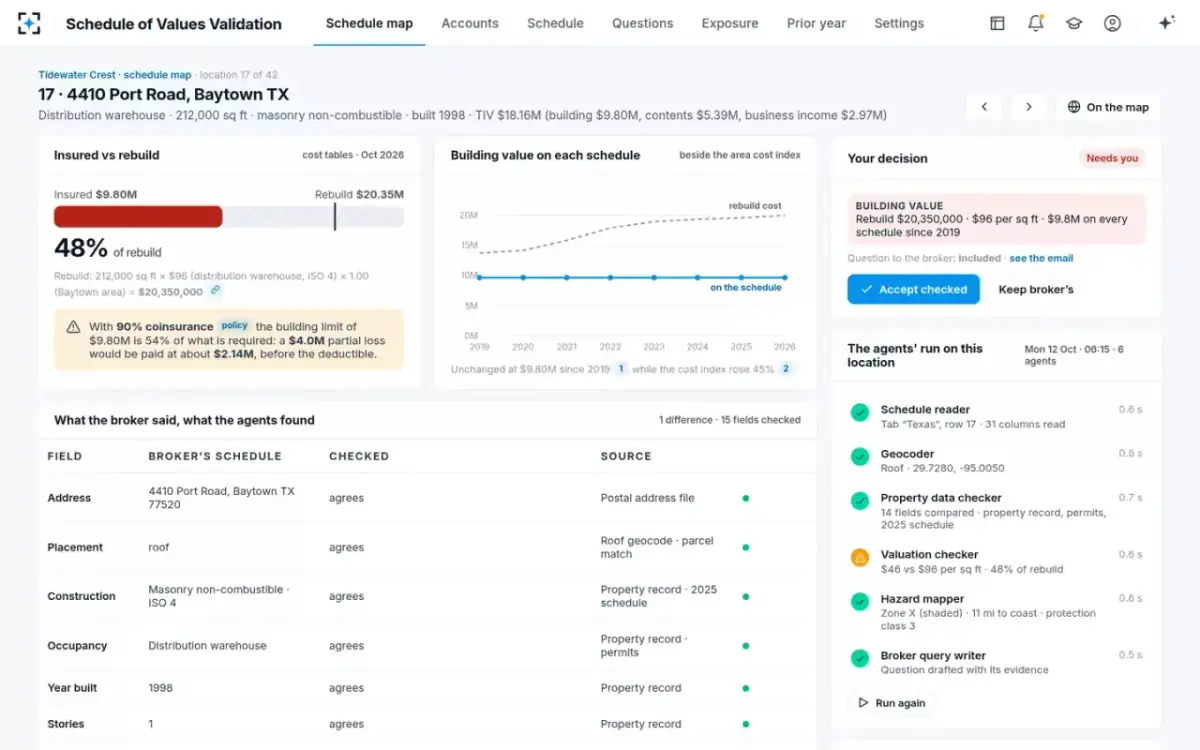
The sample renewal shows how a stale value hides. A 212,000 square foot tilt-up distribution warehouse in Baytown, Texas, built in 1998 and sprinklered, carries $9.8M on the broker's schedule, $46 a square foot. It has carried $9.8M on every schedule since 2019. The carrier's rebuild cost table puts it at about $96 a square foot for that construction and occupancy in the Houston area, $20.35M. Insured at 48% of rebuild, under the account's 90% coinsurance clause the building limit is 53.5% of what the clause requires, so a $4.0M partial loss would be paid at about $2.14M before the deductible.
The location page: insured against rebuild, and what the clause would pay
Multi-location schedules and pro rata distribution
On a multi-location schedule the same proportion can apply across locations, through a pro rata distribution clause. Maine's brochure explains it with two locations of $100,000 each: insuring only $100,000 in total on the assumption that both will not burn "is not sufficient," because "coverage is automatically distributed at the locations in proportion to their value." Carrying $100,000 against $200,000 of total value "would result in a payment of only 50% of the value of the loss. This works in the same manner as a coinsurance clause."
That is why a schedule of values is more than a list for the cat modeler. On a policy written with location limits or a distribution clause, each location's declared value sets how much of a loss there is paid. A building under-valued on the schedule is under-insured at that address, however large the total limit looks. How a statement of values moves from broker to underwriter and back traces where those values come from and who checks them.
Ways to soften the clause, and their limits
Some policies offer options that reduce or change the coinsurance test, and each one shifts rather than removes the need for a sound value. The Maine brochure describes two. A special loss settlement form "reduces the coinsurance amount to 70%, 60% or even 50%," useful for older buildings with elaborate construction that the owner would not rebuild the same way. Functional replacement cost "does not change the coinsurance percentage, but instead determines replacement cost of a functionally equivalent building or repair/replacement using less expensive materials."
Some commercial property policies also offer an agreed value option, under which the insurer accepts the declared value for a period and suspends the coinsurance test, typically on the strength of a signed statement of values. Its terms vary by policy, and its protection is only as good as the values the statement declares. None of these options helps a building whose value nobody has checked against what it costs to rebuild.
Who pays the coinsurance penalty, and who could have prevented it
The insured pays it, by absorbing the share of the loss the policy does not. The Maine brochure leaves no doubt about where the responsibility sits: "Remember, it is your responsibility to choose the right amount of coverage." In practice the insured relies on the broker for the number, and the broker relies on last year's schedule.
The underwriter is the person best placed to catch it, because the underwriter sees every location's value next to its area, construction and occupancy. In Schedule of Values Validation, the valuation checker compares each building's value per square foot with the carrier's rebuild cost for that construction and occupancy in that area, using the checked area rather than the broker's, and flags values under 80% of rebuild and values unchanged for three schedules or more. The thresholds are the underwriting leader's settings. The agent never changes a value or a limit; it puts the evidence in front of the underwriter and, if the underwriter agrees, into the questions to the broker.
The map coloured by insured value against rebuild cost
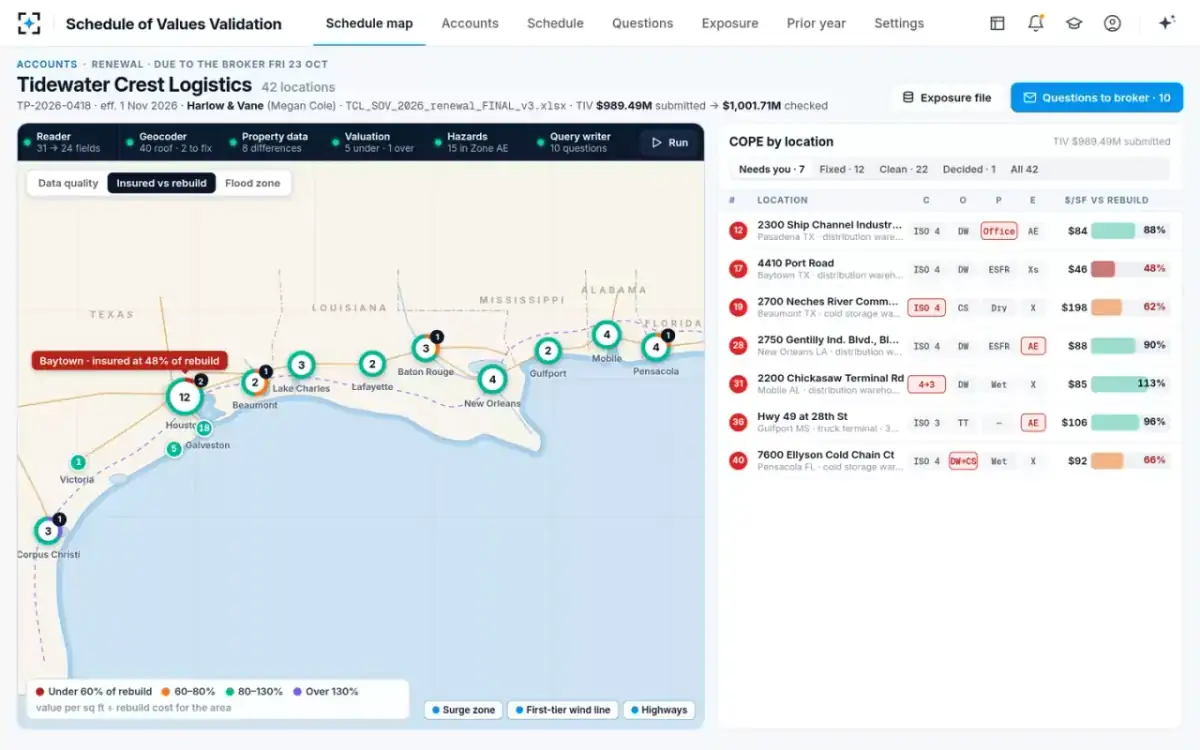
To see the coinsurance check on the sample renewal, start from Schedule of Values Validation, or read four ways to check a commercial building value before choosing how to do it.
Questions people ask
What happens if a building is underinsured and totally destroyed?
The insured is paid up to the limit, and the shortfall between the limit and the cost to rebuild is theirs. The coinsurance ratio bites hardest on partial losses, where the loss is smaller than the limit; on a total loss the limit is the ceiling either way. The Maine Bureau of Insurance advises that for full coverage of a total loss, the limit should be at least the cost to replace the property at the time of loss.
Does coinsurance apply separately to the building and its contents?
Usually, yes. Maine's guidance notes that building and business personal property values "are separate limits with separate conditions." An insured can meet the clause on contents and fail it on the building, or the reverse, and each is tested on its own value at the time of loss.
How often should commercial building values be updated?
At least every renewal, and whenever the building changes. Maine's brochure advises checking with the agent yearly and whenever property is added or improved, and notes that an endorsement may automatically increase the amounts to keep up with inflation. A yearly review against a cost table or index is enough to catch the kind of jump building costs took between 2021 and 2022.
Is coinsurance on property the same as 80/20 coinsurance in health insurance?
No. In health insurance, 80% coinsurance means the plan pays 80% of a covered cost and the patient 20%. In property insurance, an 80% coinsurance clause is a requirement to insure the building for at least 80% of its value; if that is met, covered partial losses are paid in full less the deductible.
Can an underwriter waive the coinsurance clause?
Some policies allow it through an agreed value option, typically supported by a signed statement of values and limited to a period. The terms depend on the policy and the filing, so the policy's own wording governs. An agreed value accepted without checking it against rebuild cost only moves the risk to the next schedule.