COPE, in insurance underwriting, stands for construction, occupancy, protection and exposure: what a building is made of, what it is used for and holds, how it is protected against fire inside and outside, and what surrounds it, from the building next door to the flood zone and the coast. Property underwriters use COPE to classify and rate each building, catastrophe models use it to choose the damage curve, and at claim it decides whether the building on the policy is the building that burned or flooded. On a broker's schedule of values, COPE arrives as free text, abbreviations and blanks. Botminds' Schedule of Values Validation reads it in any layout, codes it to the carrier's classes, and checks each letter against property records, building permits, risk engineering surveys, published hazard layers and last year's schedule, with the source of every difference shown to the underwriter.
Examples on this page come from the solution's sample data, a fictional 42-location logistics renewal along the Gulf Coast. Definitions come from Texas state agencies, FEMA, the NAIC and North Carolina's state property insurance fund, linked where they appear.
COPE, letter by letter: the fields, the source that can check them, the usual error
CConstruction
Fields
Construction class; year built; roof year; stories; floor area
Checked against
Risk engineering survey; building permits; property records
Most common error
“Masonry” for a building whose roof and floors are wood, which is joisted masonry, not masonry non-combustible
OOccupancy
Fields
What the building is used for and what it holds
Checked against
Survey; permits for additions and change of use; the insured’s own description
Most common error
A warehouse that became a cold store, or added a freezer, still described as dry storage
PProtection
Fields
Public protection class; sprinklers; alarms
Checked against
The area’s protection classification; sprinkler certificates; survey
Most common error
Sprinklered marked “yes” when the system covers only the office, not the warehouse
EExposure
Fields
Flood zone; distance to the coast; neighbouring risks; wildfire
Checked against
FEMA flood maps; coastline and hazard layers from the building’s pin
Most common error
Flood zone taken from a postal-code centre instead of the building
What does COPE stand for in insurance?
Construction, occupancy, protection, exposure. Each letter is a group of fields rather than one: construction covers the class, the year built, the roof and the size; occupancy covers the use and what is stored; protection covers public fire protection and private systems such as sprinklers and alarms; exposure covers what surrounds the building, both neighbouring risks and natural hazards. Together they describe a building well enough to rate it and model it.
The acronym is old and the questions behind it are older, but the way they are answered has changed. A generation ago COPE came from an inspector's visit; today most of it can be checked from a desk against public and purchased records before anyone visits. What has not changed is where the answers start: a broker's schedule, typed by the insured, carried forward from last year. The columns a statement of values should carry shows where each COPE field sits in a template.
Construction: six classes, and what each says about fire
Construction is classed by how the building's walls, floors and roof resist fire, and the classes insurers use run from 1, frame, to 6, fire resistive. A Texas state agency publishes a crosswalk from those six classes to the building code's construction types, with the fire-resistance ratings behind them, which is the clearest public statement of what each class means (Texas State Office of Risk Management, Construction and Occupancy Classification).
The six construction classes, the building-code types they map to, and what defines them
| Class | Building-code type | What defines it |
|---|---|---|
| 6 · Fire resistive | Type IA (3-hour rating) | Main structural elements noncombustible, such as masonry and concrete; basically all-concrete construction |
| 5 · Modified fire resistive | Type IB (2-hour rating) | Noncombustible elements such as heavy steel with spray-on insulation or enclosed in double layers of sheetrock; protected steel |
| 4 · Masonry noncombustible | Type IIA (1-hour rating) | Walls of masonry or concrete; roof supported by unprotected metal beams or bar joists |
| 3 · Light noncombustible | Type IIB (no hourly rating) | Walls and roof of unprotected steel: lightweight metal buildings |
| 2 · Joisted masonry | Types IIIA, IIIB and IV | Masonry or concrete exterior walls with combustible roof and floors; also heavy timber |
| 1 · Frame | Types VA and VB | Wood-framed buildings, with or without a 1-hour rating |
Two lines in the Texas document explain most construction errors on a schedule. Joisted masonry, it notes, is most often the building "where the underside of the roof is seen with wood construction but the walls are masonry or concrete": the walls look like class 4 from the street, and the roof makes it class 2. And for light metal buildings: "Caution - if metal siding is affixed to wood members, construction is TYPE VB," which is frame. A schedule that says "masonry" or "metal" has described the outside of the building, not its class.
Construction also changes how a building behaves in wind and earthquake. FEMA's Hazus inventory describes precast concrete tilt-up buildings, a common modern warehouse type: "Older or non-seismic-code buildings often have inadequate connections for the anchorage of the walls to the roof for out-of-plane forces" (FEMA Hazus Inventory Technical Manual, Hazus 6.0). For flood, the same manual notes the opposite: "most flood depth-damage functions are independent of structural system or construction material." Construction class is decisive for fire, important for wind and quake, and nearly irrelevant to flood depth damage.
Has the data been summarized or block coded in some way—how much is real data and how much is default coding? (Example: If don’t know construction type, the default is “frame”)
NAIC Catastrophe Modeling Primer, exposure draft (December 2024), suggested questions for regulators
That question cuts both ways for a property desk. A blank construction class may be modeled as the weakest class, which overstates the loss, or coded by someone as the most common class in the book, which may understate it. Neither is the building. In Schedule of Values Validation a blank stays blank and is flagged; construction is set from a survey, a permit or a property record, and the broker's words stay beside the code.
Occupancy: what the building holds, not what it is called
Occupancy is the use of the building and the hazard of what is in it. Building codes group occupancies by risk to life and by fire load; the Texas document lists, among others, storage group S, divided into "S-1 Moderate-Hazard storage and S-2 Low-Hazard storage," factory group F, and high-hazard group H for materials "that constitute a physical or health hazard in quantities in excess of those allowed by code." Insurers use their own occupancy codes, but the logic is the same: the contents and the process set the fire load.
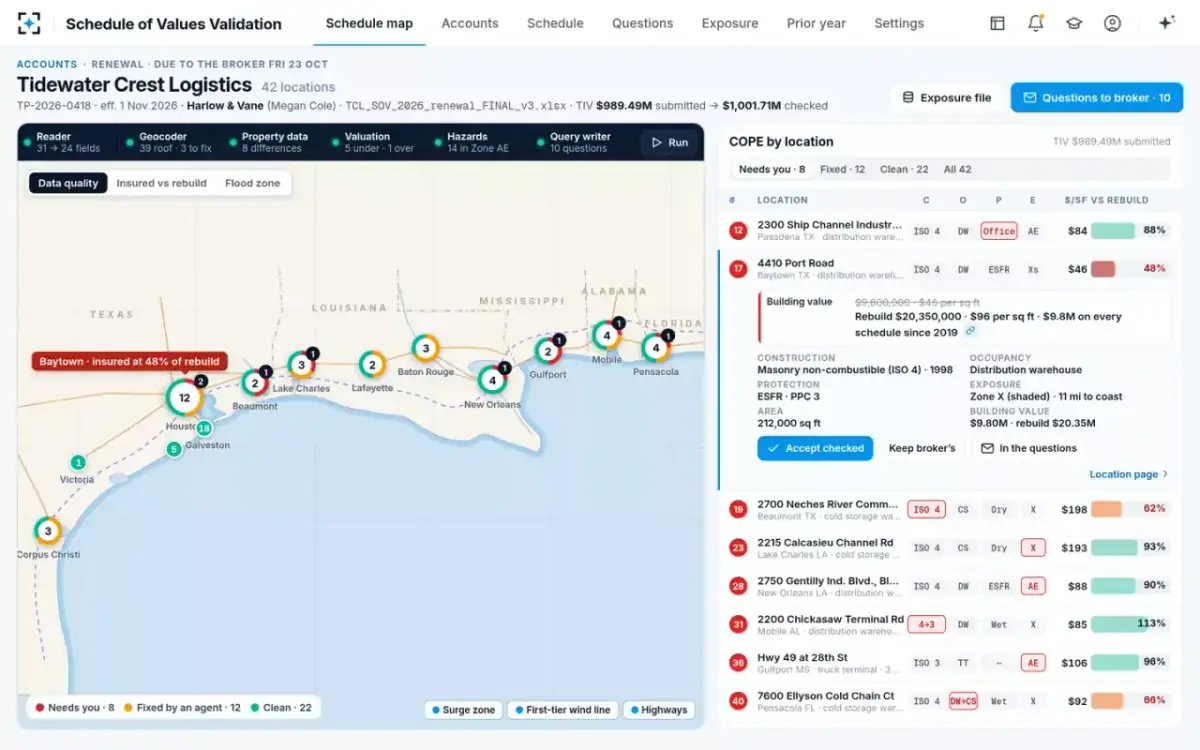
Occupancy goes wrong when a building changes use and the schedule does not. A distribution warehouse that adds a freezer becomes, in part, a cold store, with insulated panels, refrigeration plant and a different loss profile. In the sample renewal, a 2021 building permit in Beaumont, Texas, showed a 26,500 square foot freezer addition to a cold storage warehouse that the schedule still listed at 48,000 square feet; the checked area is 74,500. The permit, not the schedule, told the underwriter what the building is.
Protection: the fire department outside and the sprinklers inside
Protection has a public half and a private half. The public half is the community's fire protection, graded by the Public Protection Classification. The Texas Department of Insurance's state fire marshal explains it: communities are scored from 1 to 10, where "1 means the community has superior property fire protection" and "10 means the community’s fire protection efforts don’t meet ISO’s minimum criteria," and "Most home and business insurers use PPC scores to determine insurance premiums" (Texas Department of Insurance, FAQ: Public Protection Classification). In Texas the score weighs the fire department review at up to 50 points, the water supply at 40, emergency communications at 10 and community risk reduction at 5.5.
Location decides the class as much as the town does. The same Texas page notes that "Any building more than five road miles from a fire station or outside the boundary of a city or volunteer fire department service area has a PPC score of 10," and split classes apply a worse grade beyond 1,000 feet of a creditable water supply. A protection class copied from the insured's town, rather than looked up from the building's own location, can be several classes wrong.
The private half is sprinklers, alarms and their coverage. The usual error is binary: a schedule says "sprinklered: Y" because there are sprinklers somewhere in the building. In the sample renewal, a Pasadena, Texas distribution warehouse was listed as sprinklered; the carrier's own risk engineering survey of 14 May 2025 found sprinklers in the office only. Until the broker sends a contractor's certificate for the warehouse, the solution's checked file rates the location, $22.61M of value, as unsprinklered.
Exposure: what surrounds the building, from the neighbour to the coast
Exposure is the hazard from outside the building's walls. For fire, it is the neighbour: an adjoining building, a yard of pallets, a process plant across the road. For natural hazards, it is the flood zone, the distance to the coast, the wind band and wildfire. FEMA's flood maps classify every area into zones, from the special flood hazard area flooded by the 1%-annual-chance flood to zones of moderate and minimal hazard (FEMA, Flood Zones).
Exposure is the letter most dependent on the pin, because every hazard layer is read at a point. A location placed on its postal-code centre carries that centre's flood zone and coast distance. In the sample renewal, a Lake Charles cold store went from flood Zone X to Zone AE, base flood elevation 8 feet, when the underwriter moved its pin 5.6 km onto the building. What flood Zone X means on a schedule explains why "X" is not the same as "no flood."
The COPE table beside the map: suspect values outlined, value per square foot against rebuild
How do underwriters verify COPE data?
Against sources that were not written by the party asking for cover. Every COPE field has at least one: a property record or permit for construction, year built and area; a risk engineering survey for occupancy and sprinklers; the protection classification for the area; FEMA's flood maps and published hazard layers for exposure. Public forms already lean on these. FEMA's guide to the flood application, for example, tells the applicant to give the date of construction as "the month, day, and year of the building permit, even if the building has later been substantially improved" (FEMA NFIP, simple guide for non-residential buildings).
Where each COPE field can be checked
| Field | Best evidence | What the evidence catches |
|---|---|---|
| Construction class | Risk engineering survey; permit drawings | Wood roofs on masonry walls; metal siding on wood members |
| Year built and roof year | Property record; building and re-roof permits | Blank years; impossible years; roofs replaced after a storm |
| Floor area and stories | Property record; permits for additions | Additions missing from the schedule; stories miscounted |
| Occupancy | Survey; change-of-use and addition permits | Warehouses turned cold stores; offices turned light industry |
| Sprinklers and alarms | Survey; sprinkler contractor certificate | Systems that cover part of a building; systems impaired or removed |
| Protection class | The area’s classification, looked up from the pin | Classes copied from the town rather than the site |
| Flood zone, coast distance | FEMA flood maps and hazard layers, at the building | Zones read from a postal-code centre or the wrong building |
| Changes since last year | Last year’s schedule, matched by parcel | Values unchanged for years; construction that changed between schedules |
Last year's schedule is underrated as evidence. In the sample, the prior-year comparison, matched by parcel rather than row number, showed a Mobile, Alabama warehouse described as non-combustible in 2025 and masonry non-combustible in 2026. A building does not change class between renewals; one of the two schedules is wrong, and the question goes to the broker.
Why COPE data matters three times: the rate, the model and the claim
COPE sets the rate, drives the catastrophe model and decides the claim, so one wrong field is paid for three times. At rating, construction and protection classes set the base rate for fire. In the catastrophe model, the NAIC primer notes, the vulnerability matrix varies with "occupancy (residential, commercial, or industrial), building construction (wood, masonry, or steel), age of the building, height of the building." At claim, a building that turns out to be a different class, use or size from the one declared puts the adjuster, the underwriter and the insured in an argument about what was insured.
COPE also moves the value. North Carolina's state property fund tells agencies that some changes add replacement value and some do not: replacing an existing roof or office partitions "may not" add value, while "an addition that increases the building's size, or the installation of a sprinkler system or alarm system, would increase the replacement value of the building" (NC Office of State Fire Marshal, State Property Fire Insurance Fund). A freezer addition, like Beaumont's, changes occupancy, area and value at once.
COPE in the carrier's layout: every changed cell marked against what the broker sent
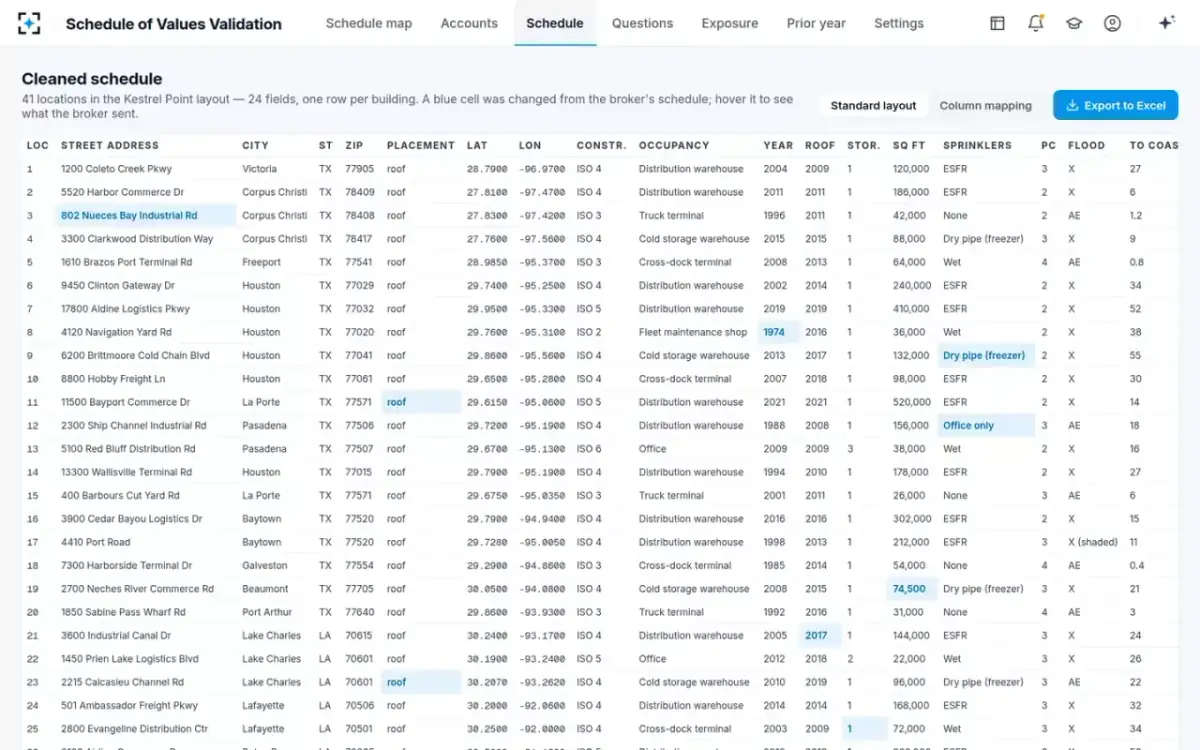
To see the COPE checks run on the sample renewal, start from Schedule of Values Validation.
The most common COPE errors on a broker's schedule
They are rarely invented; they are inherited. A construction description typed years ago, a sprinkler "Y" that was true for the first building on the site, a flood zone from a mortgage file, an area from before the addition. Each was right once, or right about something nearby. The pattern is why COPE checks work best when they compare the schedule with a source that has its own date: a permit, a survey, a map, a property record.
The other pattern is the blank that becomes a value. A missing year built filled with the account's average, a missing construction class filled with the book's most common one, a missing floor elevation left at zero: each turns an honest unknown into a confident wrong answer that the model, the rate and the claim will all believe. The safest COPE rule is also the simplest: unknown stays unknown until someone with evidence fills it.
Questions people ask
What is COPE information on a statement of values?
It is the set of columns describing each building rather than its value: construction class, year built, roof year, stories, floor area, occupancy, sprinklers and alarms, protection class, and exposure fields such as flood zone and distance to the coast. A statement of values pairs those with the building, contents and business income values for each location.
What does masonry non-combustible mean?
It is construction class 4: exterior walls of masonry or concrete, with the roof supported by noncombustible members such as unprotected metal beams or bar joists. The Texas crosswalk maps it to building-code Type IIA. If the roof or floors are wood, the building is joisted masonry, class 2, even when the walls look the same.
What does a protection class of 10 mean?
That the property's fire protection does not meet the classification's minimum criteria. In Texas's explanation, any building more than five road miles from a fire station, or outside a city or volunteer fire department's service area, is a 10 unless an automatic aid agreement changes it. The same page notes that businesses in communities with a good score typically pay less for fire insurance.
Does construction class matter for flood?
Much less than for fire or wind. FEMA's Hazus manual notes that most flood depth-damage functions are independent of structural system or construction material; what matters for flood is the water's depth relative to the building, which is why floor elevation and foundation type carry the weight.
What is a COPE worksheet?
It is a form or tab that asks for the COPE fields for each location, often sent by an underwriter when a broker's schedule leaves them out. It is only as good as its sources: a worksheet the insured fills from memory adds detail, not evidence.