Texas Insurance Code 542.060 is the damages section of the state's prompt payment of claims subchapter. If an insurer that is liable for a first-party claim has not complied with the subchapter's deadlines, it owes the policyholder or beneficiary, on top of the claim, interest on the claim amount at 18% a year as damages, plus reasonable and necessary attorney's fees. In a suit governed by chapter 542A, which covers weather and other natural-force damage to real property, the rate is the Texas post-judgment rate plus five percentage points instead. Because the statute prices lateness, a Texas claims audit can do something most states do not allow: rank its exceptions by the dollars each one puts at risk. Botminds' Claims Compliance Audit, which tests every closed claim against each state's fair claims rules, prices each late Texas step this way and shows the arithmetic.
Statutory text below is quoted from the Texas Legislative Council's statute server. The worked example and the screens use the solution's fictional sample insurer, Ashgrove Mutual Insurance Group; its claims and amounts are sample data, not a customer's.
Counting errors puts the wrong fix first; pricing them does not.
The fix plan in Claims Compliance Audit
What does Texas Insurance Code 542.060 say?
Section 542.060 says three things. Subsection (a) makes a non-compliant insurer liable, in addition to the claim, for interest at 18% a year as damages and for reasonable and necessary attorney's fees, and it keeps any prejudgment interest available on top. Subsection (b) taxes those fees as costs if a suit is filed. Subsection (c) replaces the 18% in any action to which chapter 542A applies (§542.060).
The trigger is broad. The section applies when an insurer "is not in compliance with this subchapter", not only when a payment is late. The subchapter's other sections set the deadlines it measures: acknowledgment and the request for items (§542.055), the decision (§542.056), payment (§542.057) and a general outer limit for delayed payment (§542.058). The subchapter also tells courts to read it generously, toward prompt payment (§542.054). For an audit, that means every late step on a Texas first-party claim can carry a price, not just the last one.
One thing the statute does not say is when the 18% begins to run. Subsection (c) does: interest "accrues beginning on the date the claim was required to be paid." The worked example below uses the same starting point for subsection (a), as a stated assumption. A compliance desk should have counsel approve that choice and write it into its exposure schedule.
Texas insurance code 542.060(c): the 542A interest rate in October 2026
In an action under chapter 542A, the damages are "simple interest on the amount of the claim as damages each year at the rate determined on the date of judgment by adding five percent to the interest rate determined under Section 304.003, Finance Code" (§542.060(c)). Section 304.003 sets the post-judgment rate at the prime rate published by the Federal Reserve Board, with a floor of 5% and a ceiling of 15% (Fin. Code §304.003). The consumer credit commissioner publishes it monthly; for October 2026 it was 6.75% (OCCC), so a 542A judgment entered that month carries 11.75%.
Chapter 542A reaches first-party claims under policies covering real property where the damage was caused, wholly or partly, by forces of nature, which the statute lists as including an earthquake or earth tremor, wildfire, flood, tornado, lightning, hurricane, hail, wind, snowstorm or rainstorm (§542A.001(2)). It also changes how fees are awarded. A claimant must give written notice at least 61 days before suing, stating the amount owed and the fees incurred, and the fee award is scaled by how close the judgment comes to the amount demanded in that notice: below 0.2 of it, no fees; at 0.8 or more, the full reasonable amount (§§542A.003, 542A.007).
For an exposure schedule this means two Texas bases, not one. A hail or windstorm claim on a building is priced at the 542A rate, which moves every month with the prime rate. An auto claim, a theft or a burst pipe is priced at the fixed 18%. A claim with mixed causes needs a person to decide.
Texas insurance code 542.055, 542.056 and 542.057: the clocks that start the meter
Three sections set the deadlines that section 542.060 enforces. Within 15 days of notice of a claim the insurer must acknowledge it, begin any investigation and ask for every item, statement and form it reasonably believes it will need (§542.055). It must then accept or reject in writing within 15 business days of receiving those items, giving reasons if it rejects, or within that period explain why it needs more time and decide within 45 days of that notice (§542.056). It must pay within five business days of telling the claimant it will pay (§542.057).
One sample Texas claim against the statute's clock
- Decide: 15 business days after all items21 d
- Pay: 5 business days7 d
- Items in, then accepted15 d
- Payment window7 d
- Late: waiting for a second signature14 d late
The rest of the subchapter adjusts those clocks. An eligible surplus lines insurer has 30 business days to acknowledge and 20 business days to pay (§§542.055(a), 542.057(c)). Where the insurer reasonably suspects arson, it has 30 days to accept or reject (§542.056(b)). After a weather-related catastrophe or major natural disaster as the commissioner defines it, every deadline in the subchapter is extended by 15 days (§542.059(b)). And where no other statute sets a payment period, delay beyond 60 days after the insurer has everything it asked for triggers the damages section (§542.058(a)).
A business day in Texas is "a day other than a Saturday, Sunday, or holiday recognized by this state" (§542.051(1)). The state's holiday statute lists national holidays and separate state holidays, including Texas Independence Day on 2 March, San Jacinto Day on 21 April and the Friday after Thanksgiving (Gov't Code §662.003). Which of those an audit skips is a decision for compliance to make once and record in the rule; the prompt payment clocks themselves are compared across states in prompt payment laws by state.
The worked cost of one late payment in Texas
The cost of one late Texas payment is the claim amount times the statutory rate times the days late, plus fees, and the arithmetic is worth doing once by hand. The sample claim is a $148,000 commercial property claim accepted on Tuesday 29 September 2026. Payment was due on the fifth business day, Tuesday 6 October, and went out on Tuesday 20 October, because large payments at the sample insurer waited for a second signature from treasury, which signs on Tuesdays and Fridays.
What one late Texas payment costs under §542.060
Claim accepted
$148,000.00
Commercial property, accepted in writing Tue 29 Sep 2026
Payment due
Tue 6 Oct 2026
5th business day after the notice of acceptance (§542.057(a))
Paid
Tue 20 Oct 2026
14 calendar days after the deadline
If chapter 542A does not apply
$1,021.81
$148,000 × 18% × 14 ÷ 365 (§542.060(a))
If it is a weather claim in a 542A suit, judgment in October 2026
$667.01
$148,000 × (6.75% + 5%) × 14 ÷ 365 (§542.060(c))
Attorney’s fees
Reasonable and necessary
No statutory schedule; the sample company prices an allowance of $350 per late file from its own litigation history, as an estimate
If the same payment slipped a year
$26,640.00
$148,000 × 18%, before fees, on the 18% rate
Two lessons come out of the arithmetic. The interest on a two-week delay is modest: about a thousand dollars on a claim of this size. What makes Texas exposure large is the duration and the fees. A payment that slips into litigation and lands a year late costs $26,640 at 18% before a single dollar of fees, and the fees are whatever a court finds reasonable and necessary. An audit cannot know the fee in advance, so the sample insurer prices an allowance from its own history and labels it an estimate.
The second lesson is about which claims carry the risk. Interest scales with the claim amount, so one late payment on a large commercial claim can outweigh dozens of late acknowledgments on small auto claims. That is exactly what the sample quarter showed.
Count against price: why the Texas commercial pattern ranks third
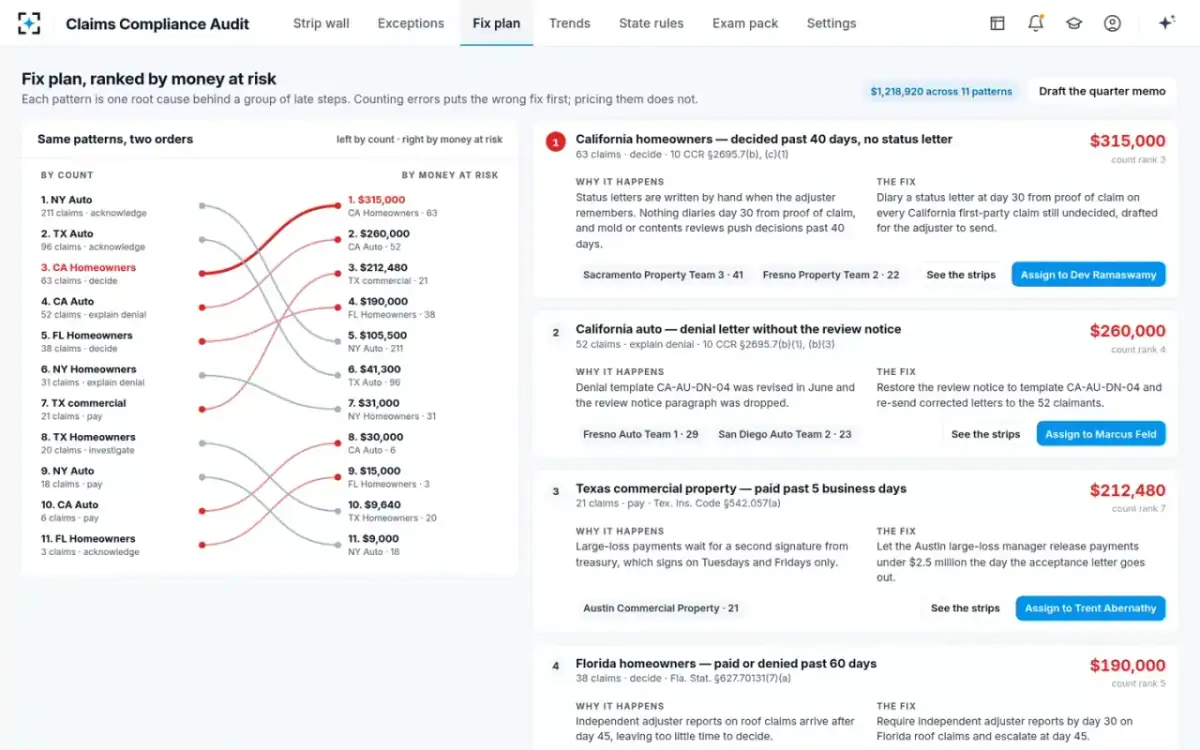
Ranked by count, the sample quarter's Texas commercial property payments were the seventh of eleven patterns: 21 claims. Ranked by money at risk, they were third: $212,480, more than ten thousand dollars per late payment. Texas auto acknowledgments past 15 days were the second-largest pattern by count, 96 claims, but carried about $430 each. The bars show money at risk per exception for the three Texas patterns.
Money at risk per late step, Texas patterns in Claims Compliance Audit's sample quarter
The fix for the commercial pattern was cheap: let the large-loss manager release payments under a set threshold on the day the acceptance letter goes out, instead of waiting for the twice-weekly treasury signature. Ranked by count, it would have waited behind three bigger groups of late acknowledgments. Why ranking by count misleads a whole fix plan, not just in Texas, is the argument of the closed claim file review process pilot.
Which claims does section 542.060 cover?
Section 542.060 covers first-party claims only. The subchapter defines a claim as one made by an insured, policyholder or named beneficiary that "must be paid by the insurer directly to the insured or beneficiary" (§542.051(2)). A third-party liability claim, paid to someone the insured injured, is outside it. So are several lines and payers listed in the statute.
Inside and outside Texas's prompt payment subchapter
| Question | Inside the subchapter | Outside it |
|---|---|---|
| Whose claim | First-party claims paid directly to the insured or a named beneficiary | Third-party claims against the insured |
| Which lines | Fire, casualty, life, health and accident | Workers’ compensation, mortgage guaranty, title, fidelity, surety and guaranty bonds, marine |
| Which insurers | Stock and mutual insurers, Lloyd’s plans, reciprocal exchanges, county and farm mutuals, risk retention and purchasing groups | Health maintenance organizations, except as §1271.005(c) provides |
| Surplus lines | Eligible surplus lines insurers, on longer deadlines | None listed |
| Guaranty associations | Associations under chapters 462 and 463 are covered by the deadlines | They are not liable for §542.060 damages |
Scope belongs at the top of a Texas audit file, before any date is tested. A Texas auto claim may be first-party collision, where 542.060 applies, or a third-party property damage claim, where it does not. An audit that prices both at 18% overstates the risk, and one that prices neither understates it.
Is 18% interest a penalty? What else Texas can do
The statute calls the 18% damages, owed to the claimant, not a penalty paid to the state. The regulator has separate tools under subchapter A of the same chapter, which Texas titles the Unfair Claim Settlement Practices Act. The Department may investigate an insurer whose complaints are out of proportion to its peers', hold a hearing and order it to stop, and if it does not, suspend or limit its business (§§542.008–542.010). The statute adds that an insurer "may not be found to be in violation of this subchapter solely because of the number and type of complaints or claims against the insurer" (§542.009(g)).
A third route runs through chapter 541. It lists unfair settlement practices, among them failing to explain promptly the basis for a denial and refusing to pay without a reasonable investigation, and it gives a person who suffers actual damages a private action, with up to three times actual damages if the act was knowing (§§541.060, 541.151, 541.152). An exposure schedule built on 542.060 is therefore a floor, not a ceiling, and the audit should say so in the memo that goes with it.
How Claims Compliance Audit prices a late Texas step
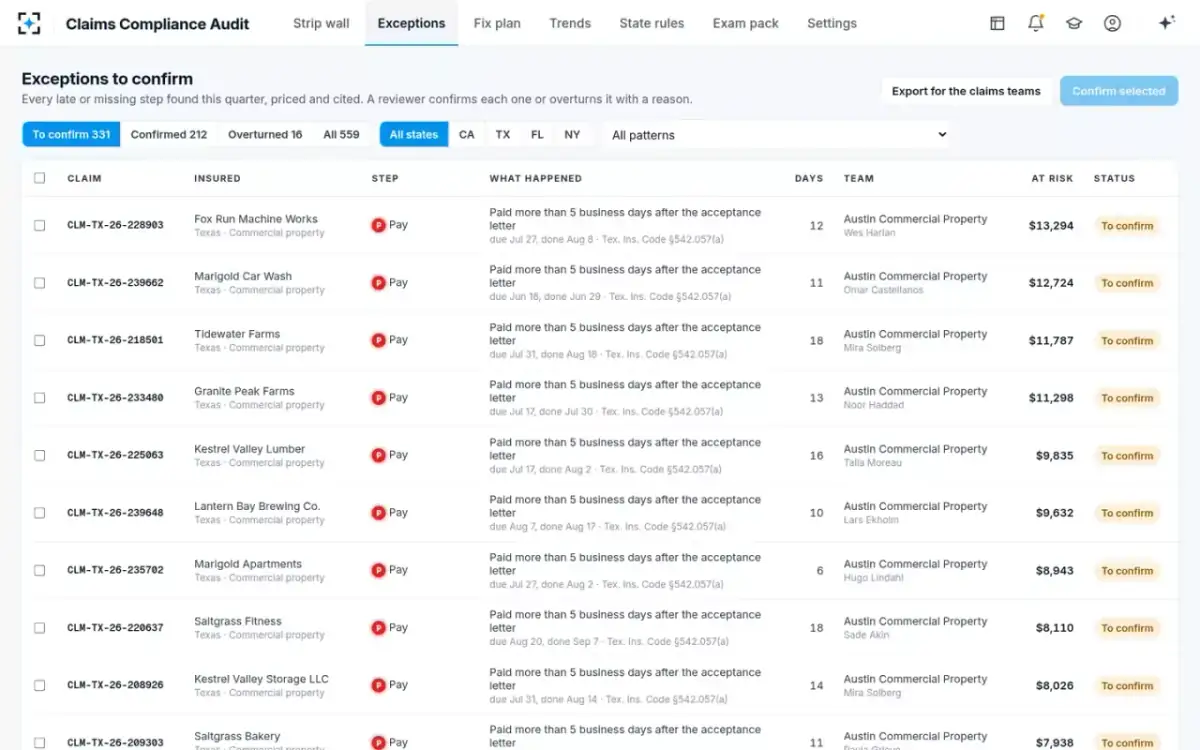
Claims Compliance Audit prices each confirmed Texas exception from an exposure schedule the VP, Compliance approves: 18% a year statutory interest, and an attorney's-fee allowance the company sets from its own litigation history. Every amount carries its basis and source, and none is ever called a fine. In the exceptions queue, the late commercial payments sit at the top, each with its due and done dates and the section it breached.
Texas commercial payments made after the fifth business day, priced and cited
The fix plan shows the same patterns twice, by count on the left and by money on the right, with the root cause and the team beside each. The Texas commercial line moves from seventh to third when it is priced. That is the whole case for pricing exceptions: it changes which fix the claims organization works on first.
The same eleven patterns, ranked by count and by money at risk
The audit also tests the clocks that come before payment. A Texas acknowledgment that slips past day 15, or an item request that comes after the first request without a reason in the file, is an exception even if the claim is later paid on time. How those clocks sit beside California's, New York's and Florida's is laid out in the claim file audit checklist.
Questions people ask
Does Texas Insurance Code 542.060 apply to third-party claims?
No. The subchapter defines a claim as a first-party claim made by an insured, policyholder or beneficiary that must be paid directly to the insured or beneficiary (§542.051(2)). A third-party liability claim against the insured falls outside it, though other duties in the Insurance Code still apply to how it is handled.
Is 542.060 interest simple or compound?
Subsection (c), for chapter 542A actions, says simple interest. Subsection (a) states only a rate of 18% a year. An audit can compute it as simple interest from the payment deadline, as the sample schedule does; because the statute is silent on the start date for (a), counsel should approve the method.
What is the Texas prompt payment act interest rate?
18% a year on the claim amount under §542.060(a). In a suit governed by chapter 542A, it is the post-judgment rate on the date of judgment plus 5%. With the October 2026 post-judgment rate at 6.75%, that is 11.75% for judgments entered that month.
What does Texas Insurance Code 542.055 require?
Within 15 days of receiving notice of a claim, the insurer must acknowledge it, begin any investigation and request all items, statements and forms it reasonably believes it will need. Eligible surplus lines insurers have 30 business days. If the acknowledgment is not in writing, the insurer must record its date, manner and content.
What does Texas Insurance Code 542.056 require?
A written acceptance or rejection within 15 business days after the insurer receives everything it asked for, or 30 days where it reasonably suspects arson. A rejection must state the reasons. If it needs more time, it must say why within that period and decide within 45 days of that notice.
Do Texas claim deadlines stop after a hurricane?
They stretch, but they do not stop. After a weather-related catastrophe or major natural disaster as the commissioner defines it, every deadline in the prompt payment subchapter is extended by 15 days (§542.059(b)). An audit should apply the extension only to claims the commissioner's declaration covers.