A claims audit checklist for an independent adjuster's fee bill has to test the bill twice: once against the fee schedule and guidelines, and once against the claim file the bill is about. A bill can follow every rule in the schedule, with the right category, the right rate and the arithmetic tied, and still charge for work the file shows did not happen as billed: four hours of field inspection by an adjuster whose own check-in log shows 35 minutes on site, or a re-inspection nobody authorised. Those are the costly errors, and a schedule-only checklist cannot see them. Botminds' Independent Adjuster Bill Review runs all three layers of the checklist below on every bill, the schedule, the file and the report, and leaves the decision to a person.
The checks draw on FEMA's flood program, whose adjuster fee schedule is the only complete public one in US property claims and whose review standards are published with it, and on state rules for adjusters. The worked examples are fictional sample bills from the solution's sample storm.
Two tests, four kinds of bill: the claims audit checklist has to find the hidden cell
Follows the schedule · matches the file
Pay it
A band fee on a claim whose gross loss sits in that band, with the report guidelines met. In the sample, 96 bills are in this cell, ready to pay.
Follows the schedule · does not match the file
The hidden cell
Field inspection, 4.0 hours at $95, the right category and rate. The adjuster’s own check-in and check-out show 35 minutes on site. A re-inspection at the right rate, with no authorisation in the claim notes.
Breaks the schedule · matches the file
The easy cell
58 photographs billed where the cap is 40; the photos exist. A band 7 fee on a gross loss of $41,280, which the estimate in the file puts in band 6.
Breaks the schedule · does not match the file
Return it
A $441.70 closed-without-payment bill flagged “Billed by Sabal Point before reassignment”, allowed at $0 until the firms’ roles on the claim are settled.
Why a claims audit checklist must test the claim file, not just the schedule
Because the schedule describes what may be billed and the file describes what was done, and only the second can show that a valid line is wrong. Every line on a time-and-expense bill makes two claims: that the work is billable at that rate, and that the work happened in that amount. A schedule check tests the first. Only the photographs, check-ins and claim notes test the second.
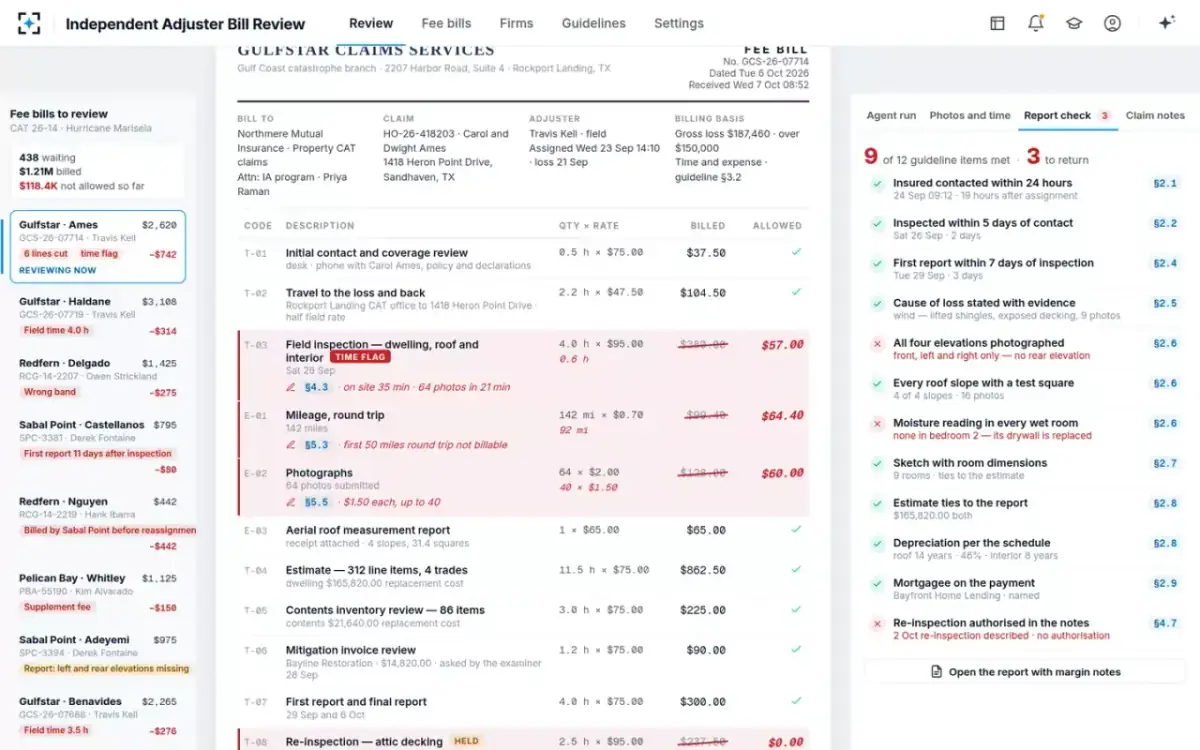
The split shows up in where the money is. On one sample bill of $2,619.90, six lines were reduced by $741.50. Four came from the schedule: mileage inside the unbillable first 50 miles, photographs over the cap and at the wrong rate, file set-up that the guidelines treat as unbillable clerical time, and postage that they treat as overhead. Two came from the file: field hours the adjuster's own log did not support, and a re-inspection with no authorisation or photographs. The two file findings were three-quarters of the money.
Independent Adjuster Bill Review on one sample bill: where the $741.50 reduction came from
Reduction by test
- Against the claim file · $560.50 · 75.6%
- Against the schedule · $181.00 · 24.4%
One bill is not a population, and the split will differ by firm and by storm. The point it makes is structural: on time-and-expense bills, the largest lines are hours, and hours are checked against the file or not at all.
Layer 1: the bill against the fee schedule and guidelines
The first layer asks whether each line is billable, at that rate, under the edition of the guidelines in force on the assignment date. It is the layer most bill review already does, and it should be done completely, because its findings are the least disputed.
Layer 1 · nine checks against the schedule
- Edition in force on the assignment date
Guidelines change; a bill is tested against the version that applied when the claim was assigned, not today’s.
- Billing basis from the gross loss
Band fee or time and expense, decided by the gross loss in the estimate, not by the firm’s choice.
- The band
The gross loss rebuilt from the estimate, before depreciation and deductible, capped by limits; then the band it falls in.
- Rates per hour and per unit
Field, desk and travel rates; mileage, photographs and other unit rates.
- Caps
Photo caps, the unbillable first miles of a round trip, maximum hours for a task.
- Never-billable categories
Clerical time, file set-up, postage and copies, overhead.
- Thresholds on extra fees
A supplement fee only above the amount the guidelines set; late-report reductions where they apply.
- Arithmetic
Every quantity × rate ties to its line, and every line to the total.
- Receipts
Each expense with its receipt attached to its own line.
The federal flood program shows why the basis matters even for a fee that looks fixed. A wrong reason code on a claim closed without payment changes the fee: the Claims Manual warns that "Use of an improper CWOP code can generate an incorrect adjuster fee payment." The band and flat-fee rules for flood claims are worked through in the NFIP adjuster fee schedule.
Layer 2: the bill against the claim file
The second layer asks whether the work billed happened as billed, using only what the file holds: the assignment, the claim notes, the photographs with their capture times and locations, and the firm's check-in log. It is where the hidden cell is found, and where most of the money in a time-and-expense bill sits.
Layer 2 · seven checks against the claim file
- Who held the claim on the billed date
A firm billing for days after the claim was reassigned, or before it was assigned.
- Authorisation for extra work
Re-inspections, engineers and supplements need an authorisation in the claim notes before the work, not after.
- Field hours against check-in and check-out
Billed field time against the on-site window in the firm’s own field app.
- Field hours against photo capture times
First and last photo at the property, and the first photo at the next one.
- The adjuster’s whole day
Every claim the adjuster billed on that date laid on one time line; billed hours cannot exceed the day.
- Travel against addresses
Miles and travel hours against the route from the office or the previous stop.
- Counts against the file
Photographs billed against photographs submitted; pages and items against the report.
The fourth and fifth checks are the ones a person rarely has time for. In the sample, one adjuster billed 26.5 hours of field inspection across seven claims on a single Saturday that ran from his first check-in at 08:05 to his last check-out at 16:21; his photographs and check-ins document 4.45 hours on site. Each bill looked plausible alone. How to read that clock fairly, with its tolerances and its limits, is the subject of an adjuster report checked against its photo times.
Layer 3: the report against the report guidelines
The third layer asks whether the report meets the carrier's report guidelines, because a bill for an incomplete report is a bill for work the carrier will pay for again. The guidelines in the sample carrier have twelve items; FEMA's flood program has its own list. Each gap is returned with the page or photo it is about.
Layer 3 · twelve report checks, as one sample carrier writes them
- Insured contacted within 24 hours of assignment
- Inspected within 5 days of contact, for catastrophe assignments
- First report within 7 days of inspection
- Cause of loss stated with its evidence
Photographs, measurements or another witness to the cause.
- All four elevations photographed
- Every roof slope with a test square
- A moisture reading in every wet room
Photographed with the meter in the frame.
- Sketch with room dimensions
- The estimate ties to the report
- Depreciation per the carrier’s schedule
- Mortgagee named on the payment recommendation
- Re-inspection authorised in the notes
Where one was done and billed.
Independent Adjuster Bill Review: nine of twelve report guidelines met, three to return
What do claims auditors look for in an adjuster's estimate?
They look for an estimate that can be checked line by line against the photographs and the sketch. FEMA's oversight section lists the errors its reviewers find most in flood estimates, and every one is a desk check.
The estimate errors FEMA's reviewers list first
| What FEMA’s reviewers find | What the auditor checks |
|---|---|
| "Estimates are not line-by-line, room-by-room using unit costs." | Every room has its own lines, each a quantity at a unit cost. |
| "Depreciation to both building and contents are not taken on a line-by-line basis." | Depreciation sits on each line, by age and condition, not as one deduction. |
| "Rooms are not described and identified." | Room names in the estimate match the sketch, with dimensions. |
| Building items on the contents inventory, or the reverse | Each item on the right side of the line between building and contents. |
| Replacement cost settlement not shown to be qualified | The file shows why replacement cost applies. |
| Photographs that do not document the claimed damage | Photos of the damage, of undamaged elements, and of damage from other causes. |
A state ethics rule adds a check on changes. Florida requires an adjuster who changes a detailed residential estimate already given to the insured or insurer to explain each change and keep the documentation behind it; a modification to the estimating program's market prices is "strictly prohibited unless the adjuster can demonstrate with additional documentation that modification is required". An auditor can ask for the variation report the rule requires.
Desk review checklist vs re-inspection report
A desk review checklist tests the file; a re-inspection report tests the property, and it is only as useful as what it documents. The GAO found the limit of a thin one after Katrina. Reviewing 740 FEMA reinspection files on flood claims, it reported that "Around two-thirds of the 740 reinspection files did not indicate whether the damages had been caused only by flooding or by a combination of wind and flooding", and did not hold enough documentation for a reviewer to decide.
The lesson for a carrier's own re-inspections is the same as for the first report: a re-inspection report should state the question it was sent to answer, the cause of loss and its evidence, every difference from the original report with a photograph, and the reinspector's measurement where it differs. A re-inspection that only says "agree" or "disagree" leaves the auditor where it started. And a re-inspection billed by the original firm needs the examiner's authorisation in the notes, which in the sample was the line held until it arrived.
How to audit an adjuster invoice in order
Audit an adjuster invoice in the order that settles questions cheapest first: arithmetic, then the schedule, then the file, then the report, then the decision. By our estimate, a time-and-expense bill and its report take about 39 minutes by hand in that order, of which the slowest step, matching billed time to photographs and check-ins, takes about 10. With the reading, schedule and file checks done before a person opens the bill, the estimate is about 8.5 minutes, most of it the report judgement and the decision.
A storm's bills, each flagged with the check it failed
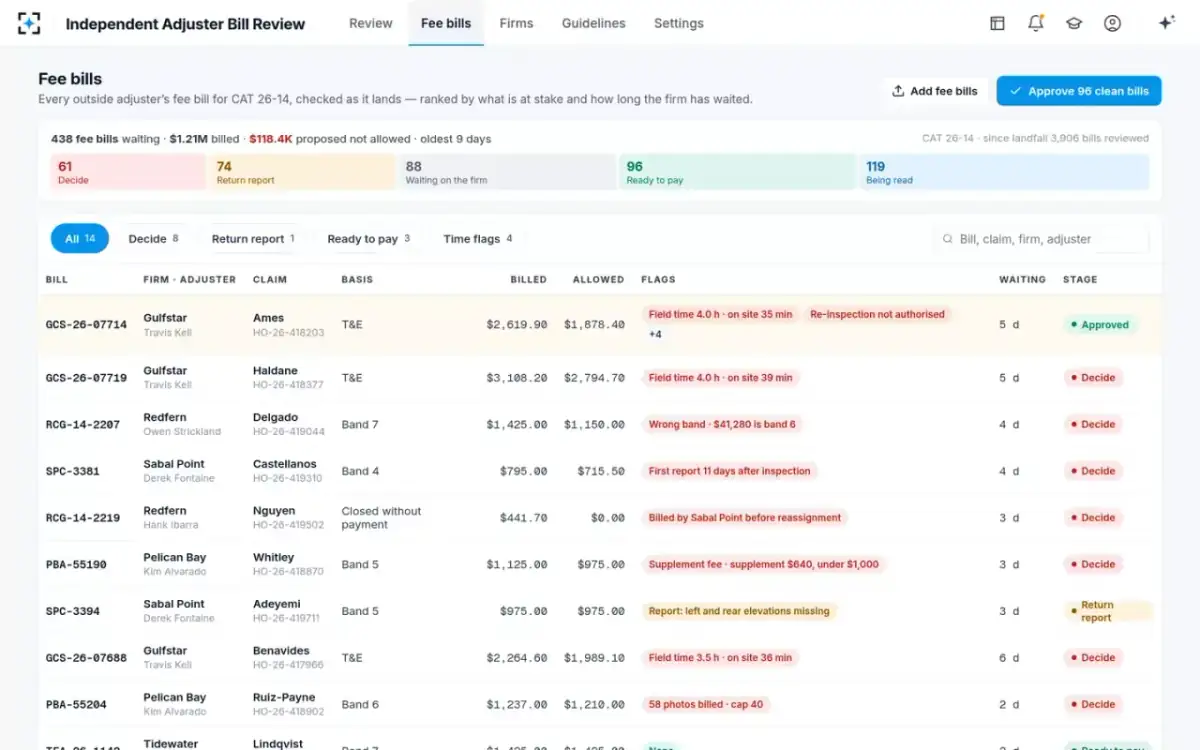
The order also decides what goes back to the firm. Arithmetic and schedule findings are rarely disputed; file findings are, and need their evidence on the line; report findings need the page or photo. In the solution all three go back in one return note, each item with its section, and the firm can answer any line with evidence the file did not hold. Running every layer on every bill, rather than on a sample, is what lets the same findings score each firm, the subject of claims audit vendors or full review. The full review is on Independent Adjuster Bill Review.
When the checklist finds a pattern, not a line
Some findings belong to a bill and some to a person or a firm, and the checklist should separate them. A line over the photo cap is a reduction on one bill. Field hours that exceed the documented time on seven bills from the same adjuster on the same day are a pattern, and a pattern is not something a bill reviewer should resolve alone by cutting each line and moving on.
In the sample, the program manager applies documented time to each of the adjuster's seven bills, which by the solution's arithmetic would not allow $2,071.00 across them, and separately refers the day to vendor management. The referral carries the evidence and says what it is: a request for review, not a finding. Across the storm, one firm of six carries 41 of the 68 time flags raised so far, which is a conversation for the vendor manager with the firm's branch, not a line on any one bill.
Keeping the two apart protects the review as much as the adjuster. A reduction on a line can be restored with one piece of evidence the file lacked, such as a check-in the field app failed to send. A conclusion about a person needs more than a bill review can see, and FEMA's own training for flood adjusters draws the same line for reports: observations go in, opinions and accusations stay out.
Questions people ask
What is the difference between a claim audit checklist and a claims quality review?
A claim audit checklist tests specific documents, here a fee bill and its report, against rules and the file. A claims quality review looks at how a claim was handled overall: contact, investigation, decision and communication. FEMA's annual reviews of flood files cover both, grading findings across documentation, operations, payment and policyholder experience.
What belongs on a desk review checklist?
Everything that can be tested from the file without a visit: the bill's arithmetic and schedule, authorisations in the claim notes, billed hours against photo times and check-ins, and the report against the report guidelines. A field re-inspection is for questions the file cannot answer, such as whether the scope matches the building.
What is a re-inspection report?
The report of a second inspection, by the carrier, a reinspector or a regulator's adjuster, that tests the first adjuster's scope and estimate against the property. It should state the question it answers and every difference with evidence; the GAO found about two-thirds of 740 FEMA flood reinspection files after Katrina did not say whether wind or flood caused the damage.
Can a bill follow the fee schedule and still be wrong?
Yes, and on time-and-expense bills that is where most of the money is. A line can be the right category at the right rate for hours the file does not support. In one sample bill, $560.50 of a $741.50 reduction came from checks against the file, not the schedule.
How often should IA bills be audited?
Every bill, if the checks can be run at that volume; a sample otherwise. A sample finds errors but cannot say how common they are unless it is random, and it cannot see a pattern that runs across one adjuster's day or one firm's season.