The claims audit process for an independent adjuster's fee bill is a chain of separate checks: the adjusting firm writes the bill and the report, a reviewer who had no hand in them reads and tests every line against the carrier's fee schedule, its guidelines and the claim file, and a person with authority over the claim decides what is paid and what goes back. The rule that holds it together is old: whoever makes a document never checks it, and whoever checks it never signs the payment alone. Outside adjusters make the process necessary, because a carrier answers for work it did not do and is billed for hours it did not see. Botminds' Independent Adjuster Bill Review runs that process on every bill the day it lands, with agents doing the reading and testing and the carrier's people deciding.
The rules and findings below come from FEMA's flood program, the GAO and state regulators, linked where they appear. The firm, adjuster and bill in the worked example are fictional sample data from the solution.
Independent Adjuster Bill Review on one bill: what each check catches
Reads the bill in the firm’s own layout, codes all 14 lines, ties each quantity × rate to the $2,619.90 total.
CatchesArithmetic and coding: 14 of 14 lines tie
Billing basis from the gross loss, then every rate, cap and exclusion in the edition in force.
Catches4 lines: mileage, photographs, file set-up, postage
Billed field time against photo capture times, GPS check-ins and the claim notes, across the adjuster’s day.
Catches2 lines: 4.0 field hours, an unauthorised re-inspection
The first report against the 12 report guidelines, each gap pinned to a photo or page.
Catches3 report items to return
Reads the proposals, edits the return note, decides; a supervisor co-signs above $500 or on a time flag.
CatchesThe decision: $1,878.40 allowed, signed twice
What is the claims audit process for an IA fee bill?
It is the review that sits between a firm's bill arriving and the carrier paying it, in five steps: read, test against the schedule, test against the file, review the report, decide. Each step answers a different question, and each needs different evidence, which is why one person doing all five on a stack of storm bills ends up skipping the last three.
Reading turns a bill in the firm's own layout into coded lines whose arithmetic ties. Testing against the schedule asks whether each line is billable at that rate under the guidelines in force on the assignment date. Testing against the file asks whether the work billed actually happened as billed: the field hours against the adjuster's own photographs and check-ins, a re-inspection against an authorisation in the claim notes. Reviewing the report asks whether the work meets the report guidelines. Deciding is a person weighing all of it, and writing back to the firm once.
The federal flood program describes the last step's duty in one line: "Claims examiners determine whether the adjuster’s work meets the standards established under this Manual and those of their company." Everything before it exists so the examiner, or the IA program manager in a carrier's catastrophe unit, decides from evidence rather than from the bill's own say-so.
Why the writer of a bill can never be its checker
A bill is the firm's claim on the carrier's money, and the firm's own quality review, however good, checks it against the firm's understanding of the guidelines. The carrier's check exists to apply the carrier's understanding, and to do so independently of whoever stands to be paid. That is the maker-checker rule, and it is as old as accounting.
Regulators now ask the same of automated review. The NAIC's model bulletin on insurers' use of artificial intelligence, which 29 jurisdictions had adopted by October 2026, expects a written program that addresses "The independence of decision-makers and lines of defense at successive stages of the AI System life cycle." A review in which the same agent reads a bill, decides the reduction and pays it would fail that test as surely as a person doing all three. The design question is not whether agents may check bills but whether the separation survives when they do.
"Only facts should be included in reports. Opinions or accusations are not to be included."
FEMA Emergency Management Institute, IS-1104 course for NFIP claims
The same separation applies to tone. FEMA teaches flood adjusters that a report carries observations, not conclusions about people; a bill review that accuses an adjuster of padding hours has crossed from checking to judging. In the solution the agent that compares billed time with the photographs reports time and nothing else, and a pattern goes to vendor management as a request for review.
How the federal flood program audits adjusters, layer by layer
The National Flood Insurance Program audits adjusters' work in at least four layers, each run by a different party and each looking at a different moment in the claim. The June 2025 Claims Manual describes them in its oversight section, and the design is a useful model for any carrier's IA program.
Four layers of review on one federal flood claim
| Layer | Who | When | What it looks at |
|---|---|---|---|
| Examiner review | The insurer’s claims examiner | Each report as it arrives; the closing report within 7 business days | Photographs against scope, entry errors, quantities and unit costs, depreciation, deductible, limits, every exception explained |
| Random Claims Quality Check | FEMA | During flood events, on open and closed claims | Whether the adjuster’s claim is on the right path, with guidance as needed |
| General adjuster re-inspection | A FEMA general adjuster | On request: special assist, congressional, appeals, FEMA requests, random checks | Desk review or on-site re-inspection of the claim |
| Operation Review | FEMA | Annually, on closed claim files | Documentation, operations, payment and policyholder experience; errors graded as Violations or Other Findings |
| Biennial audit | CPA firms engaged by the insurer | Every two years | A claims audit section within a financial audit |
The manual is explicit that the layers are meant to teach, not only to catch: "Adjusters and NFIP insurers should be mindful of the findings from the Operation Reviews, RCQC, and biennial audits, and provide the necessary training to ensure consistent oversight." It also separates two grades of error. Violations rest on the policy and the regulations; Other Findings rest on the manual and FEMA's bulletins. A carrier's IA guidelines can borrow the same split: a reduction for a line the contract never allowed is not the same kind of finding as a report that missed a guideline.
What sampling missed after Katrina
A layered process still needs to see enough files to say how accurate the whole was, and a judgmental sample cannot. After Hurricanes Katrina and Rita, FEMA's contractor re-inspected 4,316 claims chosen by size, location and complexity, not at random, and nobody analysed the results as a whole. The GAO did, on a random sample of those reinspections.
Payment errors the GAO found in its random review of FEMA's Katrina and Rita reinspections
The figures are twenty years old and are about claim payments, not fee bills, but the lesson about method has not aged. The GAO's conclusion was that because the reinspections were chosen by criteria rather than at random, "FEMA is unable to determine the overall accuracy of claims settled for specific flood events." An IA program that reviews a judgment-picked tenth of its bills is in the same position about its firms. Why that matters for scoring firms and choosing claims audit vendors is a separate page.
What does an insurance claims auditor do?
An insurance claims auditor reviews completed or in-progress claim files against the policy, the regulations and the company's guidelines, and reports errors and patterns rather than settling the claims. On outside adjusters' work, the auditor's tasks are the five steps above: read the bill, test it against the schedule, test it against the file, check the report, and write the findings back to the firm and to the people who decide.
FEMA's description of the examiner's review is close to a job description for the report side. The examiner confirms that the photographs reasonably document the scope, that there are no entry errors, that the estimate is written room by room and line by line with depreciation by age and condition, that quantities and unit costs are right, that the proper deductible and limits were applied, and that "All exceptions are fully explained by the adjuster in the narrative report." When something is wrong, "The examiner must communicate with the adjuster about whether there are any concerns with errors or omissions or necessary revisions."
What the auditor does not do is re-adjust the claim. The solution's report reviewer follows the same line: it never rewrites the adjuster's estimate, and every gap it returns names the photo or page it is about. The full list of what to test, layer by layer, is the claims audit checklist for IA bills.
Desk review vs field re-inspection: when each is used
A desk review tests the file as submitted; a field re-inspection sends someone back to the property. FEMA uses both: on a re-inspection request, it assigns a general adjuster "to conduct a desk review or on-site re-inspection." Most fee bill questions can be settled at the desk, because the evidence for a billed line is in the file or it is not.
Desk review and field re-inspection answer different questions
Desk review: Does the file support what was billed and reported?
Field re-inspection: Does the property match what was reported?
Desk review: Bill, report, estimate, photos with capture times, check-ins, claim notes
Field re-inspection: The building, measured and photographed again
Desk review: Wrong band, uncapped lines, hours the photos do not support, unauthorised work, report gaps
Field re-inspection: Wrong scope, missed or overstated damage, wrong cause of loss
Desk review: Minutes per bill once the file is read
Field re-inspection: A visit, travel and a second report
Desk review: When the file is silent on something the bill depends on
Field re-inspection: When photographs raise questions about the scope or the estimate
The desk review is where agents help most, because it is reading and cross-checking at a volume no team can match in a surge. A re-inspection remains a person's decision and a person's visit; the solution does not order one, and it holds any billed re-inspection that has no authorisation in the claim notes until the examiner's authorisation is shown.
The six agents in Independent Adjuster Bill Review, and what each may never do
Independent Adjuster Bill Review splits the desk review across six agents, so that no agent both finds a problem and acts on it. Each has a written limit, and the limits are what keep the maker-checker rule intact.
Independent Adjuster Bill Review: six agents, then the person who signs
Agent
Fee bill readerReads each bill, PDF, e-bill or spreadsheet, codes every line, ties quantity × rate to the total and attaches each receipt to its line.
Never: Alters a billed figure; it reports the difference
Agent
Guideline checkerFinds the billing basis from the gross loss and tests every line against the guidelines in force on the assignment date.
Never: Pays or rejects; reductions are proposals, each citing its section
Agent
Photo and time cross-checkerCompares billed field time with photo capture times and GPS, check-ins and claim notes, across the adjuster’s day.
Never: States motive, uses anything the firm did not submit, or calls it fraud
Agent
Report reviewerChecks the report against the report guidelines: clocks, elevations, roof slopes, moisture readings, sketch, estimate tie, mortgagee.
Never: Rewrites the adjuster’s estimate
Agent
Return note writerDrafts one note to the firm with every report gap and bill reduction, each with its section.
Never: Sends without a person
A person decides
IA program manager, and a co-signerDecides the allowed amount, edits and sends the note, refers patterns; a supervisor co-signs reductions over $500 or any time flag.
Never: Signs a reduction without its evidence
The audit replayed: each agent's check on the bill, in order
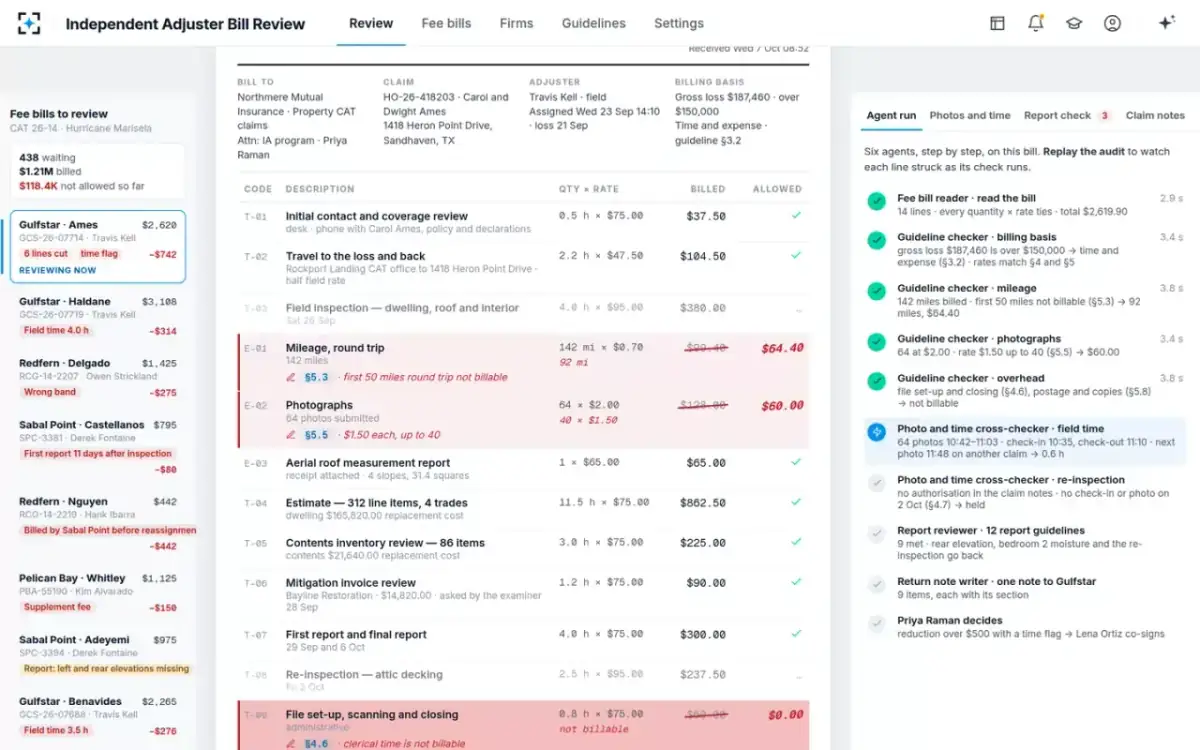
Where a person signs, and why two signatures above $500
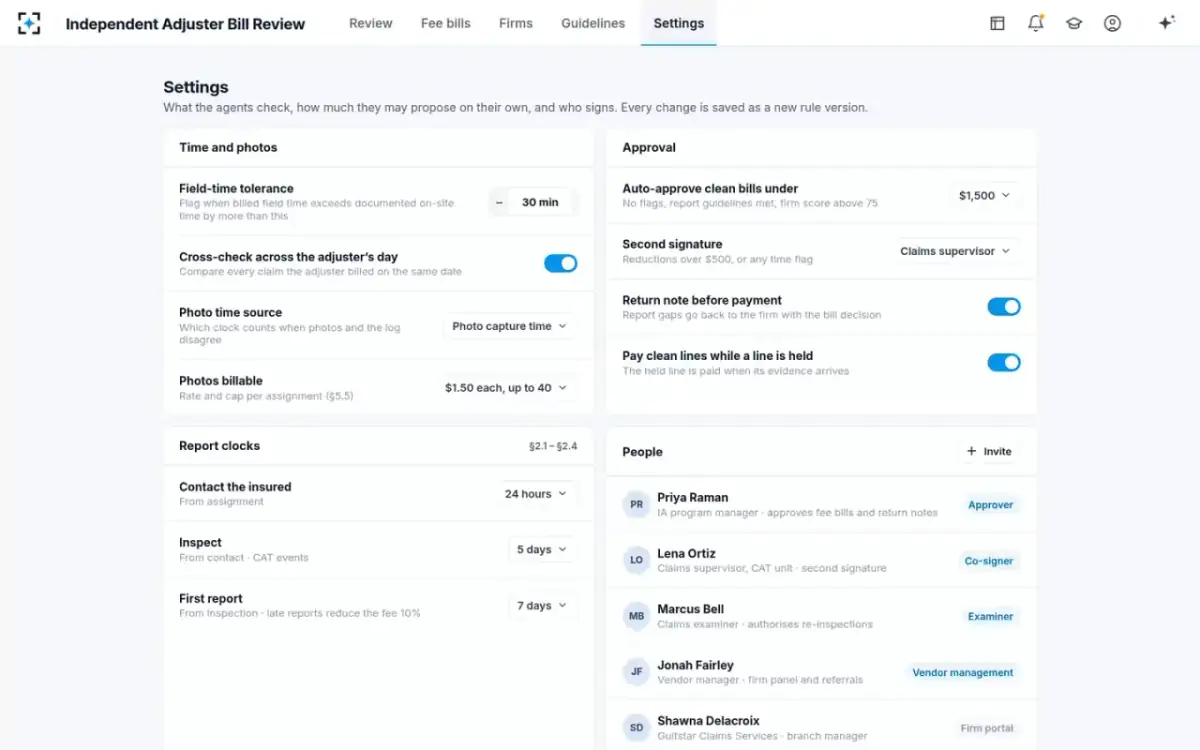
Every bill is decided by a person, and some by two. In the sample carrier's settings, the IA program manager approves every allowed amount, and a reduction over $500 or any time flag needs the claims supervisor's co-signature before the bill joins the payment run. Clean bills under a threshold can be approved automatically only if the carrier switches that on, and only with no flags, the report guidelines met and a firm score above 75.
The thresholds are settings, versioned like any other rule, and they belong to the carrier. The principle behind them is the one the flood program applies to its own expenses: FEMA does not pre-approve adjuster fees, and the insurer confirms that adjuster costs are reasonable for the work. A second signature on large or time-based reductions is the point where a firm's dispute is most likely, so it is where a second reader earns their time.
The carrier's settings: what the agents check, and who signs
How the audit trail answers a market conduct examiner
A regulator examining claims reads files, not intentions, so the audit process has to leave a file a stranger can follow. Washington's claims rule, amended with effect from 18 October 2026, states the standard: "The files must contain all notes and work papers pertaining to the claim in enough detail that pertinent events and dates of the events can be reconstructed."
For an outside fee bill that means four things on the bill itself: what each agent checked and found, with the section and the evidence; every line restored, and why; who signed and co-signed, and when; and every referral, with its evidence and its status as a request rather than a finding. In the solution each of these is on the bill's activity trail, and each settings change, from the field-time tolerance to the second-signature threshold, is saved as a new rule version, so the rule applied to any bill can be shown as it stood that day.
Questions people ask
What is in a claims auditor job description?
Typically: reviewing claim files against policy terms, regulations and internal guidelines; testing payments and expenses, including adjuster and vendor bills; documenting errors by type; and reporting patterns to claims leadership. On IA programs the role adds firm-level work, such as scoring firms and answering their disputes with the guideline section behind each reduction.
Who should review an adjuster's fee bill?
Someone on the carrier's side who did not write it and does not depend on it being paid: in a catastrophe, usually the IA program manager or a bill review team reporting to claims, with the examiner who owns the claim answering questions about what was authorised. FEMA's flood program puts the duty to confirm adjuster expenses are reasonable on the insurer, or a vendor it authorises.
Can AI audit insurance claims?
It can do the reading and cross-checking, and regulators expect insurers to govern it when it does. The NAIC model bulletin encourages "verification and testing methods to identify errors and bias" in AI systems, and suggests, where appropriate, contract terms that give the insurer audit rights over third-party systems. What it should not do is decide: in the solution, agents propose and a person signs every bill.
What are insurance claims auditing services?
Outside firms that review a carrier's claim files or vendor bills, usually on a sample, and report findings. They add independence and expertise; the trade-off is coverage, since a sample cannot score every firm or catch a pattern that runs across one adjuster's whole day.
How long should a fee bill review take?
By our estimate, checking one time-and-expense bill and its report by hand takes about 39 minutes, most of it matching billed time to photos and testing lines against the schedule. With the agents' work done before the bill is opened, the estimate is about 8.5 minutes, of which the decision and signature stay at 2.