In insurance, a staff adjuster is a licensed claims adjuster employed by the insurance company, on its payroll and its staff of adjusters, who investigates and settles claims under the insurer's own policies. Florida's statute calls this a "company employee adjuster". An independent adjuster does the same work under the same licence, but is employed by an independent adjusting firm, or self-employed, and is hired by insurers claim by claim; a public adjuster works for the policyholder instead. The definition matters most after a storm, when a carrier hands much of its claim volume to outside firms: the law still treats the work as the insurer's, so every outside report, estimate and fee bill has to be checked before it is accepted or paid. Botminds' Independent Adjuster Bill Review exists to make that check on every bill and report, with a person deciding each one.
Definitions below are quoted from Florida's statutes and rules, which spell the three roles out more precisely than most states, and from federal flood program guidance. The carrier, firm and people in the worked example are fictional sample data from the solution.
Three kinds of adjuster: who employs them, who they act for, who pays them
| Staff adjuster | Independent adjuster | Public adjuster | |
|---|---|---|---|
| Florida term | Company employee adjuster (s. 626.856) | Independent adjuster (s. 626.855) | Public adjuster (s. 626.854) |
| Licence | All-lines adjuster | All-lines adjuster | Public adjuster licence, with a $50,000 bond |
| Employed by | The insurer, or its wholly owned subsidiary | An independent adjusting firm, another independent adjuster, or self-appointed | A public adjusting firm, or self-employed |
| Acts for | The insurer | The insurer that assigns the claim | The policyholder or claimant |
| Paid by | Salary from the insurer | The firm, which bills the insurer per claim or by the hour | The policyholder, with fees capped by statute as a share of the claim payment |
What is a staff adjuster? The statutory definition
A staff adjuster is defined by who employs the adjuster, not by the work. Florida's statute is the clearest: a "company employee adjuster" is a person licensed as an all-lines adjuster "who is appointed and employed on an insurer’s staff of adjusters or a wholly owned subsidiary of the insurer" and who acts for that insurer, or other insurers under common control, to determine and settle the amount payable on a claim.
The licence underneath is the same for staff and independent adjusters. Florida's all-lines adjuster is anyone who, for pay, "directly or indirectly undertakes on behalf of a public adjuster or an insurer to ascertain and determine the amount of any claim, loss, or damage payable under an insurance contract". The appointment, by the insurer or by an adjusting firm, is what makes the licensee one type or the other. A desk adjuster who settles claims by phone and a field adjuster who inspects roofs can both be staff adjusters; the word describes the employer.
Federal flood claims use the same split with one twist. FEMA requires every adjuster on a National Flood Insurance Program claim to be registered and hold an active Flood Control Number, but the Claims Manual exempts insurers' own employees from the number, not from the standard: "NFIP insurers’ staff adjusters are not required to have an FCN, but FEMA requires the same specialized knowledge standards as those with an FCN."
Staff adjuster vs independent adjuster: same licence, different employer
The difference between a staff adjuster and an independent adjuster is employment, payment and scale, not authority or standards. Florida defines an independent adjuster as an all-lines licensee "who is self-appointed or appointed and employed by an independent adjusting firm or other independent adjuster" and who undertakes, on behalf of an insurer, to determine the amount payable or settle the claim. The insurer hires the firm; the firm employs the adjuster.
The practical differences follow from that. A staff adjuster is salaried and works the insurer's claims all year. An independent adjuster is paid through the firm, usually per claim on a fee schedule by size of loss, or by the hour on large losses, and is called in by volume. The Government Accountability Office described the flood program's version of the arrangement plainly: "Flood adjusters may be independent or employed by an insurance or adjusting company."
Where claims adjusters work: carriers and the firms around them
376,100
jobs for claims adjusters, examiners and investigators in the US in 2025
35%
of them at property and casualty carriers, the largest employer
29%
at agencies, brokerages and other insurance-related businesses
−6%
projected change in the wider occupation, 2025 to 2035
The projection matters for how carriers staff a storm. A shrinking occupation means a carrier cannot plan on its own staff growing to meet a bad season; the surge is met by outside firms, so more of the season's claims, and more of its claim spend, arrive as outside bills.
Independent adjuster vs public adjuster: whose side, and how paid
An independent adjuster works for the insurer; a public adjuster works for the policyholder. Florida defines the public adjuster as anyone who for pay "prepares, completes, or files an insurance claim for an insured or third-party claimant", or negotiates its settlement for them. The two roles cannot be mixed: under the state's code of ethics, no company or independent adjuster may later act against a person they represented as a public adjuster, and a public adjuster may not represent anyone on a claim they "previously adjusted that claim as an adjuster representing any insurer or independent adjusting firm."
Payment runs in opposite directions too. The independent adjuster's fee is a cost the insurer pays through the firm. The public adjuster's fee comes out of the policyholder's recovery, and Florida caps it: 10% of claim payments for claims arising from a declared state of emergency during the year after the declaration, and 20% otherwise. The federal flood program treats the overlap as a defect in the file. Among the findings FEMA lists for its operation reviews is the case where "The adjuster is a public adjuster and presents a conflict of interest."
What does an independent adjuster do on a carrier's claim?
An independent adjuster inspects, documents, estimates and recommends; the insurer's own examiner decides and pays. The GAO's description of the flood program still fits most property claims: "These adjusters are responsible for assessing damage, estimating losses, and submitting required reports, work sheets, and photographs to the WYO insurance company, where the claim is reviewed and, if approved, processed for payment."
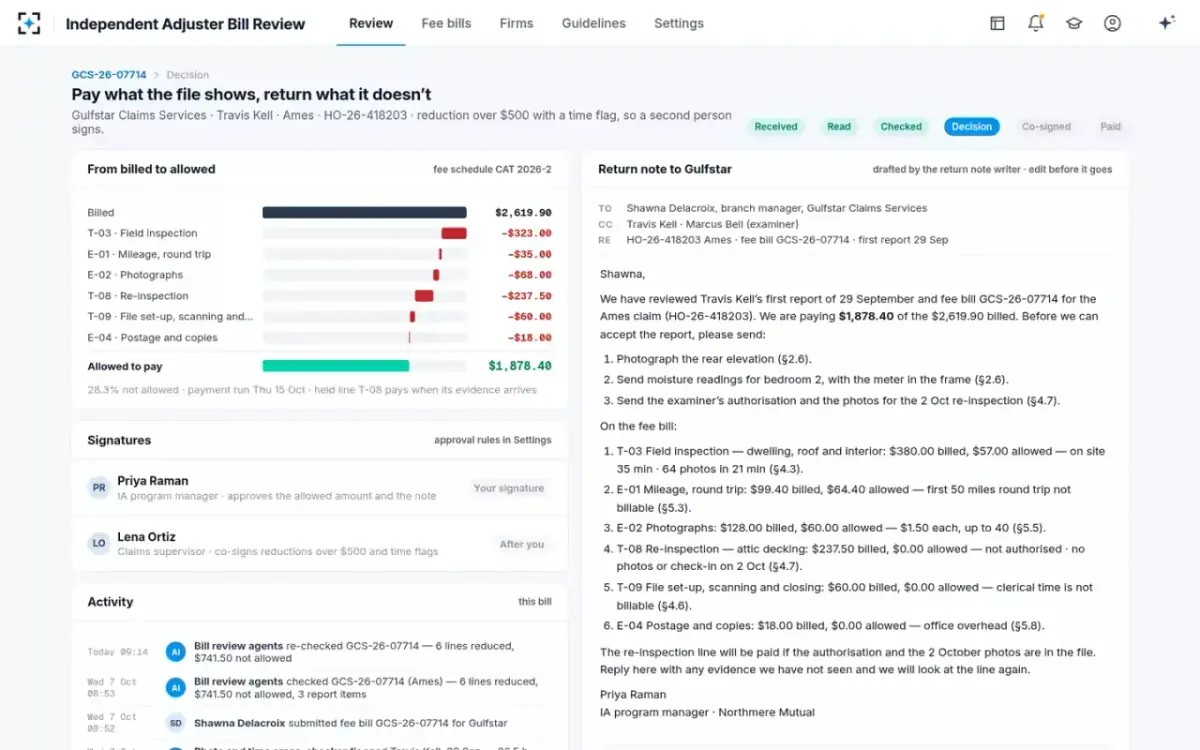
The output of one assignment is four things: a report, an estimate, a set of photographs and a fee bill. In the solution's sample storm, a firm's adjuster inspected a hurricane-damaged house, filed a nine-page first report with 64 photographs and a $165,820 estimate, and billed the carrier $2,619.90 in 14 lines. Each of the four is the adjuster's work, and each is checked by someone on the carrier's side before it counts. What the first report must contain, and when, is set out in the adjuster's preliminary report.
Who is responsible for an independent adjuster's mistakes?
The insurer is, to the policyholder and to the regulator, and the law says so in several ways. The NAIC's model unfair claims settlement practices act, the model many state unfair claims statutes are based on, defines "insurer" for its purposes to take in the agents, brokers, adjusters and third-party administrators who act in the business of insurance (NAIC Model 900, section 2). An unfair practice committed by an adjuster on a carrier's claim is, under that model, the insurer's practice.
Washington's claims rule, amended with effect from 18 October 2026, now makes insurers answerable for the accuracy of evaluations, including evaluations made for them by others (WSR 26-17-089, WAC 284-30-380(7)). The same rule carries a continuity duty when the adjuster changes: a status letter must include, "If a new adjuster has been assigned since last notice, confirmation that the new adjuster has reviewed the claim file and is prepared to timely continue the investigation."
Florida layers the duty through the firm. Each adjusting firm location must designate a primary adjuster, and "The primary adjuster in an adjusting firm is accountable for misconduct or violations of this code committed by the primary adjuster or by any other person under his or her direct supervision while acting on behalf of the adjusting firm." For emergency adjusters licensed in a catastrophe, the state's rule makes the insurer or firm that certified them answerable for their acts as if they held a regular licence (Fla. Admin. Code 69B-220.001), the subject of emergency adjuster licences in Florida.
"An adjuster shall make truthful and unbiased reports of the facts after making a complete investigation."
Florida Administrative Code 69B-220.201, code of ethics for all adjusters
Is the insurer liable for its adjuster in a lawsuit? That depends on each state's law of agency and bad faith, which this guide does not try to summarise. The regulatory answer above is enough for the claims operation: the insurer is examined on what its adjusters, staff or outside, did on its claims.
The accountability chain from assignment to payment
Because the carrier answers for the outside work, the chain from assignment to payment has to put a carrier's person at every point where the work becomes the carrier's position. The firm's people make the work; the carrier's people accept or return it, and pay or reduce the bill.
Who answers at each step of one outside assignment
A person decides
Carrier examiner assignsAssigns the claim to a contracted firm and writes what is authorised in the claim notes.
Never: An unrecorded authorisation, which the bill review cannot see
A person decides
Firm’s adjuster works the claimContacts the insured, inspects, photographs, estimates and files the first report.
Never: Work outside the licence or the assignment
A person decides
Firm’s branch manager billsSends the fee bill for the assignment, under the carrier’s fee schedule and guidelines.
Never: Lines the guidelines say are not billable
Agent
Agents read and testCode each bill line, test it against the schedule and the file, check the report against the report guidelines, draft one return note.
Never: Pay, reject, send a note or judge motive
A person decides
IA program manager decidesApproves the allowed amount, edits and sends the return note, refers a pattern to vendor management.
Never: A reduction without its section and evidence
A person decides
Claims supervisor co-signsSecond signature on reductions over $500 or any time flag, before the payment run.
Never: A large reduction on one person’s word
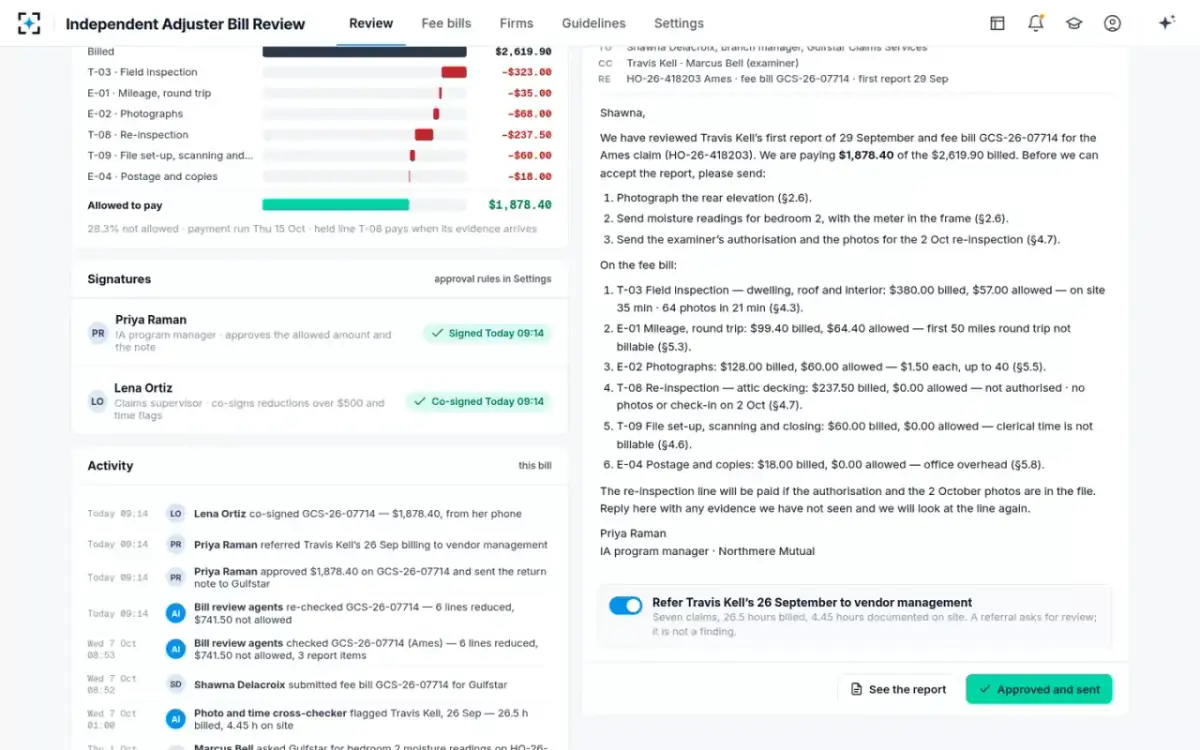
The last two steps leave a trail a market conduct examiner can follow without asking anyone. In the sample, the activity list on the bill shows the firm submitting it, the agents checking it, the program manager approving the allowed amount and referring the adjuster's day to vendor management, and the supervisor co-signing from her phone, each with a time.
Independent Adjuster Bill Review: signed and co-signed, the carrier's people on the bill's activity trail
Why the bill and the report are where the carrier exercises control
The fee bill and the report are the two documents an outside firm sends back, so they are the two places the carrier can test the work without re-doing it. The report shows whether the work meets the carrier's guidelines; the bill shows whether the carrier is being charged what its schedule allows for that work. The NFIP's Claims Manual puts the same responsibility on the insurer for expenses: "It is the insurer’s responsibility, or vendor’s if authorized, to confirm whether adjuster expenses are reasonable for the work performed."
Done by hand, that check becomes a sample. The sample carrier's program manager puts it in two sentences: "I can audit one bill in ten. The other nine get paid as billed." The over-billing that slips through is the kind only the whole file shows, such as a re-inspection nobody authorised in the claim notes or field hours the adjuster's own photographs do not support, and the report gaps that slip through come back months later as supplements. How a review can cover every bill without anyone pretending a machine has decided is the subject of the claims audit process for adjuster bills.
Independent Adjuster Bill Review: the decision the carrier's person signs
The people around one outside bill
Five people touch one outside fee bill, and only one of them works for the firm that wrote it. Their roles explain why the review has to be cited and explainable: each of them has to be able to defend the outcome to someone else.
Five roles around one outside fee bill, before and after
Today
Audits about one bill in ten; the rest are paid as billed.
With agents
Opens every bill already checked, each reduction cited, and sends one return note per bill.
Still theirs: The decision and the signature
Today
“Show me the evidence, not the accusation.”
With agents
Co-signs large reductions and time flags with the photos, log and section on each line.
Still theirs: The second signature
Today
Authorises re-inspections and asks for missing items in the claim notes.
With agents
An unauthorised re-inspection is held; the examiner’s requests go back to the firm.
Still theirs: Authority over the claim
Today
“Send me one note with everything, not five emails.”
With agents
Gets one note per bill with every item and its section, and a way to answer with evidence.
Still theirs: The right to restore a line
Today
Scores firms from a sample of bills.
With agents
Scores firms from every bill and report, and receives referrals with the evidence attached.
Still theirs: Panel decisions
The firm's view is the one most often left out of bill review design, and it decides whether reductions stick. A branch manager who receives one note with every item and its section can answer it in an afternoon; one who receives a reduction with no reason will dispute it on principle. How to roll review out so firms accept it is covered in invoice auditing software for adjuster bills.
Questions people ask
Is a staff adjuster better than an independent adjuster?
Neither is better by definition; they hold the same licence and are held to the same standards. FEMA, for example, exempts insurers' staff adjusters from its Flood Control Number but requires "the same specialized knowledge standards". The differences are employment and scale: staff adjusters work the carrier's claims all year, independent adjusters are added by volume.
Does a staff adjuster need a licence?
In states that license adjusters, yes. Florida requires a company employee adjuster to be licensed as an all-lines adjuster and appointed by the insurer, the same licence an independent adjuster holds. Licensing rules vary by state: the GAO found that two of the eight coastal states it contacted had no examination or continuing education requirements for claims adjusters during the 2005 hurricane season.
Can an independent adjuster also be a public adjuster?
Not at the same time in Florida. The state's ethics rule bars a licensed public adjuster from being appointed as a company or independent adjuster while licensed as a public adjuster, and bars switching sides on a claim the adjuster has already handled for the other party.
Who pays an independent adjuster?
The adjusting firm pays the adjuster, and the insurer pays the firm, usually per claim on a fee schedule set by size of loss, or by the hour on large losses. The policyholder does not pay. On federal flood claims, FEMA pays insurers under its published fee schedule and the insurers pay the adjusters, as set out in the NFIP adjuster fee schedule.
What is a desk adjuster compared with a staff adjuster?
A desk adjuster settles claims from photographs, estimates and calls without visiting the property; a field adjuster inspects in person. Either can be a staff or an independent adjuster, so the two words answer different questions: where the work is done, and who employs the person doing it.