The NFIP adjuster fee schedule that applies in 2026 is the 2023 NFIP Standard Adjuster Fee Schedule, issued by FEMA in bulletin W-23013 for flood claims with dates of loss on or after 1 October 2023 and reprinted as Appendix A of the June 2025 NFIP Claims Manual. It pays the adjuster one fee per claim, set by the gross loss: $680 for a loss up to $1,000, rising through seven flat bands to $2,235, then a percentage from 4.5% down to 2.8%, each with a floor. Claims that end without payment pay $510, and withdrawn or duplicate assignments $125. It matters beyond flood because it is the only complete adjuster fee schedule in US property insurance that is public; a carrier's own schedule for its independent adjusters is a private contract. Botminds' Independent Adjuster Bill Review exists to test each of those private bills against the carrier's own schedule and guidelines, and against the claim file, the day the bill arrives.
The rules below are quoted from FEMA's bulletin and manual and linked where they appear. The carrier, storm and fee bills used for comparison later on are fictional sample data from the solution, not market rates.
The NFIP adjuster fee schedule in four numbers
$680
the fee for a flood claim with a gross loss of $1,000 or less
2.8%
of gross loss over $1 million, and never less than $32,000
$510
a claim closed without payment after a site visit
$125
a claim withdrawn before inspection, or assigned twice
Which NFIP adjuster fee schedule applies in 2026?
For any flood claim with a date of loss on or after 1 October 2023, the 2023 schedule applies, and as of October 2026 FEMA has not replaced it. Bulletin W-23013 is dated 29 September 2023 and titled "NFIP Adjuster Fee Schedules – Fiscal Year (FY) 2024 Revision", which is why searches for a 2025 or 2026 schedule land on a document that says 2023. FEMA's list of bulletins to Write Your Own insurers runs from W-23014 to W-26004, issued in July 2026, without another fee schedule revision.
The June 2025 Claims Manual confirms it in its first lines on fees: the schedule in W-23013 "applies to claims with dates of loss on or after October 1, 2023." The same paragraph keeps a door open that matters after a large storm: "FEMA reserves the right to implement an alternative fee schedule for any catastrophic flood event." An adjuster or firm billing an event under an alternative schedule should be able to cite the bulletin that set it; a reviewer without that bulletin should test against the standard one.
Two schedules sit in the bulletin, and they are easy to confuse. The standard schedule covers building and contents claims. The 2022 Increased Cost of Compliance schedule, for claims under Coverage D, which pays toward the demolition, elevation, relocation or floodproofing of a flood-damaged building, was not revised in 2023 and still applies to ICC claims with dates of loss on or after 17 September 2022. Its fees run from $460 to $1,535, with $345 for a claim closed without payment and $90 for an erroneous assignment.
The 2023 NFIP adjuster fee schedule, band by band
The schedule has seven flat bands up to $50,000 of gross loss and six percentage bands above it. Each percentage band carries a floor, and the floors are not arbitrary: each equals the previous band's rate applied to the previous band's top. $6,750 is 4.5% of $150,000; $10,750 is 4.3% of $250,000; $32,000 is 3.2% of $1 million. The effect is that the fee never falls when a loss crosses into a band with a lower percentage. It stays flat for a stretch, then rises again.
The 2023 NFIP Standard Adjuster Fee Schedule, with the stretch where each floor applies
| Gross loss | Fee | Where the floor decides the fee |
|---|---|---|
| $0.01 – $1,000 | $680 | — |
| $1,000.01 – $5,000 | $1,035 | — |
| $5,000.01 – $10,000 | $1,340 | — |
| $10,000.01 – $15,000 | $1,520 | — |
| $15,000.01 – $25,000 | $1,650 | — |
| $25,000.01 – $35,000 | $1,910 | — |
| $35,000.01 – $50,000 | $2,235 | — |
| $50,000.01 – $150,000 | 4.5%, not less than $2,350 | up to $52,222 |
| $150,000.01 – $250,000 | 4.3%, not less than $6,750 | up to $156,977 |
| $250,000.01 – $350,000 | 4.0%, not less than $10,750 | up to $268,750 |
| $350,000.01 – $550,000 | 3.5%, not less than $14,000 | up to $400,000 |
| $550,000.01 – $1,000,000 | 3.2%, not less than $19,250 | up to $601,563 |
| Over $1,000,000 | 2.8%, not less than $32,000 | up to $1,142,857 |
| Erroneous assignment · claim withdrawn | $125 | flat |
| Closed without payment (CWOP) | $510 | flat |
The widest flat stretch is in the 3.5% band. Any gross loss from $350,000.01 to $400,000 pays exactly $14,000, because 3.5% of $400,000 is the first point at which the percentage beats the floor. The one place the schedule jumps rather than flattens is at $50,000: the last flat band pays $2,235, and the first percentage band starts at its $2,350 floor, $115 more for one cent of gross loss.
Read as a share of the loss, the schedule is steeply regressive by design. A small claim takes nearly as long to inspect, photograph and document as a moderate one, so the fee falls from more than two thirds of a $1,000 loss to about 4% at $50,000 and 3.2% at $1 million.
The fee as a share of the loss: from 68% of a $1,000 claim to 3.2% of a $1 million one
The schedule has moved since the last time a federal auditor priced it. Reporting on Hurricane Katrina in December 2006, the GAO wrote that "for the average claims settlement amount for Hurricane Katrina, $94,803, the NFIP fee schedule authorizes payment of 3 percent of the claim amount, or $2,844, for adjusting services." On today's schedule a gross loss of the same size falls in the 4.5% band and would pay $4,266.14, though a settlement is net of the deductible and depreciation and is therefore smaller than the gross loss the fee is now based on.
What is gross loss on an NFIP fee schedule?
Gross loss is the agreed cost to repair or replace, before depreciation, the deductible and salvage buy-back are taken off, and capped by the policy's limits. FEMA's definition is exact: "Gross loss means the agreed cost to repair or replace before the following is applied", followed by three items: depreciation, recoverable or not; the policy deductible; and salvage buy-back. It then lists what gross loss may not exceed: the building and contents limits on the declarations page, the program limits, the $2,500 special limits, $1,000 each for loss avoidance measures and for property removed to safety, $10,000 for pollution damage under the General Property form, and the policy's exclusions.
That definition decides most fee disputes, because the two common errors run in opposite directions. Billing on the net payment under-pays the adjuster; billing on an uncapped estimate over-pays. The worked example below is illustrative arithmetic, not a FEMA example.
One illustrative flood claim, three ways to read its gross loss
| Reading | How it is computed | Gross loss | Fee |
|---|---|---|---|
| Correct | Building estimate $62,400 + contents $14,800, with $4,100 of jewellery capped at the $2,500 special limit | $75,600 | 4.5% = $3,402.00 |
| Too low | The same, less $9,300 depreciation and a $2,000 deductible: the net payment, not the gross loss | $64,300 | 4.5% = $2,893.50 |
| Too high | The full estimate, with the jewellery uncapped | $77,200 | 4.5% = $3,474.00 |
Two details trip reviewers. The fee is computed on building and contents combined, as both of FEMA's own examples show. And a claim that is paid below the deductible is not, for fee purposes, a claim closed without payment, which is the next section.
What does a closed-without-payment claim pay the adjuster?
A claim closed without payment pays the adjuster a flat $510, but only when the adjuster did the work: the fee "Must include an adjuster site visit/inspection with the policyholder or their representative, photographs, and completed required forms." A claim handled by telephone alone is paid at the $125 rate for withdrawn or erroneous assignments. And a claim that closes with nothing paid because the loss is under the deductible is invoiced on the gross estimate, so it bills at its band rather than at $510.
The rest of the closed-claim rules turn on timing. If the policyholder withdraws after assignment but before inspection, the fee is $125. Once the adjuster has inspected, the claim must be reported in full and billed as closed without payment. If the policyholder withdraws, or stops pursuing the claim, after the adjuster has written an estimate, the adjuster receives the $510 and may be paid the balance of the band fee separately. FEMA's own example: an estimate of $1,500 earns a $1,035 fee; the claim is withdrawn; the adjuster receives $510 and the $525 balance is eligible for payment as a special allocated loss adjustment expense, after a withdrawal letter or a denial for failure to file a proof of loss within 60 days.
No-coverage closures carry a documentation condition that a reviewer can test from the report alone. When the damage was not caused by flood, or the property is not covered, the adjuster's narrative "must contain sufficient explanation and documentation of the facts regarding the reason no payment is due." A $510 bill on a claim whose narrative does not say why nothing is owed is the sort of line a claims audit checklist exists to catch. Why so many storm claims close this way is covered in claim closed without payment.
Supplements and reopened claims: the greater-of rule
When a closed flood claim is reopened and revised, the adjuster is paid the greater of $510 or the difference between the fee already paid and the fee on the whole revised claim. FEMA's two worked examples in the bulletin show both outcomes.
FEMA's two supplement examples: one pays the difference, one pays the $510 minimum
| Example 1 | Example 2 | |
|---|---|---|
| Original gross loss | $180,000 building + $70,000 contents = $250,000 | $165,000 + $50,000 = $215,000 |
| Original fee | 4.3% = $10,750 | 4.3% = $9,245 |
| Revised gross loss, whole claim | $240,000 + $95,000 = $335,000 | $170,000 + $55,000 = $225,000 |
| Fee on the revised claim | 4.0% = $13,400 | 4.3% = $9,675 |
| Difference | $2,650 | $430 |
| Supplemental fee paid | $2,650 | $510 (greater than the difference) |
The arithmetic slip in FEMA's own example is a useful reminder that a published schedule is still read by people. It does not change the outcome, but a reviewer who copies the bulletin's figure into a firm's dispute file would be repeating an error.
The rule that matters more for bill review is what the NFIP will not pay twice for. "The NFIP will not consider supplemental billings for inadequate or incorrect scope of repairs or avoidable estimating errors." It will consider supplemental billing for hidden or progressive flood damage. A supplemental fee therefore depends on why the claim was reopened, which is in the claim notes, not on the bill.
Can a flood adjuster bill time and expense?
Only with the insurer's approval in advance, and then the hourly bill replaces the schedule fee rather than adding to it. The Claims Manual is direct: when the complexity of a revision or adjustment warrants it, "the insurer or authorized vendor must approve before the adjuster can bill on time and expense." FEMA rejects an hourly bill without a time and expense sheet, and the sheet must give the date, the time rounded to the nearest quarter hour and a description of each activity.
Two further rules shape every hourly flood bill. The adjuster is paid the time and expense amount only, not that amount plus the schedule fee, and the insurer offsets it by the fee the schedule would have paid. And FEMA does not approve adjuster fees itself: "FEMA will not pre-approve adjuster fees; this is the responsibility of the insurer, or vendor if authorized." The manual's worked example, which still uses an older $395 closed-without-payment fee, shows the offset at work: an $800 schedule fee plus a $937.50 hourly invoice becomes a $542.50 special expense request after the $1,195 the schedule would have paid is deducted.
Some charges are never reimbursed as special adjustment expenses, whatever the bill says: lump sums, mileage within 100 miles of the loss location round trip, expenses on a policy found to be invalid, and anything undocumented or above federal travel rates. In the 48 contiguous states, lodging is reimbursed only above the $65 a night an adjuster is taken to spend anyway, and only up to the GSA rate. Every one of these is a rule a reviewer can apply to a line without calling anyone.
Where FEMA can withhold or reduce the fee
The schedule ends with a reservation that turns it from a price list into a quality standard. Under both schedules, the NFIP, through the insurers, reserves the right to withhold or reduce compensation on adjustment work deemed "Not to comply with NFIP standards", "Improperly prepared, requiring the claim to be substantially readjusted" or "Not timely adjusted, requiring reassignment." Each of the three is a judgment about the report and the file, not about the arithmetic of the bill.
That is why the fee and the report are reviewed together. The Claims Manual puts it in one line: "Claims examiners determine whether the adjuster’s work meets the standards established under this Manual and those of their company." The clocks a report is held to, a preliminary report within 15 days of assignment and a closing report 45 days after that, are set out in the adjuster's preliminary report.
Two other lines round out the bulletin. Texas sales tax on adjusting fees is reimbursed for claims adjusted in Texas, and in no other state. And incurred expenses the schedule does not cover, such as hotels, airfare, rental cars or a mobile home valuation fee, go through the special expense process with receipts.
How a private carrier's fee schedule differs: a sample next to FEMA's
A carrier's own schedule for independent adjusters usually follows the same shape, a fee by band of gross loss, with its own amounts, caps and a switch to hourly billing on large losses. The sample carrier in Independent Adjuster Bill Review, Northmere Mutual, is fictional, and so is its schedule, but it shows the differences a reviewer meets in practice.
The NFIP schedule next to a sample carrier's catastrophe schedule
NFIP, 2023 schedule: Gross loss before depreciation, deductible and salvage, capped by limits
Sample carrier, fictional: Gross loss across dwelling, other structures and contents
NFIP, 2023 schedule: $680 up to $1,000; $510 if closed without payment
Sample carrier, fictional: $350 up to $2,500, including closed without payment or under the deductible
NFIP, 2023 schedule: A percentage, 4.5% falling to 2.8%, with floors
Sample carrier, fictional: Over $150,000, time and expense: field $95 an hour, desk $75, travel $47.50
NFIP, 2023 schedule: Only with the insurer’s prior approval, offset by the schedule fee
Sample carrier, fictional: The rule above $150,000; re-inspection only if authorised
NFIP, 2023 schedule: Never reimbursed within 100 miles of the loss, round trip
Sample carrier, fictional: $0.70 a mile beyond the first 50 miles, round trip
NFIP, 2023 schedule: No photo charge on the schedule; photographs are a required part of the work
Sample carrier, fictional: $1.50 each, up to 40 per assignment
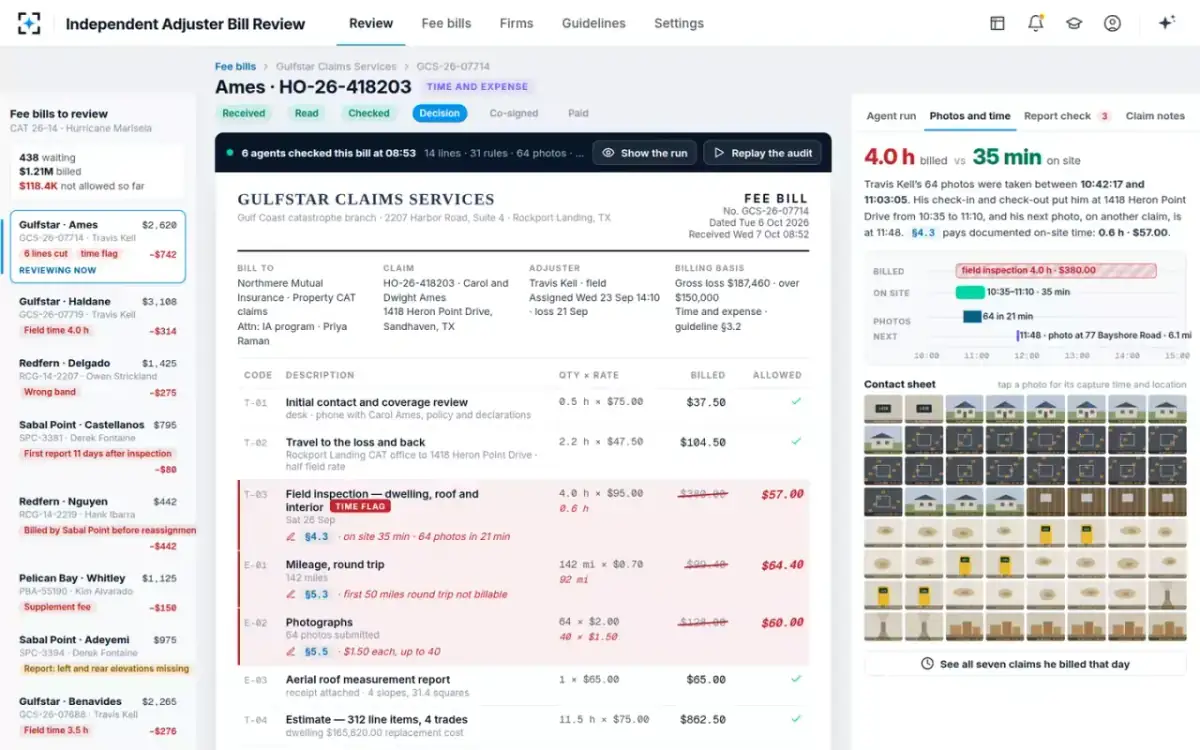
The large-loss row is where the two designs part. A percentage schedule pays the adjuster more as the loss grows, whatever the hours; an hourly schedule pays for the hours, which then have to be shown. In the sample, a wind claim with a gross loss of $187,460 was billed at $2,619.90 under the hourly rule. The same gross loss on a flood claim would carry an NFIP fee of $8,060.78. The comparison is illustrative only, since the perils, the work and the contracts differ, but it explains why hourly lines get the closer look: four hours of field time is a claim about the adjuster's day, and the day can be checked.
Independent Adjuster Bill Review: the sample fee schedule and the sections the agents cite
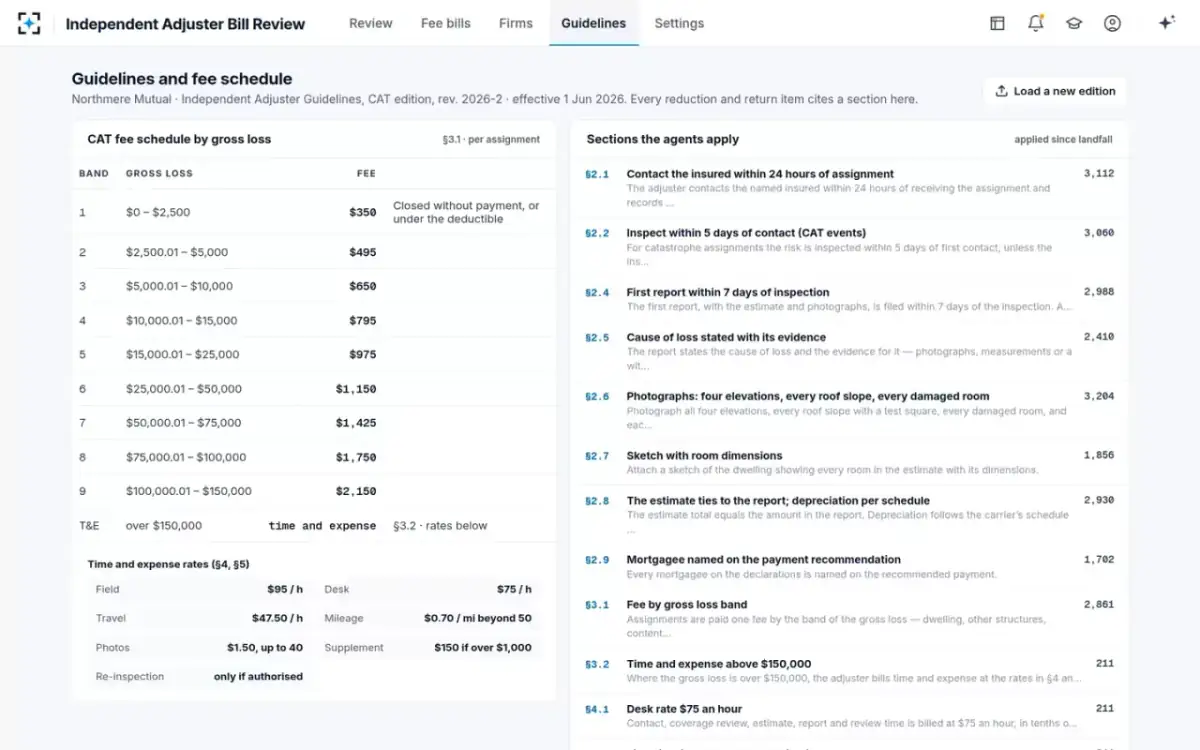
Checking a flood fee bill line by line with Independent Adjuster Bill Review
Most errors on a schedule bill come from three readings: the wrong gross loss, the wrong band, or a flat fee where another rule applies. In the sample queue, one firm billed a claim in band 7 at $1,425 when its gross loss of $41,280 sits in band 6, $1,150; another billed a supplement fee on a $640 supplement when the carrier's guideline pays one only above $1,000. Each is a one-line finding once the schedule and the claim's figures sit side by side, and each takes a person several minutes to find by hand.
Eight checks for an NFIP or schedule fee bill
- Date of loss against the schedule in force
On or after 1 October 2023 means W-23013, unless an alternative schedule was set for the event by bulletin.
- Gross loss rebuilt from the estimate
Before depreciation, deductible and salvage; capped by limits, special limits and exclusions; building and contents together.
- Band and floor
The band from the rebuilt gross loss, and the floor where the percentage falls below it.
- Closed without payment, or under the deductible
$510 needs a site visit, photos and forms; under the deductible bills on the gross estimate; telephone only is $125.
- Withdrawn or duplicate assignment
$125 before inspection; the removed adjuster on a double assignment gets $125.
- Supplement
The greater of $510 or the difference on the whole revised claim, and only if the reason was not an avoidable estimating error.
- Hourly lines
Prior approval in the file, a time sheet to the quarter hour, the schedule fee offset, no lump sums.
- Expenses
Receipts, GSA lodging rates, no mileage within 100 miles round trip, Texas sales tax only in Texas.
In the solution, the guideline checker finds the billing basis from the gross loss, band fee or time and expense, and tests every line against the rates, caps and exclusions of the guidelines in force on the assignment date. It proposes the allowed amount and cites the section; it never pays or rejects a bill. The IA program manager decides. How outside adjusters are paid during a catastrophe, and what a staffing request costs, is the subject of insurance claims temporary staffing; the whole review, bill by bill, is on Independent Adjuster Bill Review.
A fee bill with each line tested against the schedule
Questions people ask
Is there a TWIA adjuster fee schedule like the NFIP one?
Not from FEMA. The Texas Windstorm Insurance Association is not part of the National Flood Insurance Program, so W-23013 does not set its adjusters' fees, and this guide does not cover its arrangements. On a coastal Texas loss with both a flood claim and a wind claim, each is billed under its own program. The NFIP side has one Texas rule of its own: FEMA reimburses Texas sales tax on adjusting fees, and no other state's.
Who pays the adjuster on a flood claim?
Not the policyholder. The Claims Manual says FEMA uses the fee schedule "to make payment to insurers; the insurers, in turn, make payment to the adjusters." The insurer, or the vendor it authorises, decides whether the adjuster's work and expenses are reasonable before paying.
Is the NFIP adjuster fee schedule for 2025 different from 2026?
No. Both years use the 2023 schedule from W-23013, which applies by date of loss: on or after 1 October 2023. A claim with an earlier date of loss is billed under the schedule in force on that date. The Claims Manual's time and expense example, written for the schedule covering dates of loss from 24 August 2017, still shows that schedule's $395 closed-without-payment fee.
What is the FEMA flood adjuster fee schedule for ICC claims?
Increased Cost of Compliance claims use the 2022 ICC schedule, for dates of loss on or after 17 September 2022. Fees run from $460 for up to $1,000 to $1,535 for $25,000.01 to $30,000, with $345 for a claim closed without payment and $90 for an erroneous assignment.
Can FEMA use a different fee schedule after a catastrophe?
Yes. Appendix A of the June 2025 Claims Manual says FEMA "reserves the right to implement an alternative fee schedule for any catastrophic flood event." It would be issued by bulletin, so a fee bill under an alternative schedule should name it, and the reviewer should hold that bulletin in the file.
Does the fee schedule pay for a re-inspection?
Not as a separate fee. A revision is paid through the greater-of rule on the whole revised claim, and FEMA will not consider supplemental billing for avoidable estimating errors or an inadequate scope. FEMA's own general adjuster re-inspections, including random quality checks during flood events, are FEMA's oversight, not a billable adjuster service.