The claims auditing tools worth buying for independent adjuster fee bills are the ones that can show, on any reduced line, the guideline section it rests on and the evidence from the claim file, and that leave every decision to a person. Ask fifteen questions in four groups: about evidence, about guidelines and editions, about people and signatures, and about data and the adjusting firm's side. A good answer is specific and can be shown on a real bill in the demo; an evasive one talks about accuracy in general; a red flag is any tool that pays, rejects or labels anyone on its own. Botminds' Independent Adjuster Bill Review is one such tool, and this guide sets out how it answers each question, alongside what any buyer should hear from any vendor.
The regulatory expectations behind the questions are linked to their sources. Examples come from the solution's fictional sample storm, carrier and firms.
Fifteen questions for claims auditing tools, scored: good answer and red flag
| # | Question | A good answer | A red flag |
|---|---|---|---|
| 1 | Show me a reduced line. Where is the section? | The guideline text, by section and edition, on the line | “Our model flagged it” |
| 2 | Where is the evidence for that line? | The photo, check-in or claim note, opened from the line | A score or a confidence level |
| 3 | How do you check billed hours? | Against photo capture times and check-ins, across the adjuster’s day | Against industry averages |
| 4 | What do you do with time you cannot explain? | Report it as time, with a tolerance, and refer patterns to a person | Call it fraud, or score the adjuster’s honesty |
| 5 | Can it read our firms’ bills as they come? | PDF, e-bill and spreadsheet, in each firm’s layout, every line coded | A template every firm must adopt first |
| 6 | Which edition of our guidelines does a bill use? | The one in force on the assignment date, shown on the bill | Always the current one |
| 7 | How do we load a new edition? | Upload it; sections are cited by number from the day it takes effect | A change request to the vendor |
| 8 | Does it check the report as well as the bill? | Against our report guidelines, each gap pinned to a page or photo | Bills only |
| 9 | Who decides each bill? | A named person signs every bill; agents only propose | Automatic approval and rejection by default |
| 10 | Can we require a second signature? | Yes, by amount and by kind of finding | One approval level for everything |
| 11 | How does a firm answer a reduction? | One note per bill, with a reply path and a restore button | Disputes by email to the vendor |
| 12 | What data do you use about adjusters? | Only what the firm submitted to the file | Outside data, social media, or other carriers’ files |
| 13 | What is kept, and can we export it? | Every check, restore, signature and rule version, exportable | Logs the vendor keeps |
| 14 | How would we test you? | On our own past bills, against our reviewers’ decisions | A single accuracy figure from other clients |
| 15 | What happens when you are wrong? | The line is restored with a reason, and the rule or setting is fixed | “The model learns” |
What should a claims auditing tool for IA bills do?
It should do the reading and testing a reviewer has no time for, and stop where judgment begins. Concretely: read each bill in the firm's own format, code every line, test each against the guidelines in force on the assignment date, test billed time and extra work against the claim file, check the report against the report guidelines, draft one note to the firm, and leave the allowed amount, the note and any referral for a person to decide.
Regulators expect the carrier to answer for the tool's output. The NAIC's model bulletin on insurers' use of AI asks that an insurer's due diligence on third-party systems be able "to ensure that decisions made or supported from such AI Systems that could lead to Adverse Consumer Outcomes will meet the legal standards imposed on the Insurer itself." Fee bills concern firms rather than consumers, but the reports behind them decide what policyholders are paid, and the same governance applies to the whole review.
Five questions about evidence
Questions 1 to 5 test whether every finding can be defended to the firm that wrote the bill. The demo should be run on a real reduced line, not a slide: click the line and see the section, then the evidence, then the allowed amount and how it was computed.
Independent Adjuster Bill Review: one line, its section and its evidence
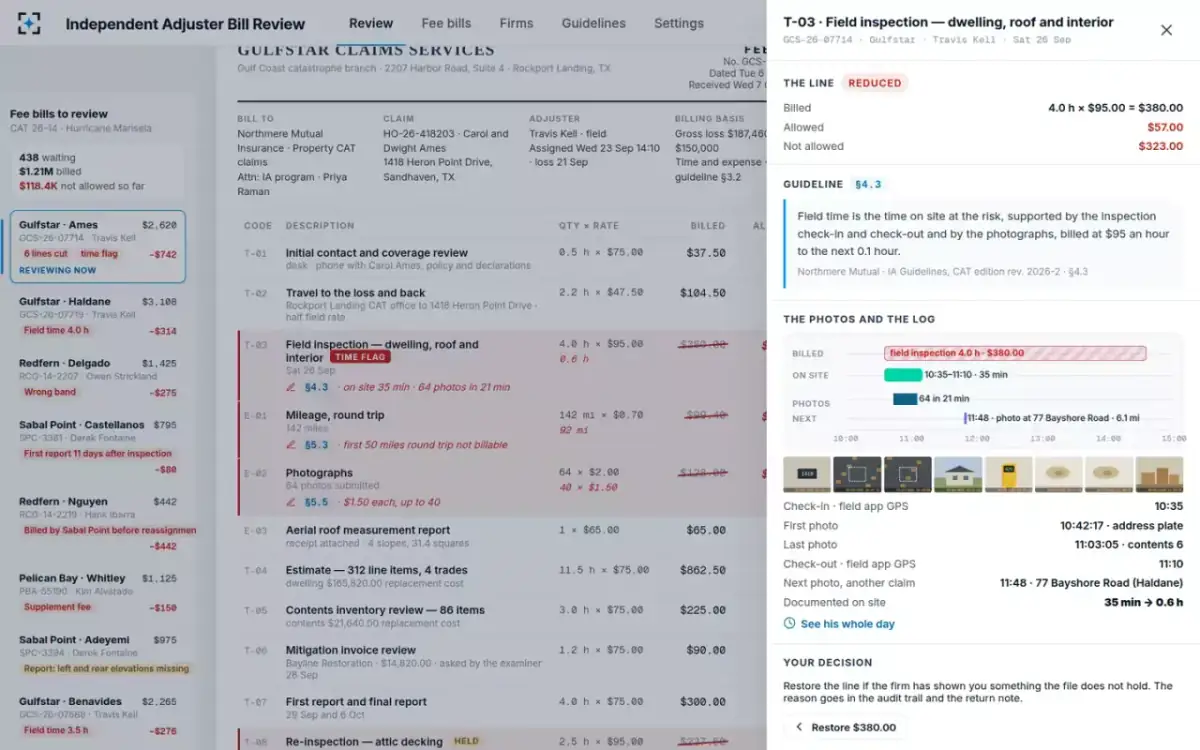
Question 3 is where tools divide. Some compare billed hours with an average for the task; that produces a number but not a reason the firm can check. The defensible check uses the adjuster's own timestamps: the check-in and check-out from the firm's field app, the capture times on the photographs, the first photo at the next address. In the sample, 4.0 billed hours met a 35-minute on-site window, and the allowed 0.6 hours is the documented time rounded up under the carrier's own section. How to read those timestamps fairly, with their limits, is the subject of an adjuster report checked against its photo times.
Question 5 is the practical one. Firms bill in their own layouts, and asking every firm to change before review starts delays it by a season. The federal flood program's billing rules for outside experts show what a line-level bill should separate: invoices must report "The site study/inspection time", travel time, report writing, an administrative fee and travel expenses with receipts. A tool should code any firm's lines into categories like these, whatever the layout.
Four questions about guidelines and editions
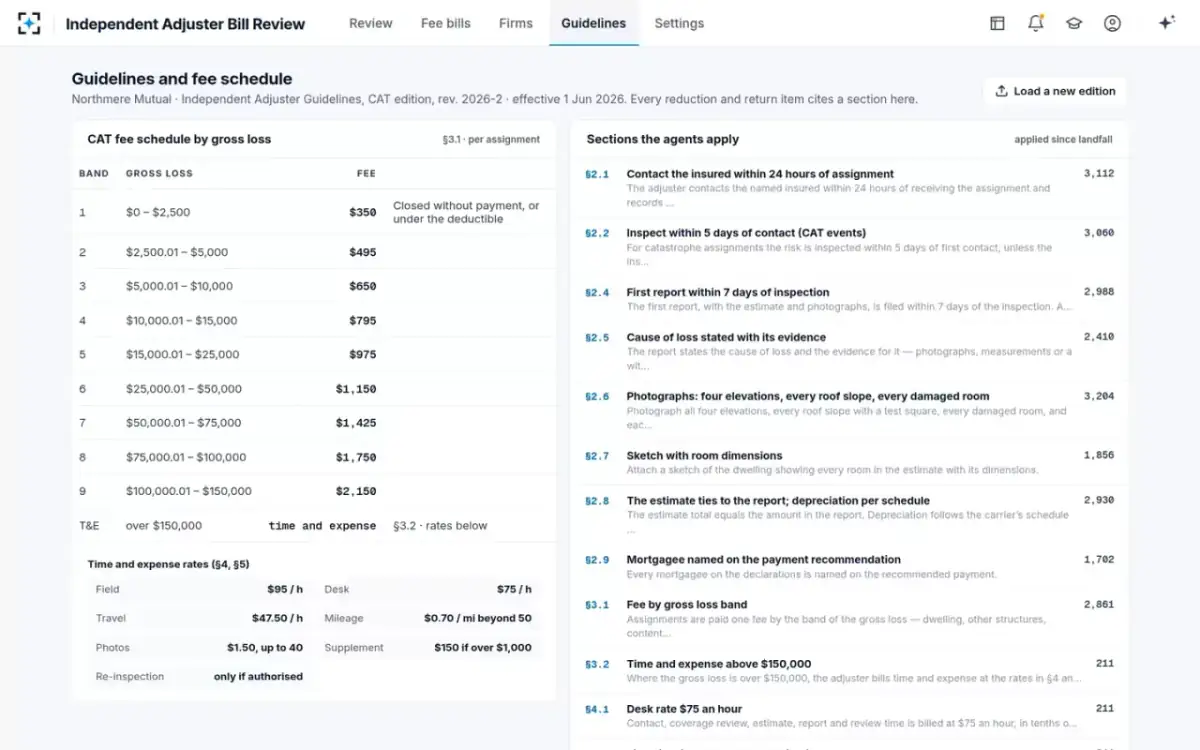
Questions 6 to 9 test whether the tool applies the carrier's rules as they stood, and keeps doing so as they change. Guidelines are revised between seasons and sometimes during one; a bill for a claim assigned in May should be tested against May's edition even if it arrives in October.
Guidelines loaded by edition, each section numbered and cited
Question 8 separates bill tools from programme tools. A bill can be correct for a report that is not finished, and the carrier will pay again for the supplement or re-inspection the gap causes. A tool that checks the report against the carrier's report guidelines, and puts the gaps in the same note as the bill reductions, lets the firm fix both at once. Washington's claims rule, in force since 18 October 2026, adds a reason not to rely on software alone for the report: an investigation may not rest solely on a database, estimating software or benchmarks (WSR 26-17-089, WAC 284-30-330(4)).
Three questions about people and signatures
Questions 9 to 11 test where the tool stops. The right answer to "who decides?" names a person and a role for every bill, a second person for the findings most likely to be disputed, and a path for the firm to answer. In the sample carrier, the IA program manager signs every bill, the claims supervisor co-signs reductions over $500 and any time flag, and the firm's branch manager can reply to the note with evidence.
Where people stay in Independent Adjuster Bill Review, on one sample bill
6
agents read and test the bill and report, and draft the note
2
people sign: the program manager, and a supervisor above $500 or on a time flag
0
bills paid, rejected or notes sent by an agent alone
1
note to the firm per bill, every item with its section
Automatic approval of clean bills is a fair feature if the carrier switches it on, sets the threshold and can switch it off. It is a red flag as a default. Automatic rejection is a red flag in any form: a bill that breaks a rule should come back to a person with the rule cited, not disappear.
Three questions about data and the firm's side
Questions 12 to 15 test what the tool knows about people and what it leaves behind. The only defensible data about an adjuster is what the adjuster's firm submitted to the claim file: the bill, the report, the photographs and their metadata, the check-ins. A tool that enriches its findings with outside data about adjusters is building a profile no firm agreed to and no reviewer can show.
What it leaves behind matters for examinations. The NAIC's model claims regulation expects claim files to hold enough to reconstruct what the insurer did, and expects claim data to be retrievable for examination (NAIC Model 902, section 4). For bill review that means every check, every restored line with its reason, every signature and every rule version, held by the carrier and exportable without the vendor's help.
What should a bill review tool never do?
Five things: pay a bill, reject a bill, send a note to a firm, state why a person billed what they billed, and use anything the firm did not submit. Each of the five turns a review into a decision or a judgment about a person, and each would leave the carrier defending something no named person decided.
Proposing and deciding: where the line sits
The tool may: Propose an allowed amount for every line, with the section
The tool may never: Pay or reject the bill
The tool may: Report billed against documented time, with the tolerance
The tool may never: Say why the hours differ, or that anyone meant to overbill
The tool may: Show a pattern and offer a referral for a person to send
The tool may never: Send the referral, or call it fraud
The tool may: Draft one note with every item and its section
The tool may never: Send the note without a person
The tool may: Use the bill, report, photos and check-ins the firm submitted
The tool may never: Use outside data about the adjuster
The tool may: Score firms and adjusters from every bill
The tool may never: Remove a firm or adjuster from the panel
Does bill review software accuse adjusters of fraud?
It should not, and a buyer should ask to see what the tool says when billed time exceeds the day. FEMA's training for flood adjusters sets the same standard for the adjusters themselves when they suspect fraud: "The adjuster should not draw any conclusions regarding the suspected fraud and should only present facts in written reports". A review tool should hold itself to no lower a standard than the people it reviews.
In the sample, seven bills from one adjuster billed 26.5 hours of field time on a Saturday whose check-ins ran from 08:05 to 16:21. The tool's finding reads as time: billed hours, documented hours, the evidence, and a line that says it reports time, not intent. The program manager decides whether to refer the day to vendor management, and the referral itself says it is a request for review, not a finding. Fraud investigation, if it ever comes to that, is a separate function with its own rules.
Scoring the demo, and pricing the tool
Score each of the fifteen answers good, evasive or red flag, on the vendor's demonstration with your own bills where possible. Any red flag on questions 4, 9 or 12 is disqualifying on its own: those are the questions about motive, decisions and data, where a wrong answer is a regulatory problem rather than a feature gap.
Before the demo: what to bring
- Twenty past bills from three firms
With your reviewers’ decisions, so the tool’s proposals can be compared line by line.
- The guidelines in force when they were assigned
And the current edition, to see both applied.
- Two bills you know are wrong, and why
One against the schedule, one against the file.
- The reports and photographs behind them
With metadata intact, and the firm’s check-in log if you have it.
- Your approval rules
Who signs, above what amount, and what needs a second signature.
Price is the question vendors answer least directly, and there is no public benchmark for it. Judge it against reductions that survive the firm's answer, net of the review's cost, rather than against reductions proposed. The rollout that earns firms' trust in the tool, rung by rung, is set out in invoice auditing software for adjuster bills, and the KPIs to judge it by in claims audit vendors or full review. Every answer in this guide can be seen on one bill on Independent Adjuster Bill Review.
Questions people ask
Can bill review software read PDF fee bills?
It should read PDFs, e-bill files and spreadsheets in each firm's own layout, code every line and tie quantity × rate to the total, without asking firms to change format. Ask to see a bill from a firm the vendor has never seen, read live.
How much does claims audit software cost?
There is no public price benchmark; vendors price by volume, users or findings. Compare offers on net reductions that hold after firms answer, and be wary of pricing tied to the amount cut, which rewards cutting.
How do I score a claims audit vendor demo?
Mark each of the fifteen answers good, evasive or red flag, on your own bills. Treat a red flag on motive, on who decides or on outside data as disqualifying; treat evasive answers on evidence as a reason for a pilot before any contract.
Is a claims auditing tool the same as claims management software?
No. Claims management software runs the claim: notice, reserves, payments, diary. A claims auditing tool for adjuster bills reads what outside firms send back and checks it before payment; it works beside the claims system, taking the claim notes and authorisations from it.
What should a claims auditing tool do with a bill it cannot read?
Say so, line by line, and send it to a person. A tool that guesses a line it cannot read, or drops it, produces a total no one can defend; in the solution the fee bill reader never alters a billed figure and cites page and line for every value it reads.