Invoice auditing software checks a supplier's invoice against what was agreed and what was delivered before it is paid. For an independent adjuster's fee bill, what was agreed is the carrier's fee schedule and guidelines in force on the assignment date, and what was delivered is in the claim file: the report, the photographs with their capture times, the adjuster's check-ins and the examiner's notes. Software that tests only the first finds the easy errors; software that tests both finds the expensive ones. Either way, it saves nothing if the adjusting firms dispute every reduction, so the rollout matters as much as the rules. Botminds' Independent Adjuster Bill Review tests every line against the schedule and the file, cites the section and the evidence for each reduction, and sends the firm one note it can answer.
The regulatory points below are linked to their sources. The carrier, firms and bills are fictional sample data from the solution, and the rollout plan is our suggestion, not a regulatory requirement.
The trust ladder: each rung earned by a measure before the next
1
Shadow review
The agents check every bill; reviewers decide as they always have, then compare. Nothing new reaches a firm.
Earned byMoves up when reviewers agree with the agents’ proposals on most lines, and every disagreement has been traced to a guideline or a setting.
2
Cited reductions to the firms
Schedule findings go out in one return note per bill, each with its section, signed by the program manager.
Earned byMoves up when few reductions are restored after firms answer, and the restores share no common cause.
3
The file checks, with a second signature
Billed hours against photo times and check-ins, unauthorised work held; any time flag needs a co-signer.
Earned byMoves up when time findings hold after firms answer, and no firm can show a systematic gap in its field app data.
4
Clean bills paid without a person opening them
Under a threshold, with no flags, report guidelines met and a firm score above a floor. Switched on per firm, if at all.
Earned byStays earned only while a random check of approved bills finds nothing the agents missed.
Why accounts payable invoice audit software misses adjuster bills
Accounts payable tools are built around the three-way match: invoice against purchase order against goods received. An adjuster's fee bill has no purchase order line for "field inspection, 4.0 hours", and its goods received are a report and a set of photographs. The rate depends on the claim's gross loss and on which edition of the guidelines applied on the day of assignment. A tool that cannot read those cannot test the bill.
An accounts payable invoice audit next to an IA fee bill review
Accounts payable invoice audit: A purchase order or contract price
IA fee bill review: A fee schedule by gross-loss band, hourly rates, caps and exclusions, by edition
Accounts payable invoice audit: A goods receipt or a service sign-off
IA fee bill review: A report, an estimate, photographs with capture times, check-ins and claim notes
Accounts payable invoice audit: Price or quantity off the order, a duplicate invoice
IA fee bill review: The wrong band, unbillable time, hours the photos do not support, unauthorised work
Accounts payable invoice audit: A supplier’s accounts receivable desk
IA fee bill review: A firm’s branch manager, on behalf of an adjuster
Accounts payable invoice audit: None: the invoice is the whole deliverable
IA fee bill review: The report, which can be returned with its own gaps
That is why an accounts payable invoice audit checklist covers only the first layer of an adjuster bill: arithmetic, duplicates and receipts. The second and third layers, the bill against the file and the report against the guidelines, are specific to claims, and they are worked through in the claims audit checklist for IA bills.
What firms need before they accept a reduction
A firm accepts a reduction it can check. That means four things on every reduced line: the guideline section it rests on, the evidence from the file, the amount allowed instead, and a way to answer. A reduction without a section reads as an opinion; one without the evidence reads as an accusation; one without a way to answer reads as final, and is disputed on principle.
Claims regulation already expects this habit of explanation from adjusters themselves. Florida's code of ethics requires an adjuster who changes a detailed residential estimate to say why: "Any changes made to a prior detailed estimate of the amount of the loss provided to the insured or insurer must include an explanation which provides the reason for any change made." A carrier that reduces a firm's bill is changing the firm's figure, and the same standard is the one that wins acceptance.
"Send me one note with everything, not five emails."
Shawna Delacroix, branch manager at a fictional firm in the solution's sample storm
Consistency is the fourth need. A firm that sees the same line cut on one bill and paid on the next, by two reviewers reading the guideline differently, has a fair complaint. Software that applies the same edition to every bill from the same assignment date removes that complaint, provided each setting the carrier changes is saved as a version and the version used is visible.
The rollout ladder, rung by rung
Roll bill review out to outside firms in four rungs, and move up only when a measure says the last one is working. The ladder above gives the order; the timeline below gives one way to pace it over a season's first quarter.
A suggested first 90 days, from shadow review to paying clean bills untouched
- Shadowwk 1–4 · shadow
- Citedwk 5–8 · cited reductions
- File checkswk 9–11 · file checks
- Clean billswk 12–13
Shadow review is the cheapest rung and the most important. The agents propose an allowed amount for every bill; the reviewers decide as before; the two are compared line by line. Every difference has one of three causes: the agents misread a guideline, the reviewers apply an unwritten rule, or the guideline itself is ambiguous. All three are worth finding before a firm sees a single note.
The second rung sends schedule findings only, the least disputed kind, to one or two firms first. The third adds the checks against the file, such as billed hours against photo times, which are the most valuable and the most disputed, and puts a second signature on every one. The fourth, paying clean bills without a person opening them, is optional and should stay that way.
Can clean bills be paid without review?
They can be paid without a person opening them, but not without review: the agents still read and test every line, and the carrier decides by rule which clean bills may pass. In the solution that rule is a setting, off unless switched on: in the sample, bills under $1,500 with no flags, every report guideline met and a firm score above 75 may be approved automatically, and the choices are $1,000, $1,500, $2,500 or never.
The setting is a decision made once by a person, and it should be revisited the way any delegated authority is. A random check of auto-approved bills each month is the measure that keeps the rung earned. The federal flood program keeps a similar discipline on speed: it expects files to be examined within seven business days of the closing report, and claims paid within seven business days of that review, but examined all the same.
How do adjusting firms respond to bill reductions?
With evidence, if the process lets them. Some reductions are wrong: a check-in that the field app failed to send, an authorisation given by phone and written up late. A firm that can answer a line with the missing evidence, and see it restored, learns that the review is about the file, not about the firm.
Independent Adjuster Bill Review: one line's evidence, and the button that restores it
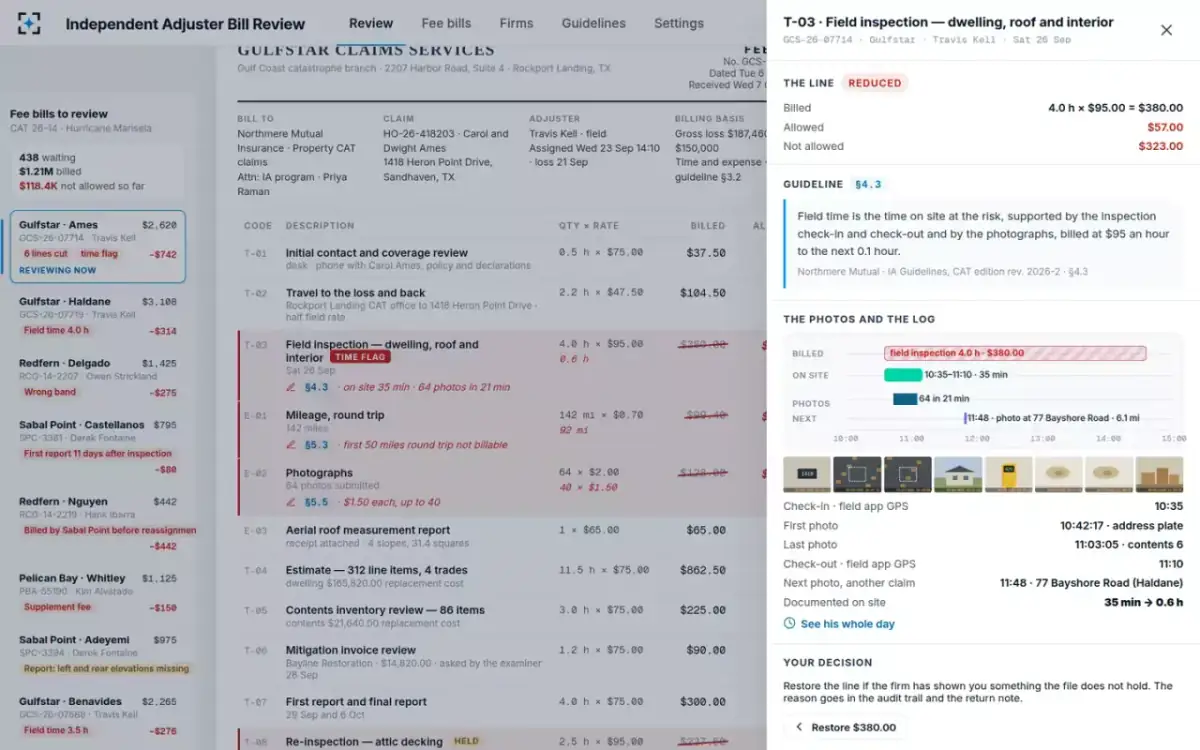
Two settings reduce friction further. Paying the clean lines while one line is held means a firm is not kept waiting for its whole bill over one disputed re-inspection; the held line pays when its authorisation arrives. FEMA follows the same logic with policyholders, paying the part of a claim the proof of loss supports while the rest is resolved. And sending report gaps in the same note as the bill decision means the firm fixes the report and answers the bill in one pass.
The return note: one message, every section
The return note is where acceptance is won or lost, because it is the only part of the review the firm sees. In the solution, the return note writer drafts one note per bill with every report gap and every reduction, each with its section, in plain words and without accusations; the program manager edits it and sends it. It never goes on its own.
Independent Adjuster Bill Review: one note to the firm, ready to edit
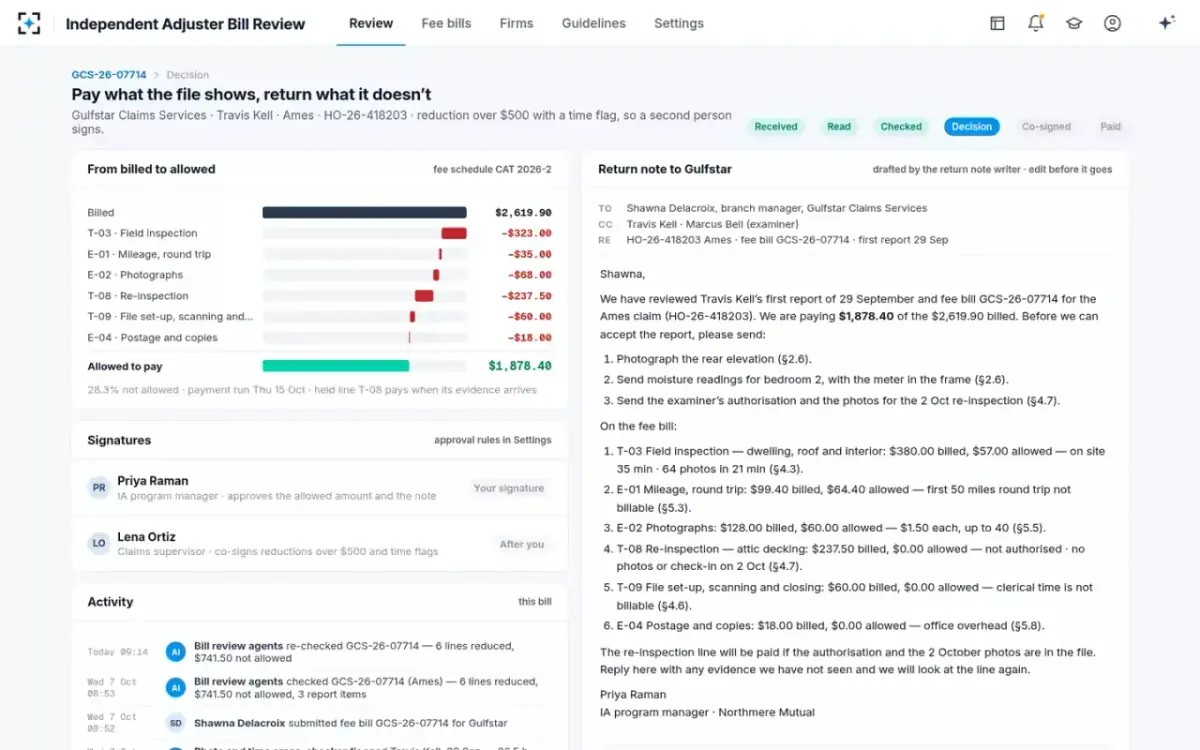
The note's last line in the sample is the one that matters most: "Reply here with any evidence we have not seen and we will look at the line again." Regulators are moving the same way with policyholders. Washington's claims rule, in force since 18 October 2026, requires an insurer that relies on a database, survey, estimating software or benchmarks for prices to tell the claimant, on request, when and where the data was collected and which businesses supplied it (WSR 26-17-089, WAC 284-30-380(8)). Showing the basis is becoming the price of using a tool.
What the carrier's contract should say about the software
The carrier answers for decisions its tools support, so the software contract should give it what a regulator will ask for. The NAIC's model bulletin on AI, which 29 jurisdictions had adopted by October 2026, suggests that an insurer's program address third-party systems with contract terms that give audit rights and that "Require the third party to cooperate with the Insurer with regard to regulatory inquiries and investigations related to the Insurer’s use of the third-party’s product or services."
Three further terms matter for bill review in particular: the carrier owns the guidelines, the findings and the audit trail, and can export them; every rule change is versioned and dated; and the software uses only what the firm submitted to the file, with no outside data on adjusters. The last is also what firms will ask about first.
Who has to trust the review, and what each of them needs to see
Today
Reductions without sections, in several emails, weeks after the work.
With agents
One note per bill, every item with its section and evidence, and a reply path.
Still theirs: The right to restore a line with evidence
Today
One bill in ten read; disputes argued from memory.
With agents
Every bill read before it is opened; disputes answered from the line’s evidence.
Still theirs: The decision and the note
Today
Asked to back reductions without seeing the file.
With agents
Co-signs time flags and large reductions with the photos and log on screen.
Still theirs: The second signature
Today
Firm reviews built on a sample and anecdotes.
With agents
Firm scores from every bill, and referrals that arrive with their evidence.
Still theirs: Panel decisions
An invoice audit checklist for the first 90 days
Before each rung: what to have in place
- Guidelines loaded by edition, with effective dates
So every bill is tested against the version in force on its assignment date.
- The unwritten rules written down
Shadow review will surface them; each becomes a section or is dropped.
- Firms told what is changing, and when
One letter to each branch before rung 2, with a sample note.
- A reply path that reaches a person
Evidence from the firm restores a line with a reason on the trail.
- Thresholds for the second signature
In the sample: reductions over $500 or any time flag.
- A tolerance for field time
In the sample: 30 minutes, so rounding and a short walk around the house do not raise a flag.
- A random check of approved bills
Monthly, before and after clean-bill approval is switched on.
- Exports the carrier owns
Findings, notes, signatures and rule versions, for examiners and auditors.
The questions to put to any vendor of such software, with good and evasive answers, are in fifteen questions for claims auditing tools. The whole review, from the bill arriving to the note going out, is on Independent Adjuster Bill Review; casualty programmes reviewing defence counsel invoices rather than adjuster bills have a different set of rules, covered by Legal Bill Review.
Questions people ask
What goes on an invoice audit checklist for adjuster bills?
Three layers: the bill against the fee schedule (edition, band, rates, caps, unbillable categories, arithmetic, receipts), the bill against the claim file (who held the claim, authorisations, billed hours against photo times and check-ins, the adjuster's whole day), and the report against the report guidelines. A generic accounts payable checklist covers only the arithmetic and receipts.
What is vendor invoice automation, for an IA programme?
Reading bills in each firm's own format, PDF, e-bill or spreadsheet, coding every line and testing it without retyping. Automation that stops at capture and routing moves the same bills faster to the same overloaded reviewers; the saving comes from the tests.
How long does it take firms to accept automated bill review?
Our suggested rollout reaches all firms with file checks by week 9 and clean-bill approval by week 12, but the pace is set by the measures, not the calendar. If many reductions are restored after firms answer, the review is cutting what the file does not support, and the next rung should wait.
Should firms see the guidelines the software uses?
Yes. A firm cannot follow a guideline it has not seen, and a reduction that cites a section the firm can read is the one least likely to be disputed. Washington's 2026 rule points the same way for claimants: on request, insurers must disclose the sources behind database and benchmark pricing.
Does the software replace the IA program manager?
No. It reads and tests every bill and drafts the note; the program manager decides every bill, edits and sends the note, and refers patterns. Clean bills are approved without a person opening them only if the carrier sets that rule.