An adjuster's preliminary report is the first formal report an adjuster sends the insurer after inspecting a claim: it describes the property and its use, states the cause and extent of the damage with annotated photographs, recommends the reserves the claim should carry, and raises anything the insurer must act on early, such as an underwriting question, a request for an engineer or a building that may be substantially damaged. On federal flood claims it is due within 15 calendar days of the loss assignment, the closing report 45 days after it, and an interim report every 30 days while the claim stays open. Carriers set their own clocks for outside adjusters, usually shorter, and the first report is where most report guidelines are first met or missed. Botminds' Independent Adjuster Bill Review checks each first report against the carrier's report guidelines the day it lands, beside the fee bill for the same work.
FEMA's National Flood Insurance Program publishes the standard in full, so it is quoted below and linked where it appears. The carrier's clocks and the reports used as examples are fictional sample data from the solution.
What an adjuster's preliminary report must contain, on a federal flood claim
- The whole form, signed, with the adjuster’s Flood Control Number
An unsigned report, or one without an active FCN, is an error in itself.
- Reserves recommended from the inspection
Building and contents, net of limits and deductible, updated as the claim moves.
- The risk described
Use, flood zone, basement or not, principal or seasonal residence, foundation type.
- Perimeter photographs and damage photographs, annotated
Each exterior photo labelled with where it was taken, such as north side or rear crawlspace.
- The water
When it entered and receded, its source, how long it stayed, and the interior and exterior heights.
- Other insurance and other adjusters
Carrier, policy and claim numbers and contacts, or the request sent for them.
- A memorandum for any special issue
A customer service issue, a large advance, an outside professional, an underwriting referral.
- An engineer request where wind and flood overlap
With the report and all photographs attached.
- The preliminary damage assessment, where damage may be substantial
Sent to FEMA and the insurer when repair may reach 50% of market value.
What is an adjuster's preliminary report?
It is the adjuster's first account of the claim to the insurer, written after the first inspection and before the estimate is final, so that the insurer can set reserves, decide on advances and act on problems while they are still cheap. FEMA's training for flood adjusters puts it simply: "The adjuster’s first report is the Preliminary Report Form." On flood claims it is a FEMA form, the Adjuster's Preliminary Report; on private carriers' claims it is usually called the first report and follows the carrier's own guidelines.
Its job is different from the closing report's. The closing report summarises a finished adjustment, with the estimate, the coverage applied and the settlement recommendation. The preliminary report tells the insurer what kind of claim this is: how large, how complicated, what it may cost, and what needs deciding now. A good one is short; a complete one leaves the examiner nothing to chase.
"All reporting from the adjuster should be limited to facts and observations that lay the groundwork for the adjuster’s recommendation."
FEMA NFIP Claims Manual, June 2025, Reporting
How soon is an adjuster's first report due?
On federal flood claims, within 15 calendar days of the adjuster's receipt of the assignment, with the closing report 45 days after the preliminary report, or an interim report instead and then every 30 days until the claim is done. FEMA's course for adjusters asks for more speed where possible: submit it "preferably the same day as the inspection but no later than 15 calendar days after the assignment", and expect that the company you work for may want it sooner.
The clocks on one federal flood claim, from assignment to closing
- To preliminaryby day 15 · preliminary
- To closing or interim+45 d · closing, or interim
- Next interim+30 d · day 90
- Next interim+30 d · day 120
One detail is worth knowing before writing a carrier guideline on the same model. The manual measures the 45 days from two different points. Its reporting section counts them from the preliminary report; its list of time-standard violations includes a "Closing report not submitted within 45 calendar days of DOL.", the date of loss. On a claim assigned late, the two give different deadlines. A carrier's guidelines should name one starting point for every clock, and a reviewer should test against that one.
The examiner's side has clocks too. FEMA lists as findings a preliminary report not received within 15 calendar days of assignment and a policyholder not contacted within two business days of it, and expects the examiner to revise reserves within five business days of receiving each preliminary, interim or closing report.
What goes in a preliminary report: the NFIP's list
The checklist above condenses what the Claims Manual and FEMA's course require. Three items carry most of the weight in practice.
The photographs come first, because every later decision leans on them. The manual asks for "Sufficient photographs, properly annotated, that describe the risk, address any underwriting concerns, and support the cause of loss and extent of damage to building and contents in the preliminary assessment." Annotation is not decoration: an exterior photograph labelled "north side" can be matched to the sketch, and an unlabelled one cannot.
The memorandum is the second. When the inspection turns up a special issue, the adjuster should attach a narrative memorandum to the preliminary report: a customer service problem, support for a large advance payment, a request for an outside professional, or an underwriting referral. Underwriting issues in particular must be raised promptly, citing the policy's current rating, the facts and the supporting photographs, because the insurer must resolve them before it can close the claim.
The third is the substantial damage assessment. Where the cost to repair may reach half the building's pre-damage market value, the adjuster completes FEMA's preliminary damage assessment as soon as possible after the inspection and sends it with the preliminary report, so that the community can direct its own inspections. Only a community can determine substantial damage; the adjuster's job is to flag it early.
Reserves on the first report
The preliminary report is where reserves stop being a system default. The manual is direct: the adjuster "must recommend reserves on the Preliminary Report and provide updated reserves as the claim progresses." It defines them as the adjuster's best approximation of the damage to the insured building and contents before an estimate is prepared, reflecting coverage limitations and the deductible.
The examiner then owns the number. FEMA expects the examiner to update reserves promptly on receiving the preliminary report and each interim report, and lists reserves not updated on receipt of the preliminary report as a violation in its operation reviews. How reserves are set and tested more broadly is the work of reserving teams; for a bill reviewer, the point is narrower. A first report without a reasoned reserve recommendation is incomplete, however good its photographs.
Interim reports every 30 days
When a claim cannot be closed within 45 days of the preliminary report, the adjuster files an interim report, and another every 30 days until it is done. It need not be long: "The Interim Report can be a brief memorandum notifying the NFIP insurer of the claim handling status, or a copy of correspondence from the adjuster to the policyholder requesting additional information or reminding the NFIP insurer of previously requested information discussed at the inspection." The adjuster should also file one whenever something arises that the insurer should know before the final recommendation.
State claims rules put a parallel duty on insurers toward policyholders. Washington's rule, amended with effect from 18 October 2026, requires a written notice every 30 days while an investigation remains unresolved, summarising the amount of loss, each item the insurer is waiting for and, if the adjuster has changed, confirmation that the new one has reviewed the file (WSR 26-17-089, WAC 284-30-370). An insurer can only write those letters from interim reports that say something.
When the adjuster's report becomes the payment document
After a large flood, the report can carry more than a recommendation. Following Hurricane Milton, FEMA directed that "NFIP insurers must exercise the option to accept their adjuster’s report to evaluate and pay a claim instead of a signed proof of loss." The policyholder received a copy of the adjuster's report supporting the payment, and a written explanation if the payment was less than the report.
Florida applies a similar transparency rule to residential claims generally: the insurer "must send the policyholder a copy of any detailed estimate of the amount of the loss within 7 days after the estimate is generated by an insurer’s adjuster." In both cases the adjuster's work goes straight to the policyholder, which raises the price of a gap. A missing elevation or a room without moisture readings, caught by the examiner a month later, is a gap the policyholder has already seen.
Writing it so the examiner does not send it back
FEMA's guidance on reports comes down to three habits. Keep to what was observed: opinions belong in a report only with the explanation that justifies them, and sarcasm or demeaning comments belong nowhere in the file. Answer questions before they are asked: the manual's tip for closing reports is to write "with the idea to answer questions before they are asked." And make every photograph findable: labelled, matched to the sketch, and covering undamaged elements and damage from other causes as well as the claimed damage.
What the examiner checks on a preliminary report, and the fix before sending
| The examiner checks | Send it with |
|---|---|
| Received within 15 days of assignment, signed, with the adjuster’s FCN | The date, the signature and an active number; a narrative if the inspection was delayed |
| Perimeter photographs of the risk and photographs of the damage | Every side of the building, each photo annotated with its location |
| Accuracy against the declarations page | Rating, foundation and occupancy as found, with any discrepancy raised as an underwriting referral |
| Advance payment requests | The request, or the reason none was recommended when one was authorised |
| Reserves | A recommendation by coverage, reflecting limits and deductible |
| Substantial damage | The preliminary damage assessment, where repair may reach 50% of value |
What Independent Adjuster Bill Review tests a first report against
A carrier's own guidelines for outside adjusters usually follow the NFIP's shape with tighter clocks and more specific photo rules. The sample carrier in Independent Adjuster Bill Review is fictional, but its first-report guidelines are typical of what a catastrophe edition contains, and they show how the federal standard translates.
The federal flood standard next to a sample carrier's first-report guidelines
NFIP, June 2025 Claims Manual: Within 48 hours of the assignment
Sample carrier, catastrophe edition, fictional: Within 24 hours of the assignment
NFIP, June 2025 Claims Manual: Promptly on assignment; delays explained
Sample carrier, catastrophe edition, fictional: Within 5 days of contact, for catastrophe assignments
NFIP, June 2025 Claims Manual: Within 15 days of assignment
Sample carrier, catastrophe edition, fictional: Within 7 days of inspection; a late report reduces the fee by 10%
NFIP, June 2025 Claims Manual: Perimeter and damage, annotated
Sample carrier, catastrophe edition, fictional: All four elevations, every roof slope with a test square, every damaged room
NFIP, June 2025 Claims Manual: Water heights, duration and drying addressed in the estimate
Sample carrier, catastrophe edition, fictional: A moisture reading photographed in every wet room
NFIP, June 2025 Claims Manual: Closing in 45 days, or interim every 30
Sample carrier, catastrophe edition, fictional: Final report with the estimate tied to it
Report clocks as the carrier sets them, with the people who sign
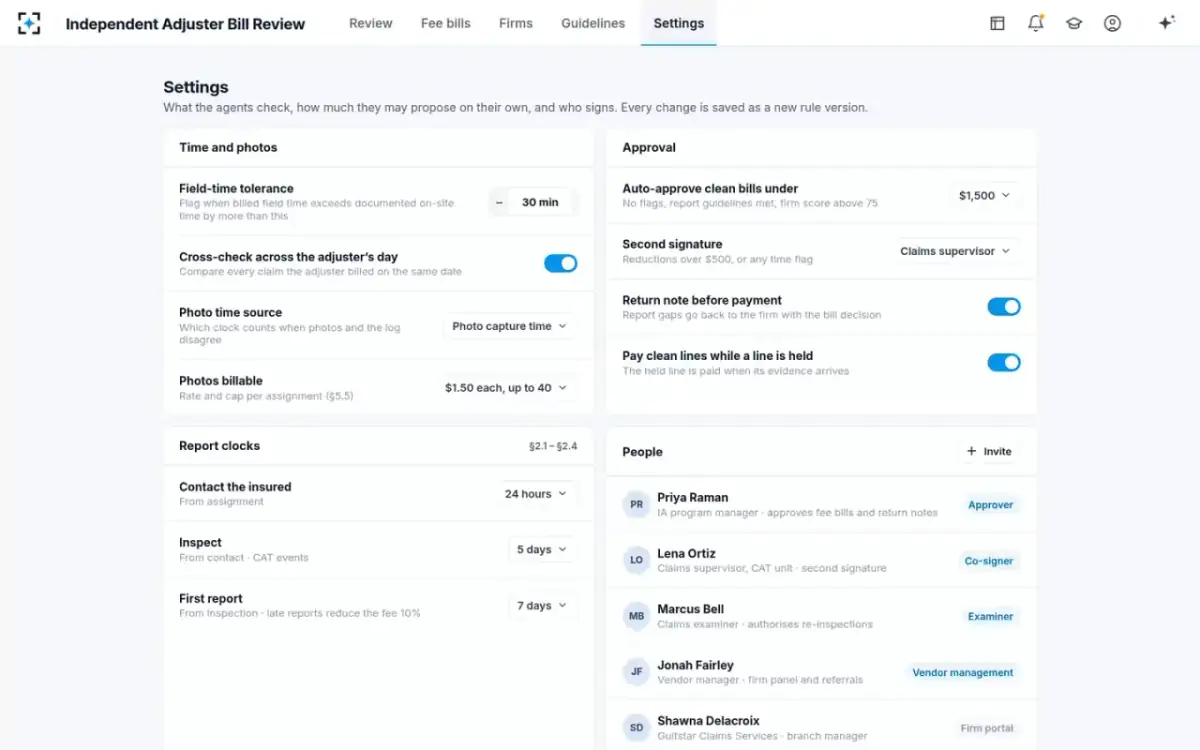
In the sample storm, the first report on the Ames claim met nine of the twelve guidelines: contact 19 hours after assignment, inspection two days after contact, the report three days after the inspection. It missed the rear elevation, a photographed moisture reading in the room with the most drywall replaced, and an authorisation for a re-inspection it described. Elsewhere in the queue, a report filed 11 days after its inspection cost the firm 10% of a $795 band fee, $715.50 allowed, under the late-report rule.
Independent Adjuster Bill Review: a first report checked against twelve guidelines
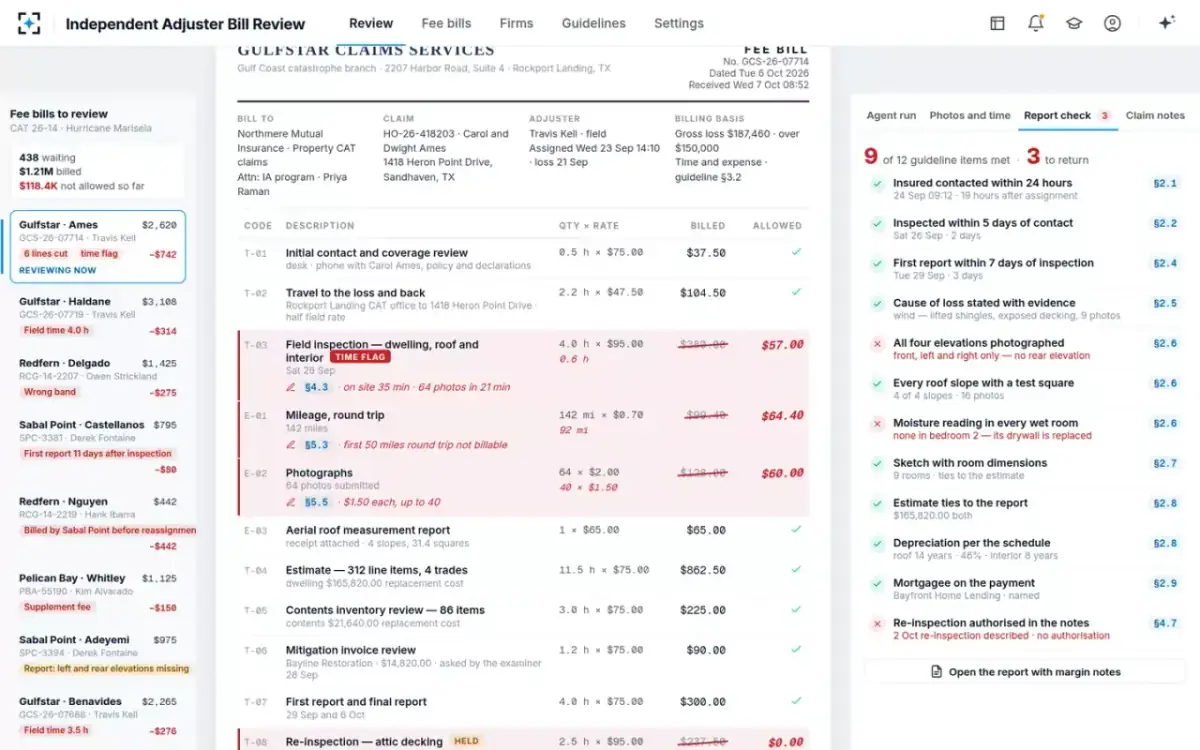
The report check sits next to the fee bill on purpose. A firm billing for a first and final report is billing for a report that meets the guidelines, and a report with three gaps will be paid for again as a supplement or a re-inspection. What the adjuster's photographs and check-ins say about the hours billed for the same visit is set out in an adjuster report checked against its photo times; how flood adjusters are paid for the work is in the NFIP adjuster fee schedule; and the whole review is on Independent Adjuster Bill Review.
Questions people ask
What are IA report requirements?
The carrier's written guidelines for what an independent adjuster's reports must contain and when: contact, inspection and report clocks, photo rules, cause of loss, sketch, estimate, mortgagee. On federal flood claims the NFIP Claims Manual sets them; on private claims each carrier sets its own, often modelled on it with shorter clocks.
What is an NFIP preliminary report?
FEMA's Adjuster's Preliminary Report form, which the adjuster signs with an active Flood Control Number and sends within 15 calendar days of the assignment, with perimeter and damage photographs and recommended reserves. FEMA's course for adjusters asks for it the same day as the inspection where possible.
What is an interim report in insurance?
A status report the adjuster sends while a claim stays open beyond the first deadline: on flood claims, when the closing report cannot be sent within 45 days of the preliminary, and then every 30 days. It can be a brief memorandum or a copy of a letter to the policyholder asking for information.
Can a preliminary report be revised?
The reserves in it are meant to be: the adjuster updates them as the claim progresses, and the examiner revises the insurer's reserves within five business days of each report. Errors found by the examiner are sent back to the adjuster for correction before the claim moves on.
Does the policyholder see the adjuster's report?
Often, yes. Florida requires insurers to send residential policyholders any detailed estimate an adjuster prepares within 7 days, and after Hurricane Milton FEMA had insurers pay flood claims on the adjuster's report with a copy sent to the policyholder. Washington gives insureds a right to request their first-party claim file, including adjusters' reports.